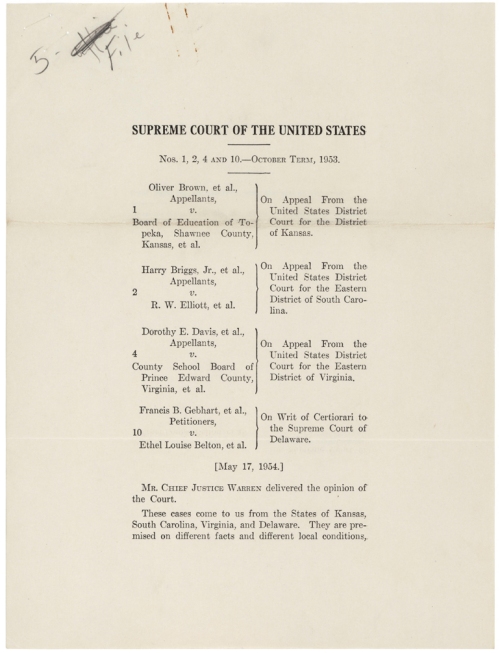
The courtroom was quiet when Chief Justice Earl Warren began reading. It was May 17, 1954, and the nine justices of the United States Supreme Court had been wrestling for months with a question that had divided America since the end of the Civil War: could a nation founded on equality continue to separate its children by the color of their skin?
Warren read for about an hour. Near the end, he reached the sentence that would change everything.
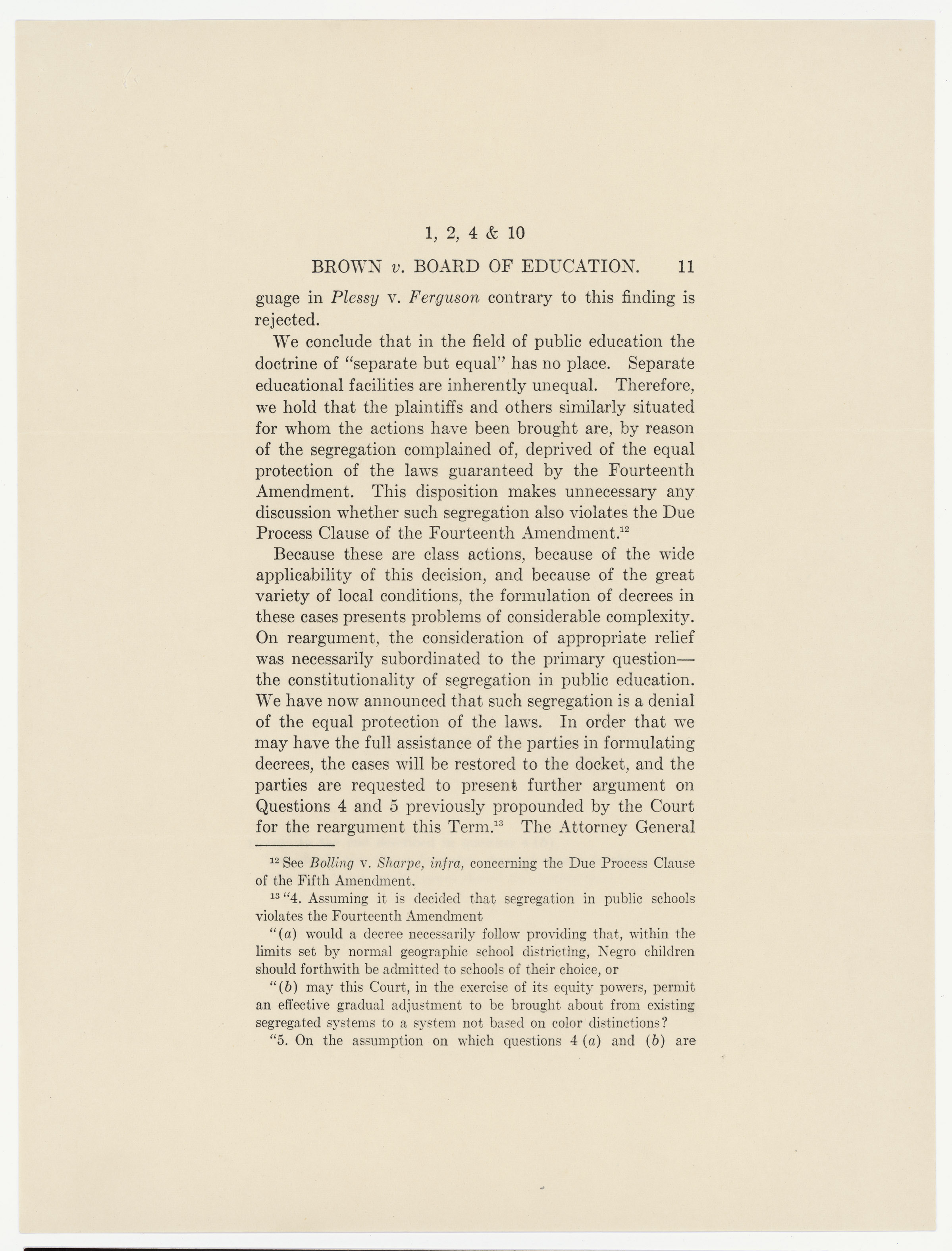
We conclude that in the field of public education the doctrine of separate but equal has no place. Separate educational facilities are inherently unequal.
Six words. Sixty years of legalized segregation, dismantled in a single sentence.
The Road to Topeka
The case that became Brown v. Board of Education did not begin as a single lawsuit. It was five separate cases from four different states — Kansas, South Carolina, Virginia, and Delaware — consolidated by the NAACP into one landmark challenge.
At the center of the Kansas case was a seven-year-old girl named Linda Brown. Every morning, Linda walked six blocks through a dangerous railroad switchyard to reach her bus stop, which would take her to the all-Black Monroe Elementary School. The all-white Sumner Elementary School was only seven blocks from her home — but it was closed to her.
Her father, Oliver Brown, attempted to enroll Linda at Sumner in the fall of 1950. He was turned away. He joined a class-action lawsuit organized by the Topeka chapter of the NAACP, and the case began its long journey toward the Supreme Court.
The legal architect of the challenge was Thurgood Marshall, the NAACPs chief counsel. Marshall had spent years dismantling segregation case by case, chipping away at the doctrine established in the 1896 Plessy v. Ferguson ruling — which had held that separate but equal facilities did not violate the Constitution. Marshalls strategy was to prove not just that Black schools were unequal in resources, but that segregation itself caused psychological harm to Black children, regardless of physical conditions.
He brought in social scientists. He introduced studies showing that Black children, when presented with both Black and white dolls, consistently chose the white doll as the nice one — internalizing the message that their own race was inferior. It was a radical argument for a courtroom, and it worked.
The Decision
The Warren Courts ruling was unanimous — nine to zero. That unanimity was no accident. Chief Justice Warren, newly appointed by President Eisenhower, had spent months carefully building consensus among justices who held widely varying views. He understood that a split decision would be seized upon by segregationists as evidence of doubt. The ruling had to be total.
The opinion was also deliberately brief. Warren kept it short — just eleven pages — and free of technical legal jargon. He wanted ordinary Americans to be able to read it and understand it. The message had to be clear.
In these days, Warren wrote, it is doubtful that any child may reasonably be expected to succeed in life if denied the opportunity of an education. Such an opportunity, where the state has undertaken to provide it, is a right which must be made available to all on equal terms.
The Reaction
The response was immediate and fierce. In the South, politicians denounced the ruling as an act of judicial tyranny. The following year, more than one hundred Southern congressmen signed the Southern Manifesto, pledging to resist desegregation by every legal means available. In some states, that resistance turned violent. It would take decades, federal troops, and the Civil Rights Act of 1964 before meaningful desegregation began in earnest.
But on May 17, 1954, in cities and towns across Black America, people wept. Thurgood Marshall, who would go on to become the first Black Supreme Court Justice in 1967, called it the greatest day of his life.
Then and Now
More than seventy years later, the questions Brown tried to answer remain unresolved. Studies consistently show that American schools are more racially and economically segregated today than they were in the 1980s — not because of law, but because of geography, housing policy, and school district boundaries drawn in ways that reproduce the separations Brown sought to eliminate.
The six words Warren read that morning in 1954 were not an ending. They were a beginning — and an argument America is still having with itself.
The Document
The original Supreme Court opinion in Brown v. Board of Education is held at the National Archives in Washington. The full text of the ruling, written in Earl Warren's hand and later typed for the official record, is available through the National Archives digital collections and remains one of the most significant legal documents in American history.