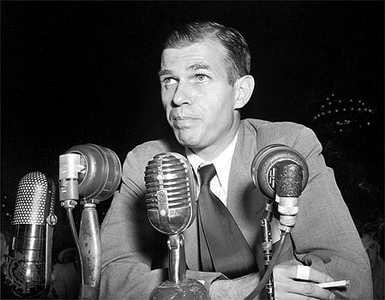
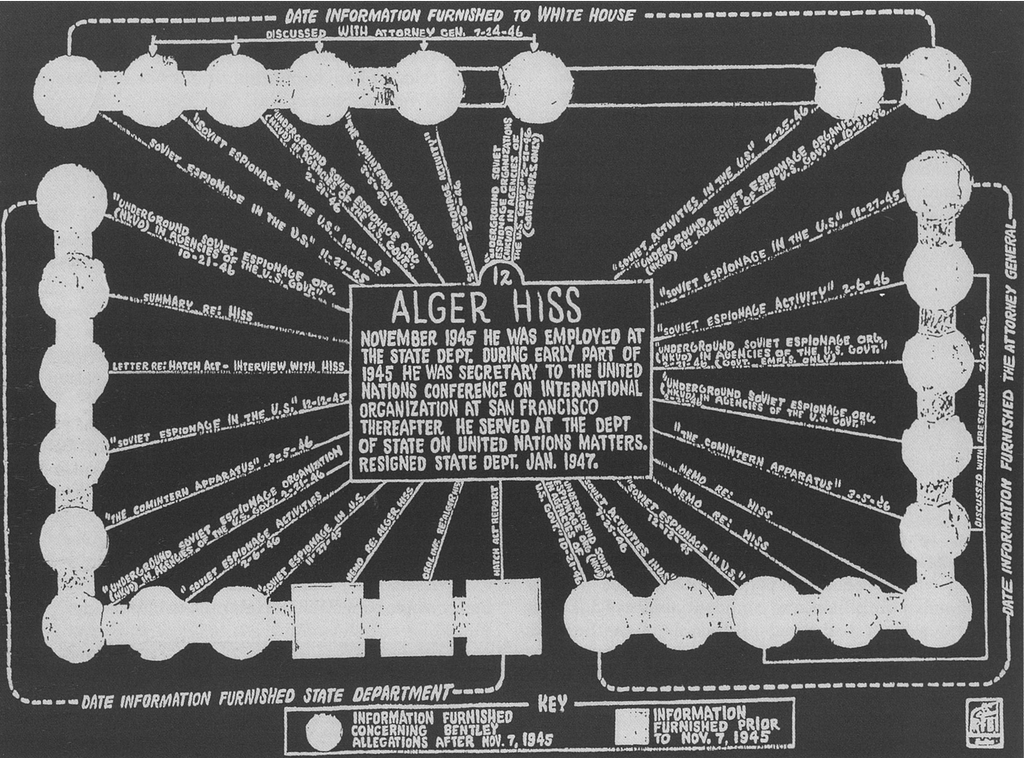
On May 31, 1949, Alger Hiss sat down in a federal courtroom in New York City and prepared to answer for what the government said he had done. He was calm. He was composed. He was, by every outward appearance, exactly what he had always been: one of the most polished and well-connected men in Washington. He was also, the prosecution intended to prove, a Soviet spy. They could not charge him with espionage. The statute of limitations had already run out. So they charged him with lying about it under oath. Perjury. Two counts. It was the only charge the law still allowed. The trial that began that day would end in a hung jury. The second trial would not.
The Man at the Top To understand what made the Hiss case so explosive, you have to understand what Alger Hiss actually was. He had clerked for Oliver Wendell Holmes. He had worked in the Roosevelt administration at the Agriculture Department and then at the State Department, rising steadily until he was one of its most influential officials. He sat at FDR's side at the Yalta Conference in February 1945, where the postwar map of the world was drawn. He served as secretary general of the United Nations founding conference in San Francisco later that same year, helping to draft the organization's charter. When he left government in 1947, he became president of the Carnegie Endowment for International Peace. He was, in short, the American establishment. Harvard Law. Supreme Court clerkship. The inner circle of the New Deal. His character witnesses at his first trial included two sitting Supreme Court Justices and a former Democratic presidential nominee. Nobody who looked like Alger Hiss was supposed to be a spy.
The Accusation On August 3, 1948, a senior editor at Time magazine named Whittaker Chambers appeared before the House Un-American Activities Committee and named Alger Hiss as a member of a secret communist cell that had been operating inside the federal government since the 1930s. Chambers was a complicated witness. He had been a committed communist himself for years before breaking with the party. He was, by his own admission at trial, a man who had lied repeatedly under oath, falsified key dates in his account, and used multiple false identities including a passport obtained with the birth certificate of a dead child. The defense hammered all of it. But Chambers had something the defense could not explain away. He knew things about Hiss that only someone who had been inside his life would know.
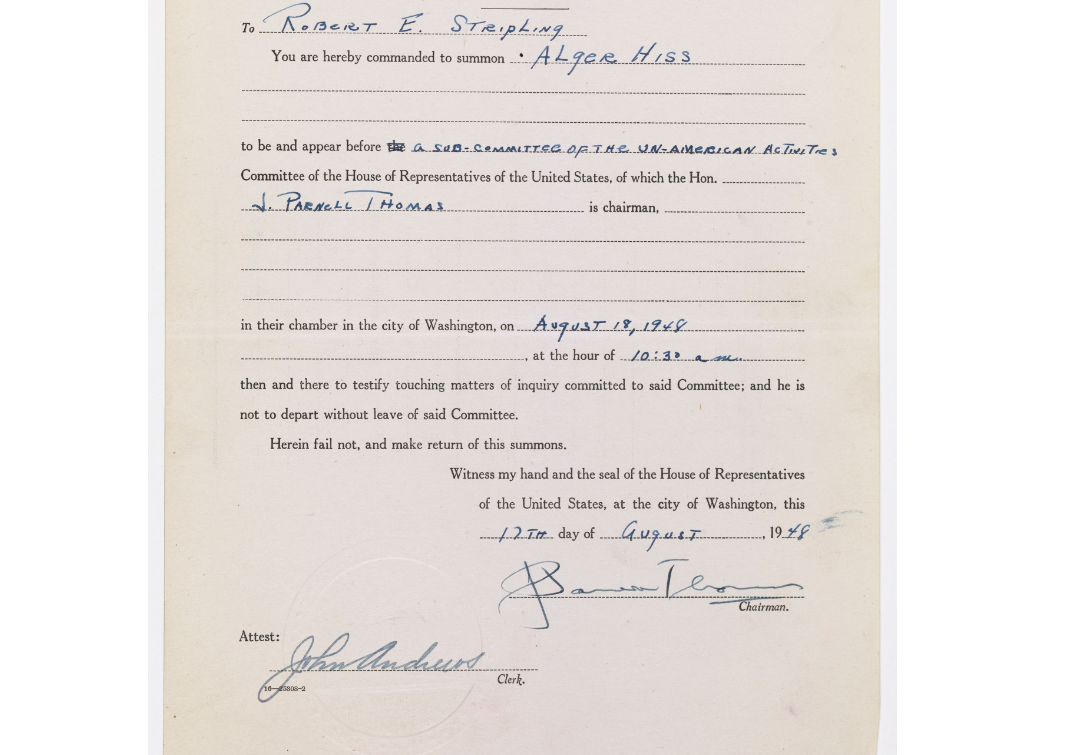 The HUAC subpoena commanding Alger Hiss to appear before the House Un-American Activities Committee, August 18, 1948. Issued seventeen days after Whittaker Chambers first named him publicly.
The layout of his houses. The names of people around him. Details about a Ford automobile Hiss had given away. And eventually, when pressed, he produced something far more damaging than testimony.
The Pumpkin In November 1948, Chambers led investigators to a pumpkin patch on his farm in Maryland. From inside a hollowed-out pumpkin, he pulled five rolls of 35mm film. He said Hiss had given them to him in 1938 to be passed along to Soviet handlers. Two of the rolls contained photographs of classified State Department documents. Alongside the film, Chambers had already produced 65 pages of retyped State Department cables and four notes handwritten in Hiss's own hand. These became known collectively as the Pumpkin Papers.
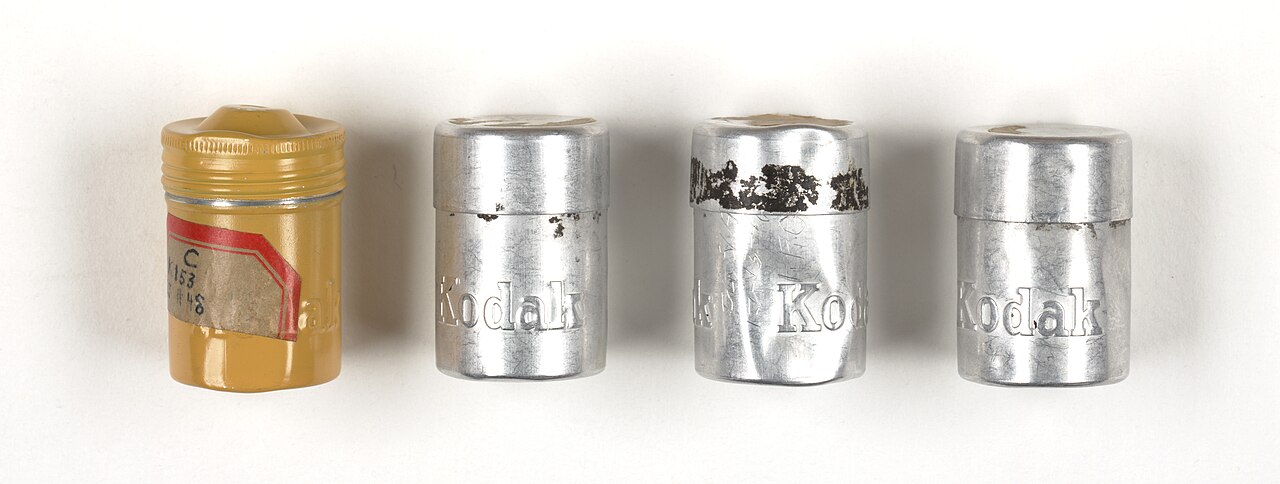 The actual Kodak film canisters retrieved from the hollowed-out pumpkin on Chambers' Maryland farm, December 1948. Now held at the National Archives.
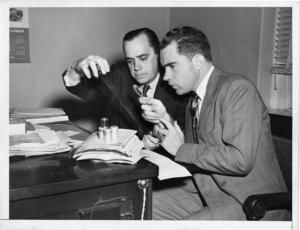 Congressman Richard Nixon and HUAC chief investigator Robert Stripling examine the Pumpkin Papers microfilm, December 1948. The case made Nixon a national figure.
The FBI's investigation into the physical evidence was exhaustive. The agency traced a Woodstock typewriter, serial number N230099, that had once belonged to the Hiss family. Laboratory analysis concluded that specimens typed on that machine matched the retyped Baltimore documents perfectly. The typewriter had been given away years earlier and was ultimately located by Hiss's own defense investigators, who then handed it over, apparently believing it would help him. It did not. The FBI also audited Chambers' bank records to address one specific defense argument: that Chambers had bought a Ford automobile in 1937 with his own money rather than with cash Hiss had given him. The bank records showed Chambers' account balance at one point stood at $2.19. There had been no large withdrawals. The money, the records suggested, had come from somewhere else.
Two Trials The first trial opened May 31, 1949, under Judge Samuel Kaufman. It ended on July 7 with a hung jury, eight to four in favor of conviction. Chambers had damaged himself badly on the stand by admitting he had lied under oath on multiple prior occasions. President Truman dismissed the entire investigation as a red herring. The second trial opened in November 1949 under a different judge. The prosecution brought in a new witness: Hede Massing, an Austrian-born confessed Soviet spy who testified that she had met Hiss at a party in 1935 and that he had tried to recruit one of her own agents away from her network to his. The defense could not shake her. On January 21, 1950, the jury found Hiss guilty on both counts of perjury. Judge Henry Goddard sentenced him to five years on each count, to run concurrently. Hiss spoke two sentences after the verdict. The first was to thank the judge. The second was to say that one day it would be revealed how forgery by typewriter had been committed. He maintained his innocence until he died.
What It Started The verdict landed like a bomb. Two weeks after Hiss was convicted, Senator Joseph McCarthy gave a speech in Wheeling, West Virginia, claiming to hold a list of known communists still working inside the State Department. The speech launched the McCarthy era. The climate of fear and accusation that followed consumed careers, destroyed reputations, and reshaped American political life for a generation. Richard Nixon, who had pursued Hiss relentlessly as a junior congressman on HUAC and had received secret access to FBI files through a back channel to J. Edgar Hoover, became a national figure overnight. The Hiss case carried him from the House to the Senate in 1950, to the vice presidency in 1952, and eventually to the presidency in 1968. One conviction. Three presidents shaped by it. The entire architecture of Cold War domestic politics built on top of it.
The Aftermath Hiss served three years and eight months at Lewisburg Federal Prison, where he worked as a volunteer attorney and tutor for fellow inmates. After his release in 1954 he was disbarred and spent years working as a stationery salesman in New York. He published a book in 1957 challenging the prosecution's evidence and never stopped fighting. In 1975, after a researcher sued the Justice Department under the Freedom of Information Act to obtain the Pumpkin Papers, the government finally released them. One roll of film turned out to be completely blank. Two others contained images of unclassified Navy documents about life rafts and fire extinguishers. Only two rolls showed anything that had been classified at the time. The dramatic revelation of 1948 was considerably more complicated than it had appeared. That same year, Hiss was readmitted to the Massachusetts bar. The state Supreme Judicial Court ruled that despite his conviction, he had demonstrated the moral and intellectual fitness required to practice law. He was the first lawyer in Massachusetts history to be readmitted to the bar after a major criminal conviction. He died on November 15, 1996, at age 92, still insisting he had been framed. Whether Alger Hiss was guilty has never been fully resolved to everyone's satisfaction. Soviet intelligence records that became partially available after the Cold War suggested he had indeed been a Soviet source. Hiss's defenders argued those records were inconclusive or had been misread. The argument has never entirely stopped. What is not in dispute is what his case did to the country. A single prosecution, built on evidence no one could charge as espionage because the clock had run out, became the foundation for a decade of political terror. Careers ended on the strength of accusations alone. Congress held hearings. Neighbors reported neighbors. A senator from Wisconsin held up a piece of paper and told America the enemy was already inside. It had all started in a courtroom in New York, on May 31, 1949, with a man at a defense table who looked nothing like a spy.
Alger Hiss's first perjury trial opened May 31, 1949, and ended in a hung jury on July 7, 1949. His second trial ran from November 17, 1949, to January 21, 1950, when he was convicted. He was sentenced to five years in federal prison. He was released November 27, 1954. He died November 15, 1996.