Colonel Andrew L. Harris made one decision that morning that would prove disastrous. After a brutal all-night march through the Florida heat, his column reached Gainesville, quickly drove off the small Confederate force holding the town, and then let his exhausted men stand down. Horses were fed. Cooks lit fires and started coffee. Some of the men began looting.
About thirty minutes later, Florida's own "Swamp Fox" came up behind them, and the Union raid on Gainesville turned into one of the most lopsided defeats of the war in Florida.
A Railroad Worth Burning
By the summer of 1864, Gainesville had become an important Confederate supply depot in central Florida, a hub where cattle and provisions destined for the army were gathered along the Florida Railroad. That made it a target.
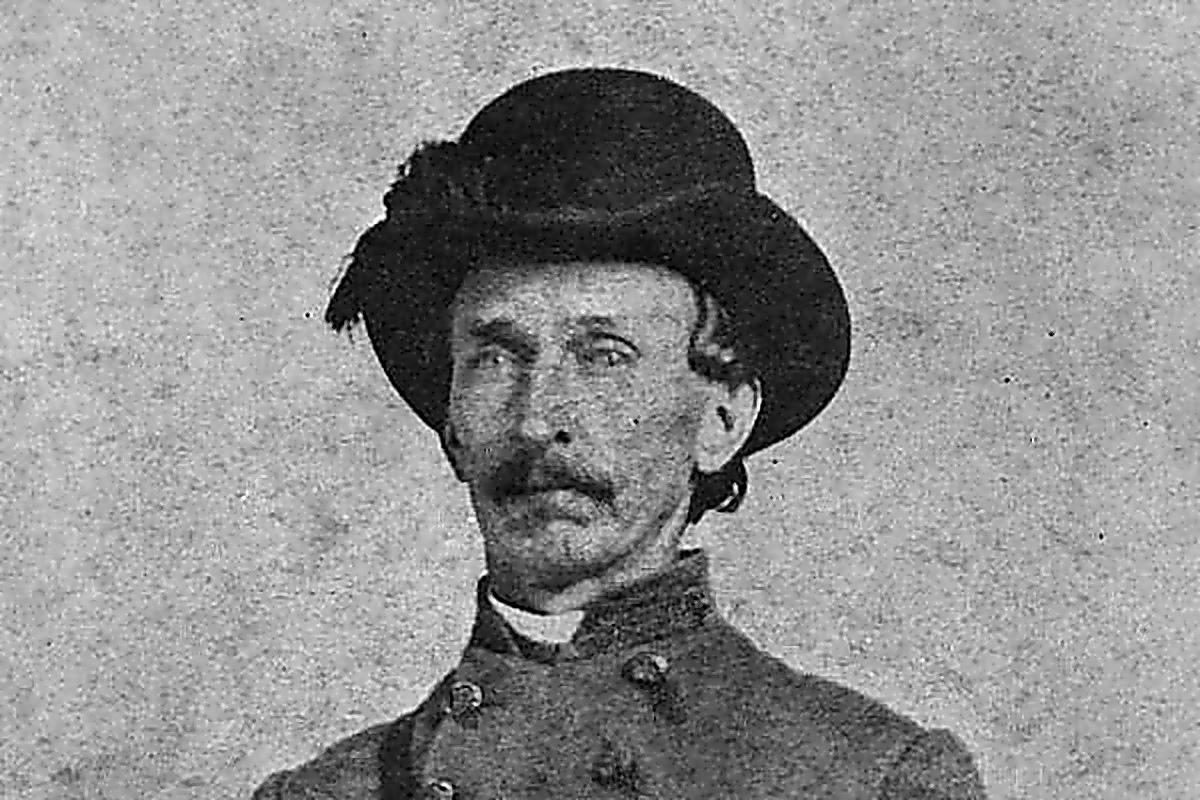
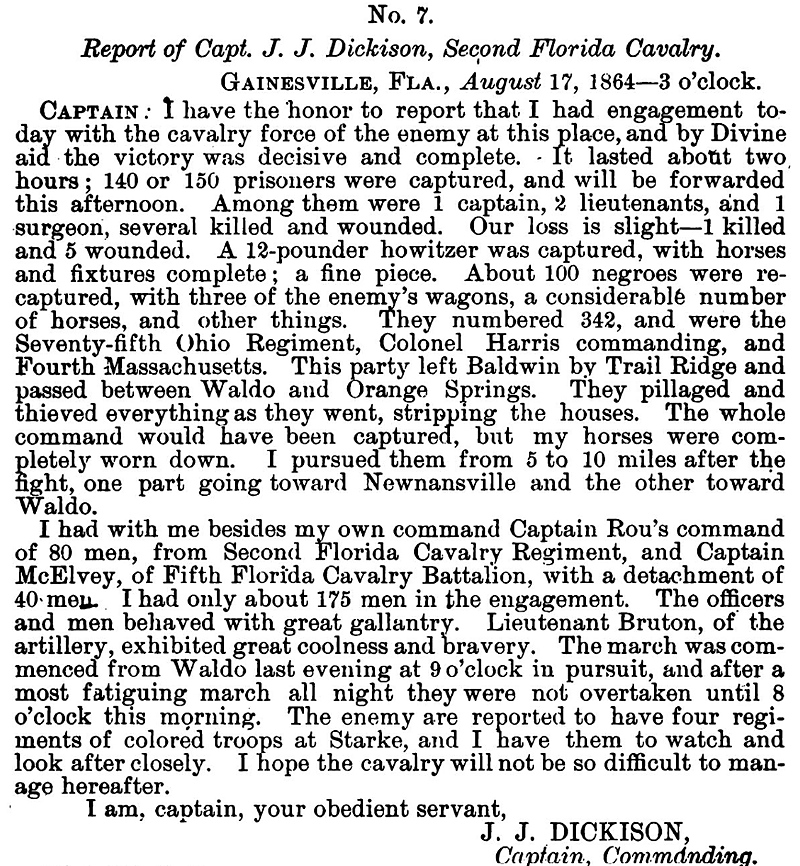
On August 15, Harris left the Union garrison at Baldwin, near Jacksonville, with orders to destroy the railroad and its warehouses. His command from the 75th Ohio Mounted Infantry, reinforced along the way at Starke by the 4th Massachusetts Cavalry and a handful of Florida Unionists, grew to roughly 342 men by the time it reached Gainesville. Capt. J.J. Dickison, the Confederate officer who would soon face them, recorded that exact figure in his own report, written the same afternoon the battle ended.
Harris pushed his column through the night and reached Gainesville early on August 17. It worked. The Federals arrived to find the town held by only one company of the 2nd Florida Cavalry, roughly seventy men, who were quickly driven off by a Union cavalry charge.
That was the last thing to go according to plan.
The Counterattack
Dickison was not in Gainesville that morning. He was in Waldo, and had been marching his own men through the night in pursuit of Harris's column since nine o'clock the evening before. His force was smaller than the one Harris had just routed from the town square: two companies of the 2nd Florida Cavalry, a detachment of forty men from the 5th Florida Cavalry Battalion, local home guards, and two cannon. Only about 175 of his roughly 290 men actually took part in the fighting that followed.
Around eight o'clock, while Harris's men were still dismounted and scattered, Dickison's column caught up.
The fight that followed lasted about two hours and was fought largely in Gainesville's town square, close enough that townspeople reportedly watched from the windows of a nearby house. Harris tried to reorganize, pulling his cavalry to cover his flanks and rear as Dickison's smaller force pressed in from multiple directions. It did not hold. Harris eventually ordered a retreat, and the withdrawal collapsed into a rout when part of his column took the wrong road out of town and was cut off entirely. The Union force lost its only artillery piece, a 12-pounder howitzer, in the confusion.
What Dickison Reported That Afternoon
Dickison's after-action report, filed from Gainesville at three o'clock that same afternoon, is remarkably specific for a document written just hours after the fighting stopped. He recorded 140 to 150 prisoners taken by his command, including a captain, two lieutenants, and a surgeon. He noted the captured howitzer arrived "with horses and fixtures complete, a fine piece." He also reported recapturing roughly 100 Black people who had joined the Union column during its march, along with three wagons and a considerable number of horses.
His own losses, as he understood them that afternoon, were light: one man killed and five wounded. That figure would shift slightly in the following days, as two of the wounded later died of their injuries, bringing the final Confederate toll closer to three killed and three wounded. Reports written in the first hours after a battle rarely match the numbers that settle out once the wounded are counted, and Gainesville is a clean example of that pattern.
Union losses were far heavier than Dickison's own toll, and the reported total became clearer as the fuller Confederate accounting came in over the following days. Confederate reports ultimately counted 221 Union men killed, wounded, or captured: 28 killed, 5 wounded, and 188 captured. Another 86 were initially listed as missing or unaccounted for, though many of those men eventually made their way back to Union lines. Confederate Brig. Gen. John K. Jackson's general order congratulating Dickison's command a week later cited that same figure, 221 of the enemy killed, wounded, and taken prisoner.
Harris, for his part, believed he had been overwhelmed. In his own report he estimated the force that hit him at 600 to 800 men. Dickison actually had 175 in the fight.
The Aftermath
Brig. Gen. John P. Hatch, the Union commander overseeing Florida, did not spare his subordinate when the reports reached his desk. "The more I hear of this affair the worse it appears," he wrote, adding that Harris had "undoubtedly allowed his men to scatter through the town and, I fear, to pillage." Hatch also noted, pointedly, that neither Harris's lieutenant colonel nor his major had been taken prisoner, and that an investigation into the conduct of the retreat was warranted.
Gainesville stayed in Confederate hands for the rest of the war. The remaining Union garrisons in north central Florida pulled back to Jacksonville and St. Augustine rather than risk another expedition into territory Dickison so clearly controlled.
It was not the first time Gainesville had changed hands that year. A smaller Union force had briefly held the town for roughly 56 hours in February before withdrawing. But the August engagement was the one after which Gainesville remained in Confederate hands for the rest of the war, and it turned on thirty minutes Harris never got back.