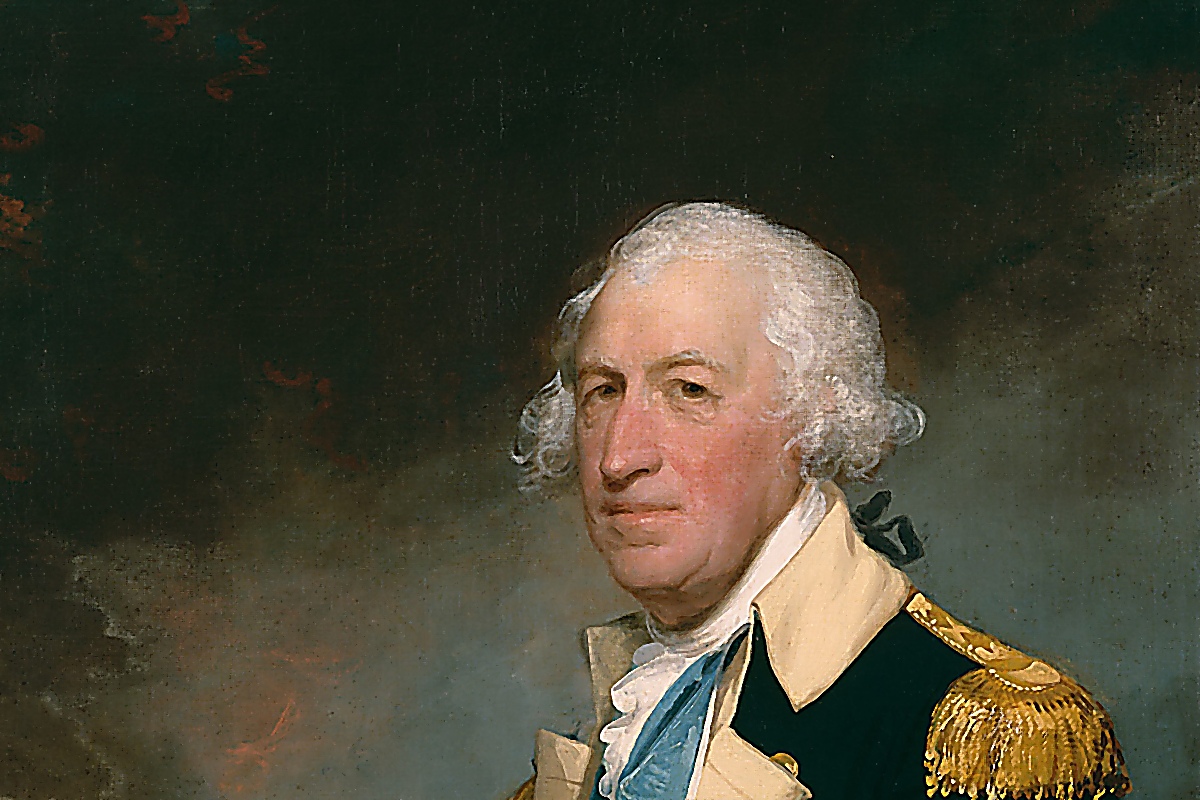
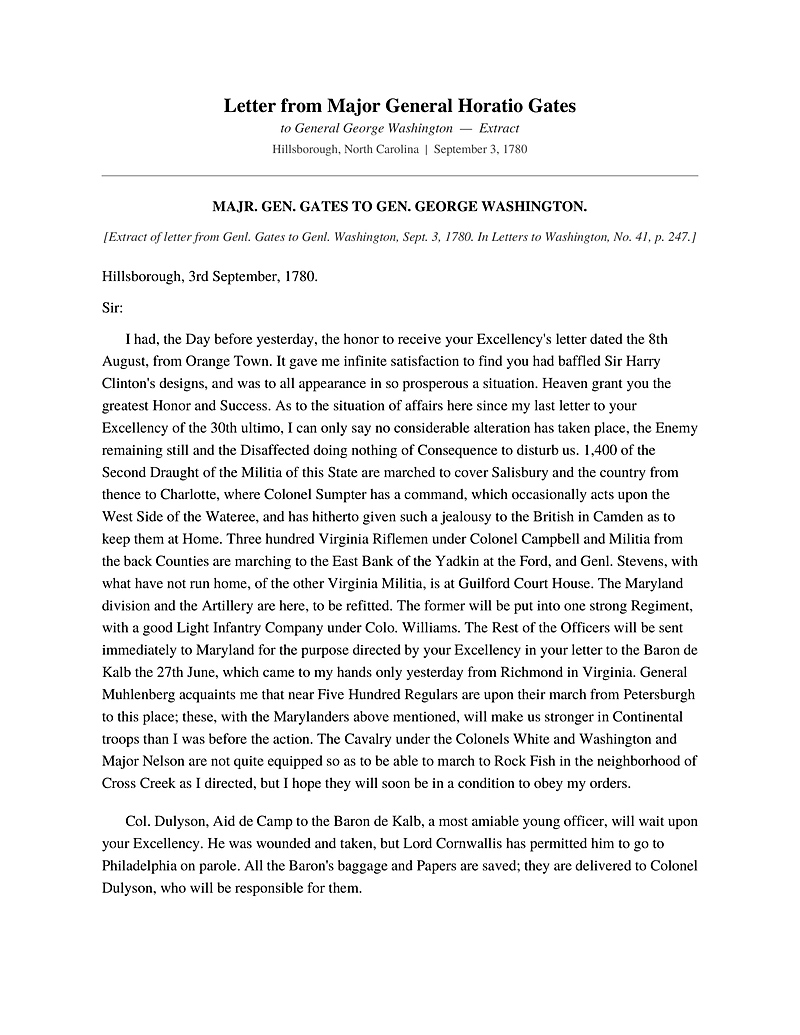
Horatio Gates arrived in the Carolina backcountry in July 1780 carrying the kind of reputation that gets a general put in charge of an army he has never commanded. Three years earlier, at Saratoga, he had done something no American officer had managed before: forced a British army under Lieutenant General John Burgoyne to surrender. Congress wanted that same result in the South. What Gates delivered instead, on the morning of August 16, 1780, was one of the worst defeats suffered by an American army in the entire Revolutionary War. The American militia line collapsed in well under an hour, even if the fighting itself, thanks to the Continentals who stood their ground, dragged on considerably longer.
A collapsing South
By the time Gates took command, the South was already going badly for the Americans. The British had taken Savannah in December 1778 and then, in May 1780, forced the surrender of Charleston along with most of the Continental Army in the region. General Charles, Lord Cornwallis was left in charge of finishing the job, garrisoning towns across South Carolina's interior, Camden among them, to hold the state for the crown.
Congress responded by sending its best-known field commander south. Gates reached the remaining Continental force, a mix of Maryland and Delaware troops under Baron Johann de Kalb, at Cox's Mill, near Buffalo Ford on North Carolina's Deep River, on July 25. Two days later, against the advice of his own officers, he ordered a direct march on Camden through country that one aide described as barren and largely hostile to the American cause. Supplies were already short. Soldiers marching through the summer heat reportedly lived on green corn, unripe fruit, and half rations of beef so poor it was barely edible, and dysentery spread through the ranks well before they reached the battlefield.
Gates picked up reinforcements along the way, North Carolina militia under Richard Caswell and Virginia militia under Edward Stevens. On paper his Grand Army swelled to more than 5,000 men, but sickness, desertion, and detachments sent off to other duties left him with something closer to 3,000 to 4,000 effectives by the time he reached the Camden area, most of them militia who had never fought together, many of them with little or no combat experience. Cornwallis, alerted to Gates's approach, marched his own army from Charleston and reached Camden on August 13 with roughly 2,000 to 2,300 regulars and provincial troops.
Two armies, one road, one night
What happened next was less a planned engagement than a coincidence. On the night of August 15, both commanders ordered their armies to march, Gates toward a defensive position on Sanders Creek, Cornwallis straight up the same road toward Gates. Neither commander expected to run into the other on the road. Around two in the morning the advance parties collided in the dark, traded fire, and both sides pulled back to wait for daylight rather than fight blind.
When the sun came up on August 16, Gates arranged his line the way an officer trained in the British army would: veteran troops on the right, the customary place of honor, less experienced troops on the left. He put his Maryland and Delaware Continentals, under de Kalb, on the right. On the left went Stevens's Virginia militia, men who had barely handled a musket in anger, let alone stood in a battle line against a bayonet charge.
Cornwallis made the same calculation and put it to better use. He placed his most experienced regiments, the 23rd and 33rd Regiments of Foot under Lt. Col. James Webster, directly across from Gates's rawest troops. It was the kind of mirrored deployment that only becomes a disaster for one side once the shooting starts.
Forty-five minutes
The British right advanced with a volley, a cheer, and fixed bayonets. The Virginia militia broke almost immediately, many without firing a shot, some without waiting to be fired on. The panic spread down the line to the North Carolina militia beside them, and within minutes most of the American center and left had come apart. Gates tried to rally them and later told Congress the men ran "like a Torrent" and swept away everything in front of them. Edward Stevens told Governor Thomas Jefferson it was beyond any man's power to stop them.
That left de Kalb's Continentals to face most of Cornwallis's army alone. They held their ground longer than anyone had reason to expect, and for a stretch actually pushed Rawdon's brigade back on the British left. But Cornwallis rode over to steady his line, and rather than chase the fleeing militia, Webster's regiments wheeled inward against the exposed Continentals. Cornwallis then committed the 71st Regiment of Foot, Fraser's Highlanders, against the Marylanders' exposed flank, while Tarleton's cavalry pressed the retreat from behind. Attacked from multiple directions at once, the Continental line finally broke too. De Kalb, trying to rally his men on foot after his horse was killed under him, was wounded repeatedly, by most accounts eight bayonet wounds and three from musket balls, and captured. He died of those wounds three days later, on August 19, still in British custody in Camden.
Gates himself reached Charlotte by evening, well ahead of most of his retreating army, and kept riding from there. In all he covered roughly 180 miles to Hillsborough, North Carolina, in three and a half days, arriving on August 19. It was a retreat fast enough that it would follow him for the rest of his career. Alexander Hamilton, writing to a friend weeks later, put the criticism more bluntly than most: was there ever an instance of a general running away from his whole army the way Gates had, he asked, before noting the exact distance himself, one hundred and eighty miles in three and a half days.
Sources disagree on exactly how costly the day was. Published estimates for American losses, killed, wounded, captured, and missing combined, range from roughly 1,300 to as many as 1,900, depending on how the surviving muster returns and unaccounted-for men are counted. What isn't disputed is the imbalance: British casualties totaled around 324, a fraction of the American losses.
What Camden actually changed
On August 20, from Hillsborough, Gates wrote to Congress that he was obliged, in his own words, to report the "Total Defeat" of the army under his command. It was an accurate preview of what came next for him personally. Congress ordered a court of inquiry into his conduct that October and designated Nathanael Greene, the officer Washington had wanted for the Southern Department, to replace him, though Greene would not actually arrive to take command until December. The court of inquiry itself never convened, and Congress eventually rescinded the order altogether. None of that mattered much for Gates's career. He never again held a field command for the rest of the war.
Camden briefly looked like it had settled the war in the South. It hadn't. Cornwallis found the state harder to hold than to win, worn down by partisan leaders like Thomas Sumter and Francis Marion who kept fighting long after Gates's army had scattered. Under Greene, the Southern Army rebuilt and, over the following year, fought Cornwallis to exhaustion in a campaign that ended at Yorktown.
The battlefield itself, about five and a half miles north of Camden, has spent the last several decades being pieced back together by preservation groups rather than paved over, and it is still giving up its dead. In the fall of 2022, archaeologists excavated the remains of fourteen soldiers from shallow graves on the site, some barely six inches down. Twelve were identified as Continental soldiers from Maryland or Delaware. One had served with the British 71st Regiment of Foot, Fraser's Highlanders. The fourteenth was a Loyalist militiaman from North Carolina whose teeth indicated possible Native American ancestry. Thirteen of the fourteen were honored at a public military ceremony in April 2023, with British and American units standing side by side more than two centuries after they had faced each other across that field. The twelve Continental soldiers among them were later reinterred at the Old Presbyterian Burial Ground in Camden that August. The Loyalist militiaman was set apart for a separate, private ceremony arranged with the Catawba Nation and the Lumbee Tribe.
Earlier this year, researchers finally put a name to one of the Continental dead. Using DNA extracted from a petrous bone, a small dense structure at the base of the skull that preserves genetic material unusually well, a forensic genealogy team traced the remains to Private John Pumphrey, an orphaned teenager from Maryland's Anne Arundel County who enlisted in Baltimore when he was about fourteen and served in the 7th Maryland Regiment. Two hundred and forty-six years after he fell at Camden, in a battle that shattered the reputation of the general Congress had been counting on to save the South, Pumphrey's remains finally have a name attached to them.