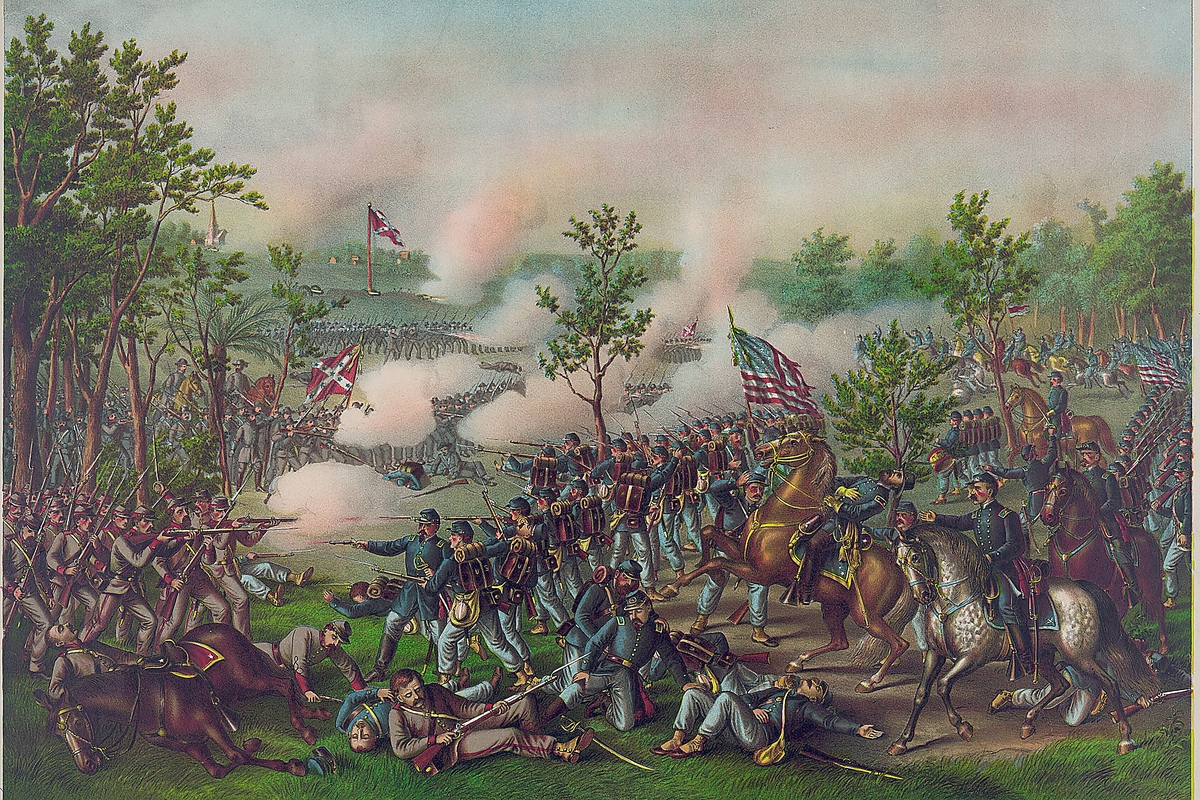
The name is the first thing that's wrong about it.
"The Battle of Atlanta" sounds like the fight that took the city. It wasn't. Atlanta held out for another six weeks after July 22, 1864, and the men fighting that day had no idea the name would attach itself to a battle that decided nothing by itself and everything in combination with what came after.
Here's what actually happened, and why eight hours east of the city mattered more than most people are taught.
A general who talked his commander out of a mistake
By July 1864, Maj. Gen. William T. Sherman had three armies converging on Atlanta, one of the Confederacy's most important remaining rail and manufacturing centers east of the Mississippi. Confederate President Jefferson Davis, frustrated that Gen. Joseph E. Johnston kept retreating instead of fighting, fired him on July 17 and replaced him with the far more aggressive Lt. Gen. John Bell Hood.
Hood wasted no time. He attacked Sherman's forces at Peachtree Creek on July 20 and lost. Two days later he tried again, east of the city, in what would become the Battle of Atlanta.
On the morning of July 22, Sherman believed Hood had abandoned his outer defenses and was evacuating Atlanta altogether. He was wrong, and he nearly acted on it anyway. Sherman planned to send an entire infantry corps away from his own left flank to tear up railroad track miles to the rear, a move that would have left that flank dangerously exposed. Maj. Gen. James B. McPherson, commanding the Army of the Tennessee, talked him out of it. Sherman agreed to hold the troops in place until early afternoon.
That conversation rarely makes it into shorter retellings, but it mattered. Keeping those troops in place didn't single-handedly save the Union line. Hardee's late arrival, fast Union entrenching, and John A. Logan's leadership later that day all played a part too. But that decision proved critical once Hood's attack finally hit.
The march that arrived too late to work
Hood's plan was ambitious. Send Lt. Gen. William Hardee's corps, seventeen to eighteen thousand men, on a fifteen mile overnight march around the Union's exposed left flank, then hit McPherson's rear at dawn while a second corps struck the Federal front head on.
It should have worked. It didn't, mostly because of the ground itself. Hardee's men marched through tangled creek bottoms and around a half mile wide millpond that no longer exists today, and by the time they reached position they were roughly six hours behind schedule, facing a flank that was now substantially reinforced thanks to McPherson's morning conversation with Sherman. Instead of catching a sleeping army from behind, Hardee's exhausted troops ran straight into Union soldiers who had spent the morning getting ready for exactly this.
The general who rode into his own killers
McPherson did not survive the afternoon. After the fighting started, he rode out to check his lines and rode into a gap in his own position where advancing Confederate infantry under Maj. Gen. Patrick Cleburne was moving forward. Ordered to surrender, McPherson tipped his hat, turned his horse, and tried to ride clear. He was shot once and died within minutes.
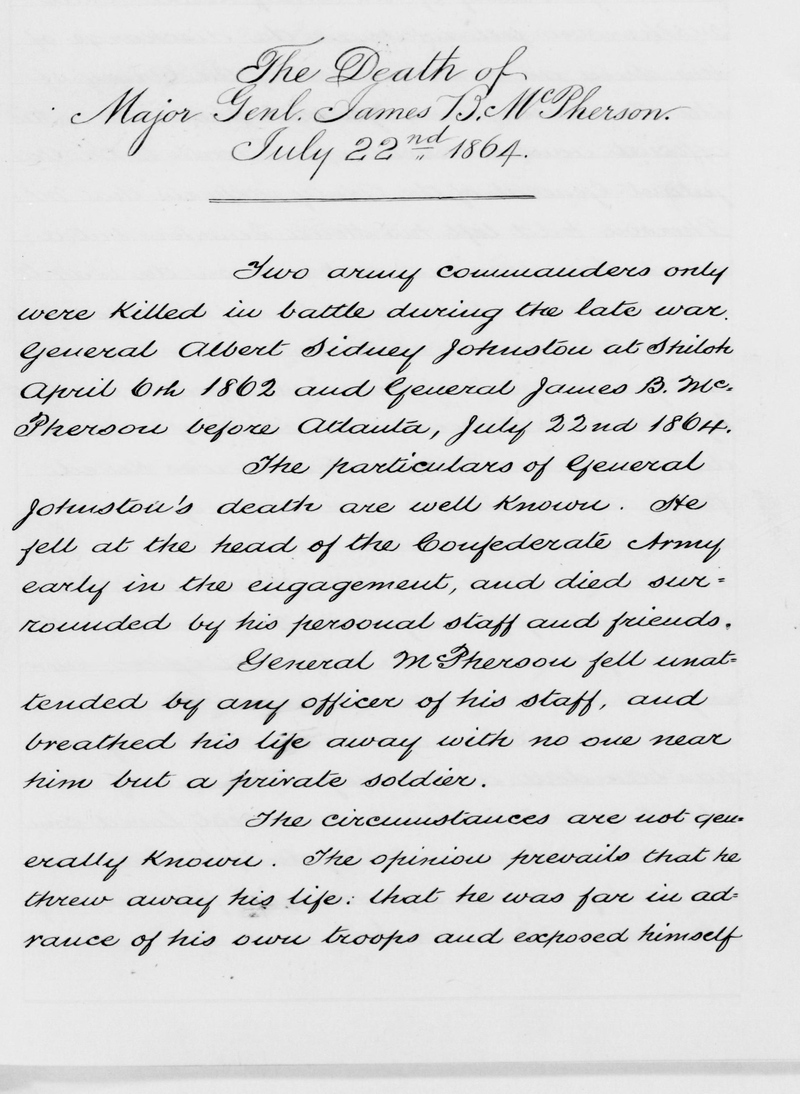
He was thirty five years old, and he was the second highest ranking Union officer killed in combat during the entire war. Only one other army commander on either side, Confederate Gen. Albert Sidney Johnston at Shiloh, died the same way. Sherman's own account of that day, preserved in his personal papers, opens with that exact comparison: two men, out of every army commander who fought the Civil War, killed outright in battle.
One detail rarely makes the shorter version. McPherson and Hood had been classmates at West Point, and by most accounts, friends. Hood later wrote that no death in the enemy's ranks caused him equal regret.
The battle the Confederates almost won
McPherson's death didn't break the Union line. What nearly did was a breakthrough hours later, when Confederate troops under Brig. Gen. Arthur Manigault found a gap near a railroad cut, poured through it, and captured a Union artillery battery along with the ground around the Troup Hurt house. For a stretch of the afternoon, the attack that was supposed to fail everywhere had actually broken the Federal line.
It didn't hold. Maj. Gen. John A. Logan, who had taken command of the Army of the Tennessee within hours of McPherson's death, rallied the scattered Union troops and led the counterattack that took the position back. Sherman, watching from high ground less than a mile away, personally ordered more than twenty Union batteries to concentrate on the Confederate breakthrough. By nightfall the guns were back in Union hands and Hood's men were retreating toward the city they were supposed to be defending.
What it cost, and what it didn't decide
The Union suffered roughly 3,722 casualties. The Confederates lost somewhere between 5,000 and 5,500, more than a tenth of Hood's entire army, in a single day. By any measure that counts bodies and ground, it was a clear Union victory.
And Atlanta still didn't fall. Hood held the city for another six weeks, through two more failed attacks, until Sherman finally cut the last open railroad line at the end of August and forced the evacuation on September 1. The battle carrying Atlanta's name in its title was, in the end, one hard afternoon in a much longer campaign, important mostly for what it made possible rather than what it finished.
What it made possible turned out to matter a great deal. Atlanta's fall in September landed in Northern newspapers just as Abraham Lincoln's reelection chances were at their lowest point of the war. The Confederacy's best remaining hope for a negotiated peace went with it.