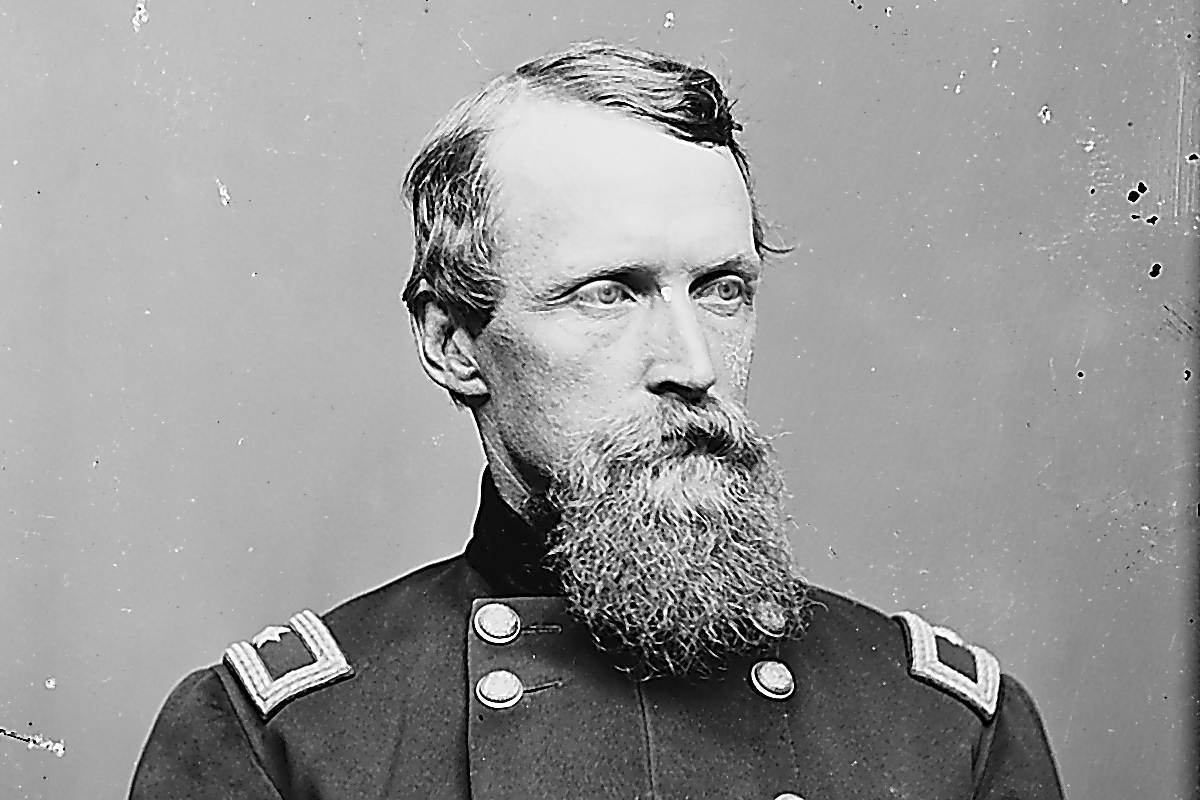
Near nightfall on July 2, 1863, Brigadier General Joseph B. Kershaw, who commanded a South Carolina brigade in the division of Major General Lafayette McLaws, turned from fighting to counting. "It was now near nightfall, and the operations of the day were over," he wrote in his report. He "commenced the melancholy task of looking up my numerous dead and wounded." He named Colonel W. D. De Saussure first among the dead and noted that he was the brigade's senior colonel, the man Kershaw had regarded as his successor "should any casualty create a vacancy."
That evening closed an afternoon usually told as three separate fights: Devil's Den, the Wheatfield, and the Peach Orchard. Read together, the reports describe one afternoon. This article follows twelve of them, Union and Confederate, from the line the Union Third Corps held at about 4 p.m. to dusk. The sections run from south to north, and the actions they describe overlapped. The reports show a pattern the three names hide. Again and again, officers on both sides explain an advance or a withdrawal by what was happening on a flank.
The Forward Line
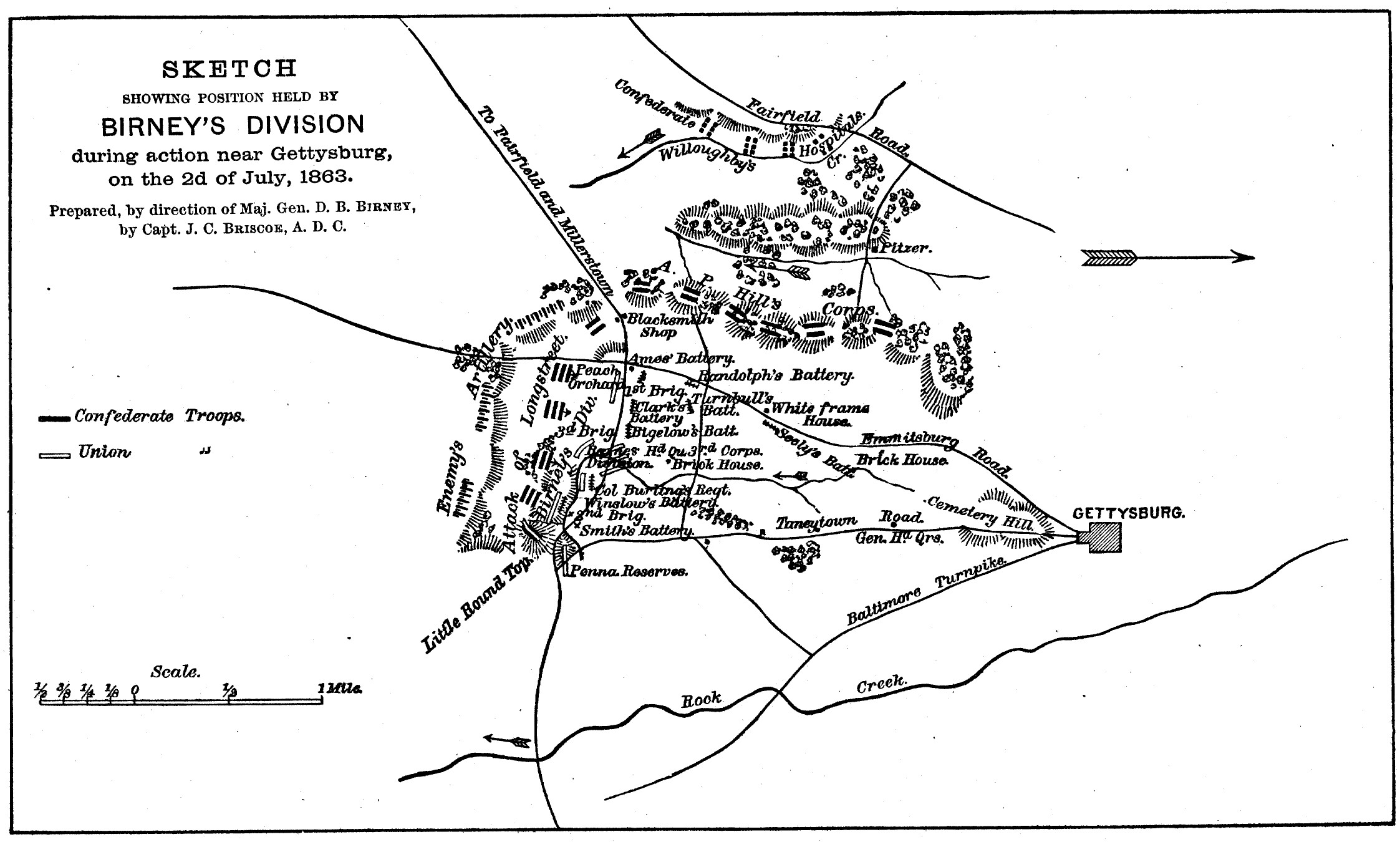 Sketch showing the position held by Birney's division on July 2, 1863, prepared by Captain J. C. Briscoe at Birney's direction. Official Records, Series I, Vol. 27, Part 1, p. 486.
The Third Corps was under Major General Daniel E. Sickles. Major General David B. Birney commanded its First Division, on the left. At 7 a.m., he wrote, he formed a line with its left on "the Sugar Loaf Mountain," the hill now called Little Round Top. Its right ran "in a direct line toward the cemetery." At noon, "believing from the constant fire of the enemy that a movement was being made toward the left," he won Sickles's permission to send out a reconnaissance of sharpshooters under Colonel Berdan. Birney wrote that "three columns of their forces were found marching to our left."
Sickles ordered him to change front. Birney advanced his left 500 yards and swung his right forward to the road at the peach orchard. Brigadier General J. H. Hobart Ward's brigade held the left, Colonel Régis de Trobriand's the center, and Brigadier General Charles K. Graham's the right, in the orchard. North of them along the same road, Brigadier General Andrew A. Humphreys's division moved forward at about 4 p.m. on Sickles's orders. Birney put the length of his own line, from the mountain to the road, at "fully a mile in length."
Meade and Randolph judged the forward line on different grounds. Major General George G. Meade, commanding the Army of the Potomac, wrote that Sickles, "not fully apprehending the instructions in regard to the position to be occupied, had advanced, or rather was in the act of advancing, his corps." By Meade's estimate it stood "some half a mile or three-quarters of a mile in front of the line of the Second Corps." Captain George E. Randolph commanded the Third Corps artillery. He wrote that the morning positions of two batteries on Birney's line were "low, unprotected, and commanded by the ridge" along the Emmitsburg road. He judged the new line "a much more desirable one," though he noted "the sharp angle in our line." Sickles was wounded in the fight, and no report from him is among those used here. The reports show what each officer did once the line existed.
The Approach
On the Confederate side, Lieutenant General James Longstreet, commanding the First Corps, had been instructed to move around to the Emmitsburg road "on the enemy's left." His report is plain about the delay. "Fearing that my force was too weak to venture to make an attack," he waited until Brigadier General E. M. Law's brigade rejoined the division of Major General John B. Hood. When the march began, the engineers led the column by a road that "would have completely disclosed the move," and more time went to finding a concealed one. McLaws's division, Longstreet wrote, "got into position opposite the enemy's left about 4 p.m."
Kershaw's report fills in the hours. His brigade waited until about noon, marched under cover toward the right, was turned back, and went by another route. At a schoolhouse on the way, Longstreet told him to attack the peach orchard, and at about 3 p.m. his column reached an open field before a stone wall. Kershaw looked first. He found the Union troops "in superior force in the orchard." Behind them a main line ran "to and upon the rocky mountain," well beyond the point where the Union flank had been supposed to rest. Carrying out the order, he judged, would expose his own right and rear. He reported to McLaws and placed his line under the wall.
The times in the reports do not agree. Randolph puts the infantry attack "shortly after 3 p.m." Birney has the enemy's infantry advancing at 4 o'clock, Kershaw puts his own advance at about 4, and Longstreet has McLaws's division in position at that hour. This article gives each time as its author gives it and does not average them.
Devil's Den
None of the reports used here calls it Devil's Den. They place the southern end of the Third Corps line at a rocky rise near "Round Top or Sugar Loaf hill," where Ward's brigade held the left. When the Confederate line came up "yelling and shouting," a volley "checked the enemy's advance suddenly." Ward then advanced toward a stone wall, and for the next hour and a half, he wrote, "did we advance and retire, both parties endeavoring to gain possession of the stone wall."
Then the enemy "concentrated his force on our extreme left, with the intention to turn our left flank through a gorge between my left and Sugar Loaf hill." Colonel Egan's Fortieth New York, sent by Birney, covered the gorge "most effectually." Ward's own men were "nearly destitute of ammunition." The brigade's loss, he wrote, was "nearly 800." "Out of 14 field officers, we lost 8." Later he totals the loss at 712 enlisted men and 46 officers, 758 in all. The volume's revised casualty return, which covers July 1–3, counts 781.
Across from him were Brigadier General J. B. Robertson's First Texas and Third Arkansas and the Georgians of Brigadier General Henry L. Benning. Robertson's left drew fire from "a heavy force." He sent a courier to Hood to say he was "hard pressed on my left." He added that McLaws's troops were not engaging on that side, which let the enemy shift "fresh troops from that part of his line down on me." The courier returned with word that Hood had been wounded.
Benning followed, climbing the rocky peak alongside part of the First Texas. "The progress was, therefore, not very rapid, but it was regular and uninterrupted." Benning wrote that his brigade took three guns, while Robertson credits the First Texas with driving the enemy from a battery. Benning was then, he wrote, "much in advance of every other part of our line of battle." Attempts to turn his position failed because the regiments on either side held. He put his loss at "not less than 400," including two regimental commanders killed.
The Stony Hill and the Wheatfield
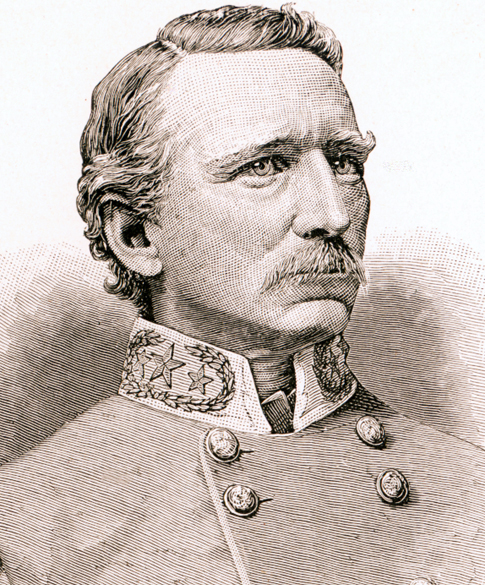 Brigadier General Joseph B. Kershaw, whose South Carolina brigade attacked toward the stony hill and the Wheatfield on July 2, 1863. Engraving from Battles and Leaders of the Civil War (New York: The Century Co., 1894), p. 176, via Wikimedia Commons.
Kershaw stepped off at about 4 o'clock, "when I received orders to advance," and moved on a stony hill from which he meant to hit the orchard's left rear. Fences, a stone house and barn, a morass, and "a raking fire of grape and canister" made it hard to keep his line in order. Colonel Kennedy's Second South Carolina went forward "in magnificent style." Brigadier General William Barksdale, on Kershaw's left, had "not yet appeared," Kershaw wrote, but "came up soon after, and cleared the orchard."
Soon after his line halted, Kershaw wrote, the enemy "advanced across the wheat-field in two lines of battle" and caught his Seventh South Carolina on the flank. "The enemy had swung around and lapped my whole line at close quarters, and the fighting was general and desperate." Fearing his men would be surrounded, he ordered the Third South Carolina back to the stone house. Coming out of the wood, he "saw Wofford coming in in splendid style." The brigade of Brigadier General William T. Wofford, which had been held in reserve, broke the enemy, and Kershaw's left wing charged with it, "sweeping the enemy before them, without a moment's stand."
On the Union side, de Trobriand held the center, at what he called "the apex of the angle," and sent his regiments to both flanks. The Fifth Michigan "sustained the loss of more than one-half of its number without yielding a foot of ground." Two Fifth Corps regiments sent to support him fell back without fighting, "by what orders I could never ascertain." He wrote that he "found myself in danger of being surrounded" and left the woods. In the wheat-field he made a counterattack with the Seventeenth Maine and the Fifth Michigan, and held the enemy off until Second Corps troops relieved him "when our ammunition was just exhausted." Birney, whom de Trobriand places with them, wrote that the Seventeenth Maine, driven back, charged again at his personal appeal and retook its position.
Caldwell and Sweitzer in the Wheatfield
Brigadier General John C. Caldwell commanded the First Division of the Second Corps. Between 4 and 5 o'clock he was ordered to report to Major General Sykes of the Fifth Corps. He sent Colonel Cross's First Brigade through the wheat-field, "driving him steadily to the farther end." His Second and Third Brigades went in on Cross's right. When Cross's men ran out of ammunition, Colonel Brooke's Fourth Brigade, held in reserve, relieved them. Caldwell then called on Brigadier General James Barnes, commanding the Fifth Corps' First Division, "who was some distance in the rear," for a brigade.
Barnes sent Colonel J. B. Sweitzer's brigade, which had already been in action. Earlier, Sweitzer wrote, when Barnes's First Brigade fell back, Barnes sent word for him to do the same, and he withdrew "in perfect good order" to the road behind the wheat-field. About fifteen minutes later a general he had never seen, who proved to be Caldwell, asked for his brigade. Sweitzer referred him to Barnes, who asked whether he would take it in. Caldwell's account of the request mentions only Barnes.
The brigade crossed the wheat-field to a stone fence. Regiments on its right left the woods, and fire began to come from behind. Sweitzer sent his aide, Lieutenant Seitz, to report to Barnes, but Seitz "reported that General Barnes was not to be found." "Finding that we were surrounded," Sweitzer ordered a withdrawal, and Colonel Jeffords of the Fourth Michigan was "thrust through with a bayonet in a contest over his colors." Sweitzer adds that Barnes told him he had sent "a verbal order to withdraw" by an orderly, but "the orderly never reached me."
Caldwell described a similar collapse on his own line. Going to his right, he found that "all the troops on my right had broken and were fleeing to the rear in great confusion." Brigadier General Zook and Colonel Cross, who led two of his brigades, fell mortally wounded, he wrote, "while driving the enemy triumphantly before them." Caldwell attributed his division's withdrawal "entirely to the breaking of the troops on the right."
The Peach Orchard
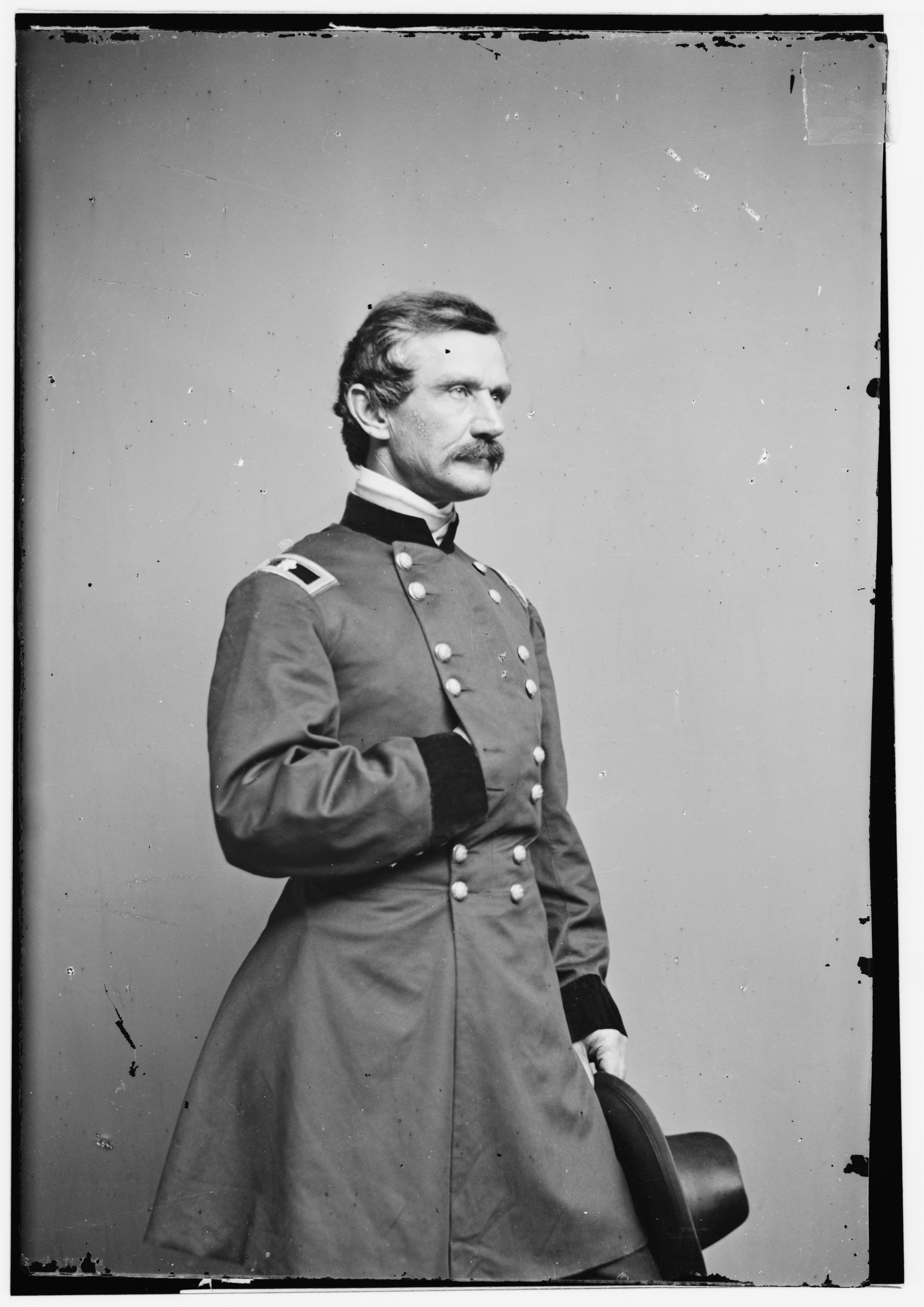 Brigadier General Andrew A. Humphreys, whose Second Division of the Third Corps held the Emmitsburg road north of the orchard on July 2, 1863. Library of Congress, LC-DIG-cwpb-04932.
The fight for the orchard overlapped with the fighting in the wheat-field. At the northern end of Birney's line, Graham's Pennsylvanians stood at the angle where the line bent to meet the road. Birney wrote that the brigade was exposed there to "a fearful artillery fire, enfilading his line." With help from the Third Maine and the Third Michigan, it "held the peach orchard until nearly dusk, when, finding the right unsupported, it fell back to the next ridge." The 141st Pennsylvania, one of his regiments, "lost, out of 200 taken into the fight, 149 men and officers killed and wounded." The revised return also totals 149, including 21 captured or missing.
Randolph had put Ames's battery in the orchard. By about 5 p.m., he wrote, the batteries were "becoming very much exhausted." Battery E of the First Rhode Island had been placed to answer a cross-fire on Ames's. It stayed "greatly exposed" until its support was pulled back to strengthen the orchard and the troops there were repulsed. That made its withdrawal, he wrote, "a matter not only of prudence but of necessity."
Kershaw wrote that Barksdale, with fire from Kershaw's Eighth South Carolina, "cleared the orchard." Longstreet reports Barksdale mortally wounded "in the attack on the evening of the 2d," without saying where. On Longstreet's left, where the brigades of Major General R. H. Anderson's division were "co-operating," Union troops in strength struck two of them and drove one back. That, he wrote, "caused my left to be somewhat exposed and outflanked." Wofford's brigade, he adds, "was driven back at the same time."
Humphreys's division, along the road north of the orchard, had the same problem on the Union side. His left was "in air," and "being the only troops on the field, the enemy's whole attention was directed to my division, which was forced back slowly, firing as they receded." In his report he put the division at 5,000 men and its loss at 2,088. A footnote where he mentions his table of losses refers readers to the revised return, which counts 2,092.
Where the Lines Stood at Dusk
By dusk the fight had pushed the Third Corps back from the Emmitsburg road. Meade's report gives the result in a sentence: Birney "was compelled to fall back and reform behind the line originally designed to be held," the enemy's numbers having enabled him "to outflank the corps in its advanced position." Humphreys gathered the remnants of his division on the left of the troops of Major General Winfield Scott Hancock, commanding the Second Corps, whose artillery opened on an enemy about 100 yards away. "The enemy broke and was driven from the field," he wrote.
Elsewhere the lines were reshaped as the light failed. Birney wrote that the Second and Fifth Corps took his division off the front line "toward dusk." Caldwell wrote that he reformed his men "behind a stone wall until relieved by the Twelfth Corps." By Hancock's direction, he then took his command back to where it had stood earlier in the day.
On the Confederate side, Kershaw gathered his regiments behind the stone wall and, about dark, was ordered to the peach orchard, where he stayed until noon the next day. Longstreet described the result as ground held on the right, "with my left withdrawn to the first position of the enemy, resting at the peach orchard." At the far end Benning's brigade stayed on the rocky peak it had taken, and held it until late the next day.
Read together, the reports describe separate positions under attack, several with an exposed flank. Their authors repeatedly tie what happened on their own ground to what was happening on a flank. Meade's report records one more assault that evening, at about 8 p.m., against the Eleventh Corps. That assault, and the fighting on Culp's Hill that night, are the subject of Part 6.
Sources: The War of the Rebellion: Official Records, Series I, Vol. 27, Part 1: Meade, pp. 114–116; revised casualty return (No. 13), pp. 173, 177–178; Caldwell, pp. 379–381; Birney, pp. 482–486; Ward, pp. 493–495; de Trobriand, pp. 519–521; Humphreys, pp. 529, 531–535; Randolph, pp. 581–585; Sweitzer, pp. 610–613. Part 2: Longstreet, pp. 357–359, 362–363; Kershaw, pp. 366–370; Robertson, pp. 404–407; Benning, pp. 414–417.