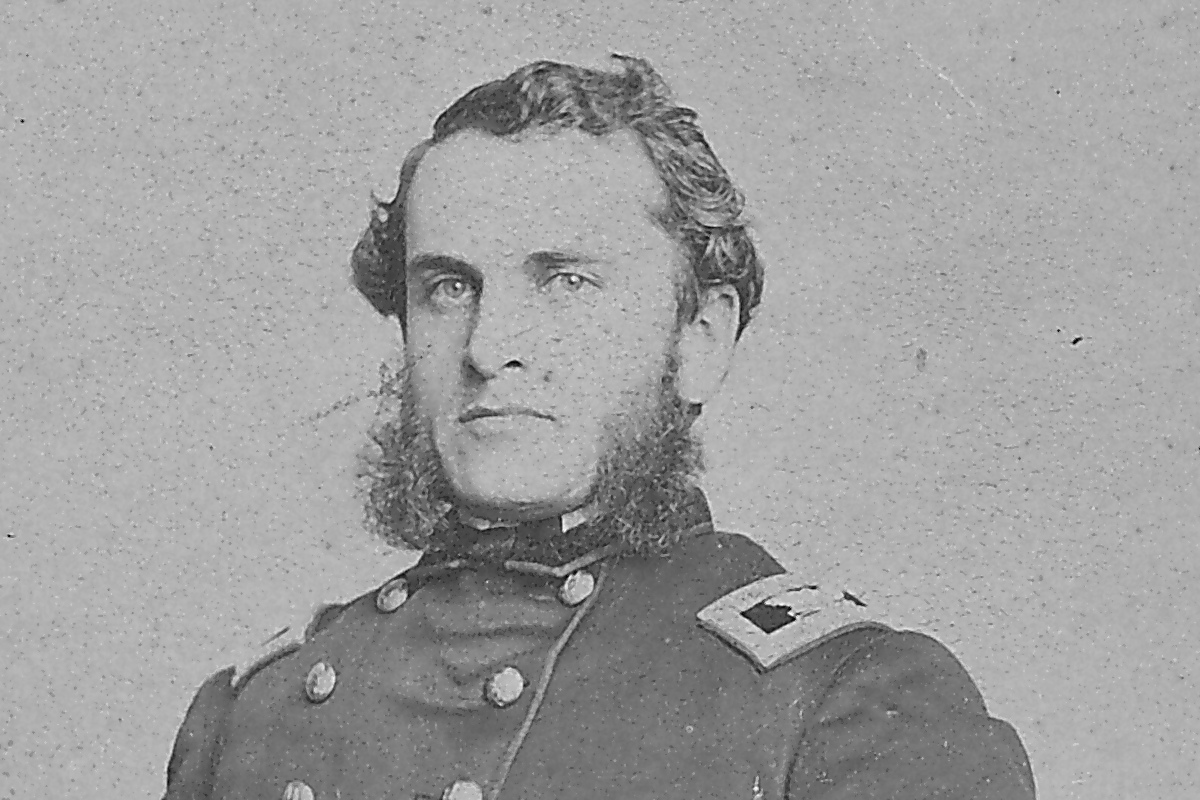
The version of the second day most often told has three moves. An army engineer finds Little Round Top nearly undefended, a brigade commander sends his regiments up it without waiting for orders, and a Maine regiment ends the fight on the left with a bayonet charge. Summaries of the battle, including the American Battlefield Trust's, tell it in roughly that order.
The reports written that summer describe the same afternoon less neatly. Little Round Top was held after several officers put troops on it during the afternoon, on different orders, and the men who wrote about it credit different officers with starting the chain. This part follows the reports in the order the troops reached the hill and marks where they disagree.
Where the Line Ended
Major General George G. Meade, commanding the Army of the Potomac, described the ground he meant to hold in a report dated October 1, 1863. Cemetery Ridge ran south from the town, "gradually diminishing in elevation until it came to a very prominent ridge called Round Top, running east and west." The Second and Third Corps were to occupy the continuation of Cemetery Ridge on the left. At about 3 p.m. Meade rode to the extreme left to post the arriving Fifth Corps and found that Major General Daniel Sickles, commanding the Third Corps, "not fully apprehending the instructions in regard to the position to be occupied," had moved forward half a mile or three-quarters of a mile in front of the Second Corps line. The reports used here include none from Sickles himself.
Major General George Sykes, who commanded the Fifth Corps, gives the same hour from his side. At 3 p.m. Meade sent for him, and when the attack began he "was at once ordered to throw my whole corps to that point and hold it at all hazards." On the way, Sykes wrote, staff officers from Sickles "in the name of that officer, asked for assistance." He refused: "the key of the battle-field was intrusted to my keeping, and I could not and would not jeopardize it by a division of my forces."
The army's chief signal officer, Captain Lemuel B. Norton, reported in September that a station on "Round Top Mountain, on the left of our line" saw the enemy "massing upon General Sickles' left" at 3:30 p.m. and told Sickles and the commanding general. Norton does not say which of the two hills he means.
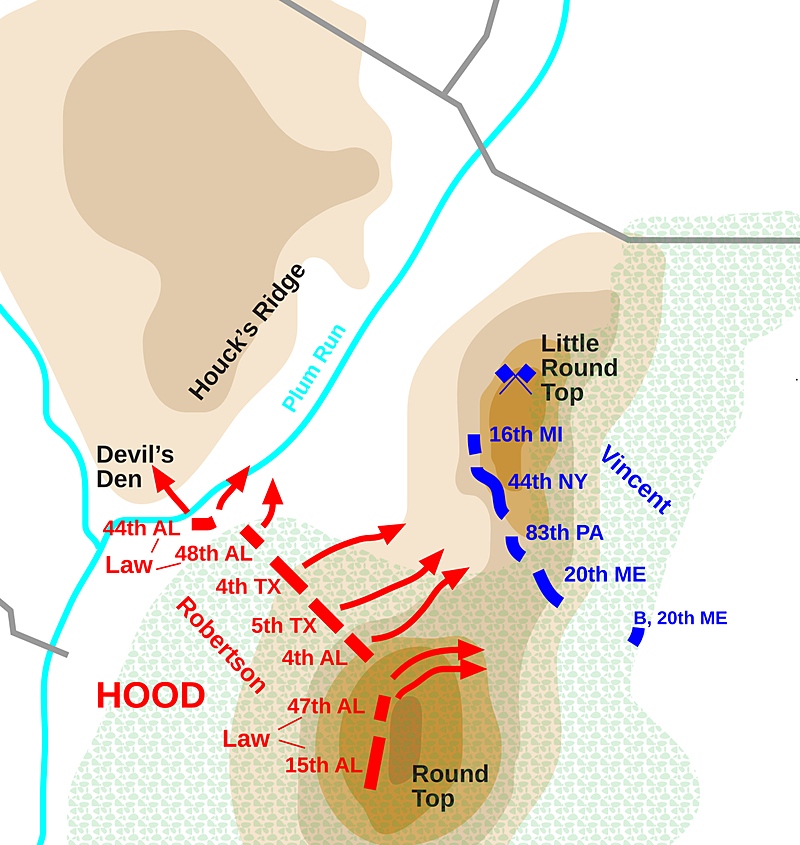 Initial Union and Confederate positions on Little Round Top, July 2, 1863. Map by Hal Jespersen. Public domain, via Wikimedia Commons.
Warren and the Request for Troops
Brigadier General Gouverneur K. Warren, chief engineer of the Army of the Potomac, is the officer most often credited with seeing the danger. The Official Records volume used here contains no report from him. His role in these pages comes through the reports of Sykes, Barnes, and Garrard, quoted below, and beyond them through his own later letters and testimony. In Bill Cameron's study of how troops reached the hill, Warren rode there with a small party of staff officers, found only a signal detachment on it, and had a nearby battery fire a shot into the woods to see what it would reveal. Cameron regards the picture of Warren discovering the Confederate line alone as an embellishment, because the signalmen had already been reporting movement. He adds that Warren sent staff officers to find troops, and that one of them, Lieutenant Ranald Mackenzie, wrote within a year that Sickles, asked through him, declined, and that Sykes supplied troops as soon as he was asked.
Sykes's own report describes a request in the other direction: it was Sickles's staff officers who asked him for help, and he turned them down. Both accounts can be true. Neither report mentions the other.
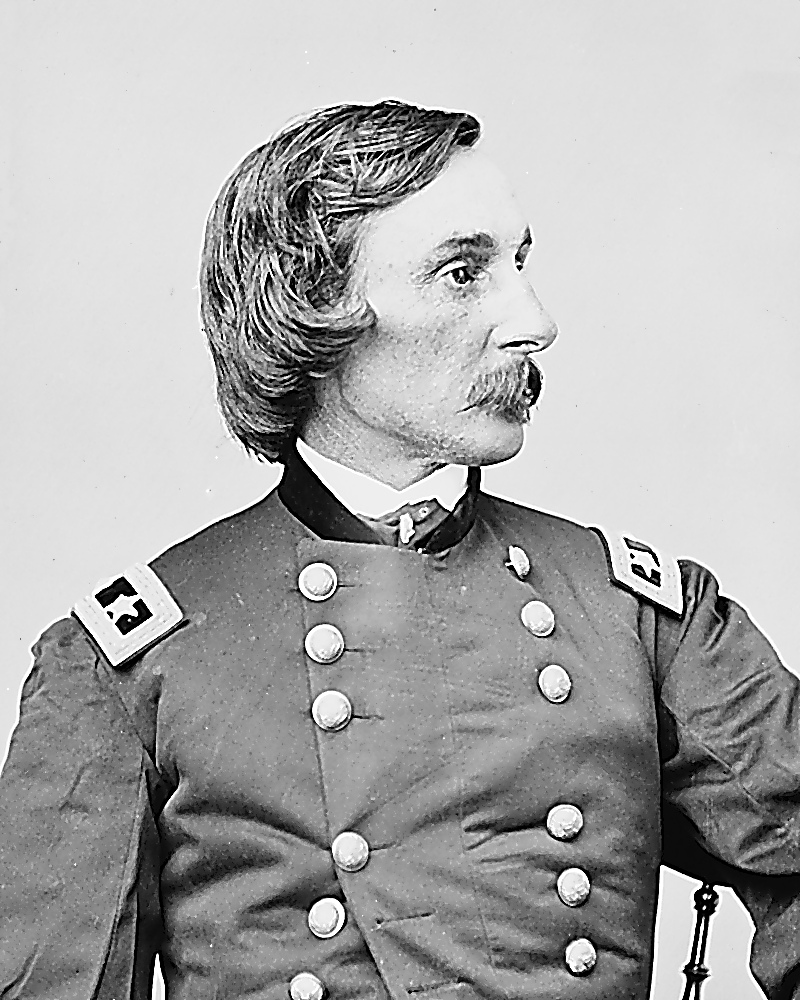 Brigadier General Gouverneur K. Warren, chief engineer of the Army of the Potomac. Library of Congress.
The Fifth Corps reports place Warren at a different moment. Brigadier General James Barnes, commanding the corps' First Division, wrote that as the head of his column entered the field, Warren "of the staff of General Meade" came up "riding rapidly from the left," pointed out the Round Top, and "urged the importance of assistance in that direction." Sykes "yielded to his urgent request, and I immediately directed Colonel Vincent, commanding the Third Brigade, to proceed to that point with his brigade." Sykes's report puts it more briefly: "Vincent's brigade, of this division, had seized the rocky height, closely followed by Weed's brigade, Second Division. These troops were posted under the direction of General Warren, chief engineer of this army." Barnes describes a request, a decision, and an order. Sykes describes a hill seized and then posted.
Vincent's Brigade Goes Up
Colonel Strong Vincent commanded the Third Brigade of Barnes's division. Colonel James C. Rice, who commanded the 44th New York in it and took over the brigade when Vincent fell, reported that it "was detached from the division and ordered into position at about 4 p. m." on the extreme left. Colonel Joshua L. Chamberlain, commanding the 20th Maine, wrote that his regiment received "from Colonel Vincent, commanding the brigade, orders to move to the left at the double-quick," up "a rugged mountain spur called Granite Spur, or Little Round Top." Vincent told him it was the extreme left of the army's line and that he was to "hold that ground at all hazards." The brigade formed a curved line, the 20th Maine on the left, the 16th Michigan on the right, and the 83rd Pennsylvania and 44th New York between them. Rice counted about 1,000 muskets.
The exchange usually quoted, in which Vincent takes responsibility for moving his brigade without waiting for Barnes, comes from later accounts. According to Brian Swartz of Emerging Civil War, Oliver Willcox Norton, the brigade's flag-bearer, published it in 1913, and Chamberlain wrote in similar terms after the war. None of the reports used here describes it. They credit Vincent with speed and with where he placed the brigade. Barnes wrote that Vincent "moved with great promptness to the post assigned to him." Captain Orpheus Woodward, commanding the 83rd Pennsylvania, wrote on July 6 that without "the prompt and skillful disposition made by Colonel Vincent" the enemy "would have succeeded in turning our left."
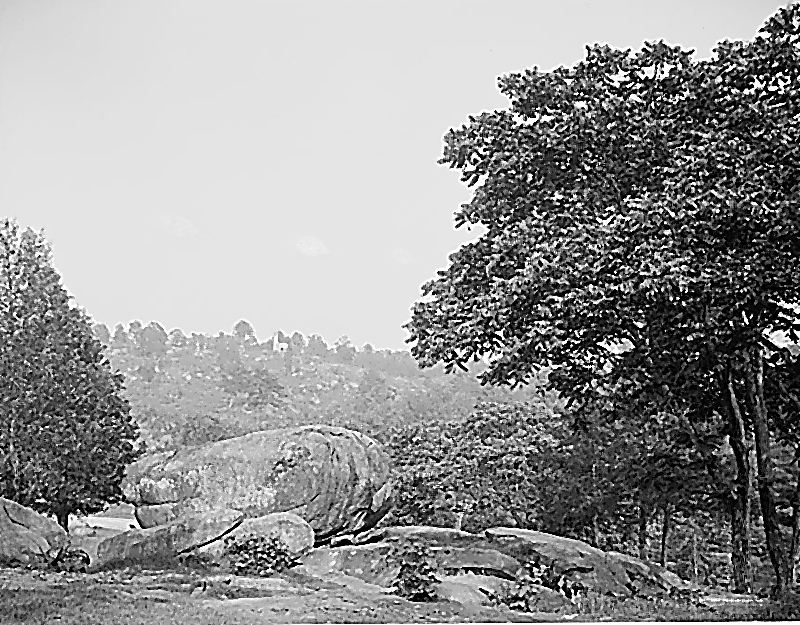 Little Round Top, viewed from Devil's Den, photographed around 1900–1910. Detroit Publishing Co. Library of Congress.
The Right of the Line
Below the hill, the Texas brigade of Brigadier General J. B. Robertson led the attack as part of Major General John Bell Hood's division. Robertson wrote that he left the Emmitsburg pike and closed on Brigadier General Evander Law's left because he saw "a mountain held by the enemy in heavy force with artillery" that was "the key to the enemy's left." Hood was wounded soon after the advance began, according to Robertson and to Lieutenant General James Longstreet, who commanded the First Corps. Longstreet's report has McLaws's division in position at about 4 p.m., with Hood's moving farther to the right.
Rice wrote that Hood's division struck the whole brigade line in three columns. For about an hour the 44th New York and 83rd Pennsylvania held. Then an attack on the right forced back part of the 16th Michigan, which, Rice wrote, was thrown into confusion "through some misunderstanding of orders," until "immediately supported by the One hundred and fortieth New York Volunteers" the line "became again firm and unbroken." It was at this point, Rice wrote, that Vincent fell, mortally wounded.
Lieutenant Colonel Norval Welch, commanding the 16th Michigan, gave his own account. "Some one (supposed to be General Weed or Major-General Sykes)" called from the crest to fall back nearer the top. The order was "not obeyed, except by single individuals," and from "misconstruction of orders" a lieutenant sent the colors to the rear. Three of the color guard followed. The rest of the regiment, Welch wrote, "retained their position until relieved."
Weed's Brigade and the Guns
The 140th New York belonged to Weed's brigade, the Fifth Corps' Second Division. Colonel Kenner Garrard, who commanded that brigade after Brigadier General Stephen Weed fell, reported that the regiment, "under the direction of General Warren," was "led to the left, up on what is known as Round Top ridge," with Lieutenant Charles Hazlett's battery behind it. When the brigade and the battery reached the ridge, Garrard wrote, it was "entirely unoccupied, excepting by a part of the First Division, on the extreme left." Colonel Patrick O'Rorke of the 140th was "mortally wounded at the head of his regiment." A few moments after Weed placed his command, he too was mortally wounded on the summit, and Hazlett, "while offering his assistance to General Weed, fell, mortally wounded."
Weed's brigade almost went elsewhere. Sykes wrote that when he came back with more troops he "found the greater part of Weed's brigade moving away from the height where it had been stationed, and where its presence was vital." When he sent an officer to ask why, the reply was "By order of General Sickles," and he directed the brigade to re-occupy the ground "at the double-quick step." Garrard adds that three of his regiments had been led forward to support the Third Corps and were ordered back at the double-quick before they were engaged.
Captain Augustus Martin, who commanded the Fifth Corps' artillery, reported that Hazlett's battery was posted on the hill "about 4.30 p. m." and that an officer from Sickles's staff had taken two of his other batteries, "thus depriving the Fifth Corps of its proper amount of artillery." Lieutenant Benjamin Rittenhouse, who took over Hazlett's battery, wrote that it "had been engaged only about an hour" when Hazlett was shot in the head. Hazlett died at 8 p.m.
The Left of the Line
Chamberlain wrote that he detached Company B as skirmishers to guard his exposed left, that the attack began before his line was complete, and that he saw a body of the enemy moving through the valley toward his left. He stretched the regiment to the left and bent his left wing back until it was nearly at right angles to the right. The fighting became hand to hand and lasted an hour. "My ammunition was soon exhausted," he wrote. "At that crisis, I ordered the bayonet. The word was enough."
Three Union reports describe that moment, and each uses different words. Chamberlain wrote "ordered the bayonet." Rice wrote that Chamberlain "then ordered a charge." Barnes wrote that the regiment's commander "ordered the bayonets to be fixed, and, at the command 'Forward,'" the regiment "rushed onward with a shout." All three agree on who gave the order and that the regiment advanced.
The Confederate report reads differently. Colonel William C. Oates, commanding the 15th Alabama, wrote on August 8 that Law had ordered him to wheel left toward the heights, "which order I failed to obey," because he was already climbing the mountain and found a heavy force in his front. The enemy, he wrote, "charged me five times." Then he saw that the Union force had "flanked me on the right, and two regiments were moving rapidly upon my rear and not 200 yards distant." He continued: "to save my regiment from capture or destruction, I ordered a retreat." Oates does not mention a bayonet charge.
Night on Round Top
Rice wrote that the enemy then tried to take "Round Top hill," and that he sent officers to Sykes for help. "Five regiments were at once sent to my support from the Third Division, General Crawford, under command of Colonel Fisher," he wrote. Rice ordered Chamberlain "to advance and take possession of the mountain," and reported that the ground was in Union hands before 9 o'clock.
Chamberlain gave the sequence differently. At dusk Rice told him that Vincent had fallen and that Colonel Joseph Fisher's brigade had come up. When Fisher's regiments did not advance, Rice directed him to seize the higher hill, which Chamberlain calls the Great Round Top. It was 9 p.m. About 200 men went up with bayonets fixed and without firing, and took 25 prisoners, "among them a staff officer of General [E. M.] Law." Brigadier General Samuel Crawford, commanding the Pennsylvania Reserves division, wrote that he directed Fisher to occupy the hill, and that Fisher "immediately detached" two regiments and the 20th Maine. Fisher wrote that he took two regiments and the 20th Maine and "at 10 p. m. ascended the hill," taking "over 30 prisoners."
What the Reports Show
The familiar version credits one discovery, one decision, and one charge. The reports show a longer chain and differ over who initiated its successive steps. Meade's report credits Sykes with sending a force to "occupy the Round Top Ridge" and does not name Warren. Sykes, Barnes, and Garrard name Warren. Rice and Chamberlain describe Vincent's orders. Woodward credits Vincent's dispositions. These are not necessarily competing claims; several officers can have taken the actions each report credits them with, though the account in which Vincent takes personal responsibility for the move appears only in writing from long after the battle.
The reports also show what the popular version leaves out. The Third Corps pulled the other way: its staff officers asked Sykes for help, an order drew Weed's brigade away, and its staff took two of Martin's batteries. The participants did not use the hill's name consistently. Barnes writes "the Little Round Top," Chamberlain "Granite Spur, or Little Round Top," Garrard "Round Top ridge," Norton "Round Top Mountain," and Martin "Rock Hill," with "[Round Top]" bracketed in the printed text. Rice's "Round Top hill" appears to be the higher hill beyond his left, as his sketch shows, so a bare "Round Top" in these pages can mean either hill, and a modern reader should not assume every instance means the same one. Chamberlain's report used here carries a July 6, 1863 dateline. According to Swartz, Chamberlain used plainer language, "a rocky and wooded hill," in an earlier July 6 report, and used "Little Round Top" only in a more detailed report he wrote years afterward for the Official Records; it is that later, more detailed version that this article quotes.
The figures vary, and likely reflect different counts and methods rather than a single error. Woodward puts his regiment in position at about 2:30 p.m., while Rice, Welch, and Chamberlain say about 4. Chamberlain reports going in with 386 men and losing 136, 30 of them killed. Barnes counts 380 men and "over 100" wounded. The army's casualty return lists the 20th Maine's loss at 125. Chamberlain claims about 400 prisoners, "mainly from the Fifteenth and Forty-seventh Alabama Regiments"; Oates counts 90 of his own regiment missing.
What the reports do support is the sequence: a signal station that saw the enemy, an engineer who asked for troops, a corps commander who spared a brigade, a brigade commander who placed it, Weed's brigade called back, and a regiment that held its ground. Whose hand began it is where the reports part. The fighting below the hill, at Devil's Den, in the Wheatfield, and in the Peach Orchard, is the subject of the next part.
Sources: The War of the Rebellion: A Compilation of the Official Records of the Union and Confederate Armies, Series I, Vol. 27, Part 1 (1889), reports of Meade (pp. 114–121), Norton (pp. 199–207), Sykes (pp. 592–597), Barnes (pp. 598–605), Rice (pp. 615–622), Chamberlain (pp. 622–626), Welch (pp. 627–628), Woodward (p. 632), Garrard (pp. 651–652), Crawford (pp. 652–656), Fisher (pp. 658–659), Martin (pp. 659–661), and the casualty return (pp. 173–192); Part 2, reports of Longstreet (pp. 357–364), Oates (pp. 392–393), and Robertson (pp. 404–407). Secondary: Bill Cameron, "The Saviors of Little Round Top"; Brian Swartz, Emerging Civil War, July 2, 2022; American Battlefield Trust, "July 2, 1863."