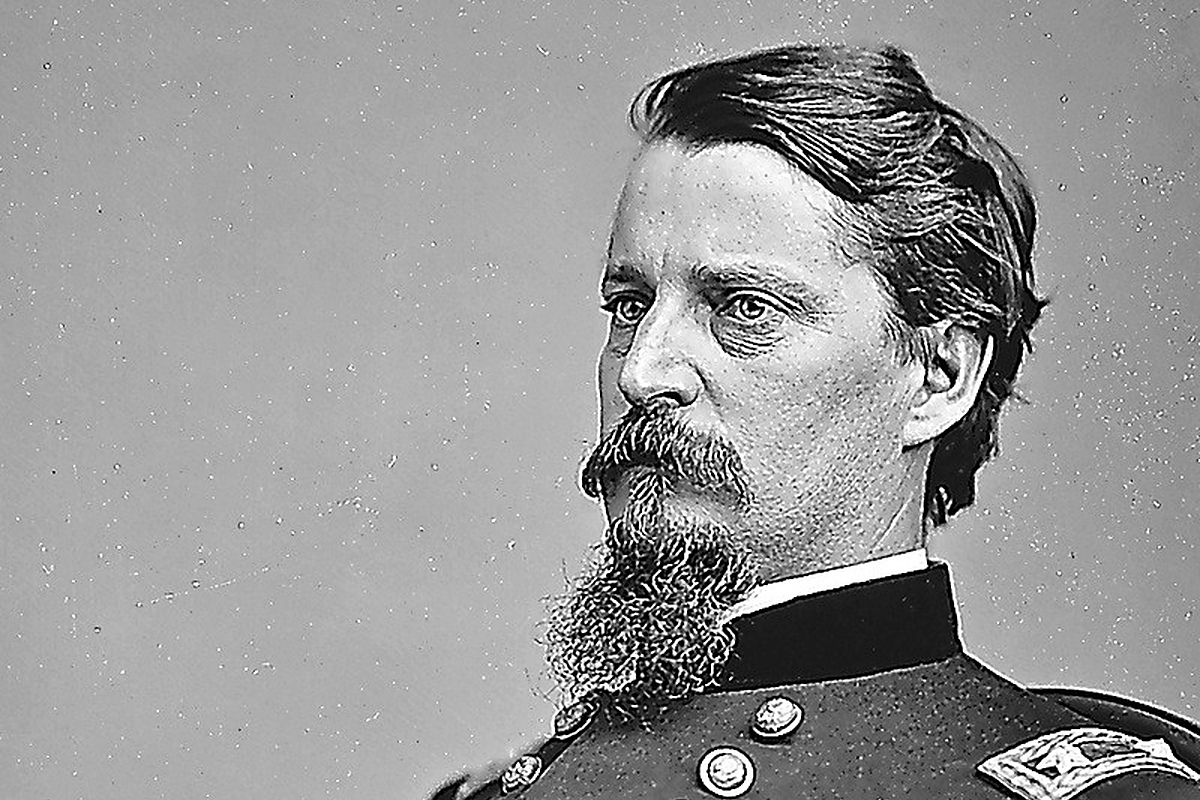
Captain Henry C. Coates signed the First Minnesota's report on August 3, 1863, as the regiment's commanding officer. Its account of July 2 is short, and the part that matters most takes up a few lines. "Our infantry in front of us had advanced upon the enemy and pushed him for a while, but were in turn driven back in some confusion, the enemy following in heavy force." The regiment was ordered forward. "To check the enemy, we were ordered to advance, which we did, moving at double-quick down the slope of the hill right upon the rebel line."
That advance was one of three actions on the Union line on July 2, 1863. Part 5 covers the afternoon fighting before it. The other two came at dusk and after dark, on Culp's Hill and East Cemetery Hill, where Lieutenant General Richard S. Ewell's Second Corps attacked the right of the Union position. This article follows nineteen Union and Confederate reports through all three. In each place, the reports show how the Union position depended on troops standing their ground, reinforcements reaching threatened points, or both. None of the reports calls the two hills by those names. They speak of a wooded hill and of Cemetery Hill, and this article uses the names visitors know today.
The First Minnesota on Cemetery Ridge
Major General Winfield Scott Hancock commanded the Second Corps. When Major General Daniel E. Sickles was wounded, Hancock wrote, Major General George G. Meade, commanding the Army of the Potomac, "directed me to assume command of the Third Corps in addition to that of my own." In his report Hancock describes an "unprotected interval" in the Union line and a Confederate regiment "about passing through" it. "It was advancing firing, and had already twice wounded my aide, Captain Miller." Then he writes: "The First Minnesota Regiment coming up at this moment, charged the rebel regiment in handsome style, capturing its colors, and driving it back in disorder."
Coates places the regiment near the center of the line, "to the left of the town," under artillery fire for most of the day and "not actively engaged until about 5 p.m.," when it was moved to support Battery C, Fourth U.S. Artillery. None of the reports used here gives a time for the charge that followed. Coates writes that the regiment "inflicted severe punishment upon the enemy, and stopped his advance." He does not mention captured colors in his account of this charge. The only colors he reports taken are those of the Twenty-eighth Virginia, which he places in the fighting of July 3, when Private Marshall Sherman of Company C took them. The reports do not resolve which colors Hancock meant, and this article quotes each account as written. The cost was great: "The fire we encountered here was terrible." He names the officers who fell. Captain Muller and Lieutenant Farrar were killed, and Captain Periam was mortally wounded. Colonel Colvill, Lieutenant Colonel Adams, Major Downie, and Adjutant Peller were "severely wounded."
Brigadier General William Harrow, whose report covers the division, wrote that the three field officers "were shot down, the two former severely, and I fear mortally, wounded, but the command maintained its position until supported by the arrival of other troops."
Hancock closed his account of the regiment with a judgment: "I cannot speak too highly of this regiment and its commander in its attack, as well as in its subsequent advance against the enemy, in which it lost three-fourths of the officers and men engaged." Coates put the loss at "more than two-thirds." The revised casualty return, which covers the whole battle, lists 224 casualties in the regiment, with a company of Minnesota sharpshooters attached. The return counts both days, so its total is not a measure of the charge alone.
The Works Left Behind
The attacks on the Union right grew out of a plan for the whole line. General Robert E. Lee wrote that "the principal attack" was to fall on the Union left. Ewell was instructed "to make a simultaneous demonstration upon the enemy's right, to be converted into a real attack should opportunity offer." "Immediately after the artillery firing ceased, which was just before sundown," Ewell wrote, Major General Edward Johnson ordered his division forward against "the wooded hill in his front," and "about dusk the attack was made." Johnson called the hill "a rugged and rocky mountain, heavily timbered and difficult of ascent; a natural fortification, rendered more formidable by deep intrenchments and thick abatis."
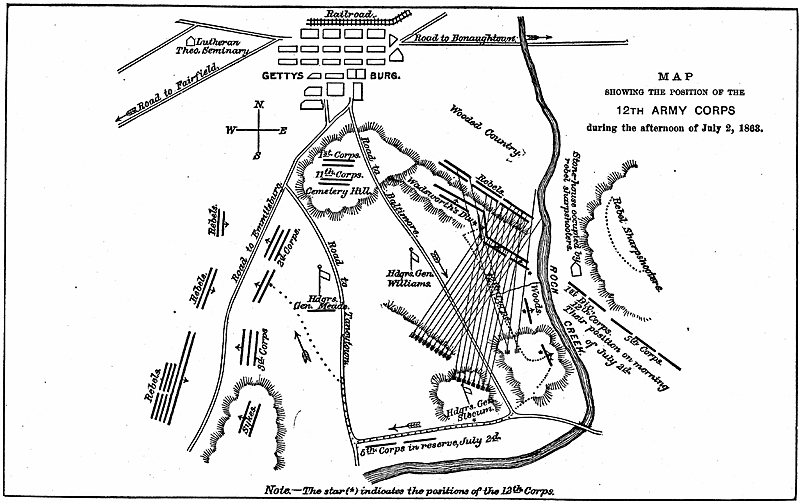 Map showing the position of the Twelfth Army Corps during the afternoon of July 2, 1863, as titled in the report of Major General Henry W. Slocum.
Brigadier General John W. Geary's division of the Twelfth Corps held the line on the hill, with Brigadier General George S. Greene's brigade on its left, joining the First Corps. Greene's men had spent the day building cover from "logs, cord-wood, stones, and earth." "By 12 o'clock we had a good cover for the men," he wrote.
Late in the day, part of the Twelfth Corps was pulled out. Meade wrote that "portions of the Twelfth Corps were sent as re-enforcements" to the left. Greene put the order at 6:30 p.m. and wrote that the First Division and two of Geary's brigades "were ordered from my right, leaving the intrenchments of Kane's brigade and Williams' division unoccupied." Geary received his order at 7 p.m. and wrote that he "received no specific instructions as to the object of the move." Greene was told to cover the whole line with his own brigade. Meade summed up what followed: "During their absence, the line on the extreme right was held by a very much reduced force. This was taken advantage of by the enemy."
Greene reported an attack on his whole front "a few minutes before 7 p.m." In Johnson's account, "by the time my other brigades had crossed Rock Creek and reached the base of the mountain, it was dark." Johnson wrote that Brigadier General George H. Steuart's brigade, on the left, "carried a line of breastworks which ran perpendicular to the enemy's main line." Steuart's report explains why it went easily. "The enemy's attention being called more especially to our right, this fortification was not occupied in force." The Twenty-third Virginia "immediately charged the work, and scattered the enemy which was behind it."
Greene's Right Flank
Geary wrote that the Confederates "quickly occupied the intrenchments left by the First Division." Colonel David Ireland's 137th New York, which held the right end of Greene's line, "changed front, forming at a right angle to the rifle-pits," as Geary put it. Greene reported that the California Regiment came up to help and was then withdrawn, "leaving our right in a very critical position."
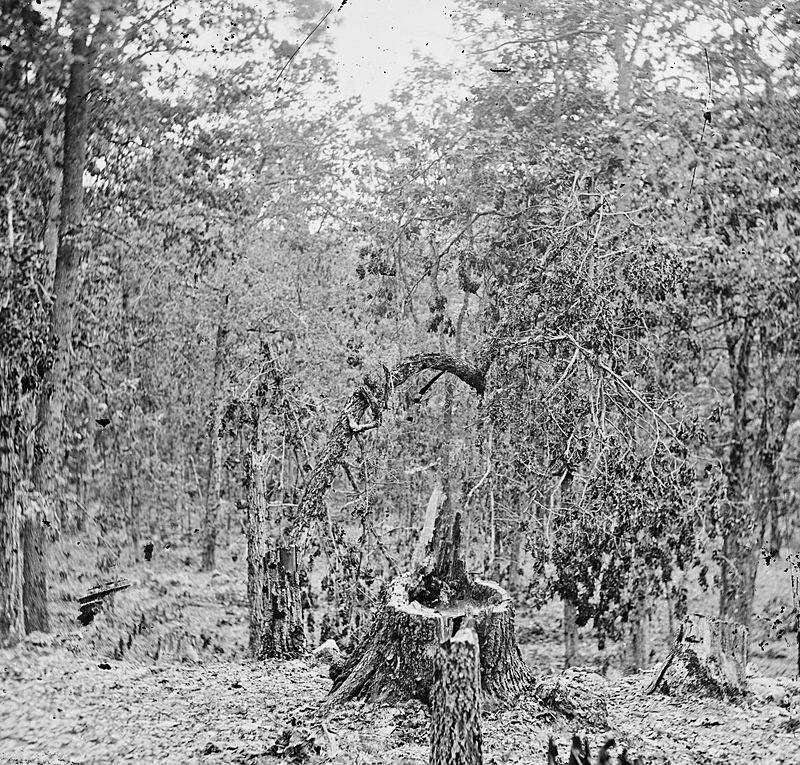 Woods on Culp's Hill, Gettysburg, Pennsylvania, showing the effect of musket fire.
Greene sent to Brigadier General James Wadsworth, commanding a First Corps division on his left, and to Major General Oliver O. Howard, commanding the Eleventh Corps. Both responded. From the First Corps came the Sixth Wisconsin, the Fourteenth Brooklyn, and the 147th New York, "in all about 355 men." From the Eleventh Corps came the 82nd Illinois, the 45th New York, and the 61st Ohio, "in all about 400 men." They were sent into the trenches "to relieve our regiments as their ammunition was exhausted and their muskets required cleaning."
Greene counted "four distinct charges between 7 and 9.30 p.m., which were effectually resisted." He wrote that "not more than 1,300 men were in the lines at any one time." Geary wrote that the enemy "discontinued their attack at about 10 p.m." and "remained in occupancy of the ridge formerly held by the First Division, General Greene still holding all his original position."
East Cemetery Hill
At about the same hour, Major General Jubal A. Early's division attacked the hill held by Howard's Eleventh Corps, north of the Baltimore turnpike, where Captain Michael Wiedrich's battery stood. Early's report says that "as soon as Johnson became warmly engaged, which was a little before dusk," he ordered Brigadier General Harry T. Hays's Louisiana brigade and Colonel Isaac E. Avery, commanding Hoke's North Carolina brigade, "to advance and carry the works on the heights in front." The men, Early wrote, drove back "at least two lines of infantry posted behind stone and plank fences."
Hays wrote that he was ordered forward "a little before 8 p.m." and that darkness helped his men. "Owing to the darkness of the evening, now verging into night, and the deep obscurity afforded by the smoke of the firing, our exact locality could not be discovered by the enemy's gunners." Then: "Arriving at the summit, by a simultaneous rush from my whole line, I captured several pieces of artillery, four stand of colors, and a number of prisoners."
The Union reports describe the same moment from behind the guns. Wiedrich, of Battery I, First New York Light Artillery, wrote that a Confederate brigade "succeeded in turning our infantry, and got into the intrenchments of my battery." Major Thomas W. Osborn, who commanded the Eleventh Corps artillery, wrote that "the infantry at first gave way, and the battery was held for a moment by the enemy, when the cannoneers rallied with the infantry, and, seizing upon any weapons they could reach, threw themselves upon the enemy, and assisted to drive them back." Howard added that Brigadier General Adelbert Ames, commanding the division, "by extraordinary exertions, arrested a panic, and the men with sponge-staffs and bayonets forced the enemy back." The reports date the charge from "Between 7 and 8 o'clock" in Osborn's to "about 9 p.m." in Brigadier General Adolph von Steinwehr's.
The Summit and the Second Corps
At the summit, Hays wrote, "a quiet of several minutes now ensued." He heard "heavy masses of infantry" approaching in the dark and held his fire because he "had been cautioned to expect friends" on his flanks. After "a second and third volley," he wrote, "the flashing of the musketry disclosed the still-advancing line to be one of the enemy." He ordered a retirement, and he later reported that he was "compelled to abandon" the captured artillery.
Help came from the Second Corps. Hancock, near Cemetery Hill, wrote of the hour: "It was nearly dark." Hearing "a heavy engagement on General Howard's front, the firing seeming to come nearer and nearer," he directed that Colonel Samuel S. Carroll's brigade be sent to Howard. Carroll's own report says the order reached him through the division's adjutant general, Major Norvell. Once there, "it being perfectly dark, and with no guide, I had to find the enemy's line entirely by their fire." Hancock wrote that Howard later told him the brigade arrived "at a very critical time." Carroll's firing went on until about 10:20.
Early's report gives the reason his brigades could not stay: "no attack was made on the immediate right, as was expected." Lee wrote that Major General Robert E. Rodes, "not having his troops in position, was unprepared to co-operate with General Early." Colonel Archibald C. Godwin, who took over Hoke's brigade, wrote that in the darkness it was "impossible to concentrate more than 40 or 50 men at any point for a farther advance." He learned only afterward that Avery had been "mortally wounded."
Night Along Rock Creek
Brigadier General Thomas L. Kane had rejoined his brigade of Geary's division that morning, after making his way through Confederate cavalry lines "in citizen's dress." At twilight, he wrote, the brigade was moved to the batteries on the turnpike and then "ordered to return to our former position." Within "200 paces of our breastwork" it was "met by a sharp fire, which we supposed to come from the First Brigade, misled by the darkness." The brigade withdrew and marched around to Greene's position, where it was "again fired upon, thus discovering that the enemy had entire possession of our works."
Greene's account of the same hour is brief. At about 10 o'clock he learned that Kane was returning, "immediately sent a staff officer to advise him that the enemy were in his intrenchments," and found that Kane "had, however, already been fired on." Kane then "gallantly assisted us by placing his small, but very reliable, command on my right, securing that flank." Geary wrote that it was "injudicious to attack the enemy in the night in their new position" and spent the rest of the night preparing "a vigorous attack at daylight." On the Confederate side, Steuart's brigade rested "from about 11 p.m. till about daylight" behind the captured works.
Whoever Was Nearest
The reports describe three places where a line held through resistance on the spot and help from elsewhere. The First Minnesota came up to a gap on Cemetery Ridge. Carroll's brigade crossed from the Second Corps to East Cemetery Hill. Greene's brigade fought from its own breastworks until regiments from the First and Eleventh Corps came into its trenches. Hancock's report also shows how uncertain the night was. Hearing firing "farther to the right," and believing it was on Slocum's front, he sent two more regiments, the 71st and 106th Pennsylvania. They "also reported to Major-General Howard."
Meade's report sums up the Eleventh Corps fight in one sentence. An assault was made "about 8 p.m. on the Eleventh Corps from the left of the town," and was "repelled, with the assistance of troops from the Second and First Corps." Kane, who came up to Greene's position that night, wrote of the place "where the noble veteran Greene, by his resistance against overwhelming odds, it should be remembered, saved the army." That was Kane's judgment. Geary and Greene describe the same stand in plainer terms.
By midnight the Confederates held part of the Union works on Culp's Hill. Greene's brigade still held its original position, with Kane's brigade now on its right. Ewell wrote that he was ordered to renew his attack at daylight, and Geary spent the night preparing to retake the trenches at the same hour. Part 7 follows the morning of July 3 on Culp's Hill.
Sources: The War of the Rebellion: Official Records, Series I, Vol. 27, Part 1: Meade, pp. 116–117; revised casualty return (No. 13), p. 176; Hancock, pp. 370–372; Harrow, pp. 419–420; Coates, pp. 424–425; Carroll, pp. 456–458; Howard, pp. 705–706; Steinwehr, p. 722; Osborn, p. 749; Wiedrich, pp. 751–752; Slocum (map), p. 760; Geary, pp. 825–827; Kane, pp. 846–848; Greene, pp. 855–858. Part 2: Lee, pp. 318–319; Ewell, pp. 446–447; Early, pp. 469–471; Hays, pp. 480–482; Godwin, pp. 484–485; Johnson, pp. 504–505; Steuart, pp. 509–511.