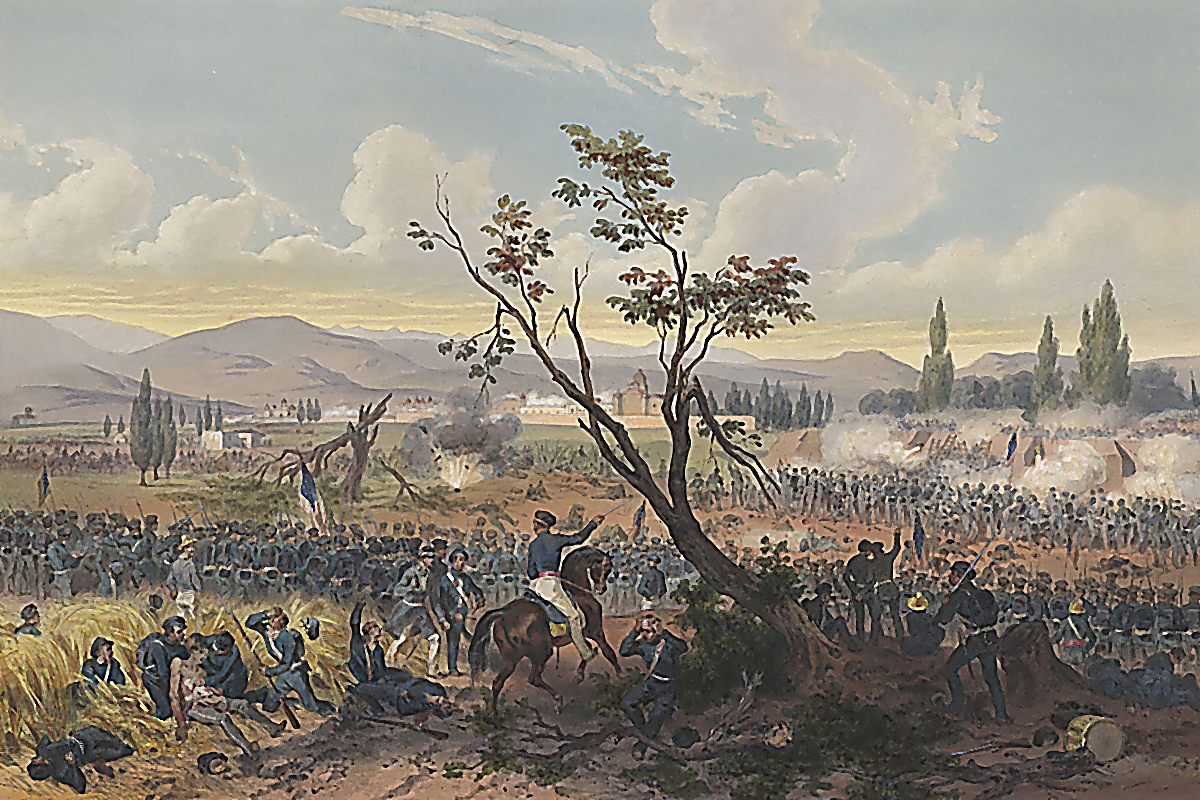
By the morning of August 20, 1847, General Winfield Scott had already won one battle before breakfast. His army had just shattered a Mexican force at Contreras, and Scott turned his divisions north toward the major defensive line standing between the United States Army and Mexico City. What followed at the village of Churubusco would become one of the costliest single days of the entire Mexican-American War, and it would end with the men of the San Patricio Battalion, deserters from the U.S. Army, fighting and dying to hold a Mexican position against their former countrymen.
Santa Anna had ordered his retreating forces to make a stand along the Churubusco River, about four miles south of the capital. Two positions anchored the line. A fortified bridgehead, called a tete de pont, guarded the crossing itself. Behind it stood a seventeenth century Franciscan convent, its walls twelve feet high and four feet thick, which Mexican gunners had turned into a makeshift fort with seven cannon.
Scott split his forces. William Worth's division would strike the bridgehead while David Twiggs and Gideon Pillow moved against the convent. This was no cleanup action. In his own report, Scott estimated that some 27,000 Mexican troops had been gathered in and around the area, drawn from every quarter and resolved to make a last stand within sight of their own capital. Mexican gunners at the convent forced Captain Taylor's American battery to withdraw, and repeated American charges against the bridgehead were thrown back. One American soldier, John Wilkins, wrote that he had never before heard "such showers of lead and iron."
One of the men caught in that fighting was Brigadier General Franklin Pierce, the future president, who had injured his leg the day before at Contreras when his horse fell on him. He insisted on accompanying part of his brigade across the river at Churubusco despite the injury. The pain became so severe that he lost consciousness on the field and had to be carried off. Whig opponents revived the episode during Pierce's 1852 presidential campaign, mocking him as "Fainting Frank" in cartoons and stump speeches even though he ran against his own former commander, Winfield Scott.
The bridgehead finally fell after a hard fight involving the 5th, 6th, and 8th Infantry. Captain J.V. Bomford of the 8th was the first man through one of the fort's embrasures, hauling his regiment's colors in with him, with Lieutenants James Longstreet and George Pickett right behind him. With the bridgehead gone, American guns turned on the convent from close range. According to several accounts of the battle, two of the defenders' cannon had already melted from sustained firing, and a third had fallen from its mount.
Inside those walls was where the battle turned strange. Defending the convent alongside Mexican regulars was the San Patricio Battalion, a unit made up largely of men who had deserted the United States Army. Most were Irish and other Catholic immigrants, though the battalion included Americans and other nationalities as well. Some deserters later cited anti-Catholic prejudice and harsh treatment in the American ranks among their reasons for switching sides. Whatever brought them there, they knew what capture meant. According to accounts of the battle, Mexican officers tried to raise a white flag over the convent three separate times as the position collapsed, and each time members of the San Patricios tore it down rather than surrender. American Captain James Milton Smith finally ended the fighting by holding up a white handkerchief himself.
When it was over, General Twiggs asked the Mexican commander, General Pedro Anaya, to hand over his remaining ammunition. Anaya reportedly gave one of the more quoted replies of the war: "If I had any ammunition, you would not be here."
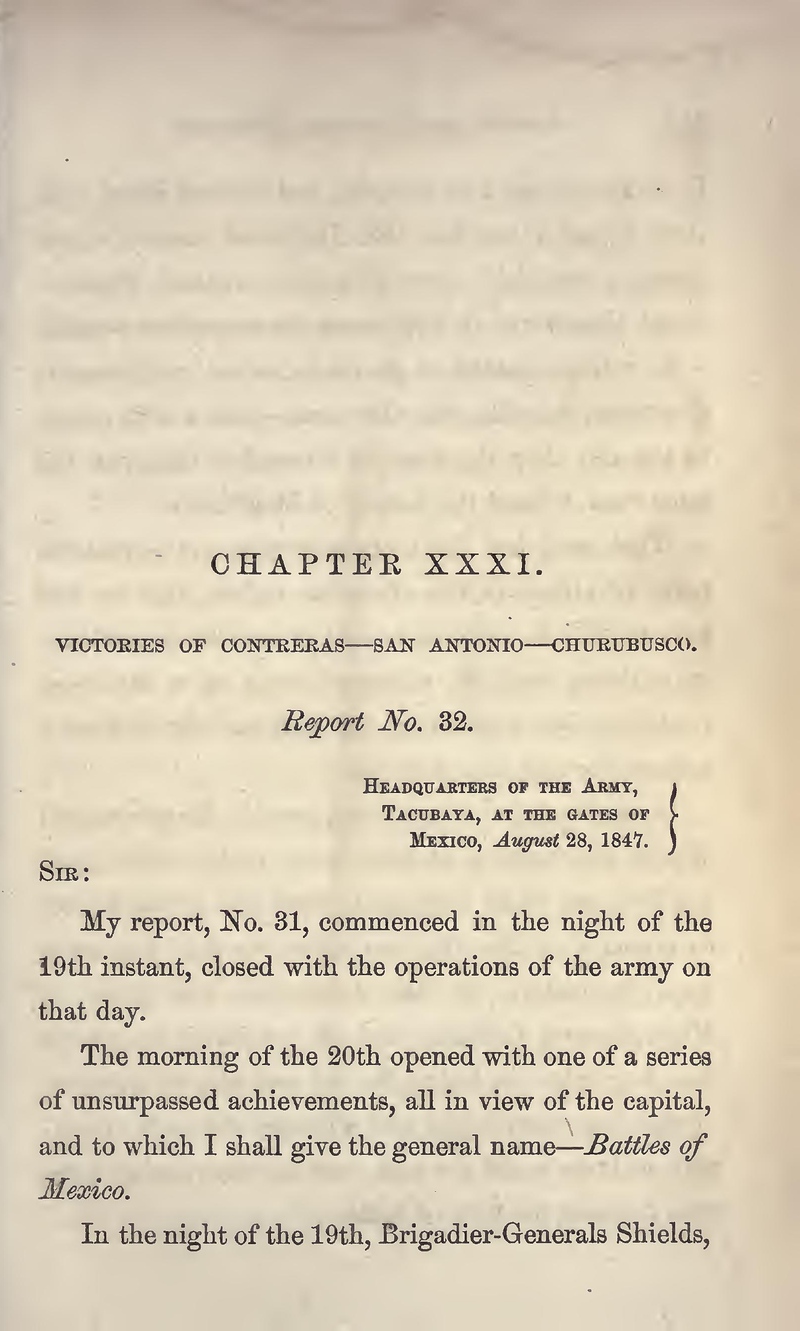
General Scott's own report to the Secretary of War, written eight days later from his headquarters at Tacubaya, gave American losses for the combined battles of Contreras and Churubusco as 139 killed and 876 wounded. He estimated Mexican casualties over the same two days at 4,297 killed and wounded, with 2,637 taken prisoner. Scott's army was now within sight of the capital, and he chose not to press the attack that evening. An armistice followed within days, though it collapsed within weeks and the fighting resumed in September.
The reckoning for the San Patricios came shortly after. Seventy two members of the battalion were tried by court martial across two proceedings, one at Tacubaya on August 23 and another at San Angel on August 26. Nearly all were initially condemned to death. Scott reviewed the verdicts and reduced a number of the sentences to flogging and branding. Fifty San Patricios were ultimately executed, in what is still widely described as the largest collective execution ever ordered by the U.S. military. Their commander, John Riley, had deserted before the United States formally declared war, a technicality that spared him the rope. He was instead given fifty lashes and branded on the cheek with the letter D.
Churubusco is usually remembered, when it is remembered at all, as a footnote on the road to Mexico City. But the men who held that convent wall to the last, tearing down their own side's surrender flag rather than face American justice, deserve to be more than a footnote themselves.