Most people who know anything about the Atlanta campaign know the Battle of Atlanta, fought on July 22, 1864. Fewer have heard of what happened six days later in the woods around a small Methodist chapel three miles west of the city. They should. Ezra Church handed John Bell Hood's army one of its bloodiest afternoons of the entire campaign, and his own field commander admitted it in writing before the week was out.
A city running out of railroads
By late July 1864, William T. Sherman had spent months pushing Confederate forces back toward Atlanta. Frustrated by what he saw as Joseph E. Johnston's excessive caution, Confederate President Jefferson Davis had relieved him in mid-July and replaced him with the far more aggressive John Bell Hood. Hood wasted no time living up to that reputation, launching two costly offensives at Peachtree Creek on July 20 and at the Battle of Atlanta on July 22. Both attacks failed, and both cost the Confederates dearly, but they had at least kept Sherman from breaking into the city outright.
With direct assaults off the table, Sherman turned to strangling Atlanta's supply lines instead. The Georgia Railroad into Decatur was already cut. That left the Macon and Western and the Atlanta and West Point railroads, both running southwest out of the city. Sherman gave the job of severing them to the Army of the Tennessee, now under Major General Oliver O. Howard, who had taken command after James B. McPherson was killed at the Battle of Atlanta.
Howard gets there first
Howard's men began moving on the morning of July 27, swinging around to the west side of Atlanta. Confederate cavalry under Brigadier General William H. "Red" Jackson noticed almost immediately. By 4:15 that morning, Hood's headquarters had already been warned that an attack on the Confederate left was likely. Howard extended his line nearly two miles south and dug in, and by July 28 his soldiers were piling up rails and logs into breastworks and stockpiling a hundred rounds of ammunition per man. They were getting ready for a fight they expected to come to them.
Hood, meanwhile, was planning a fight of his own. He ordered Lieutenant General Stephen D. Lee, only thirty years old and new to corps command, to march out the Lick Skillet Road and seize the crossroads at Ezra Church before the Federals could reach it. Major General Alexander P. Stewart's corps was to follow and strike the Union flank once Lee had secured the crossroads. It was a reasonable plan. It also assumed the crossroads was still open.
It wasn't. Major General John "Black Jack" Logan's Union infantry, part of Howard's command, was already there. Lee didn't know that when he sent Brigadier Generals John C. Brown and Henry Clayton marching west out of Atlanta's defenses around ten o'clock that morning. About a mile out, Brown ran into Confederate cavalry who told him the Yankees were already in front of him. Hood's careful plan for a coordinated flank attack was gone before it had really started. Lee, now improvising, decided to attack immediately rather than wait.
"Driven with great slaughter"
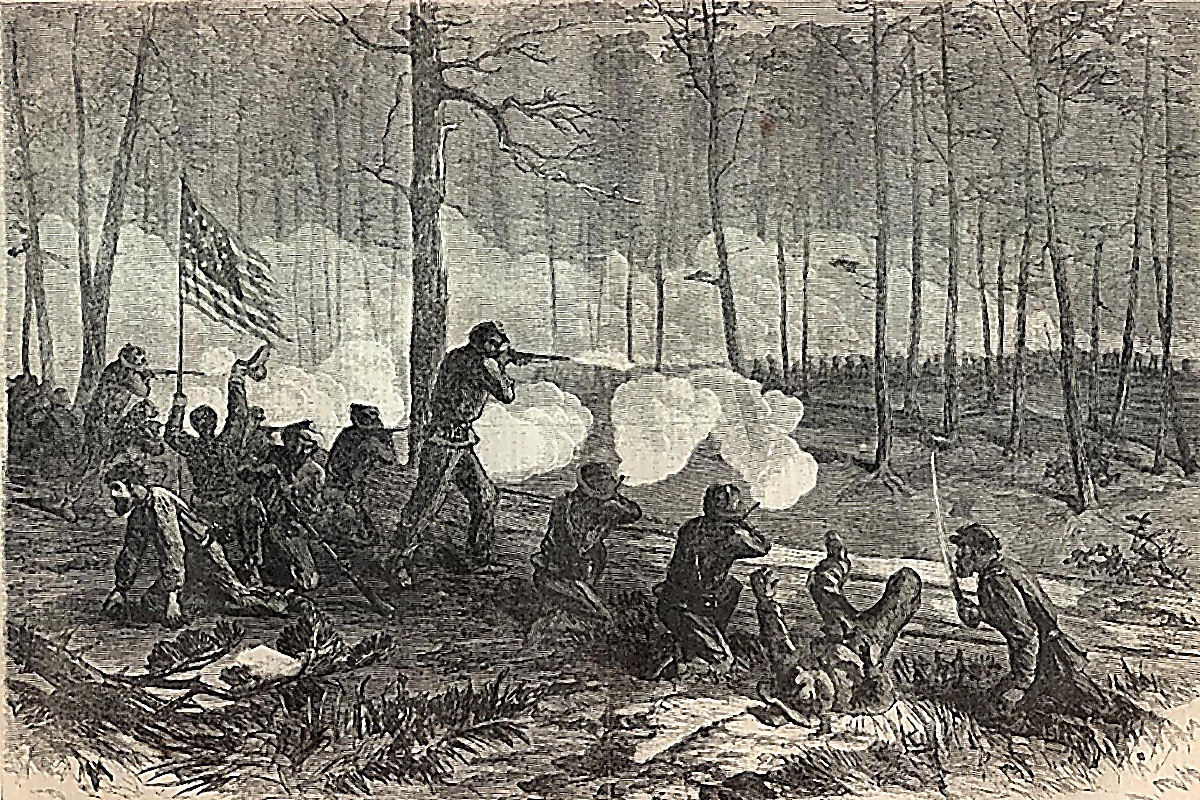
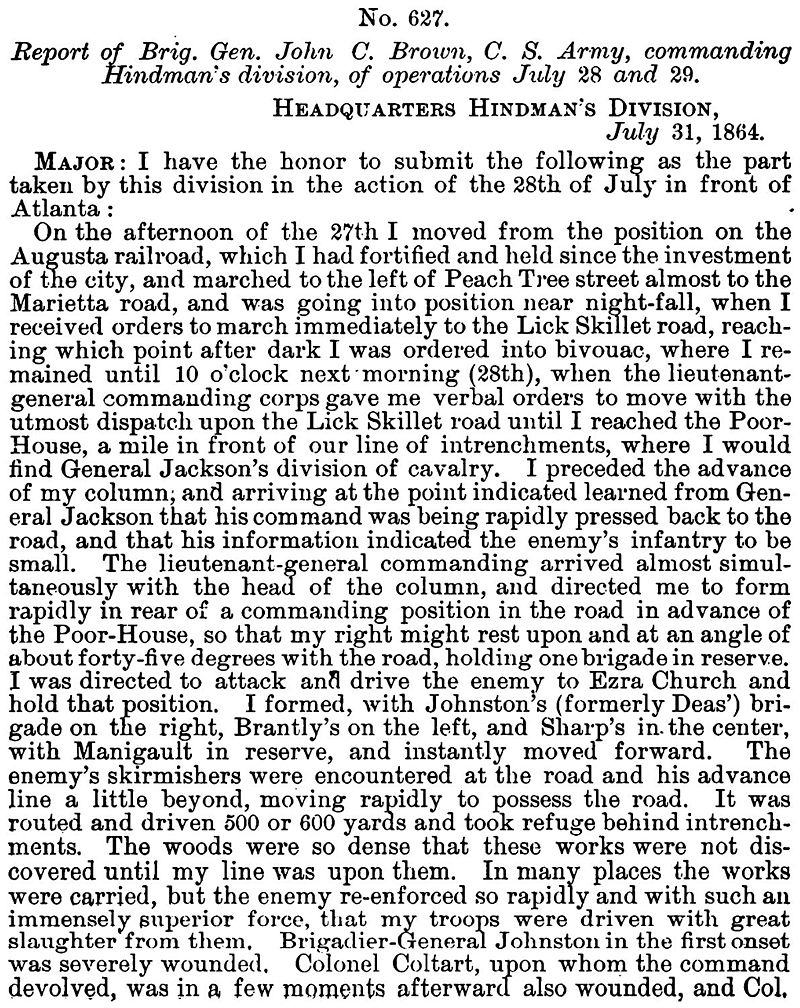
What followed was less a battle plan than a series of piecemeal assaults, one division arriving and attacking before the next was ready. Brown's division went in first, around noon, pushing through dense woods toward a Union line that was already entrenched and waiting. According to Brown's own after-action report, filed just three days later, his troops briefly reached or entered portions of the Federal line, only to be thrown back once reinforcements arrived in force. Union accounts of the same fighting generally deny the Confederates ever truly held those works, so take Brown's version as one side of a still-disputed moment. Brown wrote plainly that his men were "driven with great slaughter." He wasn't exaggerating for effect. Two of his brigade commanders, Brigadier General Johnston and Colonel Coltart, were wounded within moments of each other in the opening minutes of the fighting, and command of that brigade changed hands twice more before the day was over.
Ten minutes after Brown began, Clayton's division arrived and Lee sent it in too, but by then Howard had already rushed a dozen regiments from the Union XVI and XVII Corps to reinforce Logan's threatened line. Union soldiers even pulled the pews out of Ezra Church itself to reinforce their makeshift breastworks. Clayton's attack stalled as badly as Brown's had.
Stewart's corps arrived that afternoon expecting to execute the original flank maneuver, only to find the battle already underway and going badly. Lee, still believing the Union works were lightly held, ordered Major General Edward Walthall's division forward around two o'clock, over much the same ground Brown's men had already bled across. It went no better. After Walthall's attack broke down, no further Confederate charges were ordered. Skirmishing continued into the evening before Hood's forces withdrew under cover of darkness.
What it cost, and what it didn't
Fighting from behind cover for most of the day, Howard's Army of the Tennessee came through Ezra Church with comparatively light losses, generally put at somewhere under 650 men. Confederate losses are harder to pin down with precision, since Southern reporting on casualties grew less reliable as the war dragged on, but most estimates cluster around 3,000 killed, wounded, and missing, and at least one recent book-length study of the battle has argued the true figure may have run closer to 5,000. Either way, it was a lopsided result by any measure, and one more blow to an army that could not easily replace the men it lost.
Despite the one-sided casualties, Ezra Church was not the clean Union breakthrough it might sound like. Howard never reached the railroad he had been sent to cut. Hood's badly bloodied divisions had still succeeded in delaying Sherman from reaching the railroad. It would take another month, and another battle entirely, before Sherman finally severed that last line at Jonesborough on August 31 and forced Hood to abandon Atlanta for good.
Ezra Church rarely gets its own chapter in the popular telling of the Atlanta campaign. It sits in the shadow of the battle six days before it and the fall of the city five weeks after. But for the men in Brown's and Clayton's divisions who went into those woods on July 28, it was very much its own battle, and for one of them, Sergeant Ernst Torgler of the 37th Ohio, who pulled his wounded commanding officer, Major Charles Hipp, out of danger under fire, it was significant enough to earn a Medal of Honor. The soldiers who fought it did not need historians to tell them how costly an afternoon it had been.