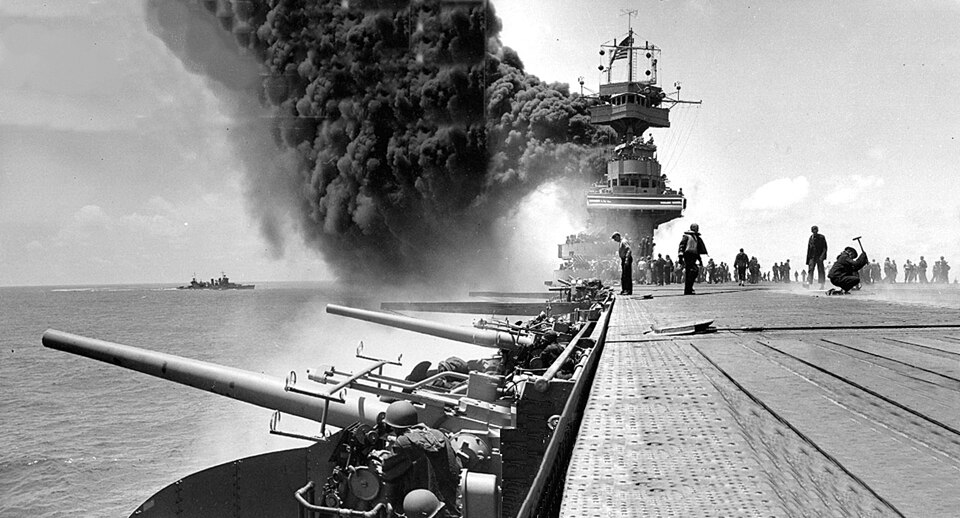
In late spring of 1942, the United States was losing the war in the Pacific. Japan's navy had moved from victory to victory since Pearl Harbor. The American fleet, minus a handful of aircraft carriers that had been out at sea the morning of the attack, lay in ruins. Admiral Isoroku Yamamoto, the architect of Japan's naval campaign, had boasted at the start of hostilities that he would "run wild for a year," but privately admitted he had "utterly no confidence for the second or third year." He understood America's industrial capacity better than most of his colleagues. His goal was to deliver one final, crushing blow before that industrial machine could be turned against Japan.
Yamamoto settled on a tiny coral atoll 1,300 miles northwest of Oahu: Midway. It was not especially valuable in itself, but he calculated that the Americans would consider it vital enough to defend, pulling the remnants of their Pacific Fleet into a battle where his superior numbers would finish them off. He would also keep the plan secret, counting on surprise as his greatest weapon.
He did not know that the Americans were already reading his mail.
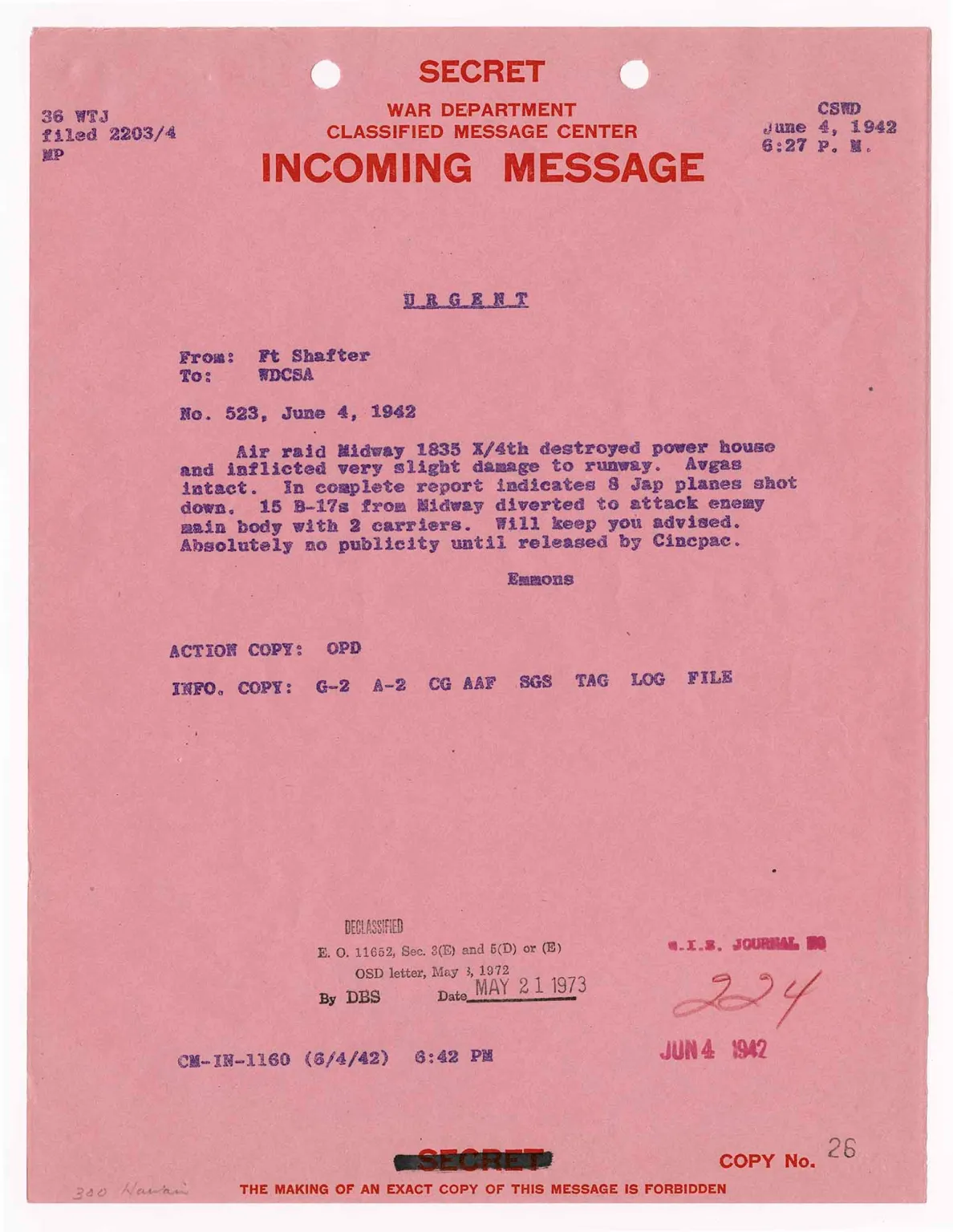
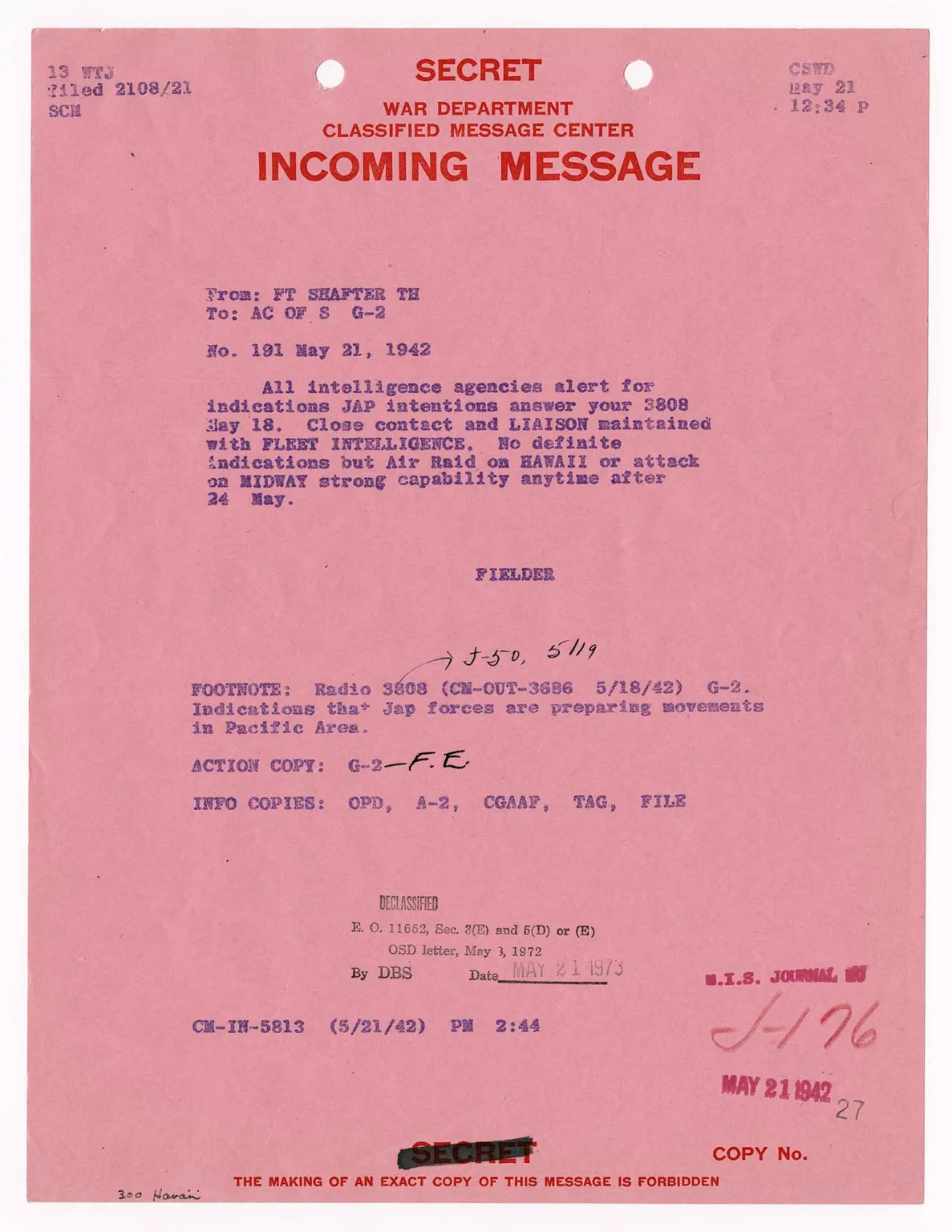 Midway Atoll, May 21, 1942. That same day, a SECRET War Department message warned Washington that a Japanese attack on Midway was possible "anytime after 24 May."
The Codebreakers in the Basement
In a basement workspace at Pearl Harbor, a Navy codebreaking unit called Station HYPO was slowly cracking Japan's primary operational code, designated JN-25 by American analysts. The work was agonizing. JN-25 used approximately 45,000 five-digit number groups, each representing a word or phrase, further scrambled with an additive cipher table. Before the attack on Pearl Harbor, American cryptanalysts had read only 10 to 15 percent of the code. By the spring of 1942, Commander Joseph Rochefort and his team had pushed that number high enough to make educated guesses about Japan's next move.
What they kept seeing in the intercepts was a reference to an upcoming operation targeting a location designated "AF." Rochefort and Captain Edwin Layton, Nimitz's fleet intelligence officer, believed AF was Midway. They had seen the "A" designator used for locations in the Hawaiian island chain, and logic pointed to Midway as Japan's most probable next target. But Admiral Chester Nimitz could not commit his entire Pacific Fleet, the last real barrier between Japan and the American West Coast, on an educated guess.
So they ran a deception.
The commanding officer at Midway was instructed to broadcast an uncoded radio message stating that the base's water distillation plant had broken down and fresh water was desperately needed. The Japanese, unaware their code had been partially cracked, dutifully relayed the report through their own encrypted channels. American intercept stations picked it up within days: "AF is short of water."
The trap was confirmed. Midway was the target.
 War Department Classified Message Center, SECRET, May 21, 1942. Two weeks before the battle, American intelligence warned the attack was coming. This document was not declassified until 1973.
Point Luck
Armed with this intelligence, Nimitz did something Yamamoto never anticipated: he positioned his carriers northeast of Midway before the Japanese fleet arrived. The location was called Point Luck. Nimitz had three carriers to Yamamoto's four. He had 233 carrier-based aircraft and 127 land-based planes on Midway to Japan's 248 carrier aircraft. On paper, the odds still favored Japan considerably. But Nimitz had something Yamamoto did not: he knew the date, the location, and the order of battle of the incoming fleet.
Yamamoto's plan also suffered from a critical structural flaw. Convinced that American carriers would not arrive until after Midway had already been neutralized, he dispersed his forces across a wide stretch of ocean, with different battle groups so far apart they could not support each other. His powerful supporting battleships and cruisers trailed Nagumo's carrier strike force by several hundred miles. When the moment of decision came, they would not be there.
The USS Yorktown, badly damaged at the Battle of the Coral Sea just one month earlier, had been given a 72-hour emergency repair at Pearl Harbor and dispatched to join Enterprise and Hornet. Japanese intelligence believed Yorktown had been sunk. She had not been.
Four Minutes That Changed the War
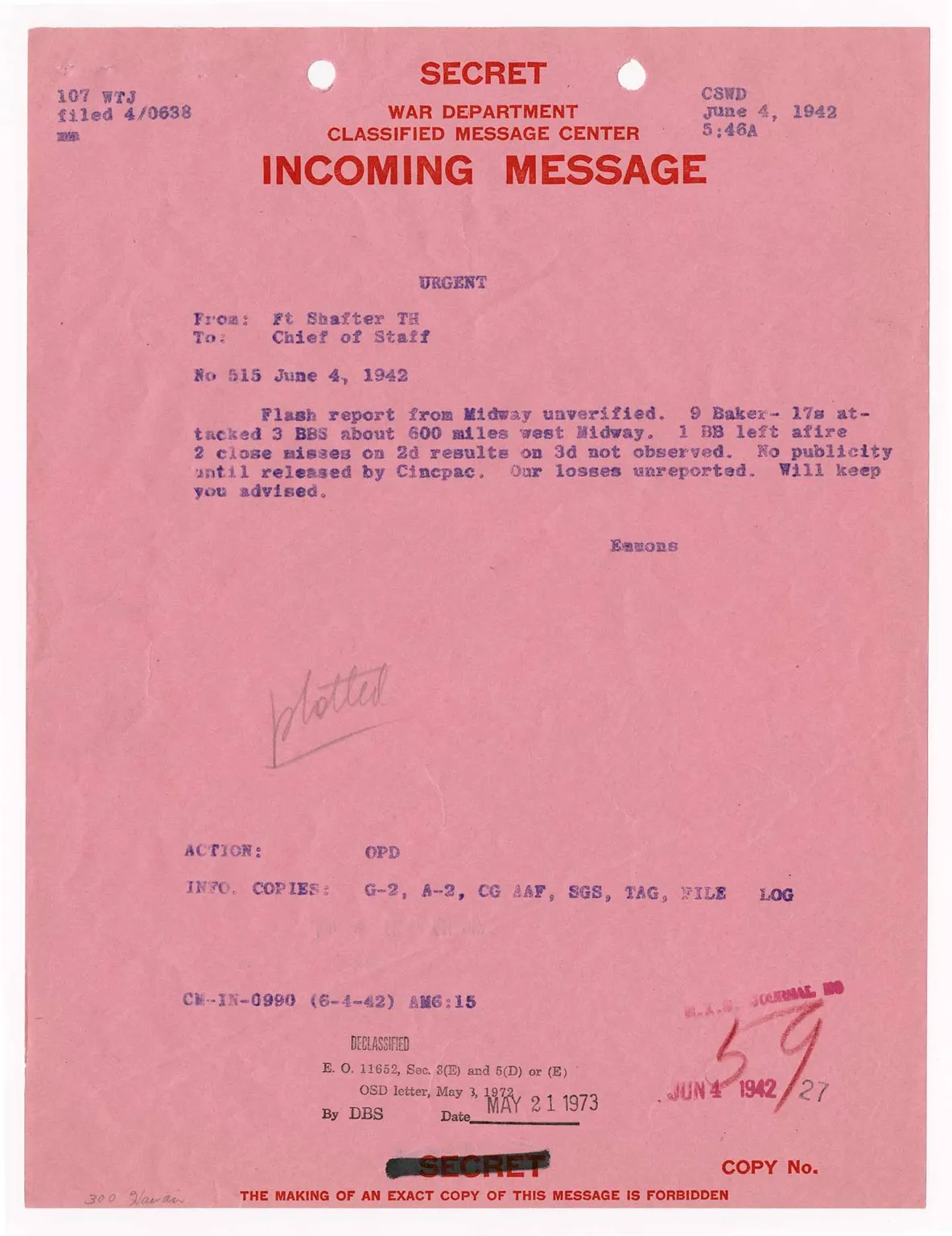
On the morning of June 4, 1942, Japanese aircraft launched from four carriers attacked Midway. They hit hard. Oil tanks burned. Buildings went up. But they failed to knock out the runway, and American bombers could still fly.
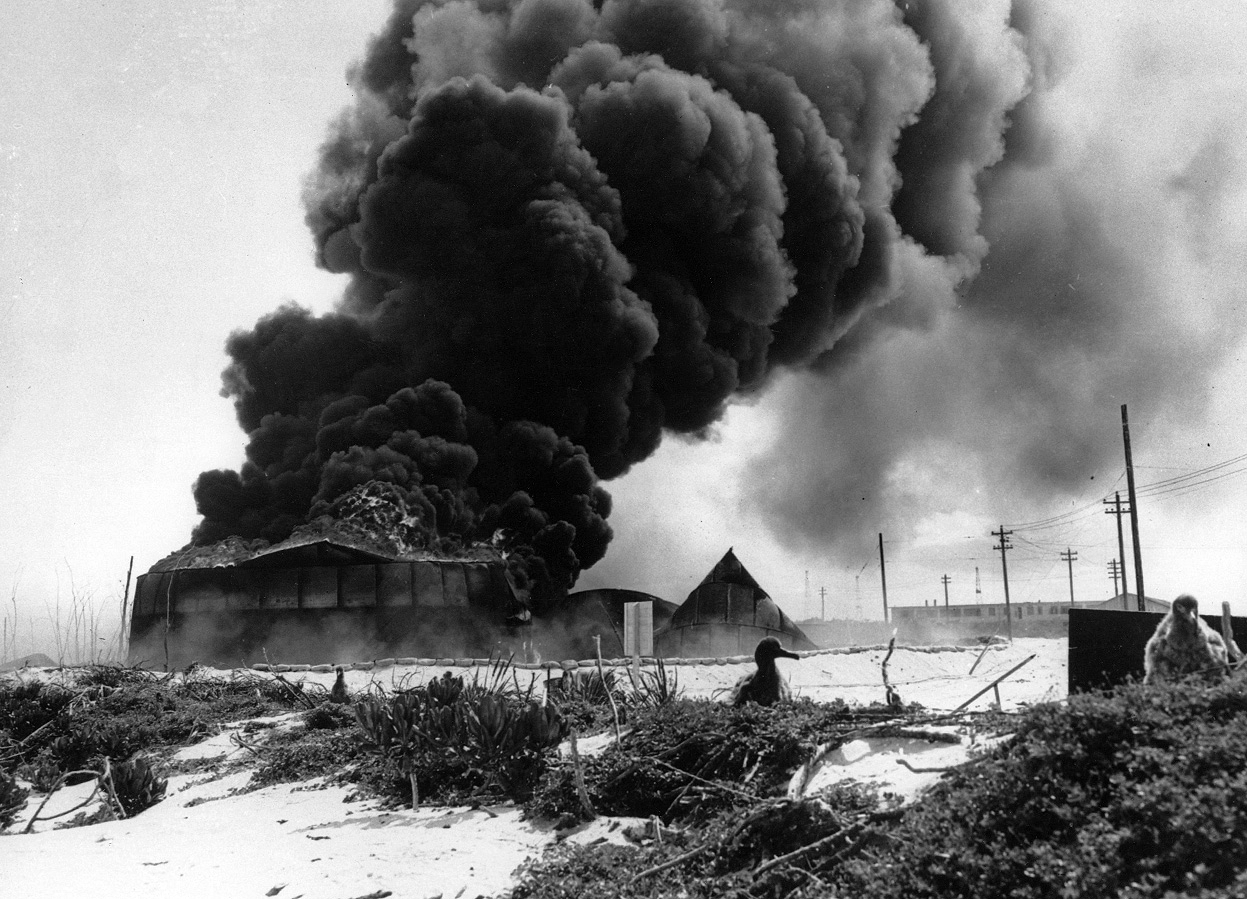 Sand Island, Midway, June 4, 1942. Japanese bombs hit the base hard, but the runway survived. The birds in the foreground are Laysan albatrosses, locally called "gooney birds," unbothered by the battle raging around them.
What followed was hours of chaotic American attacks, most of them costly and ineffective. Torpedo bombers from all three carriers attacked the Japanese fleet without fighter escort and were nearly annihilated. Torpedo Squadron 8 from the Hornet, flying obsolete TBD Devastators, was shot out of the sky almost completely. Of 30 aircrew, one man survived. They scored zero hits. The sacrifice of those torpedo bombers, however, pulled the Japanese fighter cover down to sea level and left the carrier flight decks exposed.
At 10:22 in the morning, Lieutenant Commander Wade McClusky's SBD Dauntless dive bombers from the Enterprise arrived over the Japanese fleet after a prolonged search that had nearly exhausted their fuel. McClusky had spotted the wake of a Japanese destroyer racing to rejoin the fleet and followed it. He found the carriers below with fueled and armed aircraft being frantically prepared in the enclosed hangar bays below decks, bombs and torpedoes scattered loose rather than stowed safely in the magazines.
In roughly six minutes, three of Japan's four fleet carriers were on fire and out of action. Akagi and Kaga were hit by McClusky's Enterprise bombers, while Soryu was struck almost simultaneously by Lieutenant Commander Max Leslie's dive bombers from the Yorktown, two separate attacks converging from different directions within minutes of each other. The armed and fueled planes on their decks cooked off in chain-reaction explosions. Nagumo transferred his flag to a cruiser as his carriers burned.
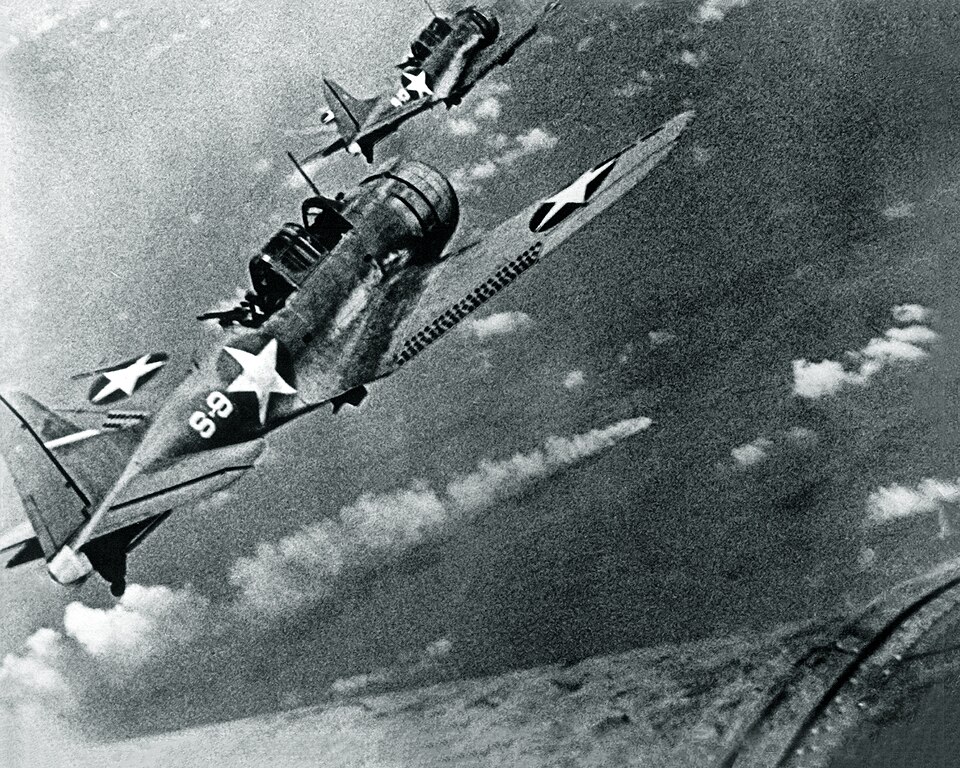 SBD Dauntless dive bombers of Scouting Squadron 8 approach the burning Japanese heavy cruiser Mikuma, June 6, 1942. These were the planes that decided the battle.
Hiryu, the fourth carrier, survived the initial attack and launched retaliatory strikes that crippled the Yorktown, eventually sending her to the bottom. But late that afternoon, Enterprise dive bombers found Hiryu and put four bombs into her flight deck. She burned through the night and sank on the morning of June 5.
Four Japanese fleet carriers, built over years and crewed by the most experienced naval aviators in the Pacific, were gone in less than 24 hours.
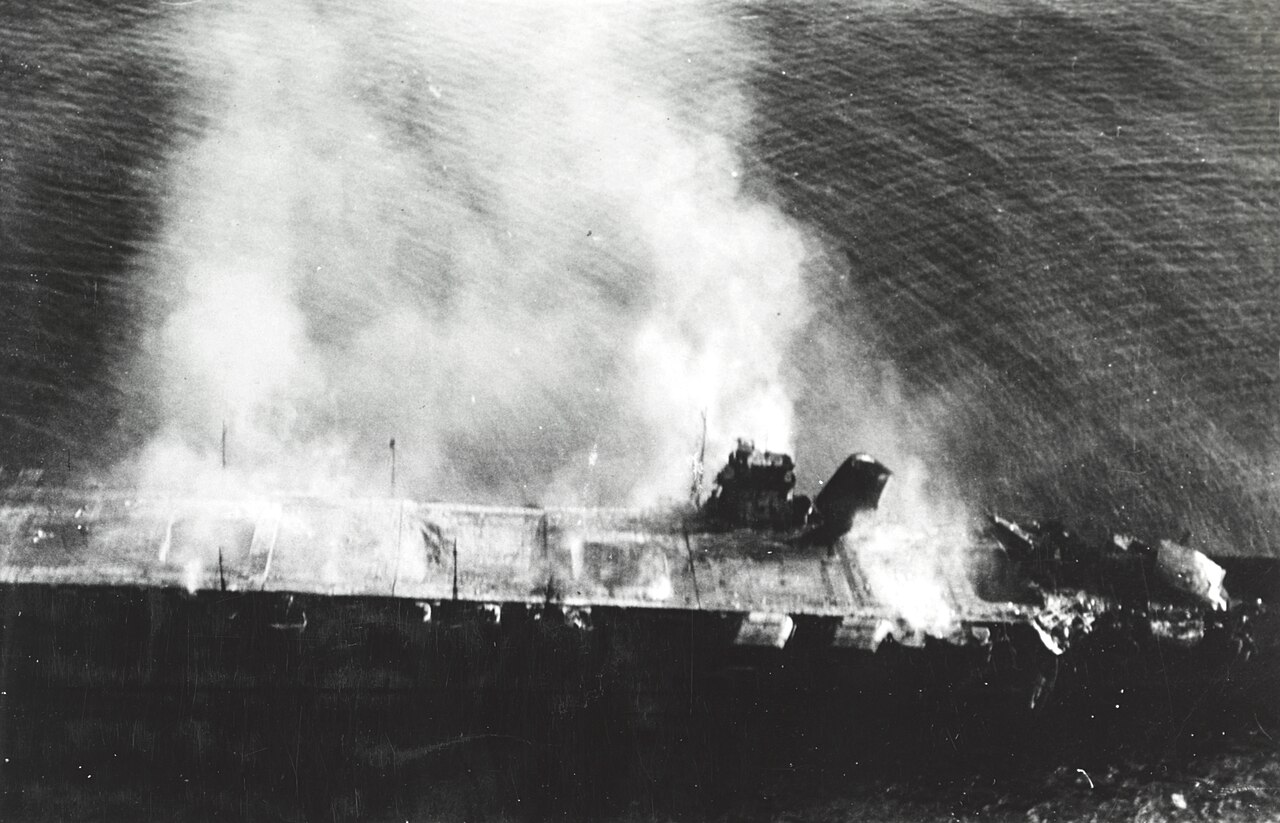 The Hiryu burning on the morning of June 5, 1942, photographed from a Japanese plane. She sank hours later. Japan had sent four fleet carriers to Midway. None returned.
What Japan Hid
The cover-up began almost immediately. The Japanese public was told of a great victory. Only Emperor Hirohito and the highest naval command were accurately informed of the true losses. When the surviving ships returned to the Japanese naval base at Hashirajima on June 14, wounded men were transferred directly to hospitals and classified as "secret patients," isolated from other patients and their own families. Surviving officers and crew were quickly dispersed to units in the South Pacific, where most died in later fighting. None of the Japanese flag officers or staff of the Combined Fleet were penalized.
Japan would never again launch a major offensive in the Pacific.
General George Marshall, the U.S. Army Chief of Staff, perhaps said it most plainly in his assessment of the battle's outcome: "As a result of cryptanalysis, we were able to concentrate our limited forces to meet their naval advance on Midway when we otherwise would have been 3,000 miles out of place."
The codebreakers in the basement had won the Pacific.
The Battle of Midway ended on June 7, 1942, the same day USS Yorktown finally sank beneath the waves. She had been hit on June 4, temporarily abandoned, brought back under tow, and then struck by a Japanese submarine's torpedoes on June 6. The Japanese navy concealed the full extent of the Midway disaster from its own military for the remainder of the war.