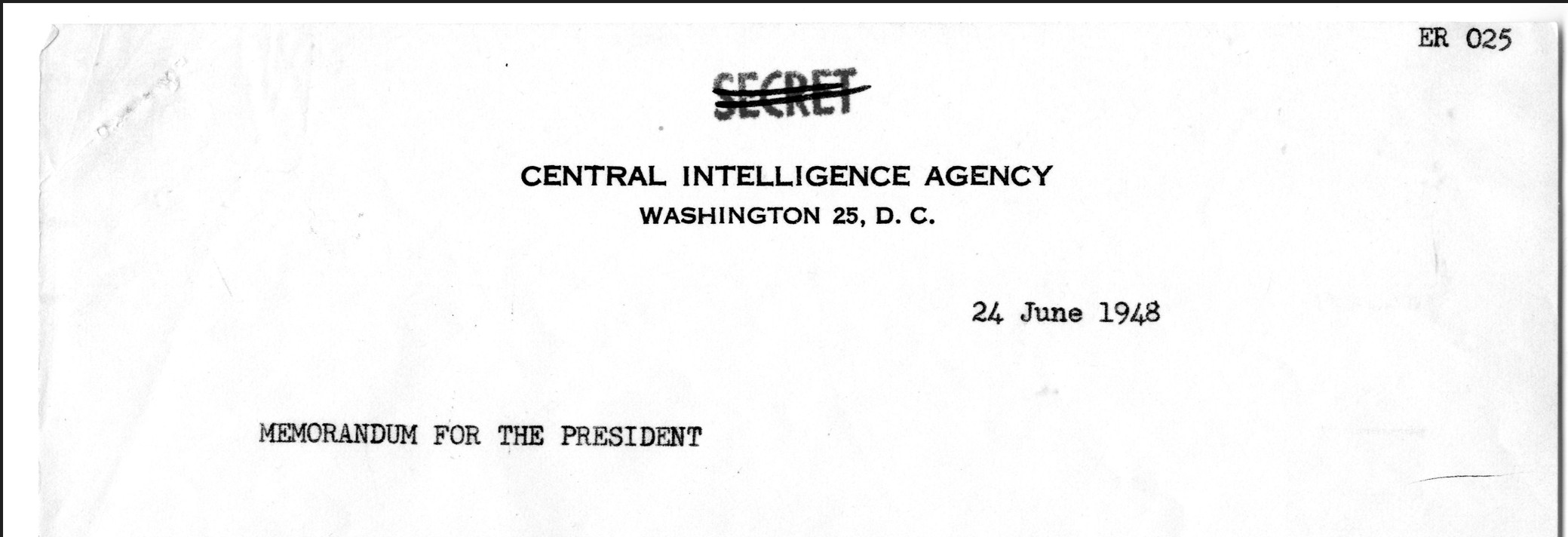
On the morning of June 24, 1948, the Director of Central Intelligence sat down and typed a two-page memorandum to the President of the United States. It was stamped SECRET. It laid out three possible Soviet courses of action in Germany. And it landed on Harry Truman's desk the same day that Joseph Stalin sealed every road, rail line, and canal leading into West Berlin.
Two million civilians. No food coming in. No fuel. No way out by land.
What Truman did next would define the opening chapter of the Cold War.
A City Divided by the Wreckage of War
To understand the Berlin Blockade, you have to understand the strange geography that made it possible.
When World War II ended in 1945, the victorious Allied powers divided defeated Germany into four occupation zones: American, British, French, and Soviet. Berlin, the German capital, was divided the same way, even though the city sat 110 miles deep inside Soviet-controlled eastern Germany. The Western Allies held West Berlin. The Soviets held the east.
The arrangement was always unstable. The Allies never formalized a written guarantee of ground access to Berlin from the west. There was only a verbal agreement between the military commanders. What the Western powers did have in writing was the right to three air corridors connecting West Germany to Berlin, established by the Allied Control Council in November 1945.
That detail would become everything.
From the moment the war ended, the Soviet Union and the Western Allies were pulling Germany in opposite directions. Stalin wanted a weakened, reparations-paying Germany that could never again threaten Soviet security. The United States wanted a rebuilt, democratic Germany that could anchor Western Europe against Soviet expansion. In March 1947, Truman formalized that vision in what became known as the Truman Doctrine, pledging American support to free peoples resisting Soviet pressure. Three months later, Secretary of State George Marshall announced the European Recovery Program, sending billions in aid to rebuild war-torn Europe, Germany included.
Stalin understood exactly what the Marshall Plan meant. If it worked, a prosperous, Western-aligned Germany would rise on his doorstep. He had hoped the United States would withdraw from Europe entirely after the war. Instead, America was digging in.
The Currency That Lit the Fuse
By early 1948, the Western Allies were moving toward a unified West German state. In March, when the Soviets discovered these plans, the Soviet representative walked out of the Allied Control Council, ending four-power cooperation entirely. In June, the Western Allies proceeded with a currency reform the Soviets had opposed and had not been permitted to shape, introducing the Deutsche Mark into their occupation zones and West Berlin. The goal was to stabilize the economy, enable Marshall Plan aid, and break the black market that had consumed the city since the war.
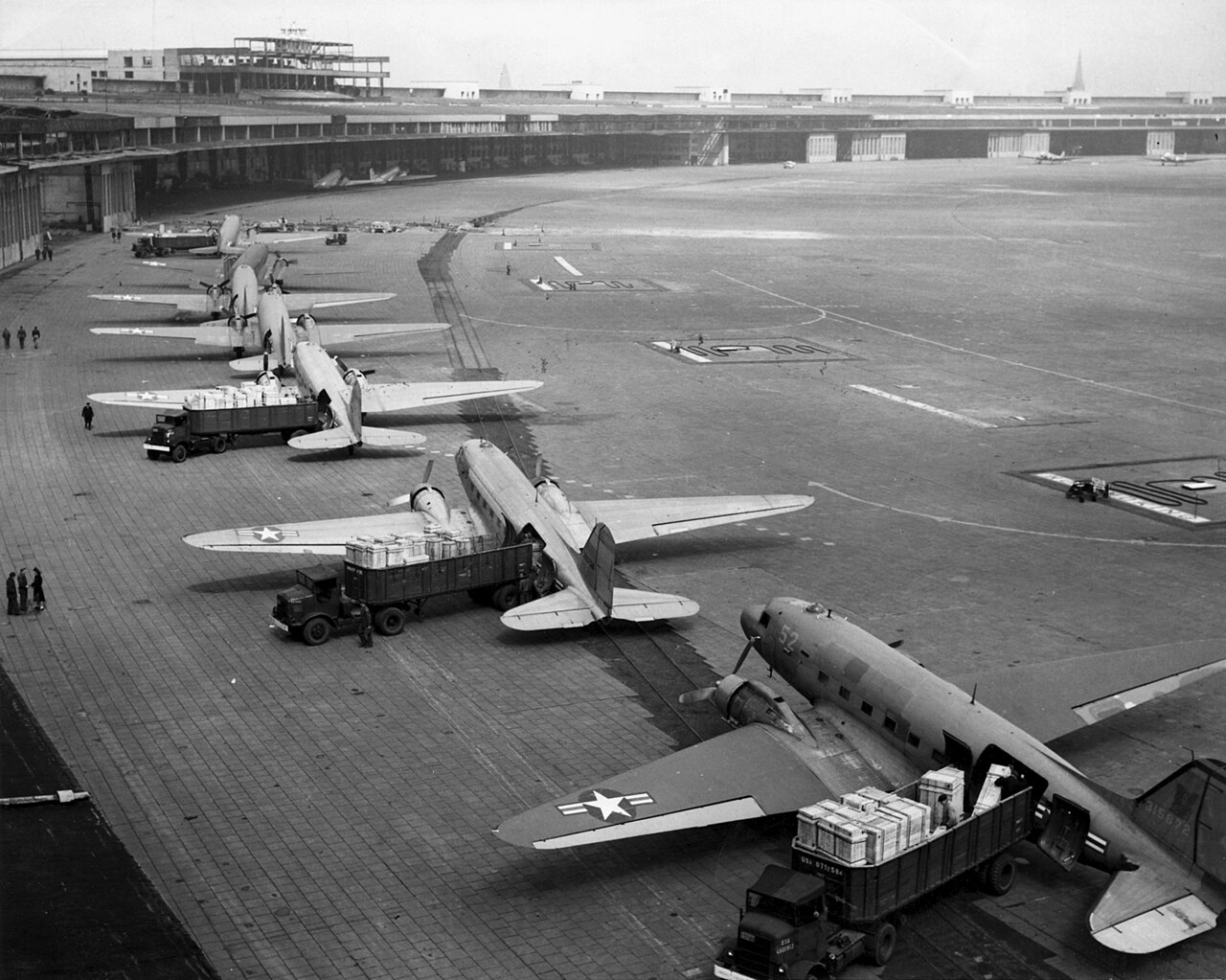 C-47s being loaded at Tempelhof Airport, Berlin, 1948. U.S. Air Force photograph. Public domain.
The Soviets saw it as a provocation. They immediately issued their own currency, the Ostmark, and on June 19 began halting rail and road traffic into Berlin. Soviet guards stopped passenger trains. Freight shipments were delayed. Barges were turned back.
Then, on June 24, 1948, Stalin ordered a full blockade.
Every road. Every railway. Every canal. All of it closed.
The Soviets announced that "technical difficulties" had disrupted rail service and that "severe shortages of electric current" had forced power cuts in the western sectors. Electricity was heavily rationed across the western sectors, with many Berliners receiving only a few hours of power each day. The 2.3 million civilians in the Western sectors had roughly 36 days of food stockpiled. After that, nothing.
The Soviet Military Administration in Germany celebrated. They believed the West had no real option but to abandon the city.
What the CIA Told Truman That Day
The declassified CIA memorandum dated June 24, 1948, signed by Director of Central Intelligence Rear Admiral R.H. Hillenkoetter, was not specifically about the blockade. It was about something that made the blockade make sense.
Hillenkoetter was briefing Truman on a Warsaw conference where Soviet Foreign Minister Molotov had gathered the foreign ministers of the Soviet satellite states. The CIA's conclusion: the USSR was using the meeting to coordinate the formation of an Eastern bloc against a "resurgent Germany" sponsored by the Western powers, announce a provisional East German government to parallel what the West was building, and quietly signal a desire to reopen negotiations, but only on Soviet terms.
The memo did not discuss the blockade itself. But it offered something arguably more valuable: a snapshot of how American intelligence read Soviet strategic intentions at the exact moment the crisis erupted. The CIA believed Stalin was not bluffing but was playing a longer strategic game, trying to prevent Western Germany from solidifying before the Soviets had positioned themselves. Crucially, the memo read Soviet behavior as coercive rather than a prelude to outright war — pressure designed to force Western concessions, not a march toward a third world war. That read mattered enormously for what Truman decided next.
What makes the document striking is not what it says about Berlin specifically. It is that it was written the same day the blockade began, capturing the intelligence community's attempt to read Stalin's mind in real time, before anyone fully understood what had just been set in motion.
Truman's Gamble
The American military position in Berlin was precarious. The Red Army outnumbered Western Allied forces in and around the city by an enormous margin. General Lucius Clay, the American commander in Germany, had written to Washington on June 13, eleven days before the blockade: "There is no practicability in maintaining our position in Berlin and it must not be evaluated on that basis. We are convinced that our remaining in Berlin is essential to our prestige in Germany and in Europe. Whether for good or bad, it has become a symbol of the American intent."
Truman agreed. His response was three words: "We stay in Berlin."
Some advisors wanted to test the blockade by sending an armored convoy down the autobahn. General Curtis LeMay, commander of U.S. Air Forces in Europe, reportedly wanted a more aggressive response involving B-29 bombers and fighter escorts approaching Soviet air bases while ground troops pushed toward the city. Washington rejected both plans.
The administration landed on a third option, one that placed the burden of any escalation squarely on the Soviets. The Western Allies held written rights to three air corridors. If the Soviets shot down unarmed cargo planes carrying food to civilians, the act of aggression would be entirely theirs. The bluff worked because it was not a bluff.
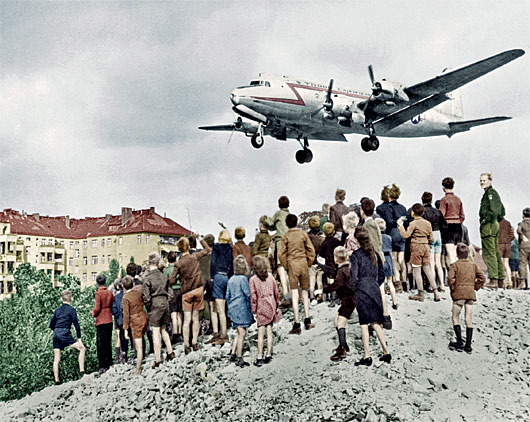
On June 26, 1948, the first American C-47s lifted off for Berlin carrying milk, flour, and medicine. Operation Vittles had begun.
The Impossible Logistics of Feeding a City by Air
No one thought it would work. On July 17, 1948, Assistant Secretary of the Air Force Cornelius Vanderbilt Whitney told the National Security Council that "the Air Staff was firmly convinced the air operation is doomed to failure."
The early numbers supported that pessimism. West Berlin required approximately 4,500 tons of supplies per day to function, rising to more than 8,000 tons in winter once heating coal was factored in. In the first week, the airlift averaged 90 tons a day.
What turned it around was Major General William H. Tunner, a logistics officer who had run the legendary Hump airlift over the Himalayas supplying China during World War II. Tunner took command in late July 1948 and immediately set about rebuilding the operation from the ground up.
He instituted instrument flight rules at all times regardless of visibility, eliminating the dangerous stacking of planes over Berlin during bad weather. He gave each aircraft one approach to land, sending any plane that missed its window back to West Germany and slotting it back into the flow. He banned pilots from leaving their aircraft while in Berlin, equipping jeeps as rolling snack bars to bring food and clearance paperwork directly to the cockpit while the plane was being unloaded. He cut ground turnaround time to 30 minutes. He replaced the smaller C-47s with C-54 Skymasters, which carried 10 tons per flight compared to 3.5.
He called it a conveyor belt. At its peak, a plane landed at Tempelhof Airport every 30 seconds.
The winter of 1948 to 1949 was one of the worst on record. Fog, ice, and near-zero visibility grounded flights and slashed delivery tonnage. Berliners endured heavily rationed coal and food supplies trimmed to survival levels.
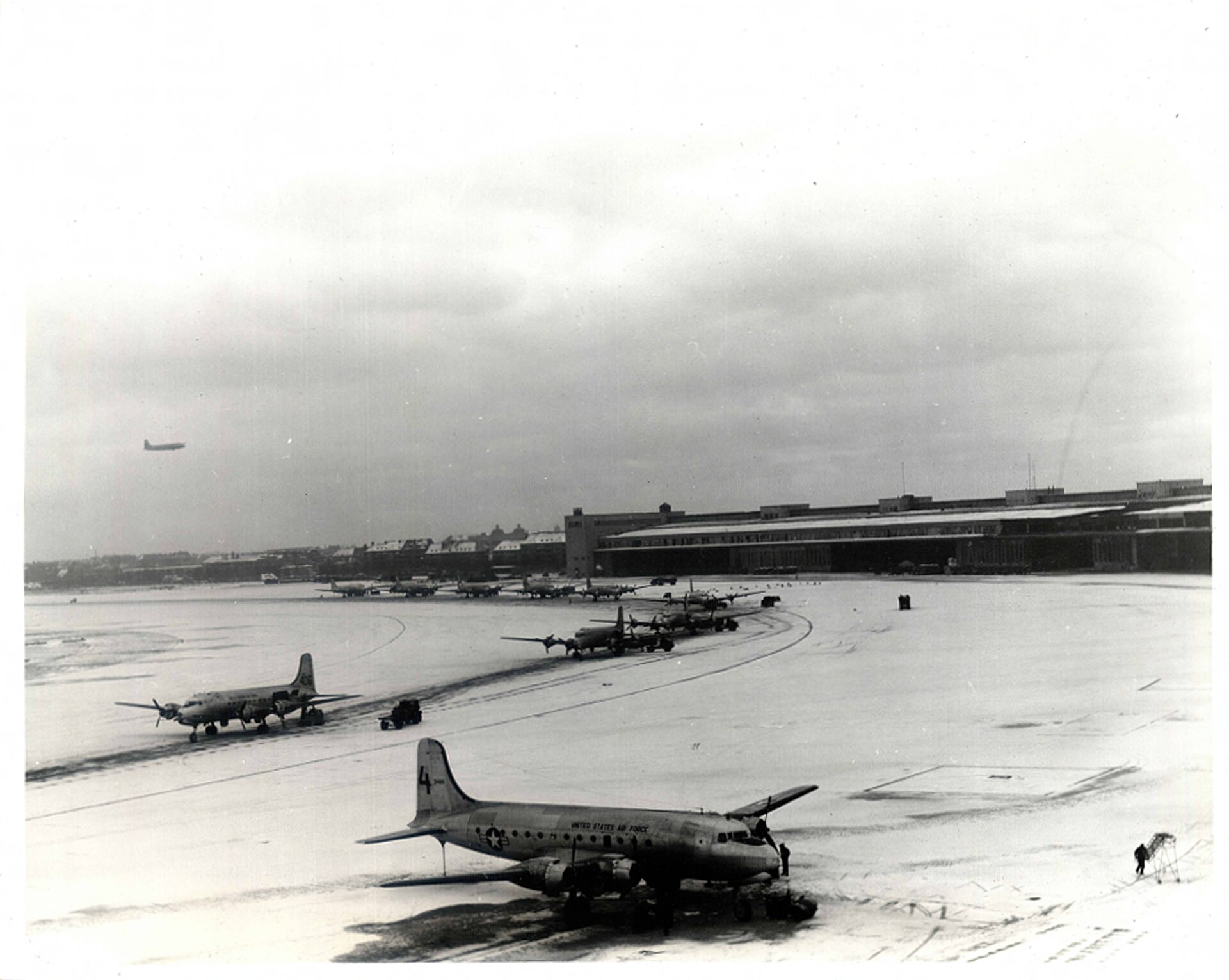 U.S. Air Force C-54s on the Tempelhof ramp during the winter of 1948 to 1949. U.S. Army Corps of Engineers photograph. Public domain.
The Soviets offered free food to anyone who crossed into East Berlin and registered their ration cards there. Fewer than 22,000 of the 2.3 million West Berliners took them up on it.
Inside that bleak winter, one pilot found a different way to fight.
First Lieutenant Gail Halvorsen had flown over to Tempelhof on his day off in July 1948, just to film the operation with his hand-held camera. Walking the fence line, he came across a group of German children watching the planes land. He had two sticks of Wrigley's Doublemint Gum in his pocket. He broke them up and handed out the pieces. The children divided them carefully, some passing around the empty wrapper just to smell it. Before he left, a boy asked how they would know it was him flying over. He said he would wiggle his wings.
The next day he rocked the aircraft on approach and dropped chocolate bars attached to a parachute made from a handkerchief. The day after that, more children were waiting. Then more. Mail started arriving at base ops addressed to "Uncle Wiggly Wings" and "The Chocolate Uncle." When Tunner heard about it, he expanded the gesture into a formal operation called Little Vittles. Other pilots joined in. Candy manufacturers in the United States sent donations. Children across America mailed their own sweets to Germany. In total, more than three tons of candy were dropped over Berlin.
The Soviets had cut the power and closed the roads. An American lieutenant had started dropping chocolate on handkerchief parachutes to children waiting in the rubble below. The propaganda war was over before anyone called it one.
On Easter Sunday, April 16, 1949, Tunner organized what became known as the Easter Parade. Flying around the clock for 24 hours, the airlift delivered 12,941 tons of coal in 1,383 flights without a single accident. It was more than Berlin had ever received by rail in a single day.
By spring 1949, it was clear the blockade had failed on every front. The airlift had not only survived but exceeded rail delivery records. West Berliners had refused to break. The Allied counter-blockade was strangling East German industry. Diplomatic negotiations were underway. On May 12, 1949, the blockade was lifted.
What It Cost, and What It Built
The numbers are staggering. American and British aircraft flew 278,228 flights over 15 months, delivering 2.3 million tons of supplies, nearly two-thirds of it coal. American C-47s and C-54s alone flew more than 92 million miles, roughly the distance from Earth to the Sun. The operation cost between $224 million and $500 million, equivalent to several billion dollars today. A total of 101 people died during the airlift, mostly in flying accidents, including 31 Americans and 40 British crew members.
But the strategic consequences dwarfed the operational ones.
Shortly before the blockade ended, the Western Allies signed the treaty establishing NATO. Two weeks after it ended, the Federal Republic of West Germany was formally established. Stalin's blockade, intended to prevent a unified Western Germany, had accelerated its creation and driven West Germany directly into an American-led military alliance.
West Berlin remained under Allied protection, a democratic island inside communist East Germany, for another 40 years.
General Clay returned home to a ticker-tape parade in New York City, an address to Congress, and a personal medal from Truman. Ernst Reuter, the mayor of West Berlin who had addressed the crowd of 300,000 at the Brandenburg Gate during the crisis, became a symbol of resistance that echoed across the continent.
The CIA, still only a year old as an agency, had been watching all of it, briefing the president in classified memoranda, trying to read a Soviet government whose intentions remained, as Hillenkoetter had written that June morning, something that "warranted explanation."
Soviet officials publicly justified the blockade as a response to the Western currency reform and alleged violations of four-power agreements. Historians generally view those explanations as pretexts. Stalin lifted the blockade when it stopped working and said nothing more.
The air corridors that saved Berlin had never been shut. They had simply never mattered before.