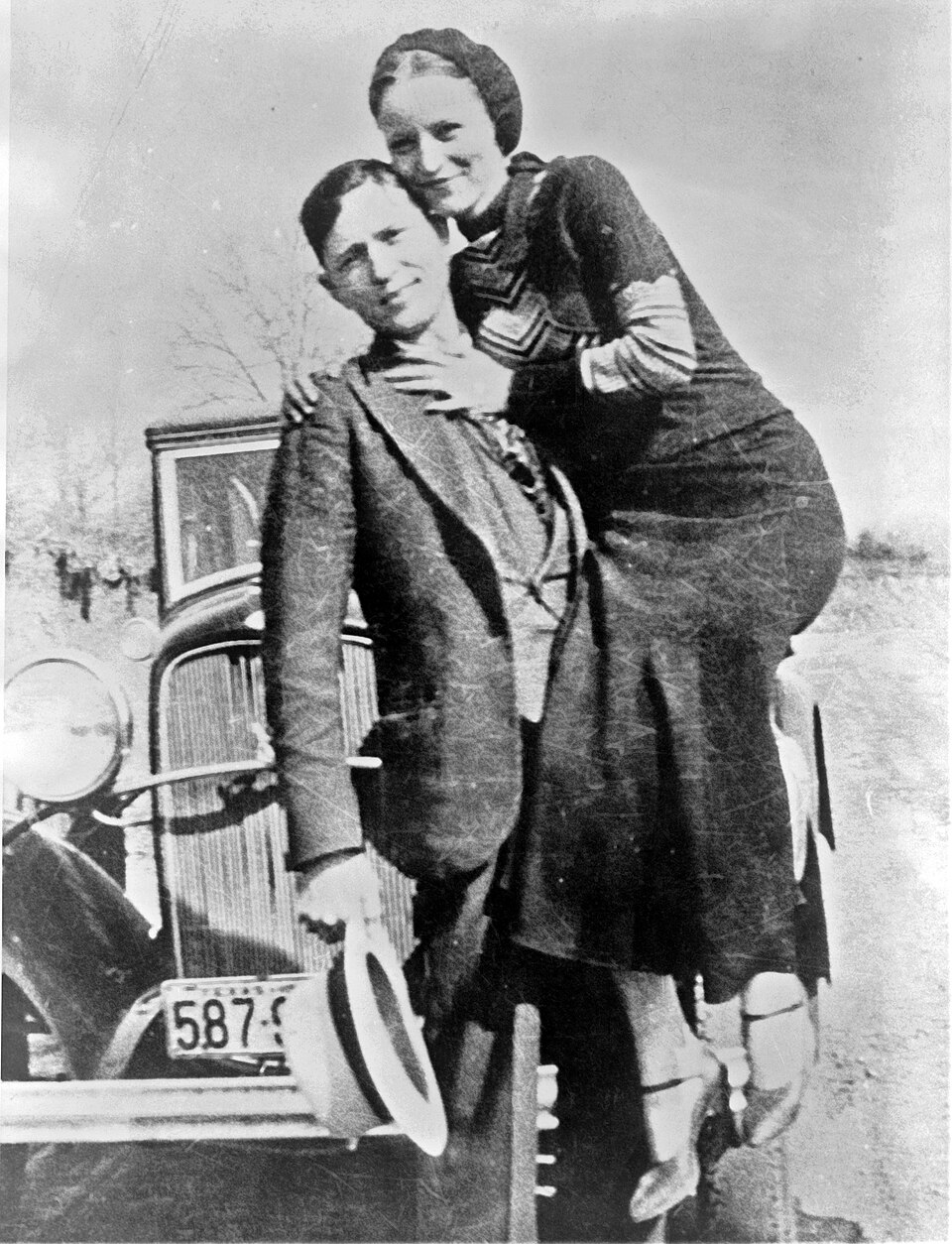
Bonnie Parker was eating a sandwich.
That is what the coroner noted. Food still in her mouth. She never saw it coming and never had the chance to swallow.
It was 9:15 in the morning on May 23, 1934, on a remote stretch of Louisiana State Highway 154 in Bienville Parish. A stolen tan Ford V8 came around a bend and slowed near a parked truck. Six men hidden in the brush alongside the road stood up and opened fire simultaneously.
They fired approximately 130 rounds in about fifteen seconds.
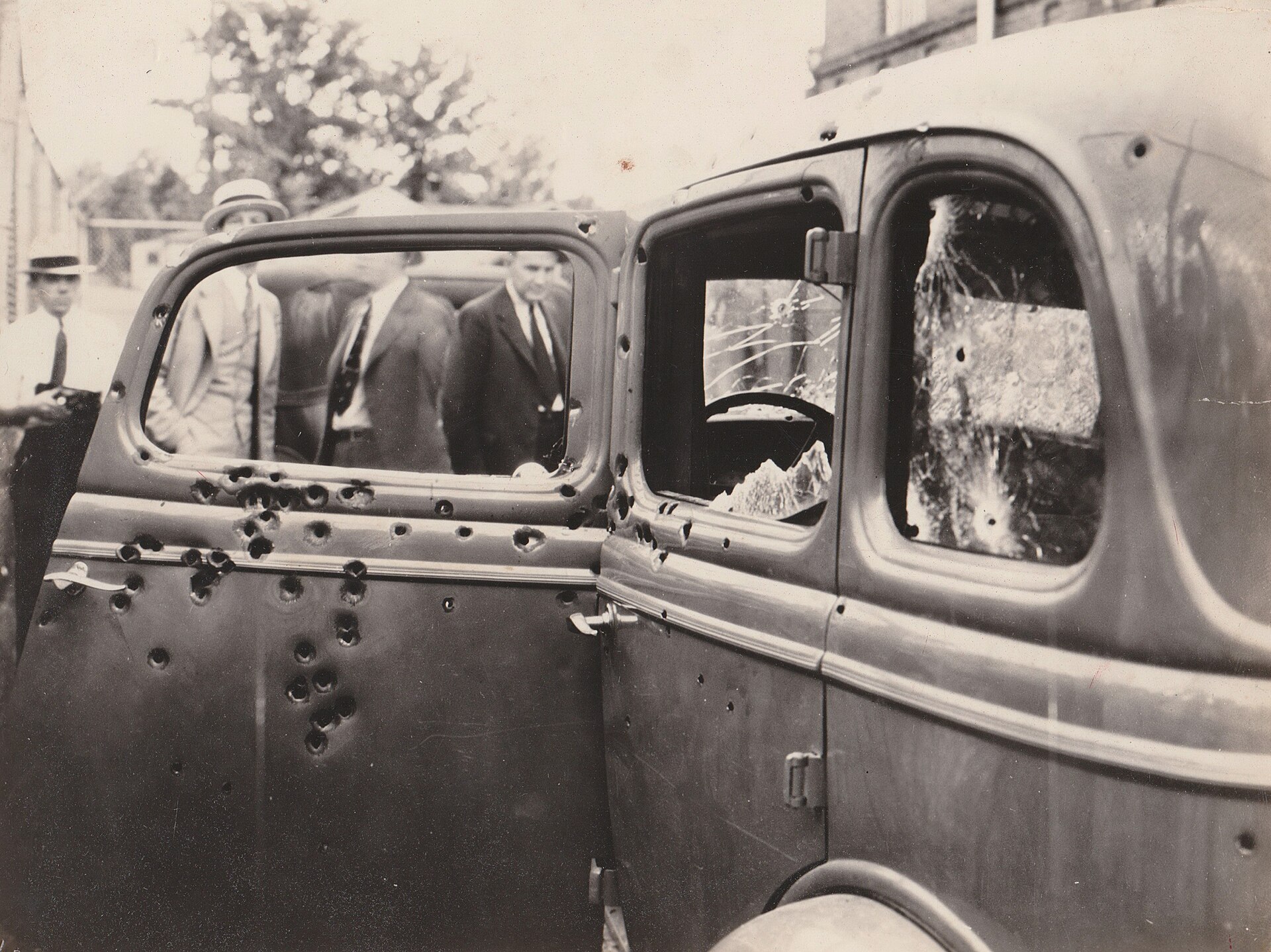
When it was over, Clyde Barrow was dead with seventeen bullet wounds. Bonnie Parker had twenty-six entrance wounds. The coroner noted that any number of them would have been fatal on their own. The car had so many holes in it that the local undertaker later said he had trouble embalming the bodies because of all the places the blood was escaping. The two most wanted criminals in America were slumped in their seats on a dirt road in the middle of nowhere, and it was all over before most people in the surrounding area even heard the shots.
It had taken two years to get to that road.
Clyde Barrow grew up in the dirt-poor West Dallas neighborhood his family reached so broke they spent their first months living under their wagon. He was barely seventeen when he was first arrested and twenty-one when he arrived at Eastham Prison Farm in Texas, a place so brutal it finished men before they left. He was sexually assaulted while there and retaliated by crushing his attacker's skull with a pipe. Another inmate serving a life sentence claimed responsibility. In late January 1932, facing more hard labor in the fields, Clyde deliberately had two of his toes amputated to get out of field work. Six days later, without his knowledge, his mother's petition for his parole was granted and he walked free. He limped for the rest of his short life.
His sister Marie said afterward: "Something awful sure must have happened to him in prison because he wasn't the same person when he got out." A fellow inmate put it more directly. He said he watched Clyde change from a schoolboy into a rattlesnake.
Bonnie Parker was nineteen years old and working as a waitress in Dallas when she met Clyde in January 1930. She was five feet tall, weighed ninety pounds and was technically still married, though her husband was serving a life sentence for murder. She was also a poet. She wrote ballads. One of them, written while she and Clyde were still alive and on the run, predicted their deaths with uncomfortable accuracy.
She was not supposed to be a killer. But she was.
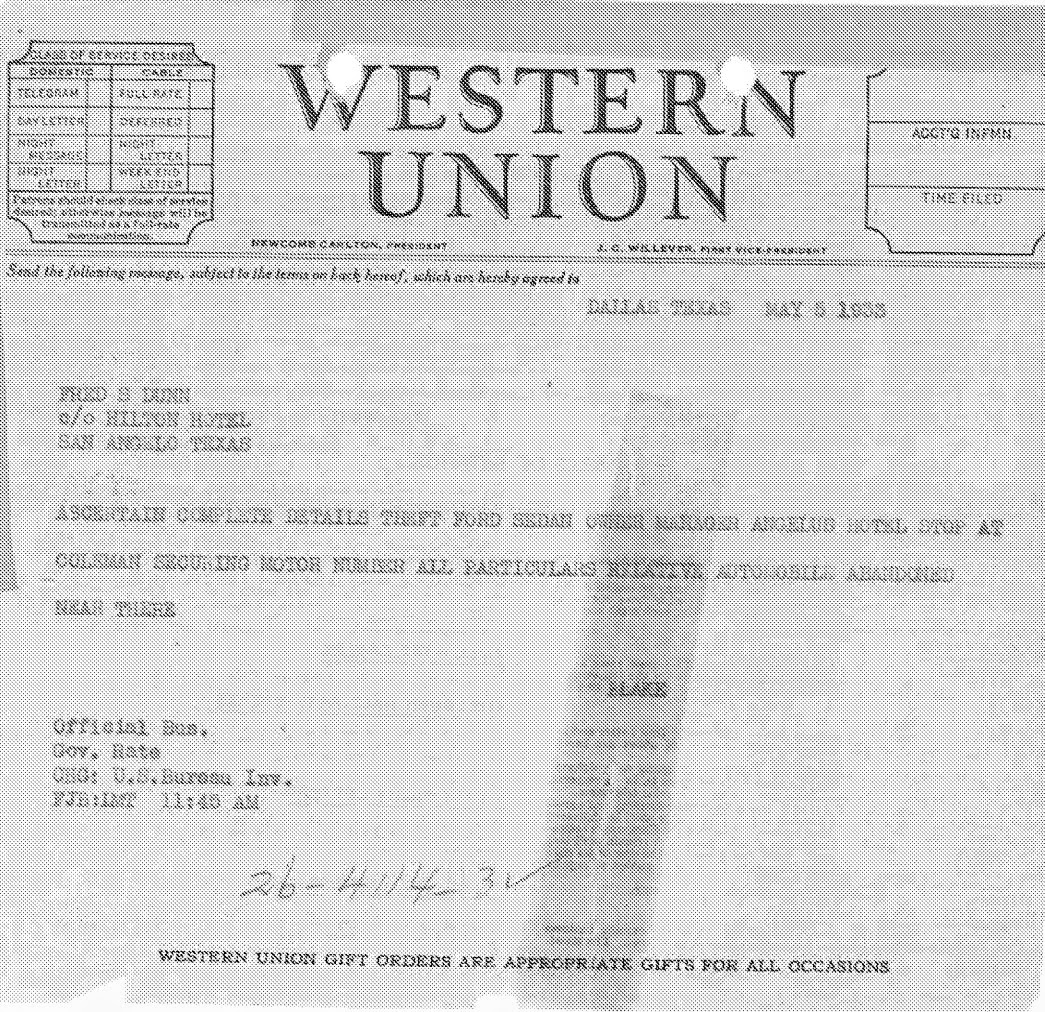
Over the course of their two years together the Barrow Gang killed at least twelve people, nine of them law enforcement officers. They robbed banks, grocery stores and gas stations across Texas, Oklahoma, Missouri and Louisiana. They broke into National Guard armories and stole automatic weapons. They kidnapped police officers and left them handcuffed to trees miles from where they had been taken. They stole so many cars that the U.S. Bureau of Investigation, which would become the FBI, opened a federal case against them under the National Motor Vehicle Theft Act. That telegram is what you are looking at in the document above. Dallas, Texas. May 8, 1933. A Bureau agent ordering a colleague to trace a stolen Ford sedan connected to the Barrow Gang. They had been hunting them for over a year at that point and would hunt them for another year before the road in Bienville Parish.
The man who finally cornered them was Frank Hamer, a legendary Texas Ranger pulled out of retirement specifically to track Barrow. Hamer was officially credited with 53 kills and had survived seventeen wounds of his own. Three of his four brothers were also Texas Rangers. Starting on February 10, 1934, he became the constant shadow of Barrow and Parker, living out of his car, just a town or two behind them.
Hamer spent 102 days mapping the gang's movements across five states. He determined that Barrow drove in wide loops skirting state lines, exploiting the rule that prevented officers from pursuing a fugitive across jurisdictions. He charted the pattern and predicted that the gang would eventually return to Louisiana to visit the family of gang member Henry Methvin. What Hamer did not know was that Methvin had already made a deal. His father Ivy agreed to cooperate with the posse in exchange for his son's protection from prosecution.
On the morning of May 23, six lawmen had been lying in the brush alongside Highway 154 since the night before. They had waited through all of May 22 with no sign of the car. By 9:15 the next morning they were nearly ready to give up.
Then they heard the Ford coming.
Ivy Methvin's truck was parked on the shoulder of the road as bait. Barrow slowed as he approached it. Prentiss Oakley, one of the Louisiana officers, stood up and fired before anyone gave an order. Barrow was shot through the head on Oakley's first bullet and died instantly. Hinton reported hearing Bonnie scream. Then all six men opened up at once.
Their official account states: "Each of us six officers had a shotgun and an automatic rifle and pistols. We opened fire with the automatic rifles. They were emptied before the car got even with us. Then we used shotguns. There was smoke coming from the car, and it looked like it was on fire. After shooting the shotguns, we emptied the pistols at the car, which had passed us and ran into a ditch about 50 yards on down the road. We kept shooting at the car even after it stopped. We weren't taking any chances."
The car rolled forward about fifty yards before it came to rest in a ditch. Neither Bonnie nor Clyde had fired a single shot in return.
When the lawmen approached the vehicle they found three automatic rifles, sawed-off shotguns, assorted handguns, several thousand rounds of ammunition, fifteen sets of license plates from various states and a saxophone that Clyde had been learning to play.
What happened next says as much about America in 1934 as anything else.
Word spread through the surrounding parishes within hours. The town of Arcadia swelled from 2,000 to an estimated 12,000 people as curious crowds arrived by carriage, horseback, plane and train. Sandwiches sold out immediately. The price of beer jumped from fifteen cents a bottle to twenty-five cents. A woman cut off locks of Bonnie's hair and pieces of her dress and sold them as souvenirs. One man opened his pocket knife and reached into the car to cut off Clyde's left ear. Another was caught trying to remove his trigger finger.
They had killed at least twelve people. They had terrorized five states for two years. And America could not get enough of them.
The Depression had made bank robbers into folk heroes for a generation of Americans who had watched banks foreclose on their homes and farms and had no sympathy left for financial institutions. Letters arrived at the Barrow family home for years after the ambush, from strangers who wrote that they were sorry.
Hamer was asked many times in the years that followed whether he felt anything about shooting a woman. He said: "I hate to bust the cap on a woman, especially when she was sitting down. However, if it wouldn't have been her, it would have been us."
Six weeks before the ambush, on April 10, 1934, Clyde had written a letter from Tulsa, Oklahoma, to Henry Ford. It read in part: "While I still have got breath in my lungs I will tell you what a dandy car you make. I have drove Fords exclusively when I could get away with one. For sustained speed and freedom from trouble the Ford has got every other car skinned and even if my business hasn't been strictly legal it don't hurt anything to tell you what a fine car you got in the V-8."
The Ford with 130 bullet holes in it is still on display today at the Primm Valley Resort in Primm, Nevada.
Alcorn claimed the saxophone from the scene. He eventually returned it to the Barrow family.
The FBI investigation file linked above documents the federal manhunt that preceded the ambush, including telegrams from Bureau agents tracking stolen vehicles connected to the Barrow Gang across multiple states. The file is a paper trail of a country trying to catch two people it could not stop talking about.