On May 24, 1883, President Chester Arthur walked across the Brooklyn Bridge and declared it one of the greatest achievements in human history. He was right. What he did not know was that the cables holding him up had been deliberately weakened by a contractor who had pocketed $300,000 in fraud and was never charged with a single crime.
That is the story of the Brooklyn Bridge that nobody tells at the opening ceremony.
The bridge took thirteen years to build and cost $15.5 million, roughly $518 million in today's dollars. The bonds used to fund it were not paid off until 1956, seventy-three years after the ribbon was cut. An estimated twenty-seven men died during construction. On the day it opened, 150,300 people crossed it. Six days later, a woman stumbled on a stairway at the Brooklyn approach, triggered a stampede, and at least twelve people were crushed to death.
The project had been born in corruption and it would be touched by fraud before it was finished.
The man who got the bridge built was not an engineer. He was a politician. William M. Boss Tweed, the head of Tammany Hall and the most powerful political figure in New York City, backed the bridge project from its earliest days. According to sworn testimony he later gave, he paid $65,000 in bribes to New York aldermen to secure their votes for a $1.5 million bond issue to fund construction. He then became a major holder of bridge stock and joined the committee overseeing the project's finances, positioning himself to skim from its contracts just as he had done with every other major public works project in the city.
Tweed had already stolen an estimated $45 million from the public during his time in power, and perhaps as much as $200 million. The New York County Courthouse, which was supposed to cost $250,000, ultimately cost the city over $13 million. Contractors billed wildly for shoddy work while the Tweed Ring took its cut at every turn.
He intended to do the same with the bridge. He was arrested in 1871 before he could fully execute the plan. He died in jail in 1878. But the corruption he had set in motion did not die with him.
The chief engineer of the Brooklyn Bridge was John Augustus Roebling, a German immigrant who had spent decades designing and building suspension bridges and who considered this project the defining work of his life. In June 1869, while conducting final surveys for the bridge, a ferry pinned his foot against a piling at the Fulton Ferry dock. His toes were amputated. He developed a tetanus infection and was dead within weeks, before construction had even properly begun.
His son Washington Roebling, thirty-two years old, took over as chief engineer. Washington would not fare much better. Working in the underwater caissons where the towers' foundations were being laid, he developed decompression sickness, a condition so new that the project's own physician, Dr. Andrew Smith, coined the term caisson disease to describe it. Between January and May of 1872, Smith treated 110 cases of the illness among the bridge workers. Three men died from it. Washington Roebling was left partially paralyzed.
He directed the completion of the bridge through a telescope from his bedroom window.
The person who actually ran the construction site for the next eleven years was Washington's wife, Emily Warren Roebling. She understood mathematics, the calculation of catenary curves, the strengths of materials, bridge specifications, and the intricacies of cable construction. She handled the day-to-day supervision and project management, communicated between her bedridden husband and the engineers on site, and became the primary liaison between the Roebling family and the bridge trustees. When the bridge opened on May 24, 1883, Emily Warren Roebling was officially the first person to cross it.
Washington Roebling was too ill to attend the ceremony.
By 1876 the bridge had depleted its original $5 million budget. The trustees petitioned the state legislature for another $8 million. In January 1877 a contract for the bridge's crucial steel cables was awarded to a man named J. Lloyd Haigh. He was associated with bridge trustee Abram Hewitt. Washington Roebling had distrusted him from the beginning.
His distrust was warranted.
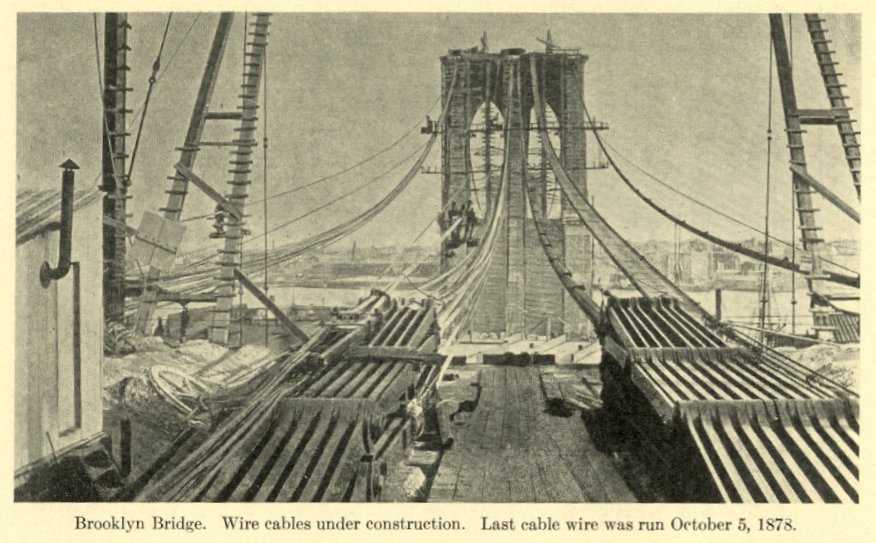
As the cables were being spun, Haigh substituted inferior quality wire for the steel that had been specified in the contract. The fraud went on for months. When Roebling's assistant engineers finally conducted a proper sampling of the wire, testing eighty rings, only five met the required standards. Haigh had earned an estimated $300,000 from the substitution.
By the time the fraud was discovered it was too late to replace the cables already constructed. Roebling determined that the inferior wire had left the bridge only four times as strong as necessary rather than the six to eight times he had originally designed for. To compensate, 150 additional wires were added to each cable.
Haigh was not fired. He was not prosecuted. He was required to personally pay for the extra higher-quality wire needed to make up the difference. The decision to keep the fraud quiet was made to avoid public controversy. The cables went into the bridge. The bridge opened on schedule. The president crossed it and called it a triumph.
The bonds were not paid off for seventy-three years. The original suspender cables installed by Haigh were not replaced until 1986, over a century after they were fraudulently installed. By 1980 the bridge was in such deteriorating condition that it faced imminent closure. In some places half the strands in the cables were broken. In June 1981 two of the diagonal stay cables snapped, killing a pedestrian.
On opening day the crowd was so large that both the mayor of New York and the mayor of Brooklyn were present, along with the President of the United States. Abram Hewitt, the same trustee who had directed the cable contract to the man who would defraud the project, gave the principal address. He described the bridge as a work of art that would outlast every other achievement of the age.
Washington Roebling, who had spent eleven years directing its construction through a telescope from his bedroom and had watched a fraudulent contractor weaken his cables while the trustees looked the other way, held a small celebratory banquet at his house and rarely visited the site again.
Emily Warren Roebling crossed the bridge on opening day with a rooster in her lap, a symbol of victory. Her name did not appear on the official dedication plaque. The plaque named her husband, her father-in-law, and the trustees.
The bridge stood for 143 years and counting. It cost twenty-seven lives, $15.5 million, seventy-three years of bond payments, and one family's health to build. A contractor stole $300,000 from it and walked free. The president called it a triumph.
He was not wrong. It just depended on whose story you were telling.
Washington Roebling's 1877 report to the trustees of the New York and Brooklyn Bridge, written during the height of the cable spinning operation and before the Haigh fraud was fully uncovered, is linked above. It is one of the most remarkable engineering documents in American history.