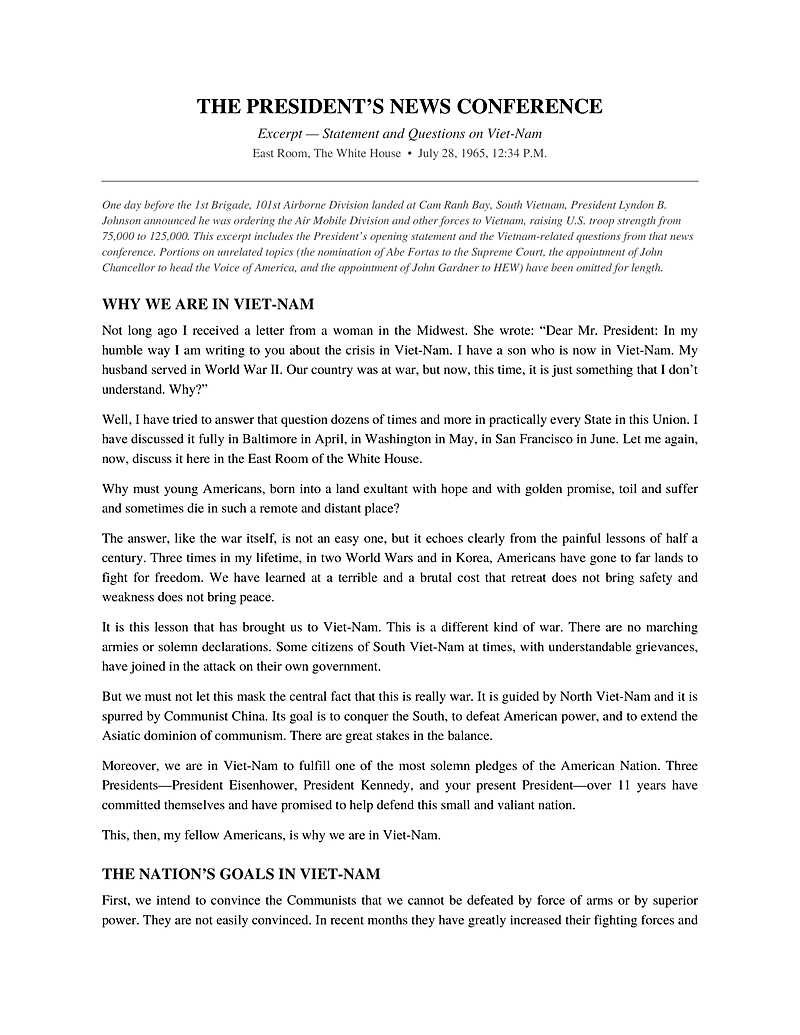
On July 28, 1965, President Lyndon Johnson stood in the East Room of the White House and told the country he had made a decision. General William Westmoreland had asked for more men to meet the mounting aggression in South Vietnam, and Johnson had agreed to send them. "I have today ordered to Viet-Nam the Air Mobile Division and certain other forces," he said, raising American troop strength from 75,000 to 125,000.
The next morning, roughly 4,000 paratroopers climbed down the side of a troopship at Cam Ranh Bay. To anyone reading the newspapers that week, the timing looked unmistakable. The president gives the order, the soldiers arrive a day later.
It is a tidy story, and it is not quite the right one.
Wrong Division, Old Orders
The men who landed at Cam Ranh Bay on July 29 belonged to the 1st Brigade, 101st Airborne Division, the famous Screaming Eagles of Normandy and Bastogne. They were not the Air Mobile Division Johnson had just named. That unit was the 1st Cavalry Division (Airmobile), a newly reorganized helicopter formation that would not leave American shores until mid-August and would not reach Vietnam until September, more than a month after Johnson's speech.
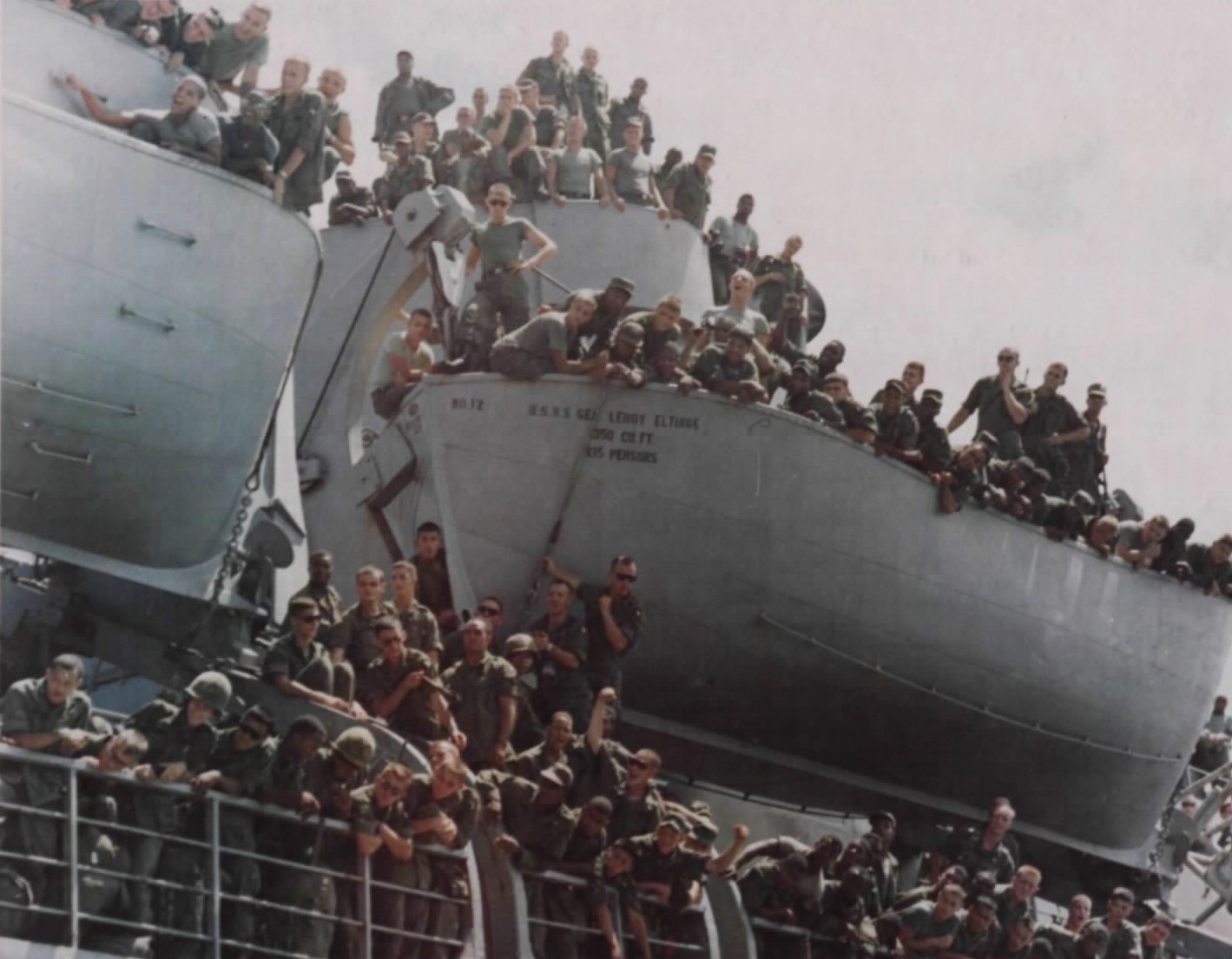
The 101st's movement, meanwhile, had nothing to do with the July 28 announcement. According to the Army's own official history of the buildup, the 1st Brigade had been moving from Fort Campbell, Kentucky to Vietnam since July 6, three weeks before Johnson spoke. The troopship carrying most of the brigade, the USNS General LeRoy Eltinge, left port on July 9 with roughly 3,600 soldiers packed aboard a vessel built to carry far fewer, and reportedly lost an engine for a day somewhere in the Pacific. The brigade's deployment had been decided and set in motion earlier that summer, well before the president stood up to announce a different division's orders on television.
The overlap was a coincidence of scheduling, not a fast response to a speech. It is an easy mistake to make, since the two stories, a famous presidential order and a division landing the next day, fit together so naturally that generations of retellings have quietly merged them into one.
What Actually Happened at the Rail
None of that made the arrival any less real for the men living it. Both Westmoreland and the outgoing American ambassador to South Vietnam, Maxwell Taylor, had commanded the 101st earlier in their careers, and both were on hand at Cam Ranh Bay as the brigade came ashore. A demonstration jump was staged as part of the arrival ceremonies, a deliberate bit of theater meant to reassure Saigon and Washington that a serious, storied division had joined the war.
What came ashore was the 1st and 2nd Battalions of the 327th Infantry and the 2nd Battalion of the 502nd Infantry, along with the 2nd Battalion of the 320th Field Artillery, a cavalry troop, and the engineer, medical, and signal units that kept a brigade moving. It was the third major American Army combat unit to reach Vietnam that year, after the 173rd Airborne Brigade in May and a brigade of the 1st Infantry Division earlier in July. The rest of the 101st, roughly two more brigades, would not follow for another two and a half years.
The Nomads of Vietnam
Operating alone, the brigade earned a nickname of its own: the Nomads of Vietnam. Rather than settling into one tactical zone the way most divisions did, it moved wherever the fighting was heaviest, eventually operating across most of the country from the Central Highlands to the coastal lowlands.
The cost of that arrangement showed itself within weeks of the brigade reaching its new base at An Khe. In September 1965, as part of a mission to secure the area ahead of the 1st Cavalry Division's arrival, the 2nd Battalion, 502nd Infantry helicoptered into a landing zone near the hamlet of An Ninh in what was code-named Operation Gibraltar. American forces came under heavy fire almost immediately, and the fight that followed, September 18 and 19, cost 13 American lives. Westmoreland later called it a clear victory. Some of the officers who fought it did not agree. Major J.C.W. Dyke of the 101st and Lieutenant Colonel David Hackworth both argued afterward that the landing zone had dropped troops into the middle of a Viet Cong training camp nobody had detected, and that the operation had been closer to a disaster than a triumph. Historians have never fully settled which account is more accurate.
It was the kind of contested outcome the brigade would see again and again over the next two years, in a string of engagements across the Central Highlands that rarely made front pages back home but steadily built its reputation among the North Vietnamese units it kept running into.
What the Nickname Actually Meant
That reputation produced an odd footnote. Vietnamese soldiers had little if any exposure to bald eagles, and the black and gold eagle patch worn by the 101st did not automatically read as a bird of prey to men unfamiliar with the species. According to American veterans and division histories, North Vietnamese and Viet Cong troops came to call them the Chicken Men, and stories circulated among American units that enemy officers warned their soldiers not to take the Chicken Men lightly.
Most American units in Vietnam eventually adopted subdued black and olive drab insignia to avoid standing out in the field. The 101st was not the only division to resist the change, but by its own internal policy it kept wearing the full-color gold and black eagle patch throughout the war, a point of stubborn pride the division shared with a handful of other storied units, including the 82nd Airborne.
Seven Years, One Valley, Two Names
The 101st's full commitment to Vietnam did not begin until December 1967, when the remaining brigades arrived at Bien Hoa in an operation called Eagle Thrust and the 1st Brigade rejoined its parent division. From there the 101st fought through the Tet Offensive and the battle for Hue, then spent much of the war's final years pushing into the A Shau Valley along the Laotian border, the route North Vietnamese forces used to move men and supplies south. That campaign produced the division's most controversial and costly battle, the assault on Hill 937 in May 1969, which American soldiers nicknamed Hamburger Hill for what the fighting did to the units that took it. The hill was abandoned soon after it was captured, a decision that led many critics to question what the battle had actually accomplished, a debate historians have never fully resolved.
By the time the last elements of the 101st left Vietnam in early 1972, the division that had waded ashore at Cam Ranh Bay as a single brigade had spent nearly seven years in the country, longer than any other Army division. According to division histories, it suffered 4,011 killed and 18,259 wounded over the course of the war. Seventeen of its soldiers earned the Medal of Honor in Vietnam, a number matched by few other American units in any conflict.
None of that was visible yet on the morning of July 29, 1965. What the photographs from that day show is simpler: a troopship easing into an unfamiliar harbor, and several thousand young men leaning over the rails to get their first look at a country where so much of that history, and a great deal of confusion about how they got there, was still waiting to happen.