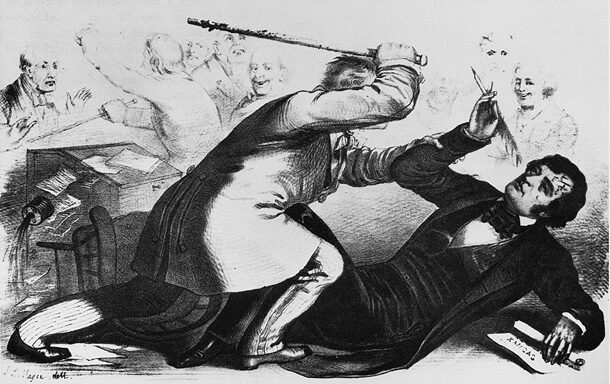
On the afternoon of May 22, 1856, the Senate chamber had nearly emptied following adjournment. Senator Charles Sumner of Massachusetts sat at his desk, bent over paperwork, unaware that Representative Preston Brooks of South Carolina had entered the room and was waiting for the galleries to clear.
Brooks had been particularly concerned that no women be present to witness what he was about to do.
When the room was quiet enough, he approached. "Mr. Sumner," he said in a low voice, "I have read your speech twice over carefully. It is a libel on South Carolina, and Mr. Butler, who is a relative of mine."
Before Sumner could rise from his chair, Brooks raised a thick gutta-percha cane with a gold head and brought it down across Sumner's skull.
He did not stop.
Two days earlier, on May 19 and 20, Sumner had delivered a five-hour address on the Senate floor that he called "The Crime Against Kansas." It was not a measured speech. It was a prosecution. Sumner targeted the Kansas-Nebraska Act and went after its authors by name, including Senator Andrew Butler of South Carolina, who was absent from Washington at the time. He mocked Butler's speech, which had been slowed by a recent stroke, and compared Butler's devotion to slavery to a knight's devotion to a mistress, one that was, in his words, "polluted in the sight of the world."
Senator Stephen Douglas, sitting nearby during the speech, reportedly muttered: "This damn fool is going to get himself killed by some other damn fool."
He was nearly right.
Preston Brooks was Butler's first cousin once removed. He was a former military officer who took Southern honor with absolute seriousness. Sumner's speech, in his view, was not political disagreement. It was a public humiliation of his kinsman and his state, delivered on the floor of the United States Senate. Brooks initially considered a duel, but his colleague Representative Laurence Keitt advised against it. Dueling was reserved for men of equal social standing, Keitt reasoned. A beating, public, deliberate, and humiliating, was more appropriate.
Brooks planned it carefully. He and Keitt entered the Senate chamber after adjournment with Representative Henry Edmundson of Virginia and waited for the room to clear.
When it did, he moved.
The eyewitness account of Colonel Jos. H. Nicholson, recorded in the Senate's official investigation six days later, is one of the most vivid documents in Congressional history. Nicholson had been in the chamber and had exchanged pleasantries with Brooks just moments before the attack, unaware that Brooks was watching the lobby and waiting for a woman to leave before he acted. Once Sumner was alone at his desk, Brooks struck without warning. Nicholson counted ten to twelve blows before the cane shattered. Sumner, trapped beneath his desk which was bolted to the floor, could not stand. He ripped the desk from its fastenings trying to get free. By the time he staggered upright he was blinded by his own blood, arms outstretched, stumbling down the aisle.
Brooks did not stop when the cane broke. He continued beating Sumner with the piece that held the gold head.
Keitt stood nearby and shouted at onlookers to stay back. Senator John Crittenden tried to intervene, pleading with Brooks not to kill Sumner. It was not until two other representatives physically restrained Brooks that the attack ended. Sumner collapsed near Senator Collamer's desk, unconscious and soaked in blood.
Brooks left the chamber quietly.
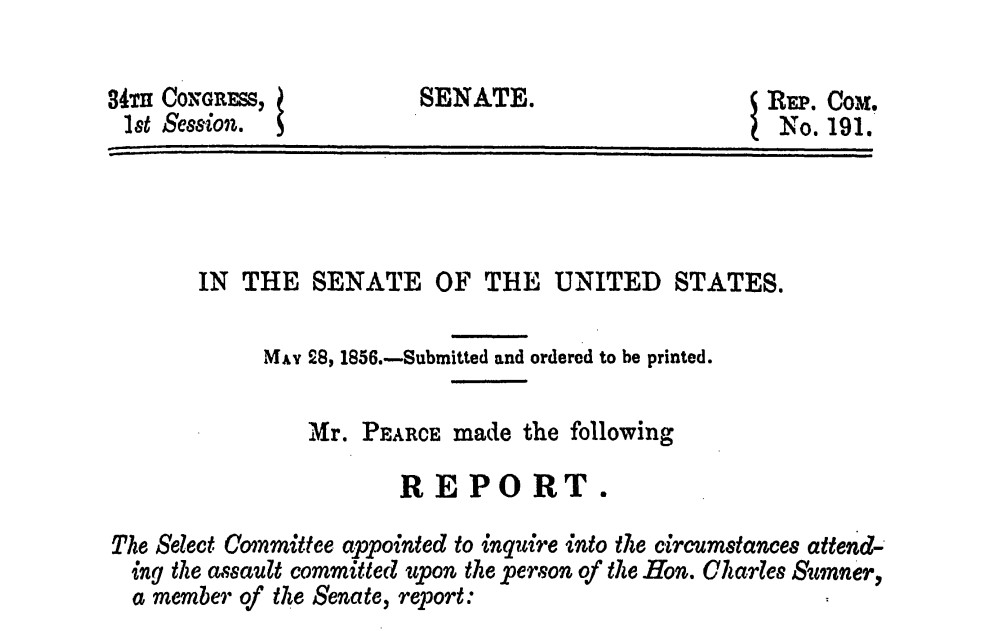
The Senate convened a Select Committee to investigate. Their report, submitted just six days after the attack, includes sworn eyewitness testimony and Brooks' own account of the assault, delivered through Governor A.G. Brown of Mississippi. Brooks described planning the attack the moment Sumner's speech was delivered. He stopped, he said, simply because he had punished Sumner to his satisfaction.
The committee concluded that the assault was a clear breach of Senate privilege and that the Senate could do nothing about it. Brooks was a House member. Under parliamentary law, only the House could discipline its own. The matter was referred. The motion to expel Brooks failed to reach the required two-thirds majority.
Brooks resigned voluntarily on July 15, 1856, to allow his constituents to render their own verdict.
They returned him to office within weeks.
The country's reaction revealed something that no speech or legislation had yet made fully visible. The North and South were not one nation disagreeing about policy. They were two nations sharing a government, with irreconcilable ideas about what kind of country they were living in. Thousands attended rallies in support of Sumner in Boston, New York, Cleveland, Detroit, and Providence. More than a million copies of his speech were distributed. Massachusetts refused to replace him in the Senate. His empty desk sat in the chamber for three years as a visible accusation, while Sumner recovered from head trauma that doctors today recognize as consistent with traumatic brain injury and post-traumatic stress disorder.
In the South, Brooks was a hero. The Richmond Enquirer called the attack "good in conception, better in execution, and best of all in consequences," and suggested Sumner should be caned every morning. Admirers from across the South mailed Brooks hundreds of new canes. One arrived inscribed with three words: Hit him again. Southern lawmakers collected the fragments of the shattered cane from the blood-soaked Senate floor and had them made into rings, which they wore on chains around their necks.
Keitt was censured by the House. His constituents re-elected him within a month.
Brooks was re-elected to a full new term in the fall of 1856. He died of croup in January 1857 before the new term began.
No United States congressman has beaten a colleague on the floor of Congress since Brooks walked out of that chamber. That particular threshold has held. But the conditions that produced the caning are not historical artifacts. The dehumanization of political opponents, the belief that the other side represents not a different opinion but an existential threat, the willingness to abandon institutional norms when the cause feels urgent enough. These are present tense.
A congressman was shot on a baseball field in 2017. A former president survived an assassination attempt in 2024. The husband of the Speaker of the House was attacked with a hammer in their home. Members of Congress on both sides of the aisle now routinely report death threats serious enough to require security details. The specific form of the violence has changed. The underlying dynamic has not.
What the caning of Charles Sumner tells us is not simply that one angry man lost his temper in 1856. It tells us what happens to a democracy when political disagreement stops being something to be argued and starts being something to be punished. When the opponent across the aisle stops being a fellow citizen with a different view and becomes an enemy whose humiliation, or injury, or silence, feels like justice.
Four and a half years after Brooks walked out of that chamber, the country was at war with itself.
The Senate investigation report, including sworn eyewitness testimony from inside the chamber and Brooks' own account of the attack, is linked above. It was submitted to the 34th Congress on May 28, 1856, six days after the assault. Report No. 191.