Ask most people what happened to Chicago in the 1870s and you'll get one answer: the Great Fire. October 1871. The legend of a cow, a lantern, and a city built largely of wood that burned almost to the water's edge.
Almost nobody mentions the second one.
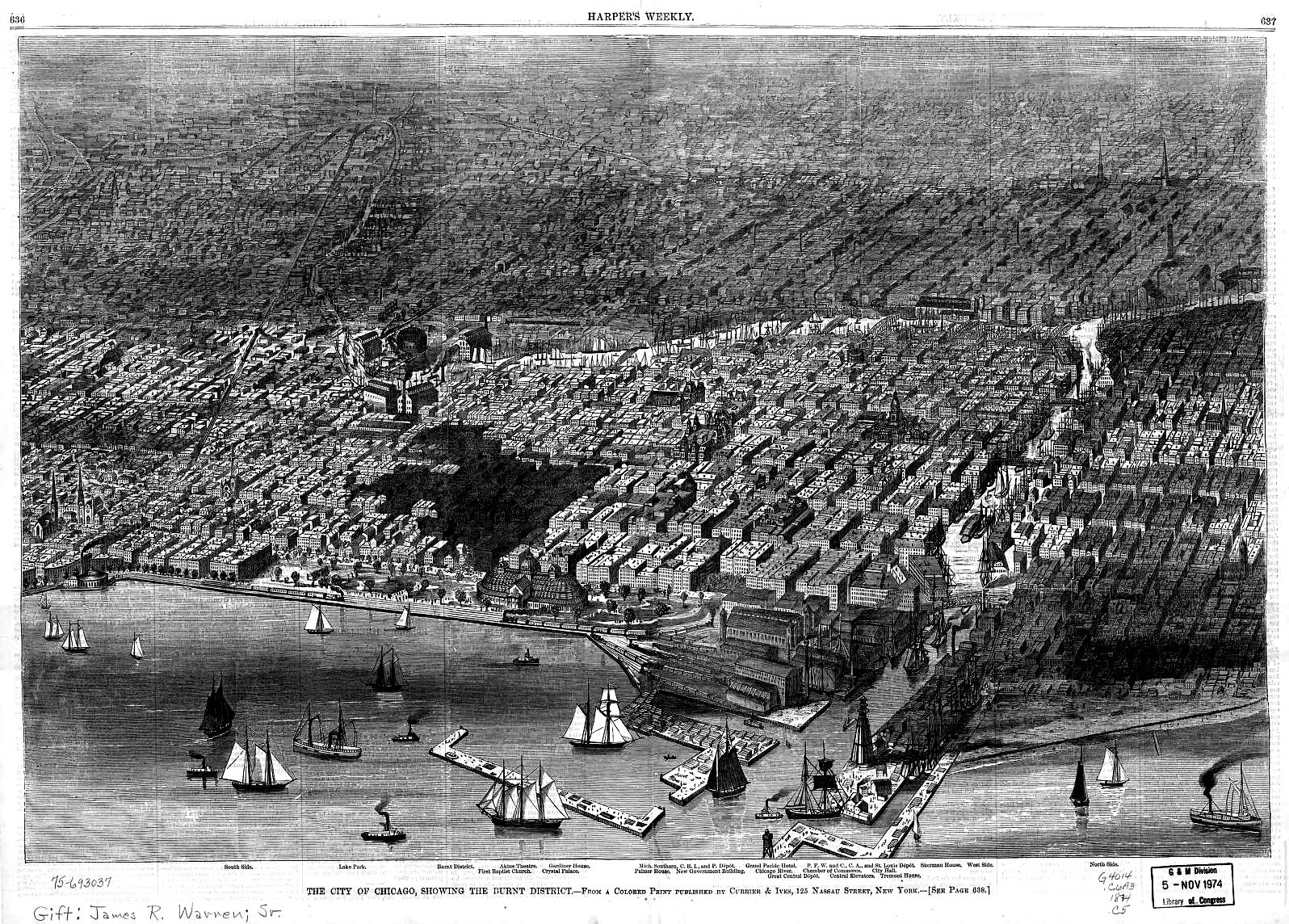
On July 14, 1874, not even three years after the city had finished mourning its first catastrophe, a fire broke out on the South Side and burned for roughly eight hours. It destroyed 812 buildings across forty-seven acres and killed twenty people. It never got a real name of its own. Newspapers at the time tried calling it "the Little Chicago Fire" to distinguish it from its famous predecessor. The name never stuck, and neither did the memory. But the fire of 1874 did something the fire of 1871 did not fully accomplish: it helped permanently reshape who lived where in Chicago, along lines of race and religion that would define the city for the next hundred years.
A City Still Rebuilding
Chicago in the summer of 1874 was a city mid-recovery. The 1871 fire had forced new building codes, creating a fire limit where new wooden construction was prohibited, roughly covering the area between 22nd Street, the river, Lake Michigan, and Halsted Street. But wooden buildings that already stood inside those limits when the ordinance passed were grandfathered in, and "temporary" wooden structures were allowed to go up in the meantime, on the promise they'd come down within a year. Many never did.
July 14 was brutally hot, north of 90 degrees, at the tail end of weeks of dry weather that had left the city primed to burn again. A strong wind was blowing in from the southwest. Almost everyone who wrote about the fire afterward noted how closely the conditions echoed 1871.
The neighborhood that burned sat just south of the rebuilt business district, in an area sometimes known as the "Cheyenne District." It was dense, poor, and still contained many of the wooden structures the 1871 ordinance had failed to eliminate. The water mains serving it were narrow and inadequate, with poor pressure and insufficient capacity to supply the steam engines fighting a major blaze. It was, by nearly every measure, a neighborhood waiting for exactly this to happen.
Where It Started, and Why Nobody Fully Agrees
Here's where the record gets genuinely murky, and it's worth being honest about that rather than picking a version and presenting it as settled.
The Fire Marshal's official report placed the origin at an oil works building on Fourth Avenue. A different account, published weeks later in the San Francisco Elevator, identified a rag shop at 527 S. Clark Street, allegedly discovered by a woman working nearby who sounded the alarm at 4:29 p.m. Alfred T. Andreas, writing a decade later in his three-volume History of Chicago, put the origin a few doors down at 449 S. Clark, in a saloon owned by a man named Le Grand Odell. All three accounts place the origin somewhere in the same general area, the alley behind Fourth Avenue and Clark Street, just south of Taylor, and around the same time, a little before 4:30 in the afternoon. They disagree on the exact building and the exact cause, and it's worth noting the later accounts may not be independent of the earliest reporting rather than separate confirmations of it.
What isn't disputed is who got blamed. A man named Nathan Isaacson, who owned a small barn near the fire's likely point of origin according to contemporary accounts, was arrested and charged with arson. Neighbors testified in court that they'd seen him set the blaze. He was never convicted. Alice Maggio, who later researched the case, has argued that the testimony against him looks more like anti-Jewish prejudice than evidence, though that reading is her interpretation of a case that was never definitively resolved either way at the time.
What Burned
Once it caught, the fire moved fast. Pushed by the southwest wind, it jumped north and east rather than spreading south, crossing State Street by early evening and threatening to reach all the way to Lake Michigan before firefighters managed to hold a line just short of Michigan Avenue.
An alderman at one point pleaded with the Police Superintendent to blow up buildings in the fire's path with gunpowder to create a firebreak. He was told there wasn't authorization for that, and when he appealed to Mayor Harvey Doolittle Colvin directly, he got the same answer. By the time officials tried to organize a demolition effort anyway, there wasn't enough gunpowder readily available in the city to make much difference.
By the time it burned out around midnight, the fire had destroyed the First Baptist Church, the Great Adelphi Theatre (formerly Aiken's Theatre), the newly built Jones School, the Michigan Avenue Hotel, Congress Hall, the Inter-Ocean Building, the St. James Hotel, and a post office that had previously served as the Wabash Avenue Methodist Church. Eight churches and two synagogues, Kehelath B'nai Sholom and Kehilath Anshe Ma'arav, lost their buildings entirely. Engine Company 21, Chicago's first fire company composed of Black firefighters, lost its firehouse in the blaze it was fighting, and the firehouse was not rebuilt on that site. The company itself wasn't disbanded; it was reassigned and later given a new firehouse, and within a few years one of its members, George Reid, was credited in later accounts with helping introduce the department's first sliding pole, a design that became standard in firehouses.
The Board of Police's report, filed in the immediate aftermath, put total losses at $1,067,260 against $1,860,000 in insurance claims. That figure was an early snapshot, not a final tally. A more complete accounting compiled afterward put the real total closer to $3,845,000 in losses against roughly $2.2 million insured, a reminder that the first number out the door after a disaster is rarely the last word.
The Insurance Industry Draws a Line
The response from the insurance industry was immediate and blunt. The National Board of Fire Underwriters, based in New York and referred to in the Chicago press at the time simply as "the National Board of Underwriters," issued a warning that unless the city expanded its water mains, put the fire department under a single accountable chief instead of an elected board, and banned new wooden construction citywide, many insurers would stop writing policies in Chicago altogether. Before all of the board's demands were fully met, several companies made good on the threat and pulled out of the market that October.
Chicago responded with real, if reluctant, speed. On July 20, six days after the fire, the city council extended the fire limits to cover the entire corporate boundary of Chicago, banning new wood-frame construction citywide. The newly formed Citizens' Association of Chicago went further, bringing in Alexander Shaler, chief engineer of New York City's fire department, to reorganize the department along military lines: six battalions, each led by an assistant marshal and divided into companies commanded by captains and lieutenants. Matthias Benner, criticized in the press for his handling of the fire, was kept on as chief of the restructured department. Most of the insurance industry's demands were met by that fall, and coverage resumed.
Who Got to Stay
The reforms strengthened the city's water system and building regulations. They didn't put the displaced residents back in their old neighborhood, and in most cases, nobody particularly wanted to.
The burned district had been home to a community of Jewish immigrants from Russia and Poland, and to a substantial population of middle-class Black families. Contemporary newspaper coverage of both groups was ugly by any standard, then or now. One paper described Jewish residents fleeing the fire in language built entirely around ethnic caricature. Coverage of the neighborhood's Black residents was somewhat more measured but still framed through a lens of financial suspicion rather than sympathy. Some papers went further still, describing the fire in openly moralizing terms, framing the destruction of what one writer called a district of "houses of ill-fame" as a kind of civic cleansing, and suggesting more of the South Side ought to burn for the city's own good.
That coverage matters not because it was accurate, but because it tells you how the survivors were treated in the months that followed. Many of the Jewish families displaced by the fire resettled west of the Chicago River, in areas where earlier immigrant communities, largely Irish and German, were already moving outward into newer neighborhoods. That district, later centered around Maxwell Street, came to be described in later accounts as a "cradle of Jewish culture" for the city for decades afterward.
For Chicago's Black community, the damage was especially severe. Some historical estimates suggest the fire destroyed as much as 85 percent of Black-owned property in the city, a figure worth treating as an estimate rather than a precise count. A good number of the displaced families scattered into mixed neighborhoods. Many of the rest eventually concentrated in an area that became known as the Black Belt, which would go on to anchor Black Chicago for much of the twentieth century, though that concentration was shaped by decades of segregation and discriminatory housing practices that followed, not by the fire alone. The fire was an accelerant, not the sole cause. An estimated 500 women who worked in the neighborhood's brothels were displaced as well, and many resettled south of 18th Street rather than disappearing from the city's economy, in a district that became known as the Levee. Chicago's wealthier residents, who had lived on the northern edge of the burned district on Wabash Avenue, largely relocated south to Prairie Avenue, taking their churches with them.
None of that was written into any ordinance. It happened anyway, in the months after a fire that most people today have never heard of.
What the Document Says
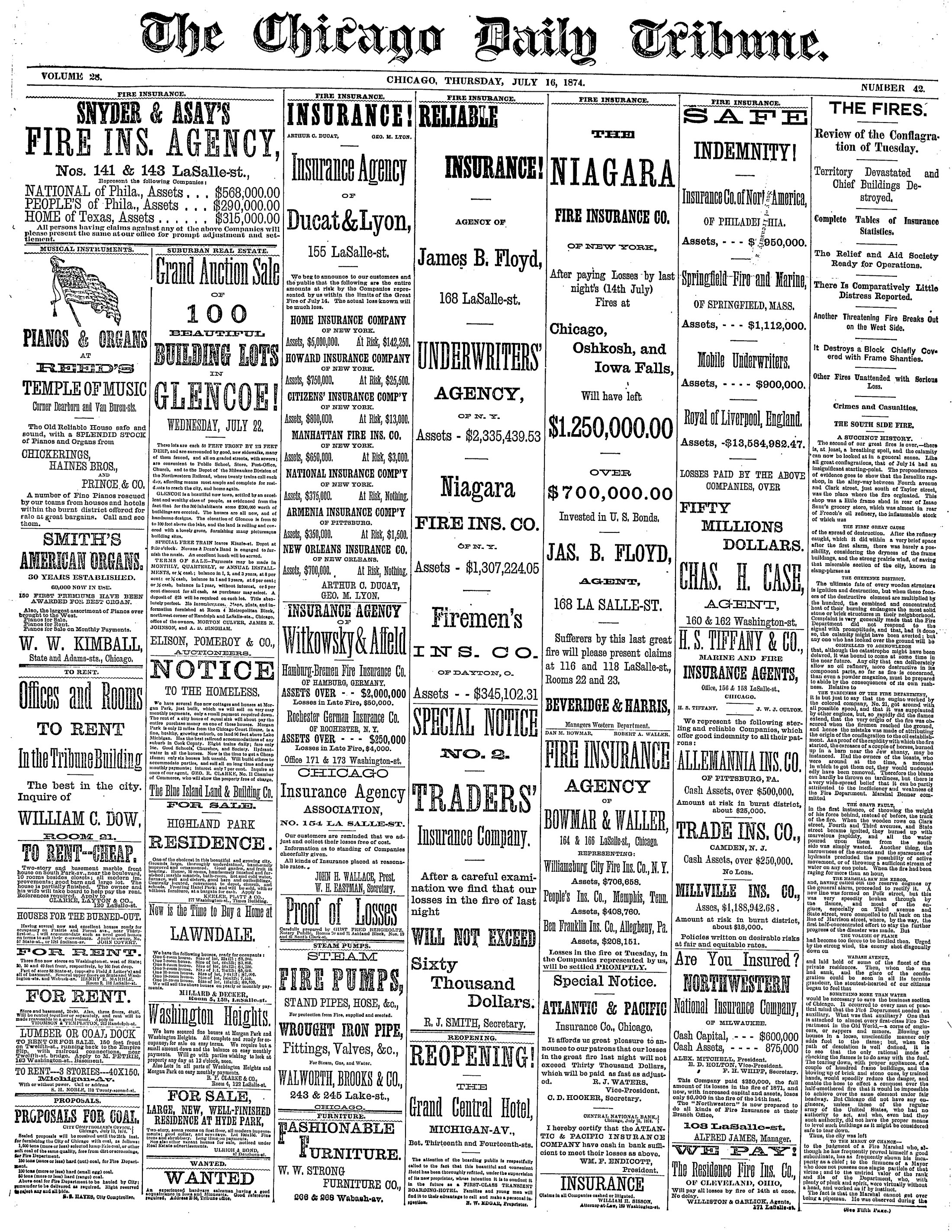
The July 16 edition of the Chicago Daily Tribune, two days after the fire, is among the best surviving windows into how the city processed the disaster in real time. Its retrospective, headlined simply "The Fires," opens on the front page and continues across two more pages inside that day's edition. Together they cover the fire's disputed origin, a pointed public critique of Fire Marshal Benner's command decisions, an interview with General Philip Sheridan (who watched the blaze and complained loudly about the department's disorganization), detailed company-by-company insurance loss tables, and a list of the confirmed dead.
It also captures something the modern retellings tend to flatten out: real uncertainty, recorded just two days after the fact, before anyone had settled on what the fire meant or who was to blame. That's usually the most honest version of any disaster you'll find in the historical record. Not the tidy narrative that gets repeated for the next 150 years, but the version written while the ash was still warm.