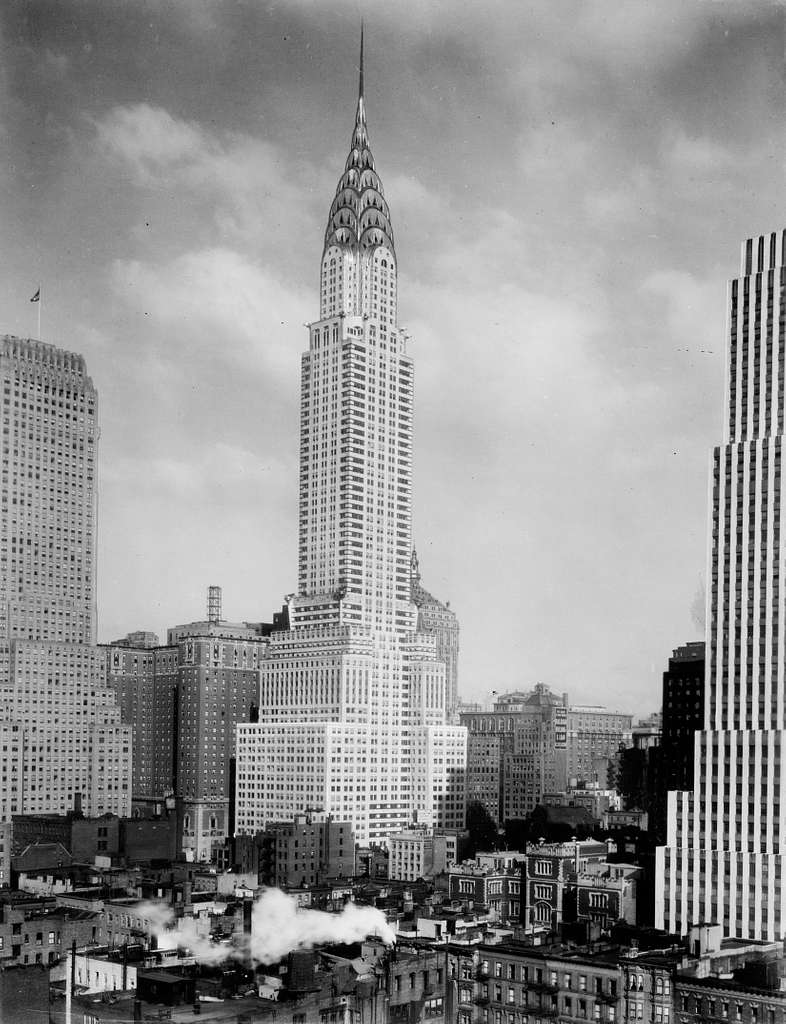
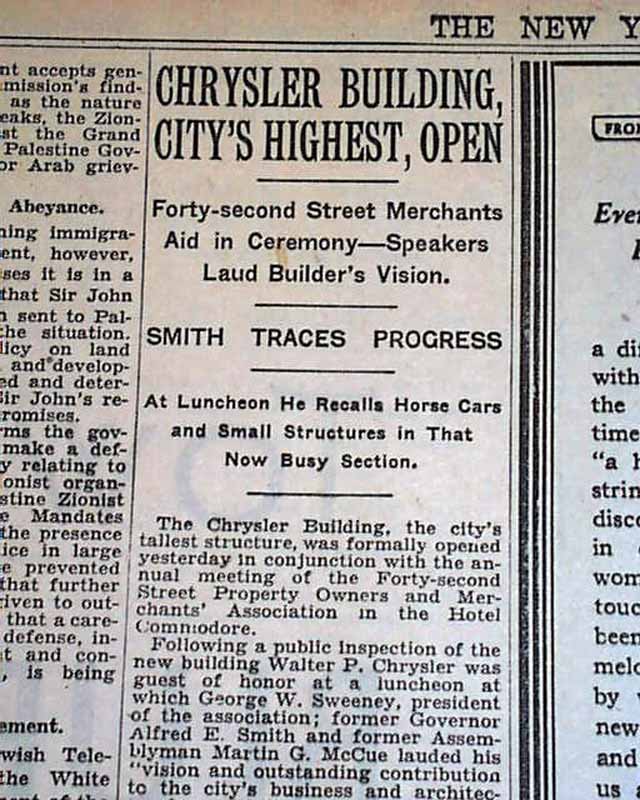
On the morning of May 27, 1930, New York City's tallest building opened its doors at the corner of 42nd Street and Lexington Avenue. Guests toured the lobby. Speeches were made. A bronze plaque was presented to Walter P. Chrysler in recognition of his contribution to civic life. Former Governor Al Smith was there. So was George W. Sweeney, president of the 42nd Street Property Owners and Merchants Association, whose annual meeting provided the occasion.
What nobody mentioned at the luncheon was how the building had actually won.
The Race
In 1928, New York City was in the middle of a building boom unlike anything the world had seen. The economy was roaring, real estate speculation was rampant, and architects were competing not just for commissions but for history. The goal was simple and absolute: build the tallest structure on earth.
Three projects entered the race. The Chrysler Building at 42nd and Lexington. The Empire State Building at 34th and Fifth. And 40 Wall Street, a downtown tower backed by banker George Ohrstrom and designed by architect H. Craig Severance.
The Severance connection mattered. He and William Van Alen, the architect Walter Chrysler had hired for his building, had once been partners. Their firm had dissolved years earlier in a bitter dispute, with lawsuits over clients and money that lasted more than a year. Now, by coincidence or fate, they were on opposite sides of the same competition. The race for the sky was also a personal score to settle.
The Secret Inside the Dome
By April 1929, Severance had increased 40 Wall Street's planned height to 927 feet, edging ahead of the Chrysler Building's published plans. Construction on 40 Wall began that May and moved fast. It was completed twelve months later, becoming the world's tallest building.
For approximately one month.
What Severance did not know was that Van Alen had obtained permission for a 125-foot steel spire and had it secretly constructed inside the frame of the Chrysler Building's dome. Severance had no idea it existed. Nobody outside a small circle did.
On October 23, 1929, one week after the Chrysler Building had already surpassed the height of the Woolworth Building, and one day before the Wall Street Crash of 1929, workers hoisted the spire's four sections to the top of the building. Within 90 minutes, the pieces were raised and riveted into place, lifting the tower to 1,046 feet. Van Alen watched from the street alongside the building's engineers and Walter Chrysler himself. He later compared the experience to watching a butterfly leave its cocoon.
Contemporary newspapers did not report on the spire's installation for days. There were no press releases. The New York Herald Tribune, which had followed the building's construction closely, missed it entirely until after the fact. Severance found out the same way everyone else did.
40 Wall Street had been the world's tallest building. Now it was not. It never would be again.
What 1,046 Feet Actually Meant
When the Chrysler Building officially opened on May 27, 1930, it was not simply the tallest building in New York or the United States. It was the tallest man-made structure on earth, surpassing the Eiffel Tower for the first time any building had done so. It was the first structure ever built taller than 1,000 feet. One newspaper noted that its height exceeded the summit of the highest point in five American states.
The Art Deco details reinforced what it stood for. The gargoyles on the 31st floor and the eagles on the 61st were modeled on 1929 Chrysler radiator caps and hood ornaments. The stainless steel sunburst dome was unlike anything that had been built before. The lobby, clad in dark African wood, marble, and inlaid elevator doors featuring Japanese ash and Oriental walnut, announced wealth and confidence in equal measure.
Walter Chrysler had paid for all of it himself, out of his personal income from his car company. The Chrysler Corporation never owned the building and never moved its headquarters there. Chrysler built it for his sons to inherit, and said as much in his autobiography. He wanted to erect something, he wrote, so that his sons would have something to be responsible for.
Eleven Months
The Chrysler Building held the title of world's tallest for eleven months. Empire State Building developers, tipped off about the spire trick, revised their own plans upward and opened on May 1, 1931 at 1,250 feet, making the contest permanent.
The Chrysler Building is still the world's tallest steel-supported brick building. Commercially, it outperformed its rival for years. By 1935, 70 percent of its floor space was leased. The Empire State Building at the same point had filled only 23 percent of its space and was being called the Empty State Building around the city.
The race had defined both buildings. The Chrysler won the moment. The Empire State won the century.
The Architect
Van Alen's story did not end well. After the building opened, Walter Chrysler refused to pay the remaining balance of his architectural fee, accusing Van Alen of having taken bribes from suppliers. Van Alen sued. The courts ruled in his favor and ordered Chrysler to pay $840,000, equal to six percent of the total construction budget.
He won the lawsuit and lost his career. The accusation had damaged his reputation badly enough that major commissions stopped coming. He spent his remaining working years as a professor of sculpture at the Beaux-Arts Institute of Design and died in 1954. One author who studied his life wrote that the Chrysler Building was his greatest accomplishment and the one that guaranteed his obscurity.
The building still stands at 42nd and Lexington. The spire still sits where it was riveted into place in 90 minutes on the eve of the Great Depression. Walter Chrysler is still on the lobby plaque.
Van Alen's name is not on it.
The Chrysler Building held the title of world's tallest structure from May 27, 1930 to May 1, 1931, a span of eleven months. It was designated a New York City landmark in 1978 and a National Historic Landmark in 1976. William Van Alen died in 1954. Walter Chrysler died in 1940. The building he built for his sons was sold in 1953.