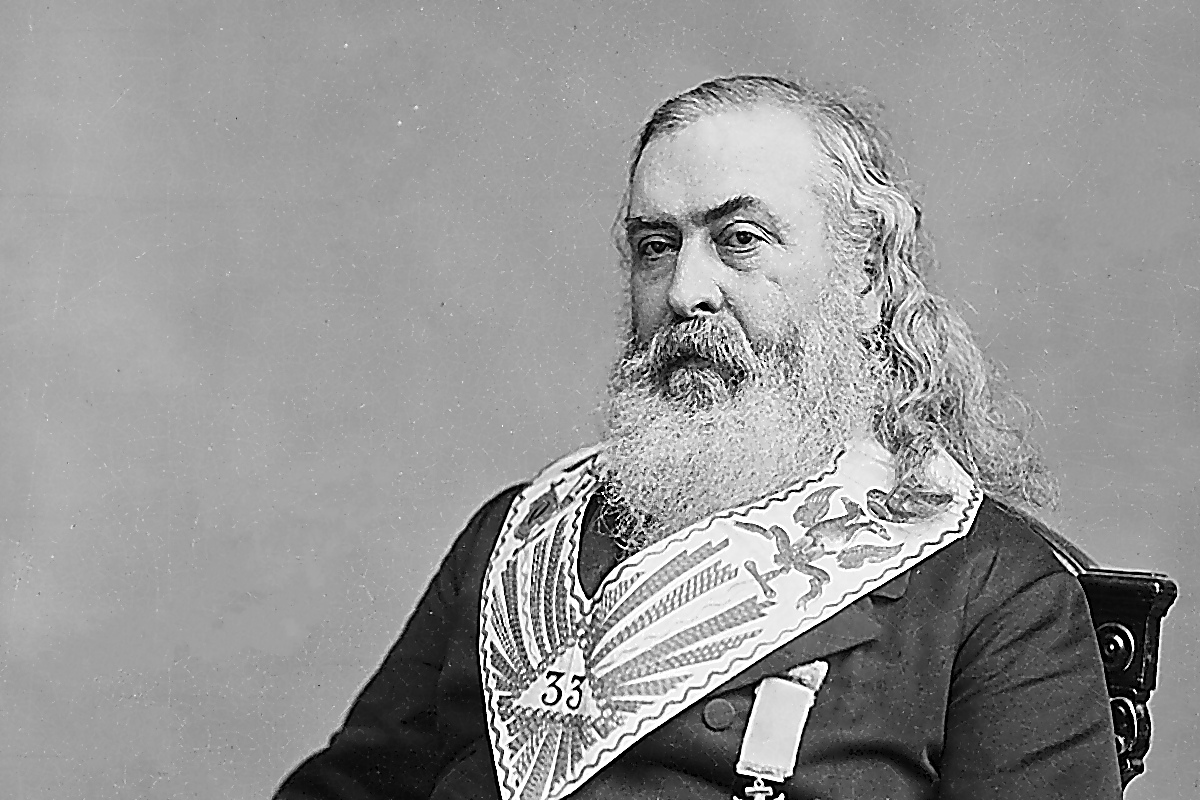
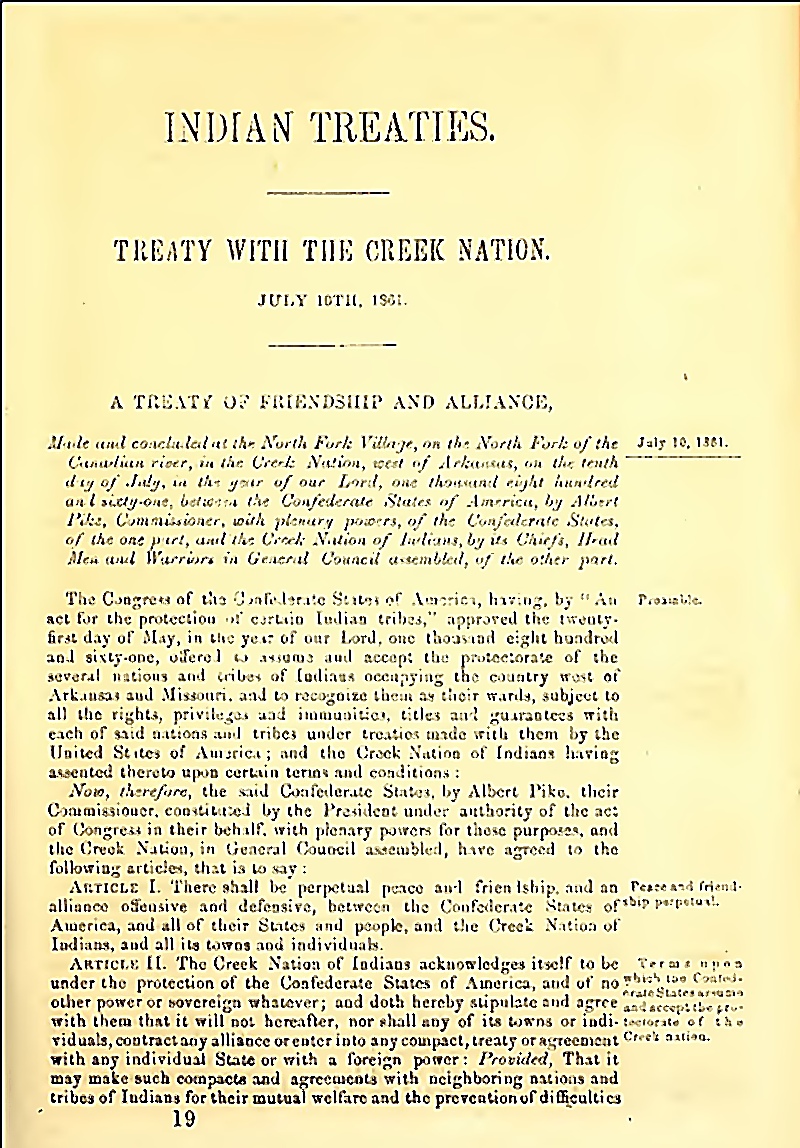
On July 10, 1861, at a trading settlement called North Fork Village, in what is now eastern Oklahoma, a Confederate commissioner named Albert Pike sat down with a delegation of Creek leaders and signed sixty-eight articles of "perpetual peace and friendship."
It was the first of nine treaties Pike would negotiate with tribes in Indian Territory that year. It would not be the last time a Creek delegation signed something that large parts of the Creek Nation would later reject.
Within five months, thousands of Creeks were fleeing north through freezing prairie, fighting Confederate forces that included men who had signed this treaty on their nation's behalf.
The Document on the Table
The treaty runs page after page in the Confederacy's official Statutes at Large — sixty-eight articles, plus supplementary schedules, bound into the same 1864 volume that contains the Confederate Constitution itself. It opens with language that could pass for any nineteenth-century peace treaty: the Confederate States "assume and accept the protectorate" of the Creek Nation, and in exchange guarantee the Creeks their land "in fee simple forever... so long as grass shall grow and water run."
Read past the preamble, though, and the document gets specific in ways general histories tend to skip.
Article XXXII states plainly that "the institution of slavery in the said nation is legal, and has existed from time immemorial" — and goes on to guarantee that Creek slaveholders' title to enslaved people would be recognized and enforced under Confederate law. Article XXIX extends the Confederacy's fugitive slave laws directly into Creek territory, obligating the Creek Nation to return anyone who escaped slavery there, exactly as if they'd fled from a Confederate state.
In exchange for protection, the Creek Nation committed real manpower. Article XXXVI obligates the Creeks to raise a full regiment — ten companies of mounted men — to serve the Confederacy for twelve months, officered by men the Creeks themselves elected. Article XXXVII goes further, binding the nation to furnish troops "at any future time" upon request of the Confederate president. In return, Article XXXVIII promises the Creeks would never be billed for the war's cost, and Article XL grants the Creek and Seminole nations a joint, non-voting delegate seat in the Confederate House of Representatives — a level of formal political representation the Creek Nation had never held in Washington.
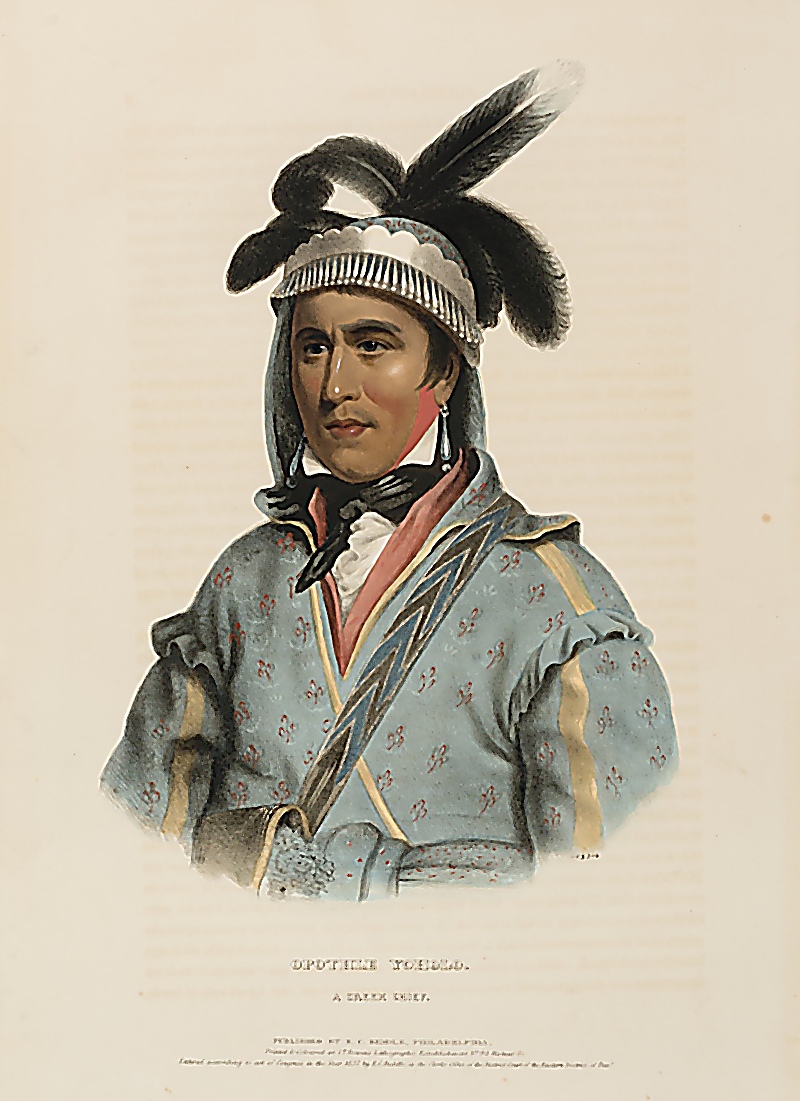 An 1866 U.S. Army Engineer Bureau map of Indian Territory, showing the boundaries of Creek Country as they had been established in 1858–59 — the land Pike's treaty was written over. Library of Congress, Geography and Map Division.
The Men Who Signed It
Pike signed as commissioner, "with plenary powers, of the Confederate States." Fourteen Creek men signed opposite him, led by Principal Chief Motey Kennard.
Two of those names carry a weight the treaty text itself never explains: Chilly McIntosh and Daniel N. McIntosh.
Thirty-six years earlier, in 1825, their father — William McIntosh, a leading Lower Creek chief — had signed the second Treaty of Indian Springs, ceding nearly all remaining Creek land in Georgia to the United States without the consent of the Creek National Council. Under Creek law at the time, unauthorized land cessions were a capital offense. A war party led by chief Menawa executed McIntosh at his own plantation and burned it down.
Thirty-six years later, his sons were back at the negotiating table, binding their nation to a different foreign power — this time with the Creek National Council's blessing, at least on paper. The General Council of the Creek Nation formally ratified the treaty ten days later, on July 20, at a place the ratification record calls simply "the Council Ground."
The Nation That Didn't Sign
Not every Creek accepted that ratification as final.
Opothleyahola, the elderly Speaker of the Upper Creek Council and a longtime political rival of the McIntosh faction, rejected the Confederate alliance outright. He'd spent decades opposing removal and land cessions pushed by exactly this kind of leadership; he wasn't about to accept a new one now. Through the late summer and fall of 1861, thousands of Unionist Creeks, Seminoles, and enslaved and free Black people gathered at his plantation near North Fork Village — the very settlement where Pike's treaty had been signed.
In August, Opothleyahola wrote directly to Abraham Lincoln asking for federal protection. In September, Washington told him to bring his people to Fort Row, in Wilson County, Kansas.
Getting there meant fighting the Confederate government he'd just refused to recognize. Confederate Colonel Douglas H. Cooper led roughly 1,400 men — including Confederate Creek and Choctaw troops raised under treaties like this one — to stop him. Opothleyahola's band held them off at the Battle of Round Mountain on November 19, fought again at Chusto-Talasah on December 9, and was finally broken at the Battle of Chustenahlah on December 26, in the middle of a blizzard.
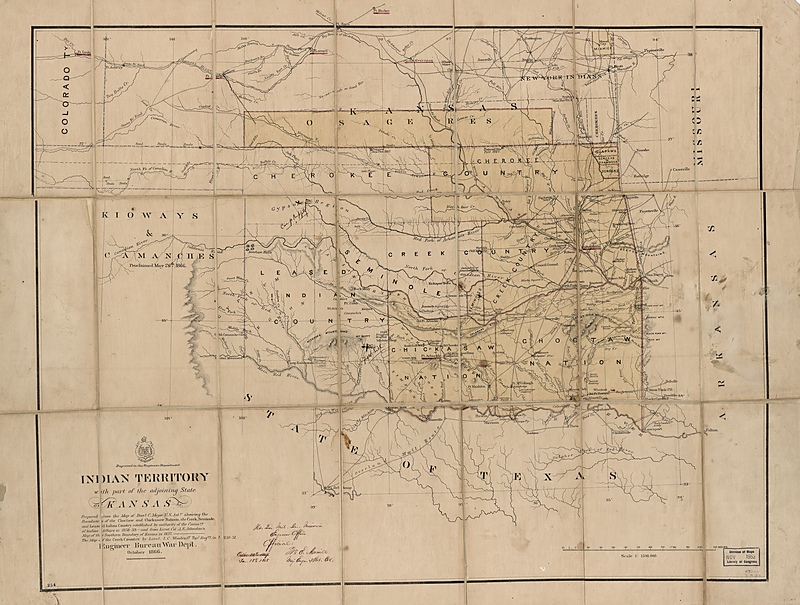 Opothle Yoholo, A Creek Chief. Hand-colored lithograph, ca. 1837, after Charles Bird King, published in McKenney and Hall's History of the Indian Tribes of North America. Smithsonian American Art Museum.
Of the roughly 9,000 people who set out with Opothleyahola, an estimated 2,000 never made it to Kansas — killed in the fighting, or lost to exposure and disease on what survivors later called the Trail of Blood on Ice. Opothleyahola himself died in a refugee camp in Kansas in March 1863, two years before the war he'd refused to join finally ended.
A Treaty That Didn't Tell the Whole Story — Even to Itself
There's one more detail buried in the Statutes at Large that's easy to miss.
When the Confederate Congress formally ratified the treaty, its resolution advised and consented to "the ratification of the articles of treaty, including the Secret Article and Supplementary Article." That language is right there in the official published record. The Supplementary Article is printed in full a few pages later — it deals with reparations claims from an earlier band of displaced Florida Creeks. The Secret Article is not printed at all. Although it was omitted from the published Statutes at Large, surviving manuscript copies indicate it dealt largely with military cooperation, including the Confederate occupation of Fort Gibson and related logistics — rather than some deeper hidden bargain. Still, an ordinary reader of the official 1864 volume would never have known it existed at all.
It's a small detail, but it's a reminder that the published treaty was not the entire agreement reached at North Fork that summer.
What the Treaty Actually Bought
None of the guarantees in Pike's treaty survived the war. The Creek Nation — including the families who'd never accepted the Confederate alliance and had fought and died resisting it — was treated by the postwar United States government as a defeated Confederate ally. Under the 1866 Reconstruction Treaties, the Creek Nation was forced to cede roughly 3.2 million acres — about half its land — and formally abolish slavery within its own borders, regardless of which Creeks had actually signed with Pike, which had fled to Kansas under a Union promise of protection, and which had died on the way.
The treaty promised the Creek Nation would never be annexed to a state or territory without its own free consent. Indian Territory became Oklahoma in 1907. The Creek Nation was not asked.