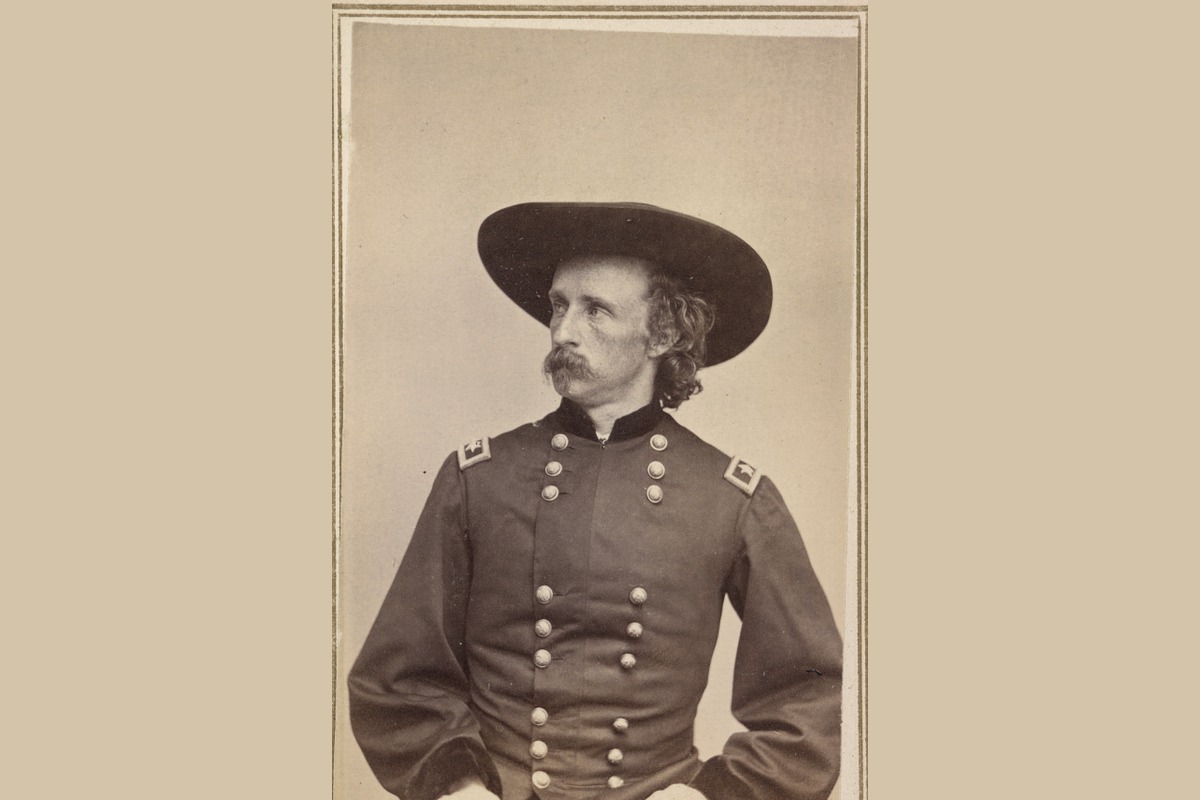
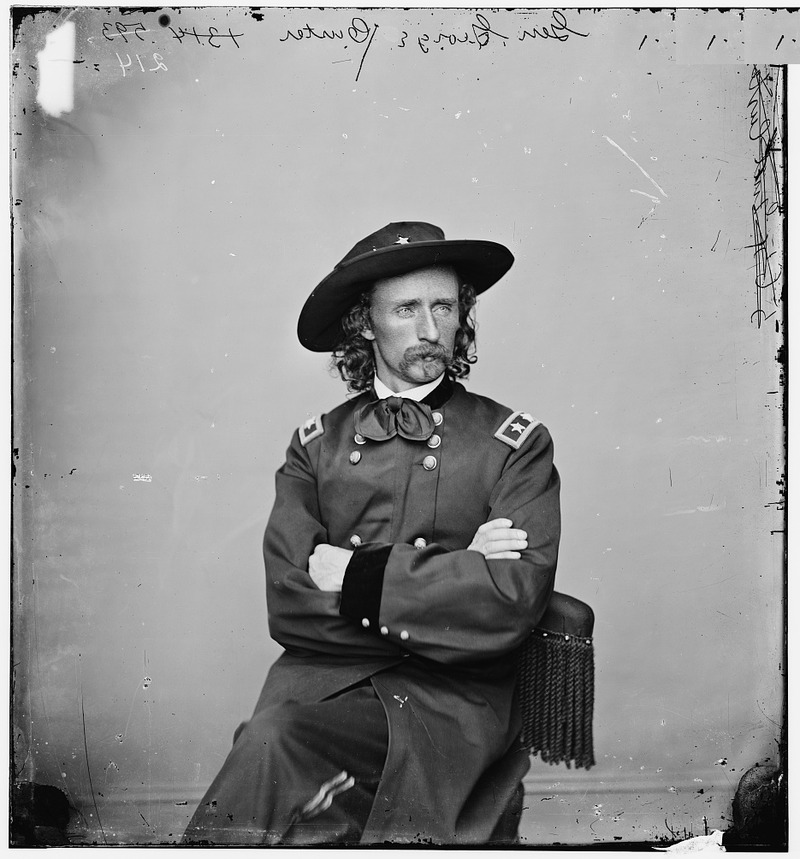
On June 29, 1863, a 23-year-old Army captain named George Armstrong Custer received orders that no one, including Custer himself, expected. He had been jumped over the ranks of major, lieutenant colonel, and colonel in a single stroke. As of that morning, he commanded a brigade of four Michigan cavalry regiments.
He had never held permanent field command of even a company.
Three days later, he rode those four regiments into the Battle of Gettysburg.
The Man Who Made It Happen
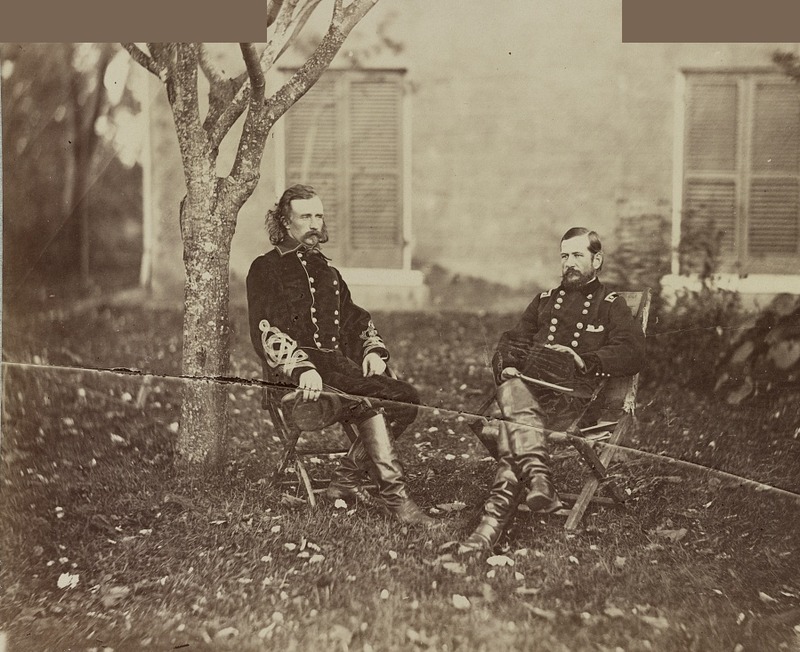
The photograph above was taken in October 1863, four months after the promotion. The younger officer on the left is Custer, still 23. The older man on the right is Major General Alfred Pleasonton, commander of the Army of the Potomac's Cavalry Corps — the man who reached down past a dozen ranks and handed Custer his stars.
Pleasonton had just been elevated himself, promoted to major general on June 22. With new command came the authority to reshape his officer corps. He had grown convinced that the cavalry's problems were not tactical but personal: too many of its generals had been appointed for political reasons and were unwilling to personally lead a charge. He wanted, in his words, commanders with the "proper dash to command cavalry."
On June 29, after consulting with the newly appointed commander of the Army of the Potomac, George Meade, Pleasonton acted. He promoted three of his aides simultaneously: Wesley Merritt, Elon Farnsworth, and Custer. All three jumped to brigadier general of volunteers that same day. Merritt and Farnsworth at least had some command experience. Custer had none.
Pleasonton never regretted the decision. He would later declare, "Custer is the best cavalry general in the world."
Last in His Class
Nothing in Custer's record on paper would have predicted any of this.
He had graduated from West Point in June 1861 ranked last out of 34 cadets — a distinction known at the Academy as "the Goat." He accumulated demerits at a historic pace, earning extra guard duty nearly every Saturday. The demerits came from pranks, unauthorized excursions, and a general refusal to take the academic side of military education seriously. He came close to expulsion more than once.
What saved him was the Civil War. The class of 1861 graduated roughly a year ahead of schedule because the Union Army needed officers urgently. Many of his Southern classmates had already resigned to fight for the Confederacy. When Custer walked out of West Point dead last in his class, he walked out into a war that had no patience for the normal pace of promotion.
He was commissioned a second lieutenant in the 2nd U.S. Cavalry and almost immediately found himself at the First Battle of Bull Run, carrying messages under fire to General Irvin McDowell. His coolness under fire attracted favorable notice from senior officers.
The River and the General
The moment that truly changed Custer's trajectory came during the Peninsula Campaign in May 1862.
General George McClellan and his staff were reconnoitering a crossing point on the Chickahominy River when someone remarked that no one knew how deep it was. Before anyone else moved, Custer spurred his horse into the river, rode to the middle, turned around to face the assembled officers, and demonstrated the depth himself. McClellan called it a "very gallant affair" and invited Custer onto his personal staff.
That was Custer's method: create the moment, then ride it. He joined McClellan's staff with a temporary captain's rank, built relationships with the senior commanders of the Army of the Potomac, and by June 1863 had become aide-de-camp to Alfred Pleasonton, who by then commanded the entire cavalry corps. The two developed an unusual bond. Custer later wrote that he did not believe a father could love his son more than Pleasonton loved him.
When Pleasonton went looking for officers with dash on June 29, 1863, he knew exactly where to find one.
Four Regiments, No Experience, Three Days
The Michigan Cavalry Brigade that Custer now commanded — the First, Fifth, Sixth, and Seventh Michigan — would come to be known as the Wolverines. They were experienced. Their new general was not.
What Custer lacked in experience he compensated for in a way his men noticed immediately. He did not direct charges from behind. He led them from the front. Captain James Kidd of the Sixth Michigan saw his new commander for the first time the day after the promotion and later wrote that Custer had welded the four regiments into a cohesive unit almost at once.
The test came fast. On July 3, 1863, three days after the promotion, Confederate General J.E.B. Stuart moved roughly six thousand cavalrymen around the Union right flank toward the Union rear — in what many historians believe was an attempt to coordinate with Lee's main assault on Cemetery Ridge.
Custer's brigade, numbering roughly twelve hundred men, was part of Brigadier General David Gregg's division holding that flank. Together they faced a Confederate force several times their size.
When Stuart launched a massive mounted charge, Custer rode to the head of the First Michigan Cavalry, threw off his hat so his men could see his long hair, and charged directly into the Confederate column. The collision was described by one observer as so violent that horses and men went end over end. Stuart's attack was stopped before it could threaten the Union rear. Meanwhile, Pickett's Charge collapsed on Cemetery Ridge under the weight of the Union center's defense. The battle turned that afternoon, and Gettysburg would later be remembered as one of the war's great turning points.
Custer's brigade suffered 257 casualties at Gettysburg, the highest loss of any Union cavalry brigade in the battle.
The Photograph
The two men in the photograph above met in the spring of 1863, barely a year before it was taken. By October 1863, when Timothy O'Sullivan photographed them together at Warrenton, Virginia, Custer had already fought at Gettysburg, Hanover, Hunterstown, and Falling Waters. He had become a national figure. Harper's Weekly had run an illustration of one of his charges.
Pleasonton, the older man, looks composed and unremarkable beside his young protege. But it was Pleasonton's gamble on June 29, 1863 — bypassing the normal rules of seniority to hand a 23-year-old captain a brigade command four days before one of the most consequential cavalry engagements of the war — that made everything after it possible.
It was also one of the most consequential promotions the Union Army ever made. Not because of what Custer did at Gettysburg, but because of what it established: that in this war, bravado and audacity could outrun the normal order of things.
Custer would spend the rest of his life testing that proposition.
 General George Armstrong Custer, Brady's National Photographic Portrait Galleries, circa 1863. Library of Congress, Prints and Photographs Division. No known restrictions on publication.
He ended the Civil War as the youngest major general in the Union Army. When the war was over, the Volunteer Army was disbanded and he reverted to his Regular Army rank: lieutenant colonel. He spent the next decade in the West, fighting a different kind of war against the Plains tribes, chasing a version of glory that the cavalry charges of Virginia had made him believe was always available to the aggressive man.
On June 25, 1876, at a river in Montana called the Little Bighorn, he found out it wasn't.