Most people who have heard of the U.S.-Dakota War picture a single ugly event. An uprising. A massacre. Something that started and ended in the same breath, far off on the frontier, with no real chain of cause and effect behind it.
It did not start that way. It started with a trader's insult, broken promises from Washington, and four young men on a failed hunting trip who made a decision that plunged their people into a war many of them never wanted.
By the summer of 1862, the eastern Dakota bands of southwestern Minnesota were starving. Treaties signed in 1851 and 1858 had already stripped away most of their land in exchange for annuity payments the government was legally bound to deliver. Those payments were late again, while the federal government was consumed by the Civil War and the Indian agency system, riddled with its own administrative failures and corruption, struggled to deliver what had been promised. A failed crop the year before and a brutal winter had left many Dakota families with nothing to eat.
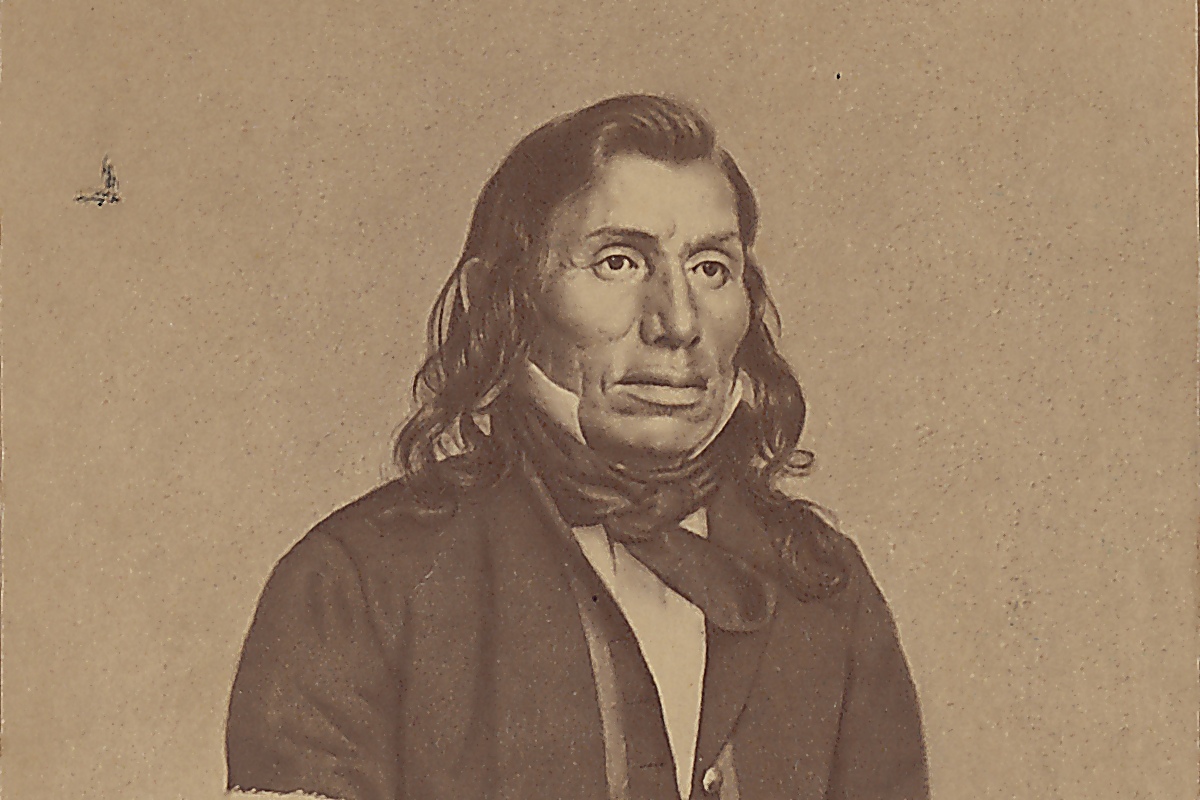
In early August, a group of Dakota men asked a trader named Andrew Myrick whether he would extend credit until the annuity money arrived. Myrick's reported answer became one of the most quoted lines in Minnesota history: if they were hungry, they could eat grass. Historians still debate the exact context of that remark and whether it was said to the men directly or reported secondhand. Whatever its precise context, Little Crow later cited the remark directly when explaining why the fighting began, in a September letter to Colonel Henry Sibley.
The spark came on August 17, when four young Dakota men returning empty handed from a hunt found some chicken eggs on a farm near Acton and argued among themselves about whether to take them. One dared another to prove he was not afraid of how a white settler would react. They approached a settler named Robinson Jones and proposed a shooting match, which turned deadly when the men reloaded and fired on the settlers present. Five people were dead by the end of it. Fearing the consequences, the men fled back to their village and asked their leaders for protection. That night, a war council gathered at Little Crow's house. Little Crow argued against war. According to accounts of the council, he was challenged as a coward for opposing it, and by morning he ultimately agreed to lead the fighting.
On the morning of August 18, Dakota fighters struck the Lower Sioux Agency at Redwood. Myrick was among the first killed, shot while fleeing through a window. Soldiers sent from Fort Ridgely to respond were ambushed and defeated at Redwood Ferry that same afternoon, losing 24 men, including their commanding officer. Within days the fighting spread to New Ulm and to Fort Ridgely itself, and by the end of the six week conflict, hundreds of settlers and soldiers, along with an unknown number of Dakota fighters, were dead.
Here is the part that rarely makes it into the popular version of the story. Historian Mary Wingerd, among others, has pushed back hard on the idea that this was ever "the Dakota" going to war as a people. Out of a Dakota population of more than 7,000 in Minnesota at the time, fewer than 1,000 men, primarily Mdewakanton, ever took up arms. Many Dakota individuals and families sheltered settlers, warned them to flee, or refused outright to participate. The war that ended with the forced exile of most of the Dakota from Minnesota was fought by a fraction of that people, over the objections of many of their own elders.
The fighting itself ended at the Battle of Wood Lake on September 23, when Colonel Henry Sibley's forces broke the last organized Dakota resistance. Three days later, at what became known as Camp Release, 269 captives were handed back to Sibley's men. What followed was not a trial in any sense the word usually carries. A military commission rapidly tried 392 Dakota men, sentencing 303 to death. Some hearings lasted less than five minutes. None of the defendants had legal counsel.
The case then went to Abraham Lincoln, who was simultaneously finalizing the Emancipation Proclamation and fighting a war for the country's survival. Lincoln had his staff comb through every trial record looking specifically for convictions tied to the killing or rape of civilians, as distinct from combat deaths. Out of 303 death sentences, he confirmed 39. One man received a last minute reprieve after new doubts about his guilt reached Sibley. On December 26, 1862, the remaining 38 were hanged together in Mankato. It remains the largest single day mass execution in American history. Lincoln's review commuted 264 of the 303 death sentences.
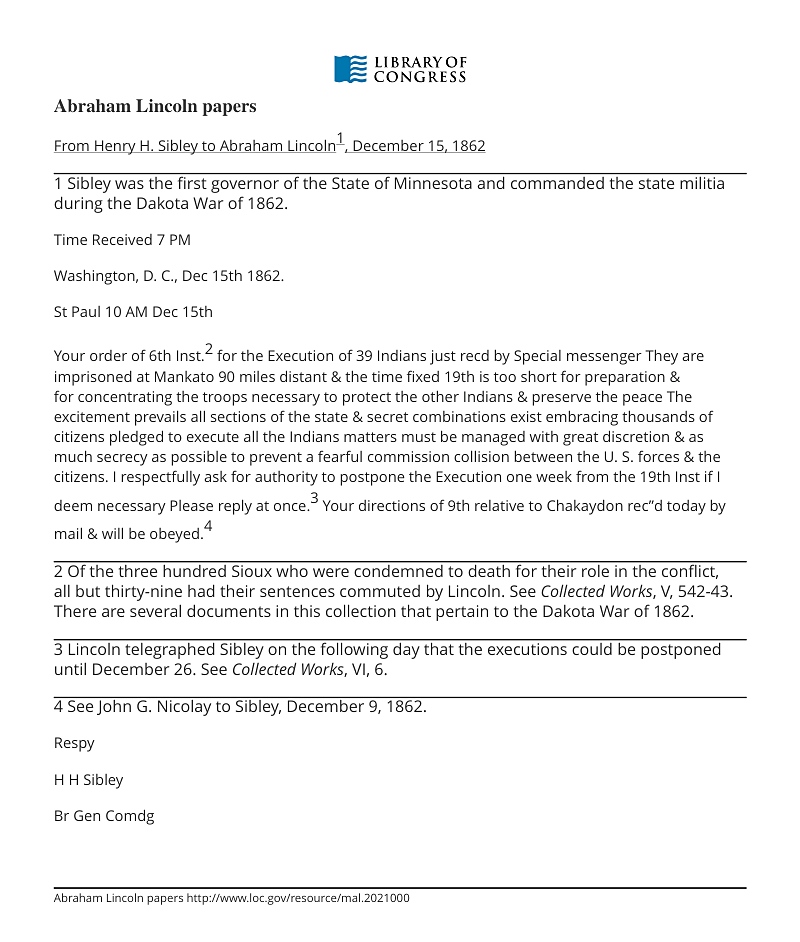
The document attached to this story is not from the battle or the trials. It is a telegram Sibley sent Lincoln on December 15, the day he received the execution order, asking for one more week. In it, Sibley warned that "secret combinations exist embracing thousands of citizens pledged to execute all the Indians," and that the situation had to be handled with discretion to prevent violence between the army and the citizens. Lincoln granted the delay, moving the hangings from December 19 to December 26. It is a small, procedural piece of paper. It is also a direct window into how close the aftermath came to being even worse than what actually happened.
What came after the hangings reached far beyond the 38 men on the scaffold. In early 1863, Congress voided every remaining treaty with the Dakota and stripped them of any legal claim to land in Minnesota. Roughly 1,600 Dakota noncombatants, overwhelmingly women, children, and the elderly, had already spent the winter in a fenced camp below Fort Snelling, where disease killed an estimated 130 to 300 of them. That May, the survivors were loaded onto steamboats and sent to a reservation in Dakota Territory. The policies that followed, treaty abrogation, land confiscation, and forced removal, were built to keep the Dakota out of Minnesota for good, though some individuals and families did eventually return in the decades after.
Little Crow did not live to see most of it. He fled north after Wood Lake, was turned away by tribal leaders he had hoped would join him, and slipped back into Minnesota the following summer to pick raspberries with his teenage son. A settler named Nathan Lamson shot him during that outing. Lamson did not know at the time that his victim was Little Crow. The state awarded Lamson a $500 bounty. His scalp, skull, and other remains were displayed by the Minnesota Historical Society for decades before finally being returned to his descendants and buried near Flandreau, South Dakota, in 1971.