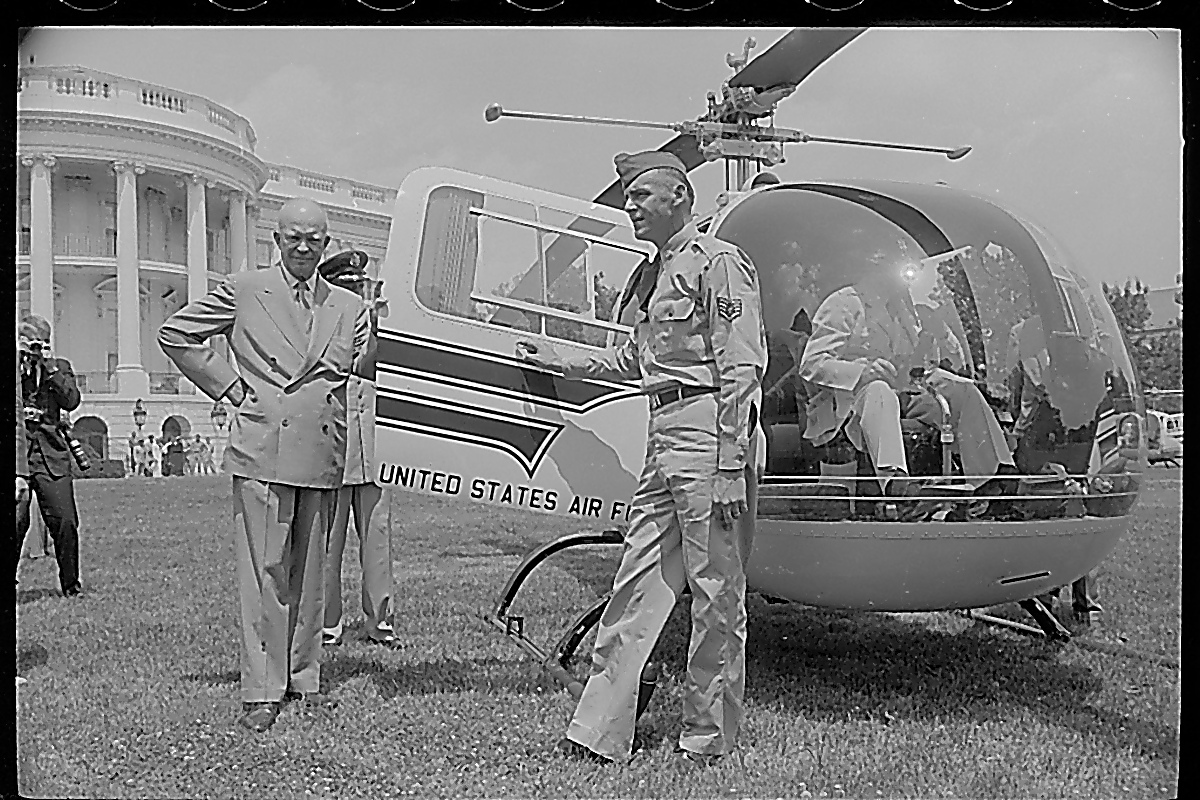
On the afternoon of July 12, 1957, Dwight Eisenhower left the Oval Office, crossed the South Lawn of the White House, boarded a small, bubble-nosed helicopter waiting on the grass, and lifted off for Camp David. According to the White House's own appointment log, he departed at 2:04 p.m. No sitting American president had ever flown in a helicopter before.
He was not headed to a ribbon cutting. He was rehearsing how the president would be evacuated from Washington if a nuclear attack appeared imminent.
The Log on the Table
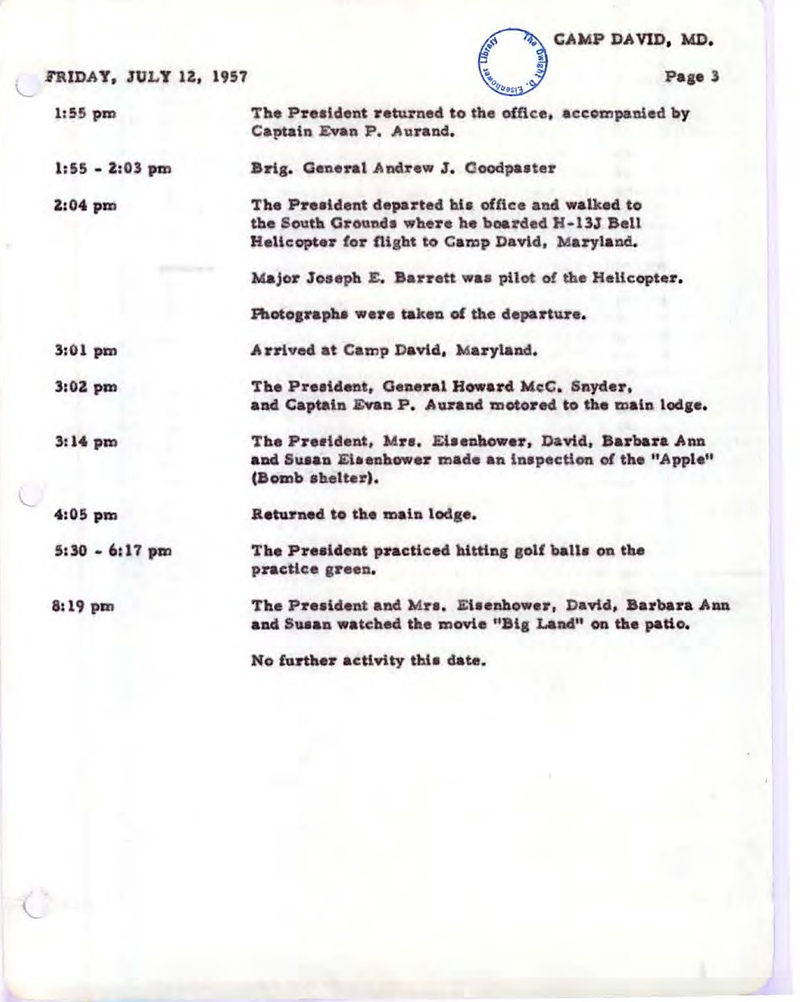
The document above is a single page from the president's daily appointment book, the record his staff kept of where he went and who he saw, hour by hour, for eight years in office. The entry for July 12, 1957 is almost clerical in its plainness. The entry notes that Brig. General Andrew Goodpaster briefed him until 2:03 p.m. At 2:04 p.m., the president "departed his office and walked to the South Grounds where he boarded H-13J Bell Helicopter for flight to Camp David, Maryland." The log identifies the pilot as Major Joseph E. Barrett and records that photographs were taken.
Then, without any change in tone, it records the president landing at Camp David at 3:01 p.m., and at 3:14 p.m., touring a bomb shelter with his wife and grandchildren.
The log does not explain why. It did not need to.
A Test Called Operation Alert
The helicopter flight was one small piece of a much larger exercise the government had been running annually since 1954, a simulated nuclear attack on the United States called Operation Alert. Each summer, federal agencies rehearsed evacuating Washington on short notice, moving the president, his cabinet, and thousands of federal officials to secure locations outside the capital before a hypothetical Soviet strike could hit.
By 1957, the math of that problem had changed. The Soviet Union's growing nuclear capability meant that if Washington had to be evacuated for real, there might be no time to clear traffic for a motorcade. Eisenhower's Air Force aide, Lieutenant Colonel William Draper, had spent months searching for a small aircraft that could pull the president out fast. The Secret Service resisted the idea for a long time, refusing to approve routine presidential helicopter flights except in what it considered a genuine emergency, and Draper had to argue his case for months before he won them over.
The aircraft they settled on was a Bell H-13J, the military version of Bell's civilian Ranger series, best known for its transparent "fishbowl" nose. It was not an impressive machine. It carried only two passengers in real comfort, had a range of roughly 150 miles, and topped out around 100 miles an hour. But it had something the larger, faster helicopters under consideration did not: an unusually strong safety record, built on a decade of reliable civilian service. The Air Force bought two of them, plus spare parts, for approximately $201,000, a fraction of the cost of the president's fixed wing aircraft.
There was a public relations problem tucked inside the purchase, too. A Pennsylvania newspaper had reported that Eisenhower, an avid golfer, might start using his new helicopters for trips to the country club. The Air Force's answer was to point at Operation Alert: this was not a toy for the golf course, it was a piece of Cold War infrastructure. That answer happened to be true. It also happened to be convenient.
The Flight Itself
At 2:04 p.m. on July 12, Major Barrett lifted the H-13J off the South Lawn with Eisenhower in the right rear seat and James Rowley, the head of the Secret Service's White House detail, beside him. A second, identical helicopter followed close behind, carrying the president's physician, Major General Howard Snyder, and a second agent. Around them, several larger military helicopters were doing the same thing for other officials, lifting staffers and pool reporters off the Ellipse in an improvised airlift that briefly turned the White House grounds into something like a small airport.
By the standards of later presidential travel, it was not a smooth ride. The larger helicopters supporting the exercise, faster and better equipped, had already landed at Camp David and shut down their engines by the time Eisenhower's small Bell finally touched down at 3:01 p.m. One of the pilots who was there recalled that when the president arrived he was "sweating from an uncomfortable ride and annoyed" to find everyone else already on the ground, engines cooled down, waiting on him.
Whatever the president thought of the ride, the purpose of the trip was not comfort. Not long after he arrived, Eisenhower walked his wife and three grandchildren through an inspection of the site's bomb shelter, a bunker the family called simply "the Apple." It is one line in the appointment log, sandwiched between an entry about motoring to the main lodge and an entry about the president practicing his golf swing that evening. Read on its own, it looks routine. Read as part of the day it happened, it is the entire point of the exercise laid bare: a nuclear war drill disguised, almost successfully, as an ordinary presidential weekend.
What Came Next
Eisenhower was not immediately sold on the little Bell helicopter. He found it slow and cramped, and its plexiglass bubble turned into a greenhouse in direct sun. Less than two months later, on September 6, 1957, he flew for the first time aboard a larger Marine Corps helicopter and preferred it enough that he had his staff shift most of his future flights to Marine and Army aircraft instead. Not wanting to be seen favoring one service over the other, he alternated between the two for the rest of his presidency, a habit that outlasted him.
That arrangement held until 1976, when President Gerald Ford, looking to cut costs, handed all presidential helicopter duty over to the Marine Corps alone. It has stayed there ever since, which is why the helicopter carrying the president today, whenever he is aboard, flies under the call sign Marine One.
None of that existed yet on July 12, 1957. What existed was a small, underpowered helicopter, a nervous Secret Service that had only recently stopped objecting to the whole idea, and a president who spent his Friday afternoon rehearsing how fast he could vanish from Washington if the Cold War ever stopped being cold.