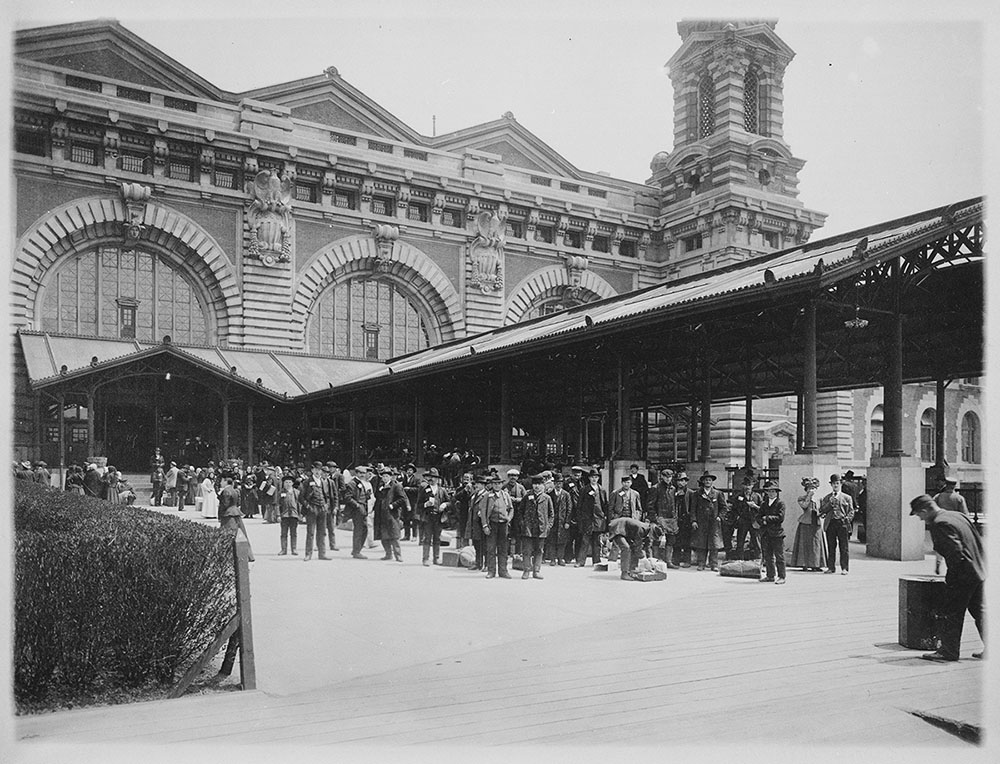
For most of its history, the United States had no limit on how many people could come.
There were restrictions. The Chinese Exclusion Act of 1882 had barred Chinese laborers entirely, and a series of laws had excluded criminals, the mentally ill, and those deemed likely to become a public charge. But for European immigrants arriving at Ellis Island, the door was essentially open. Between 1880 and 1920, more than 20 million people walked through it.
They came from Italy, Poland, Russia, Hungary, Greece, and dozens of other countries. They came poor, speaking no English, carrying everything they owned. They settled in tenements in New York, in steel towns in Pennsylvania, in meatpacking neighborhoods in Chicago. They built the infrastructure of industrial America.
On May 19, 1921, Congress decided there had been enough of them.
The Emergency Quota Act, signed into law by President Warren G. Harding exactly 105 years ago today, established for the first time a numerical cap on immigration based on national origin. No nationality could send more than 3 percent of the number of its people already living in the United States, as counted by the 1910 census.
That last detail was not an accident.
The choice of 1910 as the baseline was deliberate and precise. By 1910, the great wave of Southern and Eastern European immigration was still building. Millions of Italians, Poles, Russians, and Jews had not yet arrived. Anchoring the quotas to that year meant anchoring them to an America that was still predominantly Northern and Western European. The math guaranteed it.
Under the new law, a country like Great Britain received a generous quota because large numbers of British immigrants were already counted in the 1910 census. Italy, which had sent hundreds of thousands of immigrants in the years after 1910, received a quota that was a fraction of what the country had been sending annually. The same was true for Poland, Russia, Greece, and most of Southern and Eastern Europe.
The bill's authors did not hide what they were doing. The debate in Congress was explicit about the goal, which was slowing the arrival of immigrants considered racially or culturally inferior to Northern Europeans. The eugenics movement was at its height, and its language ran through the congressional record.
The act was called an emergency measure. It was set to expire on June 30, 1922. It did not expire. It was extended, and then in 1924 replaced by an even more restrictive law, the Immigration Act of 1924, that cut quotas further and effectively ended mass immigration from Southern and Eastern Europe for four decades.
The door that had been open for the better part of a century was closed. It would not open again until 1965.
A century later, the questions the Emergency Quota Act raised have never left American politics. Who gets to come. How many. From where. By what criteria. The 1921 law answered those questions one way. The Immigration and Nationality Act of 1965 answered them differently, abolishing national origin quotas entirely and shifting preference to family reunification and skills.
Today those answers are contested again. The specific numbers and countries change with each administration and each Congress, but the underlying argument is the same one that played out in the halls of the Sixty-Seventh Congress in the spring of 1921: what kind of country is America choosing to be, and who gets to be part of it.
The Emergency Quota Act did not settle that question. It never could. No law has.