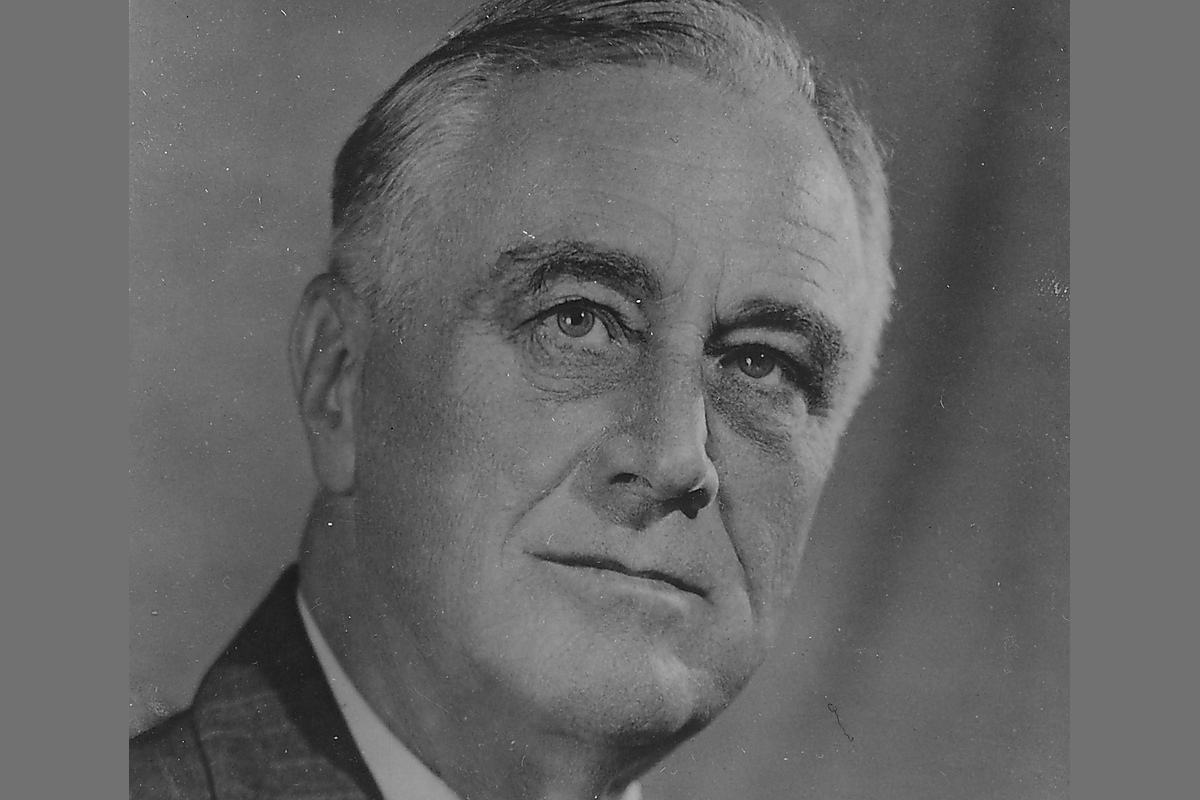
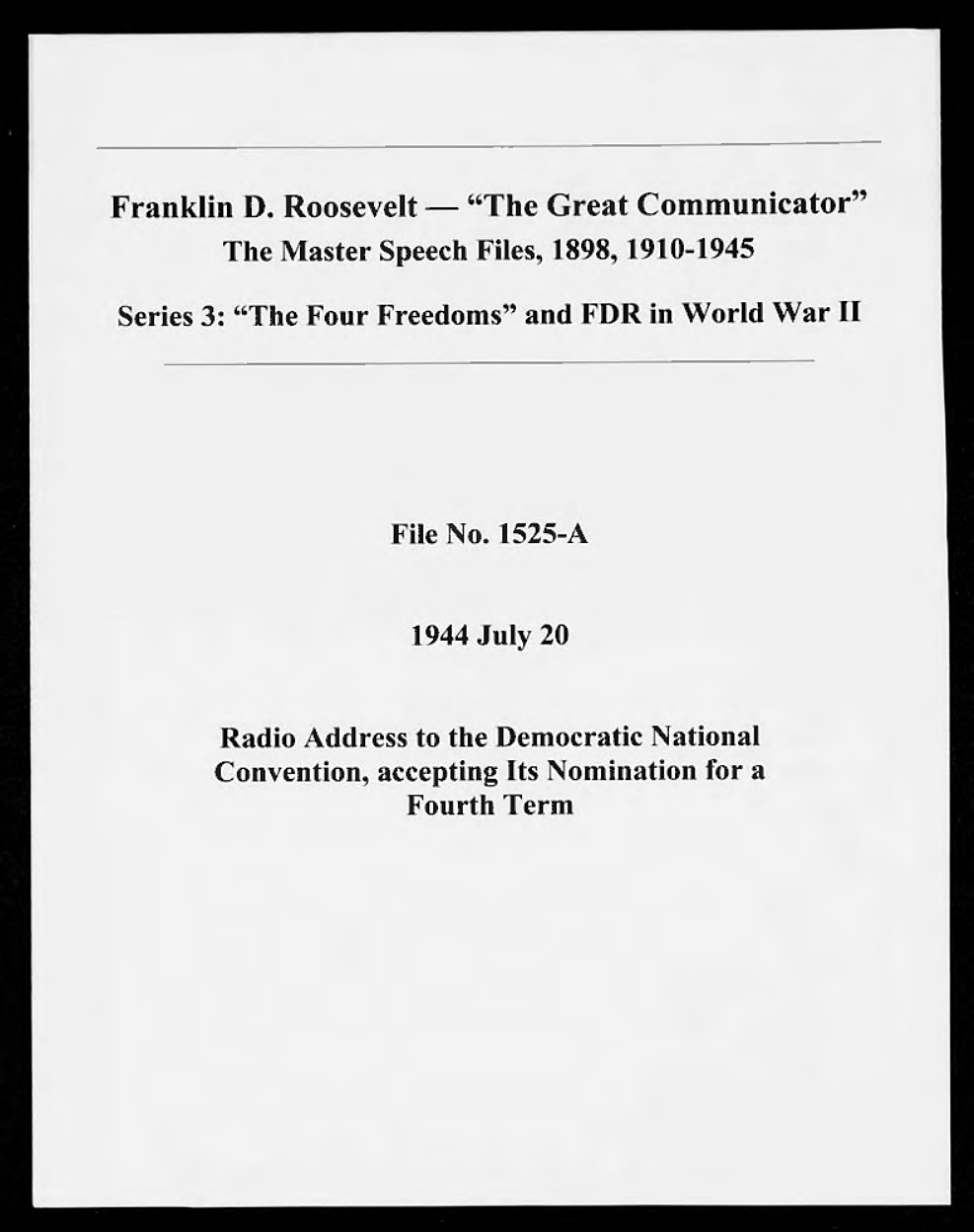
Picture Franklin Roosevelt accepting his fourth presidential nomination and you probably picture a podium, a packed hall, delegates on their feet. That is not what happened. On the night of July 20, 1944, the president accepted the nomination from a railroad car parked at a naval base in San Diego, California, more than two thousand miles from the Chicago Stadium floor where the Democratic Party had just chosen him.
He was not being cautious. He was on his way to Hawaii.
A convention held without its nominee
The 1944 Democratic National Convention ran three days, July 19 through July 21, at the Chicago Stadium. It was Roosevelt's fifth appearance on a national Democratic ticket, after a vice presidential run in 1920 and presidential nominations in 1932, 1936, and 1940. No other president in American history has matched that number on a major party ticket except Richard Nixon, who reached five between his two vice presidential nominations and three presidential ones.
Roosevelt skipped this convention the same way he had skipped the one in 1940. Wartime responsibilities made a personal appearance impractical, and Roosevelt was already traveling to Pearl Harbor, where he was scheduled to meet General Douglas MacArthur and Admiral Chester Nimitz to settle strategy for the Pacific campaign. The naval base stop in San Diego was a waypoint on that trip, not the destination.
The convention opened in Chicago while Roosevelt continued west by train. Governor Robert S. Kerr of Oklahoma delivered the keynote, praising Roosevelt's wartime leadership and New Deal record to a hall the president would never see in person. The first ballot for the presidential nomination came the next day, July 20. Roosevelt won it decisively: 1,086 votes against 89 for Virginia Senator Harry F. Byrd, who had never actively campaigned, and a single vote for former Postmaster General James Farley. Some Southern delegates had hoped to draft Byrd as a protest against Roosevelt's civil rights record, but the effort never came close to threatening the outcome.
That night, delegates gathered around radios to hear the man they had just nominated accept the honor from nearly a continent away. It would be 76 years before another major-party presidential nominee accepted a nomination entirely from outside the convention hall, when Joe Biden addressed the 2020 Democratic National Convention from Delaware during the COVID-19 pandemic.
What Roosevelt actually said
The speech itself was short on ceremony and long on sober arithmetic. Roosevelt told the delegates he was accepting out of obligation rather than ambition, and he made no effort to disguise his fatigue with campaigning. "I shall not campaign, in the usual sense, for the office," he said. "In these days of tragic sorrow, I do not consider it fitting."
He spent most of the address laying out what he considered the actual job ahead: winning the war outright, building international organizations capable of keeping the peace afterward, and preparing an economy that could absorb millions of returning veterans without repeating the breadlines of the early 1930s. The reading copy preserved in the FDR Library shows he added lines on the fly, including a small but telling hedge on Allied victory over Germany and Japan, changed in his own hand from a flat prediction to "sooner or later."
The speech closed by borrowing, deliberately, from Abraham Lincoln's second inaugural, asking Americans to finish the work of the war "with firmness in the right, as God gives us to see the right."
The fight nobody put on the radio
The real drama of the 1944 convention had nothing to do with the top of the ticket. It centered on who would stand behind Roosevelt as his running mate, and it was fought almost entirely out of public view.
Vice President Henry Wallace was popular with rank-and-file Democrats and was Roosevelt's own preference. He was also, in the judgment of the party's conservative wing, too far to the left and too closely tied to organized labor to be one heartbeat from the presidency at a moment when Roosevelt's health was visibly failing. A group of party operators, including national chairman Robert Hannegan, treasurer Edwin Pauley, strategist Edward Flynn, Chicago Mayor Edward Kelly, and lobbyist George Allen, worked to block Wallace's renomination. Allen gave the group a name that stuck: the Conspiracy of the Pure in Heart.
Roosevelt, characteristically, tried not to choose a side outright. He wrote to convention officials that he would be glad to run with either Wallace or Missouri Senator Harry Truman, a deliberately noncommittal endorsement that left the party bosses room to maneuver. Truman was not a natural pick. He had entered the Senate in 1935 carrying the reputation of being the candidate of a corrupt Kansas City political machine, and Roosevelt barely knew him. What Truman had built since then was a name for competence: he chaired the Senate committee investigating waste and fraud in wartime defense spending, work that made him a credible, unthreatening choice to party leaders looking for exactly that.
Wallace led comfortably on the first vice presidential ballot, 429.5 votes to Truman's 319.5, with the rest scattered among more than a dozen favorite-son candidates. It did not matter. By the second ballot, after a night of vote trading on the convention floor, Truman had it locked up, 1,031 to 105.
Samuel Jackson, the Indiana official who had worked hardest to secure Truman's nomination, later said he wanted his tombstone to read that he was the man who stopped Henry Wallace from becoming president. He was not exaggerating the stakes. Roosevelt died in office the following April, eleven weeks into the term he accepted from that rail car in San Diego. The vice president chosen through backroom negotiations most Americans never saw became the thirty-third president of the United States.
Roosevelt would go on to defeat Republican nominee Thomas Dewey that November, 432 electoral votes to 99, and remained the only president in American history ever elected to four terms. After his death, Congress proposed the Twenty-Second Amendment, formalizing the two-term tradition that earlier presidents, going back to Washington, had generally chosen to observe on their own. It was ratified in 1951.