Most people learn the Pearl Harbor story backward. Japan struck without warning, and America was pulled into a war it never wanted. That's the version that fits on a plaque.
Here's what doesn't fit on a plaque. Five months before the attack, the United States had already responded with its most powerful economic weapon. No bombs, no declaration, just a signature. On July 26, 1941, Franklin Roosevelt signed Executive Order 8832 and froze every Japanese asset in the country. Overnight, Japan's access to American banks and trade was frozen, and its access to American oil was placed under a licensing system that would soon become an effective embargo.
Many Japanese leaders regarded it as economic warfare, a hostile act just short of a shooting war.
A slow squeeze, not a sudden one
The freeze order didn't come from nowhere. Washington had been tightening the screws on Tokyo for years, one restriction at a time.
It started in 1938, when the U.S. government announced what came to be called the "moral embargo," a request, not a law, urging American companies not to sell airplanes and aircraft parts to countries bombing civilian populations. Japan was the intended target, though the embargo relied entirely on voluntary compliance. By December 1939, that same pressure extended to raw materials used in building planes: molybdenum, aluminum, nickel. On July 26, 1940, exactly one year before the freeze, Roosevelt restricted export licenses on iron, heavy scrap steel, lubricating oil, and aviation gasoline bound for Japan. Since Japan depended heavily on American exports, the restriction made it harder to keep fighting its war in China, a conflict that had been grinding on since 1937.
Japan didn't back off. It escalated. In September 1940, Japanese troops moved into northern French Indochina, aiming to cut off supply routes feeding Chinese forces. Days later, Japan signed the Tripartite Pact with Germany and Italy, formally joining the Axis.
By July 1941, Japan pushed further south, occupying the rest of French Indochina with the cooperation of the Vichy French government. The goal was air and naval bases within striking distance of British Malaya, the Dutch East Indies, and the Philippines. That move is what triggered the freeze, not the other way around. Roosevelt signed the order in direct retaliation for the occupation of southern Indochina, and he extended the same freeze to Chinese assets at the request of Chiang Kai-shek, as a gesture of support for China. Britain and the Dutch East Indies followed Washington's lead within days.
What the freeze actually did
On paper, an asset freeze sounds bureaucratic. In practice, it strangled Japan's economy. Because so much international trade, including Japan's transactions with Latin America and Europe, was settled through the dollar-based American financial system, the freeze didn't just cut off the United States. It cut off Japan's ability to do business almost everywhere.
Oil was the real chokepoint, and it didn't happen in one clean stroke. The July 26 freeze required Japan to obtain a license for any purchase, and for a few weeks the Roosevelt administration left open the possibility that some oil licenses might still be approved. By early August, almost none were. That gradual tightening, not a single announcement, is what historians generally mean by "the oil embargo." Japan had imported roughly 80 to 90 percent of its oil, and the bulk of that had come from the United States. With American oil effectively cut off, Japanese planners estimated their reserves would last somewhere between eighteen months and three years, depending on how much of that fuel went to the military versus everyday civilian use. Nobody was working from an exact number. Everybody agreed the clock was running.
Japan's leadership didn't simply pick between two doors. Over the following months, cabinet ministers and military planners argued through a whole menu of bad options: keep negotiating and hope for a diplomatic opening, pull troops back from Indochina and China, ride out the economic decline and stay put, or push into the oil fields of the Dutch East Indies while somehow avoiding a shooting war with the United States, a scenario most planners considered wishful thinking. War was on that list too, and it wasn't the first option anyone reached for. It became the dominant one only after months of imperial conferences failed to produce a diplomatic way out, and after a final round of negotiations collapsed in late November 1941, when the United States delivered what became known as the Hull Note, a set of terms many Japanese leaders read as an ultimatum. By then, the military had concluded that war offered Japan's best remaining chance.
The document itself
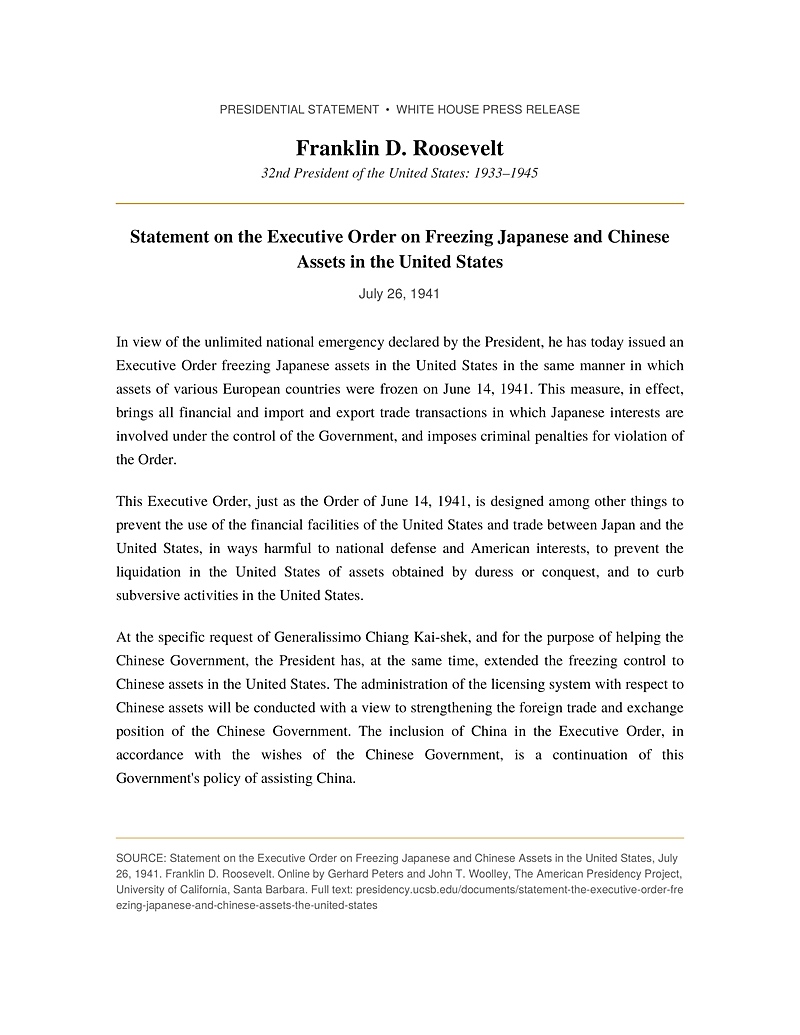
The White House statement announcing the order, released the same day Roosevelt signed it, is careful, almost clinical in tone. It frames the freeze as a defensive measure "to prevent the use of the financial facilities of the United States" for purposes harmful to American interests, and to stop the liquidation of assets "obtained by duress or conquest." Nowhere does it use the word war. It didn't need to. Japanese leaders understood what it meant.
Four months later, on December 7, 1941, Japan attacked Pearl Harbor.
Historians still argue about how much credit, or blame, the freeze deserves. Some see it as a sanction that backed Japan into a corner it couldn't escape without war. Others point out it also bought the United States time to rearm and signaled a resolve Tokyo couldn't ignore. What's not really in dispute is the sequence: the signature came first, and the bombs came after.
The plaques remember the bombs. They rarely mention the signature that came first.