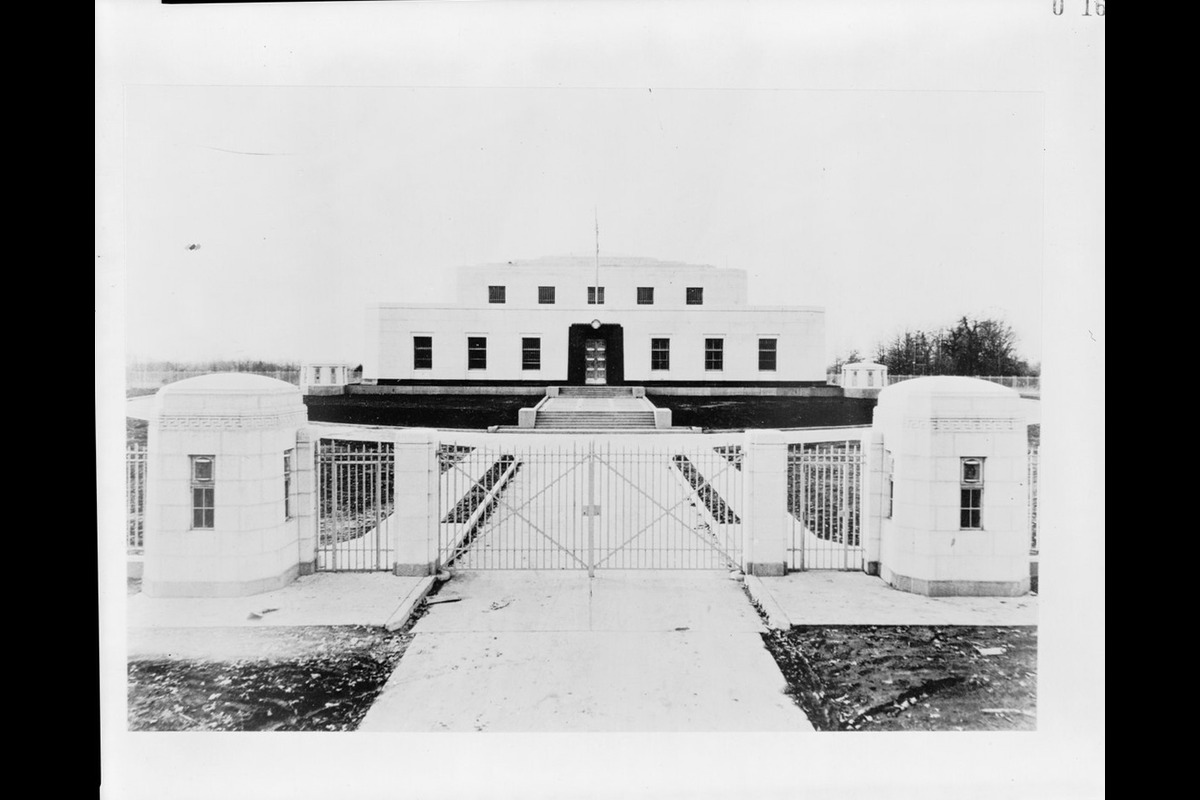
On June 28, 1935, federal officials quietly disclosed a plan that had been kept secret for months. The Treasury Department was going to build a vault. Not just any vault. A heavily fortified, blast-resistant depository built on an active Army post in the middle of Kentucky, hundreds of miles from any coast.
What they did not advertise in that announcement was the full story of where the gold had come from.
First, They Took the Gold
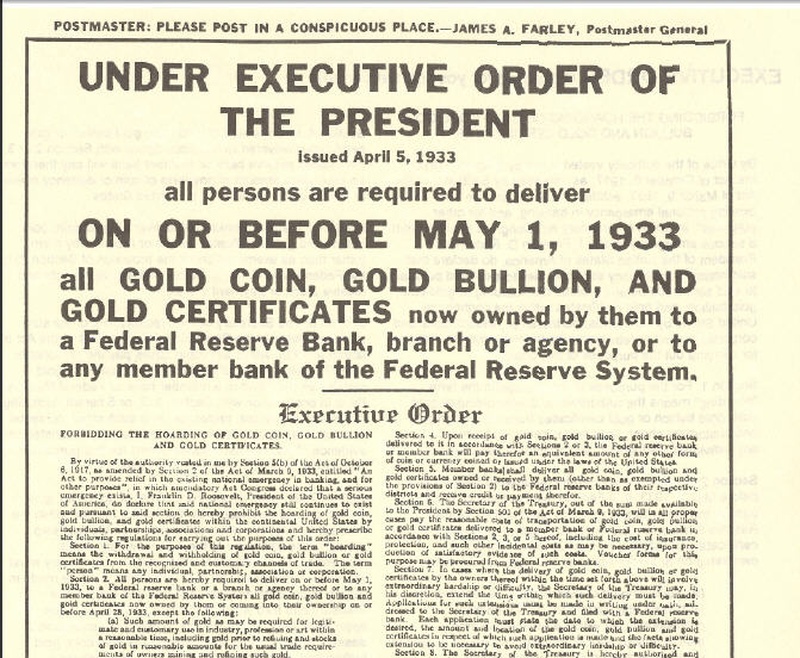
Two years earlier, on April 5, 1933, President Franklin D. Roosevelt had signed Executive Order 6102. The order, issued under authority derived from the Trading with the Enemy Act of 1917 as amended by the Emergency Banking Act of March 1933, was blunt: most Americans holding monetary gold were required to surrender their gold coins, bullion, and gold certificates to the Federal Reserve on or before May 1, 1933. The payment rate was $20.67 per troy ounce.
The penalty for refusal was a $10,000 fine, ten years in prison, or both.
Exceptions were narrow. Jewelers and industrial users could keep small working quantities. Collectors could retain coins of recognized numismatic value. Most holders of monetary gold complied, treating it as a wartime-style sacrifice for a nation that had been bleeding economically for three years.
Then, the following January, Roosevelt signed the Gold Reserve Act of 1934. Among other provisions, it transferred all monetary gold in the Federal Reserve to the U.S. Treasury outright. And on the day after signing the Act, Roosevelt issued a proclamation raising the official price of gold from $20.67 per troy ounce to $35.
The people who had surrendered their gold at $20.67 had no recourse. The revaluation produced a bookkeeping gain for the Treasury of roughly $2.8 billion, the equivalent of more than $60 billion today, which was used to establish the Exchange Stabilization Fund. The dollar was simultaneously devalued by the same stroke. Americans had been paid in the old currency for gold that was immediately repriced 69 percent higher.
Then, They Needed Somewhere to Put It
By mid-1935, the scale of the accumulated stockpile had outrun available storage. Federal Reserve banks and branch mints were running out of room. The Treasury needed a solution, and it needed one that fit a second, less-publicized concern: fear of attack.
The gold reserves were concentrated in New York and Philadelphia, coastal cities vulnerable to naval bombardment or, in an increasingly unstable world, worse. The decision was made to move the reserves inland, and the location chosen was the grounds of Fort Knox, Kentucky, an established Army post in north central Kentucky.
The military logic was deliberate. Contemporary planners believed the Appalachian Mountains added a natural layer of protection against a hypothetical invasion from the Eastern Seaboard. The Army's only fully mechanized cavalry unit was already stationed at the adjacent fort, ready to defend the facility on short notice. There were also practical benefits: centralized storage, an existing military installation, and distance from vulnerable port cities.
On June 28, 1935, the Treasury disclosed the plan publicly. Construction began the following year.
What They Built
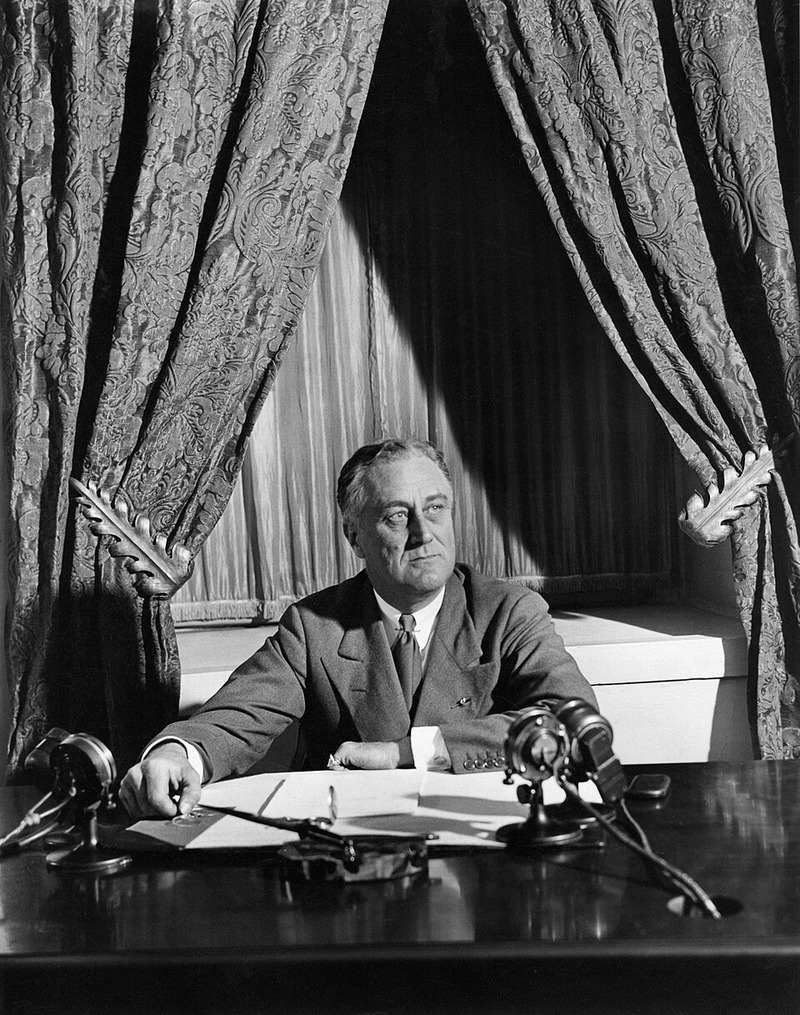 President Franklin D. Roosevelt preparing for a fireside chat, March 12, 1933. Harris and Ewing, public domain.
The United States Bullion Depository was completed in December 1936 at a cost of $560,000. The building measures 105 by 121 feet and rises 42 feet above ground level. Its construction consumed 16,500 cubic feet of granite, 4,200 cubic yards of concrete, 750 tons of reinforcing steel, and 670 tons of structural steel. The granite was quarried in North Carolina.
Below the structure lies the vault itself. The vault casing is 25 inches thick. The main door, manufactured by the Mosler Safe Company, is 21 inches of torch-and-drill-resistant steel and weighs 20 tons. It operates on a 100-hour time lock. No single person holds the full combination. Multiple staff members must each dial separate combinations known only to themselves. An escape tunnel runs from the lower vault level for anyone accidentally locked inside, operable only from within when the doors are closed and locked.
The surrounding grounds are enclosed by security fencing and rings of razor wire, monitored by extensive electronic security systems, and guarded by the United States Mint Police.
Visitors are not permitted inside. In the nearly nine decades since it opened, only three groups of outsiders have ever been allowed in: President Roosevelt visited the depository in 1943, a congressional delegation and press corps were admitted in 1974, and Treasury Secretary Steven Mnuchin brought a small group of officials in 2017.
The Gold Moves
The first shipment of gold arrived on January 11, 1937, shipped from the Philadelphia Mint via the United States Postal Service, the only agency at the time that could insure assets at that scale. The delivery was anything but routine.
Postal trucks moved gold onto trains under municipal police escort. Inside the armored cars, postal workers were accompanied by soldiers, Secret Service agents, and Mint guards. Contemporary accounts describe the use of decoy trains on parallel routes. At the Kentucky end, Army trucks under cavalry escort transferred the bullion to the depository under the protection of troops armed with armor-piercing ammunition and machine guns.
The first wave of shipments ran semi-weekly from January through June 1937, requiring 39 trains and 215 rail cars. It moved 157.8 million troy ounces of gold, nearly 45 percent of all U.S. gold reserves at the time. A second major wave followed in 1940 and 1941, ultimately bringing the depository's total to more than 416 million troy ounces, roughly 65 percent of all U.S. gold reserves.
By the end of 1940, the United States held approximately 80 percent of the world's official monetary gold.
What Else Went In
During World War II, the vault held more than gold.
As German forces swept through Europe and the threat of attack on Washington grew real, the Librarian of Congress, Archibald MacLeish, arranged to transfer the nation's most irreplaceable documents to Fort Knox for safekeeping. They arrived by train on December 26, 1941, nineteen days after Pearl Harbor. The shipment included the signed originals of the Constitution, the Declaration of Independence, and the Articles of Confederation, two autographed drafts of Lincoln's Gettysburg Address, Lincoln's Second Inaugural Address, a Gutenberg Bible, and an exemplified copy of the Magna Carta that had been on loan from Lincoln Cathedral since the 1939 World's Fair.
Special bronze containers were heated for six hours to drive out moisture before the documents were sealed inside, then embedded in mineral wool and encased in lead. Air conditioning and calcium chloride dryers were installed in the vault to protect against humidity and insects.
After the war, the vault held the Crown of St. Stephen and the Hungarian crown jewels, given to American military authorities by members of the Royal Hungarian Crown Guard who feared they would fall to the Soviets. They remained at Fort Knox until 1978.
During the Cold War, the depository also stored the nation's emergency stockpile of opium and morphine, enough to meet the entire country's legal painkiller needs for one year if foreign supplies were cut off.
What's There Now
Fort Knox currently holds 147.3 million troy ounces of gold, a little more than half of all gold held by the United States government. The Treasury carries it on the books at $42.22 per ounce, a statutory figure frozen in 1973. At today's market price, the same gold is worth roughly $600 billion.
The vault combination remains unknown to any single person. No tour is offered. No visitor gets in without a decision at the cabinet level.
The original document that started all of it, Executive Order 6102, sits in the National Archives. One page. Roosevelt's signature at the bottom.
It ordered most Americans holding monetary gold to surrender it to the Federal Reserve in exchange for paper currency.
They had until May 1, 1933, to comply.