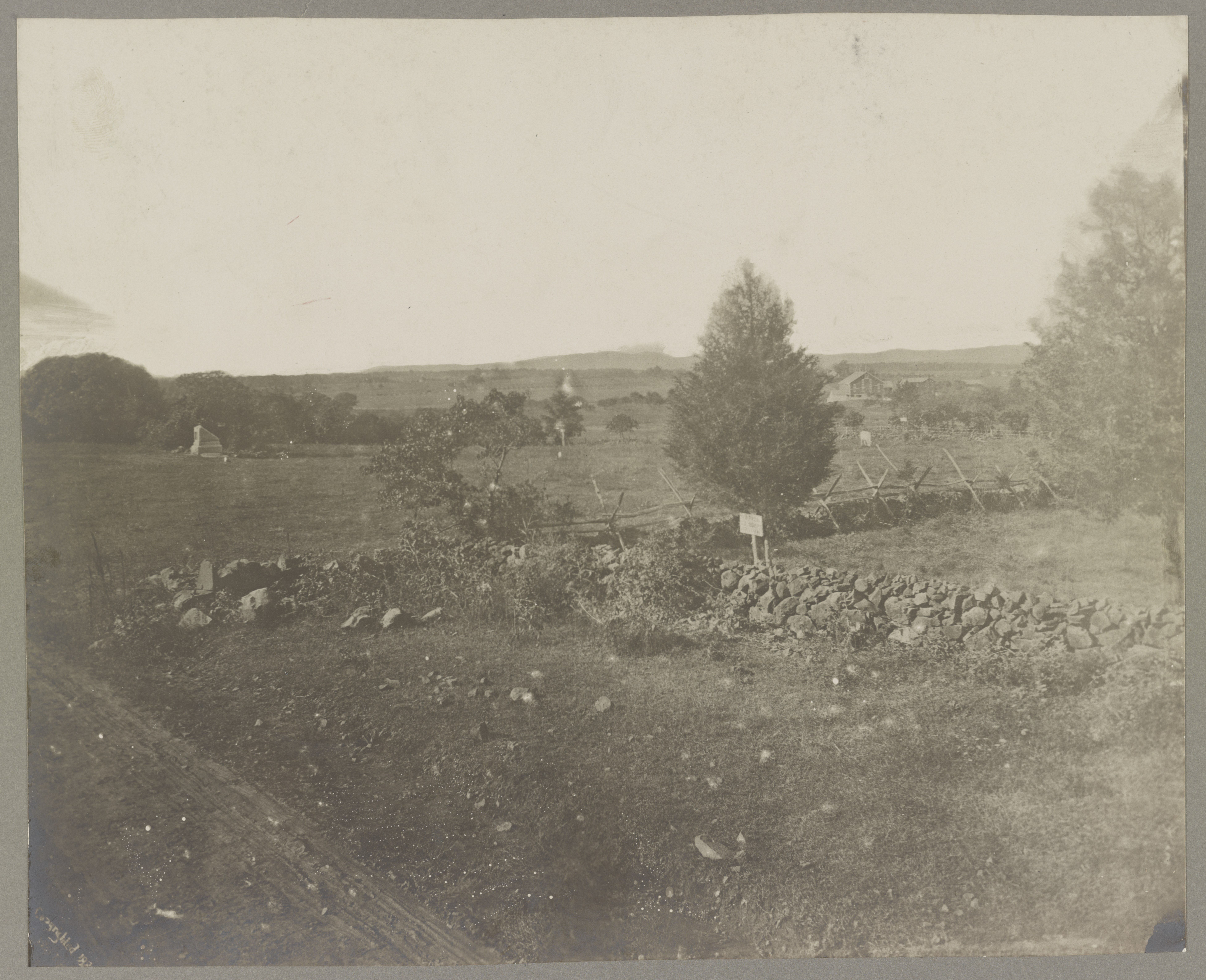
On the afternoon of July 3, 1863, three Confederate divisions stepped out of the tree line on Seminary Ridge and started walking across three quarters of a mile of open Pennsylvania farmland. Roughly 12,500 men. Within an hour, more than half of them would be dead, wounded, or captured.
History remembers this as Pickett's Charge. History remembers it as an order Robert E. Lee gave, and George Pickett carried out.
The paper trail from that afternoon tells a messier story. The word to advance was never actually spoken by the man everyone assumes spoke it. It moved down a chain of three officers, each one trying not to be the one who pulled the trigger, until an artillery colonel running low on ammunition made the call almost by default.
The Document on the Table
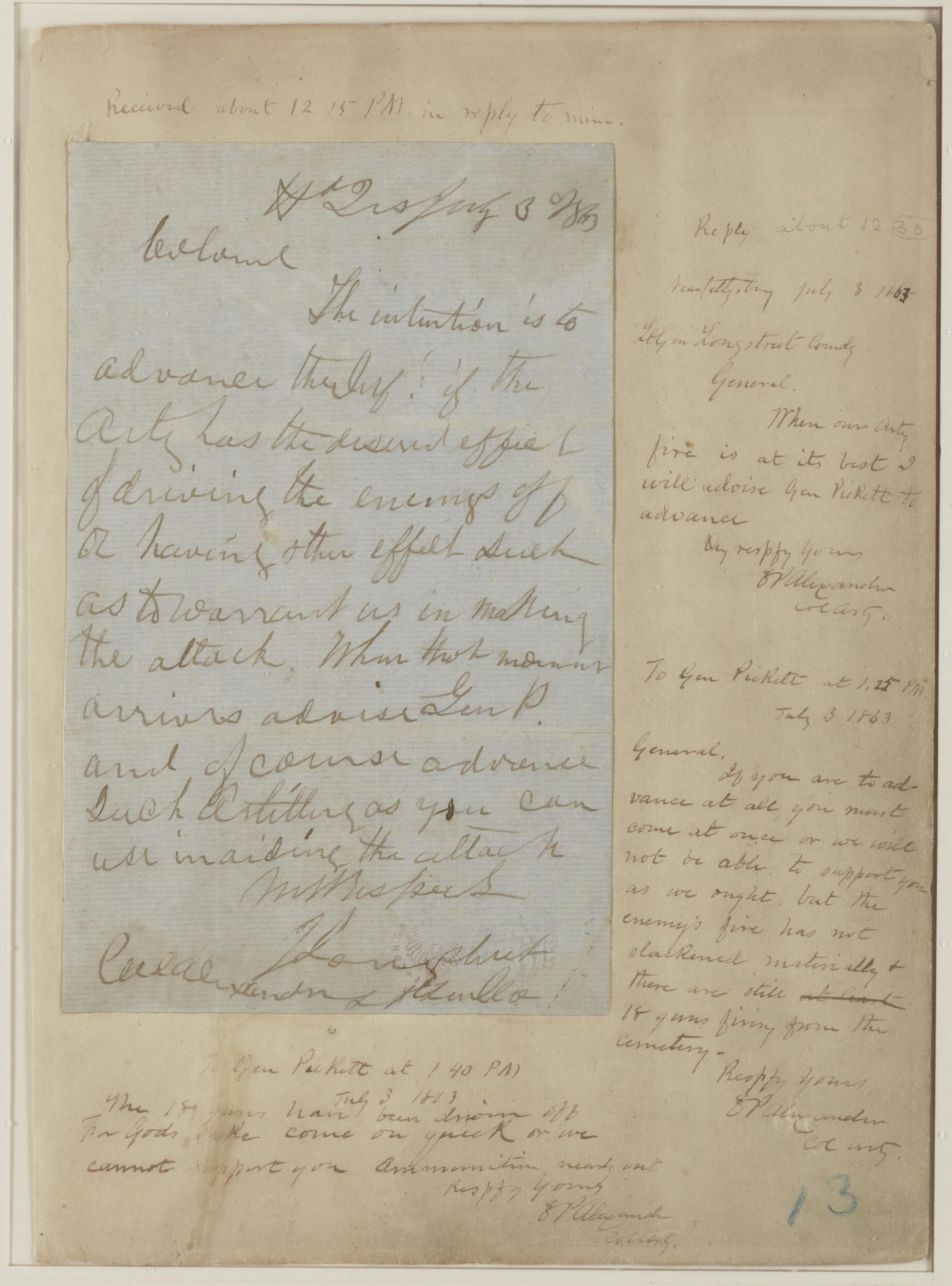
The pages above are battlefield dispatches, written in pencil in the middle of the largest artillery bombardment of the Civil War. They passed between three men on July 3, 1863: Lt. Gen. James Longstreet, Col. Edward Porter Alexander, and Maj. Gen. George Pickett. They are part of the Edward Porter Alexander Papers, held today by the Library of Congress.
Read them in order and a pattern emerges. At the top, Longstreet writes to Alexander with instructions that sound less like a battle plan and more like an attempt to hand off responsibility. The intention, he writes, is to advance the infantry if the artillery has the desired effect of driving off the enemy or having some other effect that would warrant making the attack. When that moment arrives, he tells Alexander, advise General Pickett. Longstreet closes with "Most respectfully" and signs his name.
He does not specify exactly when the attack should begin. Instead, he tells Alexander to judge when the bombardment has achieved the desired effect and then notify Pickett.
Alexander's reply comes back within the hour: "When our arty fire is at its best I will advise Gen Pickett to advance."
Then, at 1:25 p.m., a note from Alexander to Pickett directly: "If you are to advance at all you must come at once or we will not be able to support you as we ought, but the enemy's fire has not slackened materially and there are still 18 guns firing from the cemetery."
Fifteen minutes later, a final message: "The 18 guns have been driven off. For God's sake come on quick or we cannot support you. Ammunition nearly out."
That is the message that actually set the assault in motion. Not a command from Lee. Not even a clean instruction from Longstreet. A colonel of artillery, watching his shells run out, telling an infantry general to hurry up before it was too late to help him.
Fifteen Thousand Men Who Had Never Been Arrayed for Battle
The attack had been Lee's idea, and Lee's alone. Longstreet, his most trusted corps commander, argued against it that morning in terms he would repeat for the rest of his life. In his postwar memoir, Longstreet recalled telling Lee that no army had the numbers to make the attack succeed. Lee had told him the assault force would number fifteen thousand men. Longstreet's response, as he later wrote it: "the fifteen thousand men who could make successful assault over that field had never been arrayed for battle."
Lee was not in a mood to be talked out of it. He had beaten this army before. He believed the Union center, battered by two days of fighting on its flanks, was the weak point left to exploit. He gave the order to prepare the attack and left the details of timing to Longstreet.
Longstreet, by his own account, could not bring himself to give the final word out loud. When Pickett rode up before the charge and asked whether he should advance, Longstreet did not answer. He only nodded, or in his own recollection, could not speak and simply bowed his head. Pickett took that as his order and rode off to form his division.
So the chain runs like this: Lee decided there would be an attack, and told Longstreet to run it. According to Longstreet's later recollection, he could not bring himself to speak the order, and left the timing decision to his artillery colonel. Alexander watched the bombardment, watched his ammunition dwindle, and told Pickett to move before support ran out entirely. Pickett moved when Alexander signaled that the bombardment had reached the point Longstreet had designated for the advance, the final link in a decision Lee had made hours earlier.
Three fresh divisions who had not fought in the first two days of the battle, Pickett's among them, formed the spearhead. Two more divisions, worn down from July 1, marched alongside them. Together they walked toward a low stone wall on Cemetery Ridge, at a jog in the fence line the soldiers would later call the Angle, next to a stand of oaks known as the Copse of Trees.
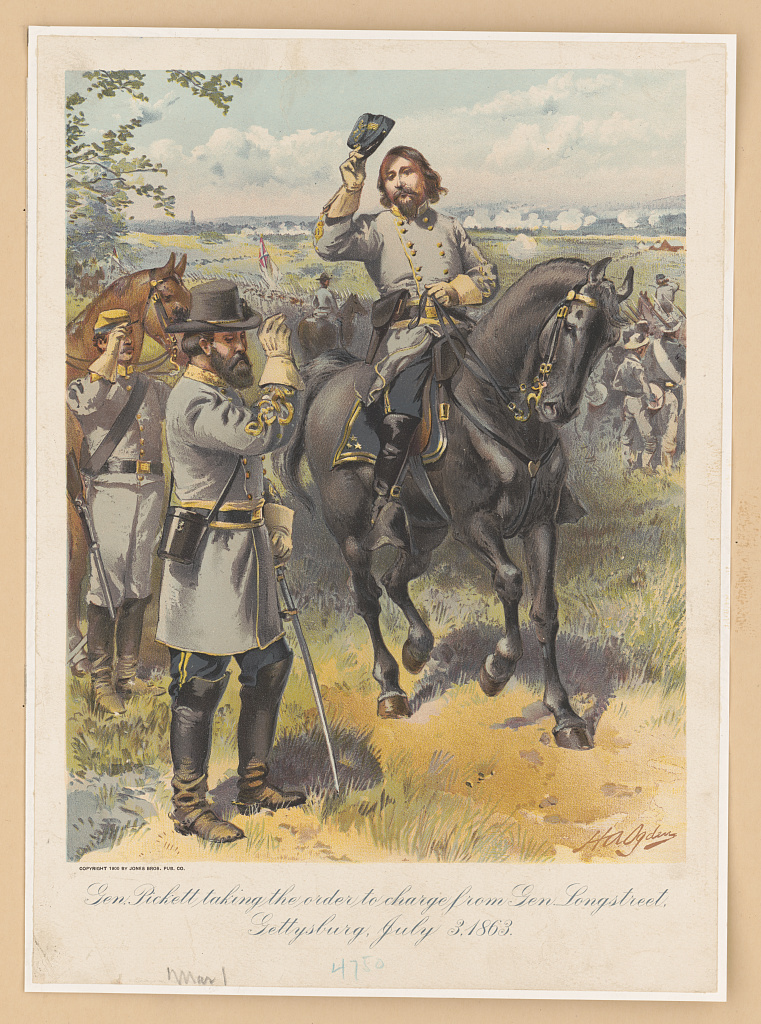 Gen. Pickett taking the order to charge from Gen. Longstreet, Gettysburg, July 3, 1863. Henry Alexander Ogden, artist, 1900. Library of Congress, public domain.
Fifty Minutes
Union artillery under Brig. Gen. Henry Hunt had spent the bombardment deliberately going quiet, one battery at a time, to convince Alexander his guns were doing their job. It worked. When the Confederate infantry stepped into the open field, the Union cannon that Alexander believed were silenced opened up again with devastating effect, joined by rifle fire from Maj. Gen. Winfield Scott Hancock's II Corps dug in along the ridge.
Only one brigade briefly broke through the Union line. Brig. Gen. Lewis Armistead led his men over the stone wall at the Angle, his hat raised on the tip of his sword, and was shot down moments later. He is remembered as having shouted "Give them cold steel, boys!" as he fell. His breakthrough lasted only minutes before Union reinforcements sealed the gap. The moment is remembered today as the high water mark of the Confederacy, the farthest the Army of Northern Virginia ever advanced into Union lines.
Pickett's division lost roughly two out of every three men who marched with it that afternoon. All three of his brigade commanders were killed or wounded. Across the full assault force, casualties ran past half. Lee met the survivors as they straggled back to Seminary Ridge and told them plainly, "It's all my fault."
"General, I Have No Division"
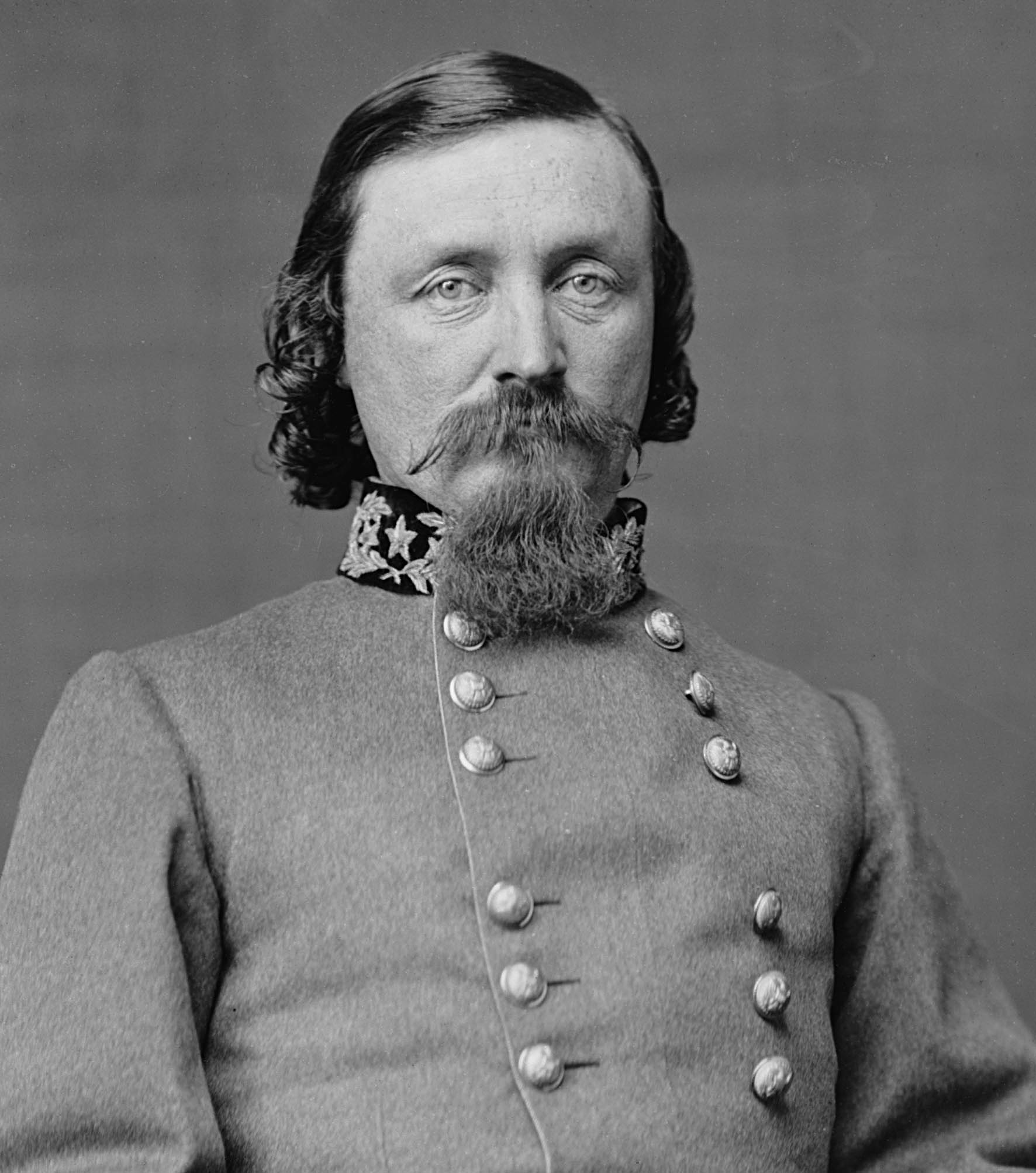 Maj. Gen. George E. Pickett. Library of Congress, public domain.
Pickett never forgave him. When Lee later asked Pickett to rally what remained of his command in case of a Union counterattack, Pickett is said to have answered, "General, I have no division." He was, by most accounts, inconsolable for the rest of the day.
The charge is remembered today by the name of the man who led it. The order behind it belongs to no one man cleanly. Lee decided there would be an attack and never spoke the word himself. Longstreet could not say it out loud and passed the timing decision to his artillery chief. Alexander, watching his shells run low, told Pickett to come on quick or be left unsupported. Pickett went forward on that signal, the last link in a chain of command Lee had set in motion hours before.
Twelve thousand five hundred men crossed that field because of how the order moved, not just because of what it said.