On the morning of May 10, 1775, Ethan Allen and Benedict Arnold stormed Fort Ticonderoga in the dark, caught its sleeping garrison by surprise, and took the fort without losing a man. It became one of the most celebrated opening acts of the Revolution. Schoolchildren still learn the line Allen supposedly shouted at the fort's commander: "in the name of the Great Jehovah and the Continental Congress."
Two years later, the British took the fort back. No battle. No dramatic surrender. No line anyone remembers.
They just walked in.
The Mountain Nobody Defended
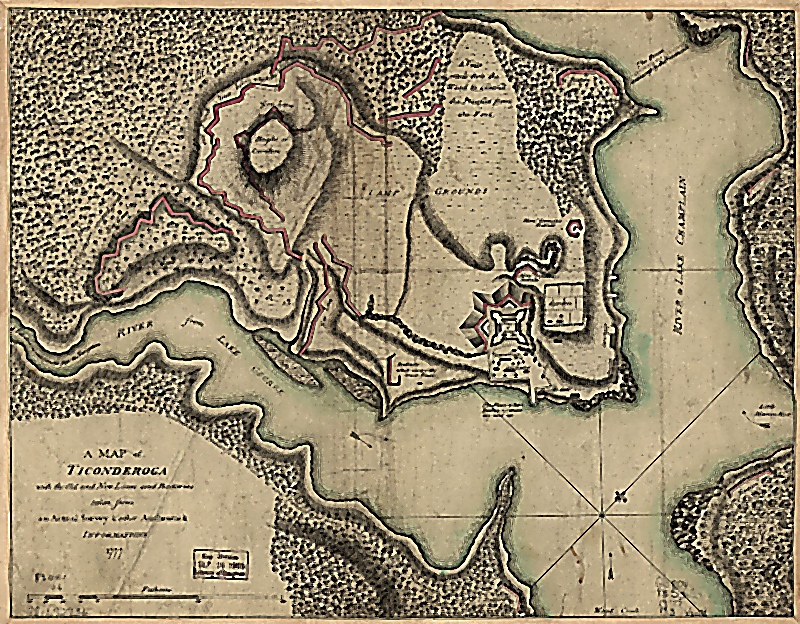
By the summer of 1777, Fort Ticonderoga was still known as the "Gibraltar of the North," a reputation built after its French defenders repelled one of the largest British armies yet assembled in North America in 1758. American engineers had spent the winter reinforcing its walls and fortifying a peninsula across the water called Mount Independence. What they had not done was properly defend a height called Sugar Loaf, later renamed Mount Defiance, overlooking both positions. Officers including John Trumbull, Anthony Wayne, and an injured Benedict Arnold had climbed it the year before and noted that cannon could probably be dragged to the top. The prevailing belief was that it was impractical to actually do it, and that abandoning the fort to properly garrison the hill was not a politically viable option anyway.
British engineers disagreed. Starting July 2, they began quietly clearing gun emplacements on the summit. By July 4, while the Americans below held a subdued toast to the previous year's Declaration of Independence, the British finished hauling artillery into position above them. The Americans did not realize what had happened until that night, when Indian scouts accompanying the British lit fires on the summit and gave the position away.
"Save His Character, or Save the Army"
Major General Arthur St. Clair commanded a badly under-strength garrison, somewhere between 2,500 and 3,000 effectives, against roughly 7,800 British and German regulars, supported by Native American allies. A war council on June 20 had already concluded the position was "greatly inadequate to the defense" and that "it is prudent to provide for a retreat." When St. Clair saw British guns on the heights on July 4, that assessment became fact rather than contingency.
St. Clair described the choice to a quartermaster in terms that left no room for comfort: he could "save his character and lose the army" by holding the fort, or "save the army and lose his character" by ordering a retreat. He chose the army.
The Night They Slipped Away
The withdrawal began after dark on July 5. St. Clair loaded the sick, the wounded, and as many supplies and armaments as the boats could carry, and sent them up the lake toward Skenesboro under Colonel Pierse Long. There were not enough boats. Four invalids were left behind, along with the largest cannons and a scattering of supplies down to tents and cattle. The rest of the army crossed to Mount Independence and marched for Hubbardton, on a road the German column had not yet reached.
Secrecy was the entire plan, and it lasted only a few hours. A French volunteer officer, the Chevalier de Fermoy, reportedly set fire to his own quarters on Mount Independence before leaving. The blaze lit up the night sky and told the British exactly what was happening. A small guard left at the pontoon bridge with loaded, double-shotted cannon, meant to cover the retreat, had emptied the last of the command's wine and fallen asleep by the time British troops arrived the next morning, and never touched off a shot.
By the morning of July 6, British and German troops occupied Fort Ticonderoga and Mount Independence without firing a shot in either direction. Advance units pursued the retreating Americans down the Hubbardton road.
"We Shall Never Defend a Post Until We Shoot a General"
Word reached George Washington within days. He wrote to General Philip Schuyler, St. Clair's superior, calling the evacuation "an event of chagrin and surprise, not apprehended nor within the compass of my reasoning." John Adams was less measured: "I think we shall never be able to defend a post," he wrote, "until we shoot a general."
Rumors spread that St. Clair and Schuyler had been bribed to abandon the fort. Congress ordered both men brought before courts-martial. The proceedings did not convene until September 1778, delayed in part by political maneuvering against Washington himself. Both generals were fully exonerated. Neither was ever given another field command during the Revolution. St. Clair's next major command would not come until 1791, when he led American forces to one of the worst defeats in U.S. military history against a Native American confederacy in the Northwest Territory, a disaster that still bears his name.
Across the Atlantic, the news landed differently. King George III is reported to have burst into the Queen's chambers, exclaiming, "I have beat them! I have beat all the Americans!" France and Spain, both quietly aiding the American cause, were unsettled enough by the British victory that London tried to press the advantage, demanding both crowns close their ports to American ships. Both refused.
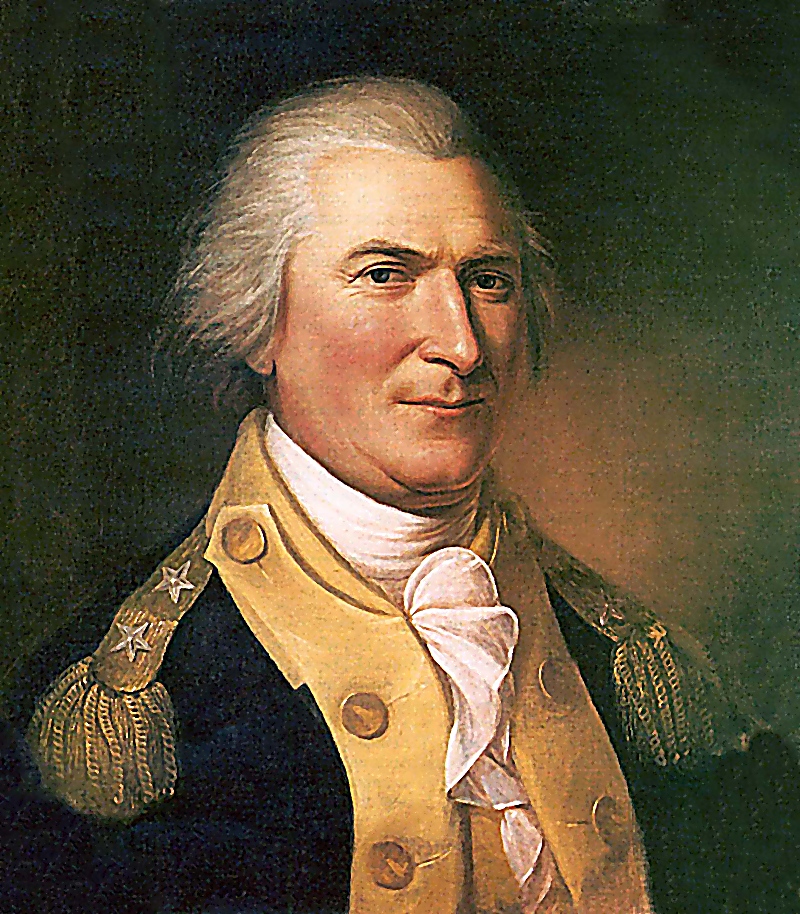 Major General Arthur St. Clair. Portrait attributed to Charles Willson Peale.
The Retreat That Won the War
St. Clair's decision looked like a disaster in July. Casualty counts from the campaign vary by source and by which skirmishes are included, but even the higher estimates describe a fight measured in dozens of dead and wounded on each side, not the mass losses a defense of the fort itself might have produced. The retreating column did lose men, supplies, and artillery in the running fights that followed at Hubbardton and Fort Anne. But most of St. Clair's army escaped destruction and lived to join General Horatio Gates's forces near Saratoga that fall.
Burgoyne, meanwhile, pushed on toward Albany, still garrisoning the fort he had just won, with supply lines stretched hundreds of miles back through increasingly hostile country. At Saratoga that October, his army was surrounded and forced to surrender, a defeat significant enough to bring France into the war on the American side. The British abandoned Fort Ticonderoga the following month, destroying what they could of its defenses before they left.
The fort that fell twice without a real fight ended up mattering less than the ground it forced two armies to fight over.