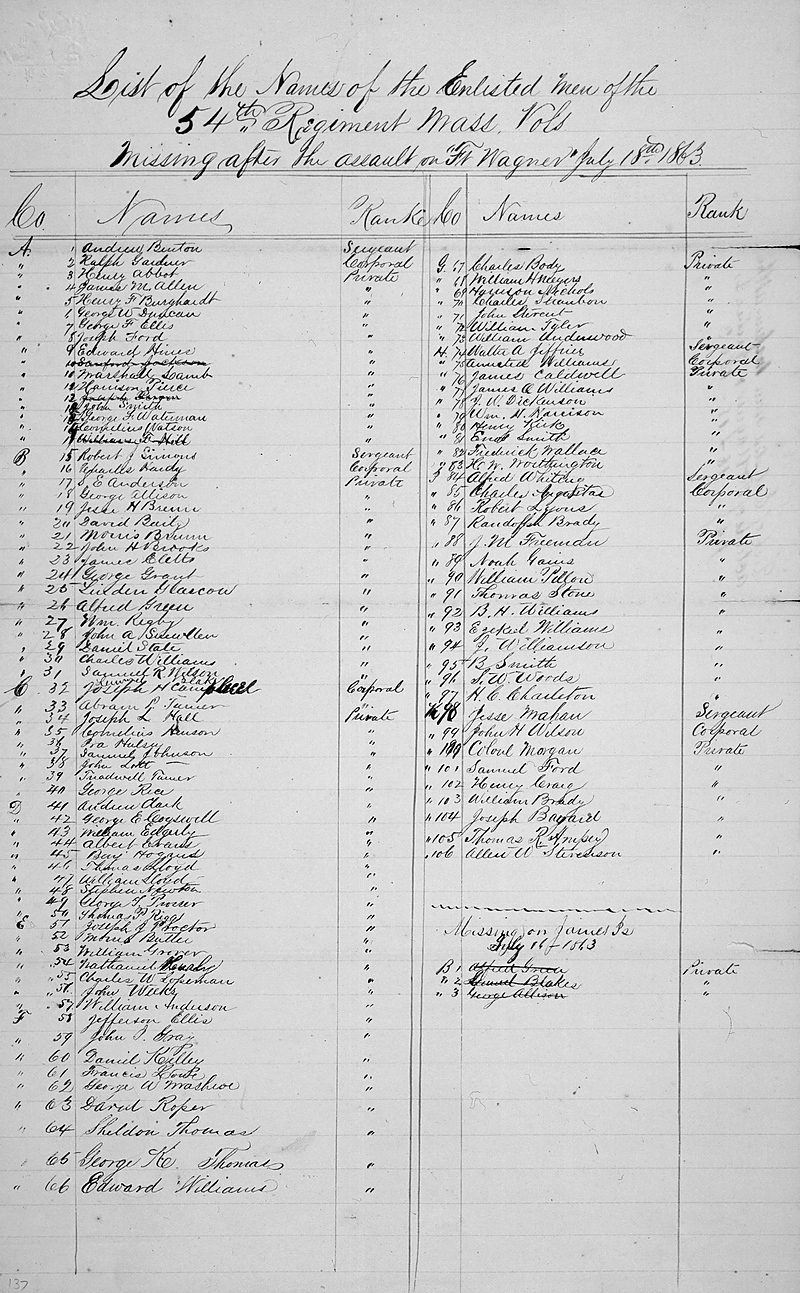
The document above is not a record of the dead. It is a record of not knowing.
Compiled in the days after July 18, 1863, it lists 106 enlisted men of the 54th Massachusetts as missing after the assault on Fort Wagner. Not killed. Missing. The Army did not yet know which of those men were dead, which were prisoners, and which might still stagger back into camp. Some names on that page belonged to men who were already in shallow graves on Morris Island. A few belonged to men who would turn up alive weeks later. The paperwork could not tell the difference yet, and in some cases, it never fully could.
That gap between what happened and what got written down is worth sitting with, because it runs through almost every part of this story.
A regiment thrown straight into the hardest assignment
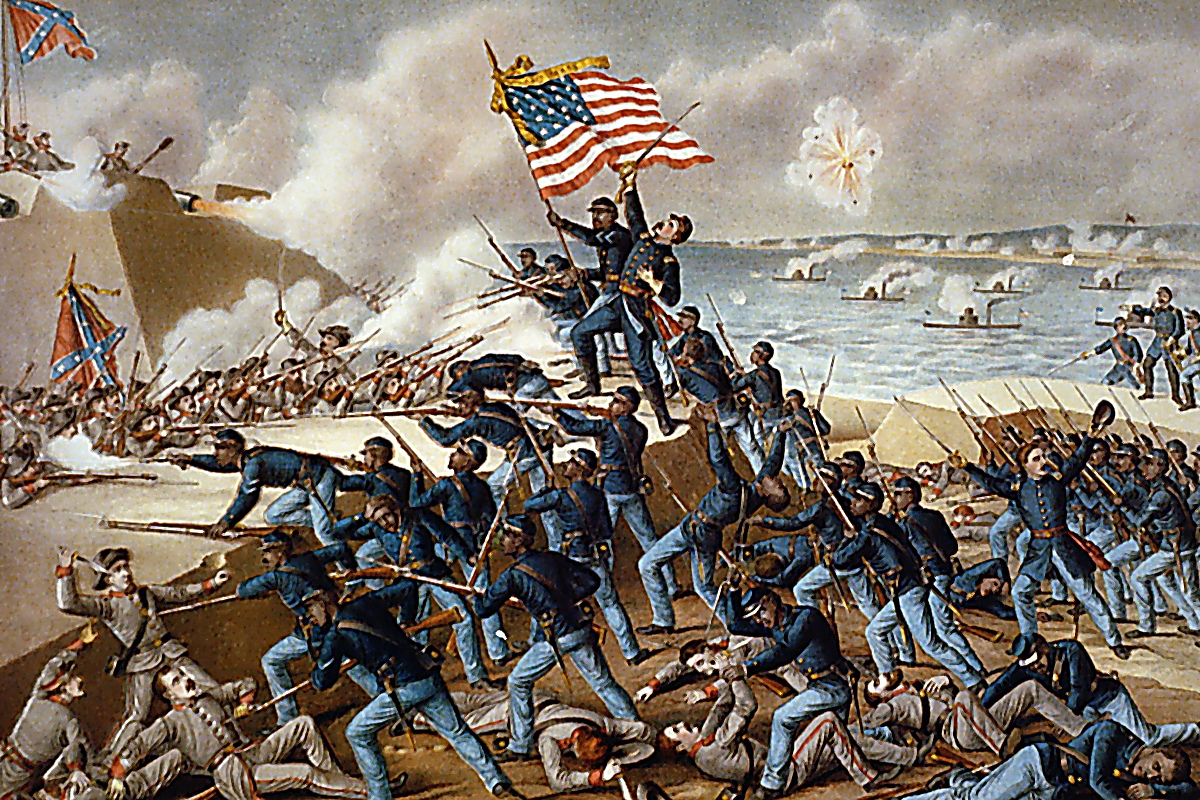
The 54th Massachusetts had been in the field only since May. By mid-July they had already marched, raided, and fought on James Island, where they held off a Confederate attack on July 16 and earned a formal commendation for their conduct. Two days later, still worn down from the fighting and the exhausting march that followed it, they were placed at the front of the column for an assault on Fort Wagner, the earthwork guarding the approach to Charleston Harbor.
Estimates of how many men the regiment put into that charge vary by source, landing somewhere between about 600 and 650. That range itself is a small example of the larger problem: strength returns shifted daily with sickness, detached duty, and men still making their way back from James Island, so no single number was ever going to be exact.
At around 7:45 in the evening, after a full day of naval and artillery bombardment that had done far less damage to the fort than the Union command hoped, Colonel Robert Gould Shaw led the regiment down a narrow strip of beach toward Wagner's walls. Confederate defenders, sheltered through the bombardment, came up to meet them. Shaw reached the parapet, was shot, and died there. The fighting that followed was close and chaotic, much of it hand to hand, with darkness, confusion, and overlapping attacks creating conditions in which friendly fire may also have occurred.
The numbers nobody can quite agree on
Here is what the record does support with reasonable confidence: of the roughly 600 to 650 men of the 54th Massachusetts who went into the assault, something close to 270 to 280 became casualties, killed, wounded, captured, or missing. That is somewhere in the neighborhood of 40 to 45 percent of the regiment in a single hour of fighting. Shaw was among the dead.
Push for more precision than that and the sources start to diverge. One tally lists 20 killed outright, 24 more who died of wounds, 15 captured, 52 missing, and 149 wounded. Another account gives 281 total casualties, with 54 killed or mortally wounded and 48 never accounted for. The document at the top of this article, the missing list itself, names 106 men, a number that does not cleanly match either total, because it was compiled before the fog had cleared.
Confederate losses show the same pattern. Brigadier General William B. Taliaferro, who commanded the fort's defenders, put his own casualties at 36 killed and 145 wounded and missing in his official report, a total of 181. Later secondary accounts put the number at 174, or as high as 222, depending on which source is doing the counting. Even the officer who was there, writing his own after-action report, did not produce a figure that later histories consistently repeat.
None of this is a scandal. It is simply what battlefield record-keeping looked like in 1863, done by exhausted men under fire, updated as new information trickled in over days and weeks. But it is a useful corrective to the version of this story that gets told with clean, confident numbers, as though someone stood at the base of Fort Wagner with a clipboard and got it right the first time.
The flag, and the medal that took 37 years to catch up
One soldier's actions that night are not in dispute. Sergeant William Harvey Carney, born enslaved in Virginia and living in New Bedford by the time he enlisted, saw the color bearer fall and the flag start to go down. He dropped his own weapon, grabbed the staff, and carried the colors to the fort's wall and back through the retreat, wounded multiple times along the way. By his own account, he told the men around him that the flag had never touched the ground.
What happened next is the part that rarely makes it into the retelling. Carney's actions were praised at the time, but the Civil War's award process was inconsistent by nature, and no Medal of Honor nomination for him was completed or processed in the years that followed. He received no formal recognition for decades. According to the commonly accepted account, the omission only came to light in 1900, when an organizer preparing material for the Paris Exposition went looking for a photograph of an African American Medal of Honor recipient, contacted Carney, and discovered that he had never received a Medal of Honor for his actions. Only then, thirty-seven years after Fort Wagner, was the medal granted. Because his actions occurred in 1863, Carney is recognized as the earliest action for which an African American received the Medal of Honor, even though the award itself did not come until 1900, and even that recognition exists only because someone happened to notice a hole in the files at exactly the right moment.
What the list actually preserves
It is worth looking again at the document itself with that in mind. It is not a monument. It is a working list, ruled by hand into columns for company, name, and rank, written out while the 54th's officers were still trying to figure out who they had lost. Some of the men on it never came home. A few did. The list does not know which is which, and it was never meant to. It is simply what the Army had on hand at the moment someone needed to write something down.
That is, in its own way, more honest than a tidy casualty count would be. Fort Wagner was not a battle that produced clean answers, not for the Union command trying to reckon its losses, not for the Confederate defenders trying to count their own, and not for a nation still debating the role and effectiveness of Black soldiers in Union service. The list of the missing is what that uncertainty looked like on paper. It survives as one of the least interpreted records from the battle: a working administrative document created before anyone knew the final outcome.