Every schoolbook version of Reconstruction has the same shape. The Confederacy loses, the Union readmits the rebel states one by one, the country moves on. Georgia doesn't fit that shape. Georgia was restored to congressional representation in July 1868, stripped of that status by Congress within a year, and restored again for good on July 15, 1870, the last day Congress sat before adjourning for the year. It remains the only former Confederate state that was readmitted, kicked back out, and readmitted a second time.
The reason is not a paperwork error. It's 33 men.
A legislature elected, then unelected
In April 1868, Georgia held its first elections under the new constitution Congress had demanded from every former Confederate state. Voters sent 33 Black Georgians to the General Assembly, 30 to the House and 3 to the Senate, alongside a Republican governor, Rufus Bullock. Most of the 33 were ministers. Several, including Henry McNeal Turner of Bibb County and Tunis Campbell of McIntosh County, had already served as delegates to the constitutional convention that made their own election possible.
That July, the legislature ratified the Fourteenth Amendment, Bullock was sworn in, and Congress declared that Georgia was entitled to representation in Congress once again. It looked finished.
It wasn't. Within weeks, white Democrats in the General Assembly, joined by a bloc of conservative white Republicans, argued that while the new state constitution gave Black men the vote, it never said they could hold office. Over a series of votes that August and September, most of the Black legislators were pushed out. Turner, expelled from the body he'd helped design, rose to answer the argument in person. "Am I a man?" he asked the chamber. "If I am such, I claim the rights of a man."
A week after the last of the votes, a Republican rally in the south Georgia town of Camilla ended in gunfire. White residents, some deputized as "special officers" on the spot, opened fire on a mostly Black crowd marching toward the courthouse. At least a dozen people were killed.
The state that voted against Grant
Georgia's response to the fallout was to vote against Ulysses S. Grant that November, one of only two former Confederate states to do so. Congress noticed. So did the federal courts, eventually: in June 1869, the Georgia Supreme Court ruled 2 to 1, in White v. Clements, that the 1868 constitution already guaranteed Black citizens the right to hold office in the state. One of the two judges in the majority was Chief Justice Joseph E. Brown, the same man who had governed Georgia for the Confederacy less than a decade earlier and then rebuilt himself as a Republican.
The ruling didn't reseat anyone. It took an act of Congress to do that.
An act built to force the issue
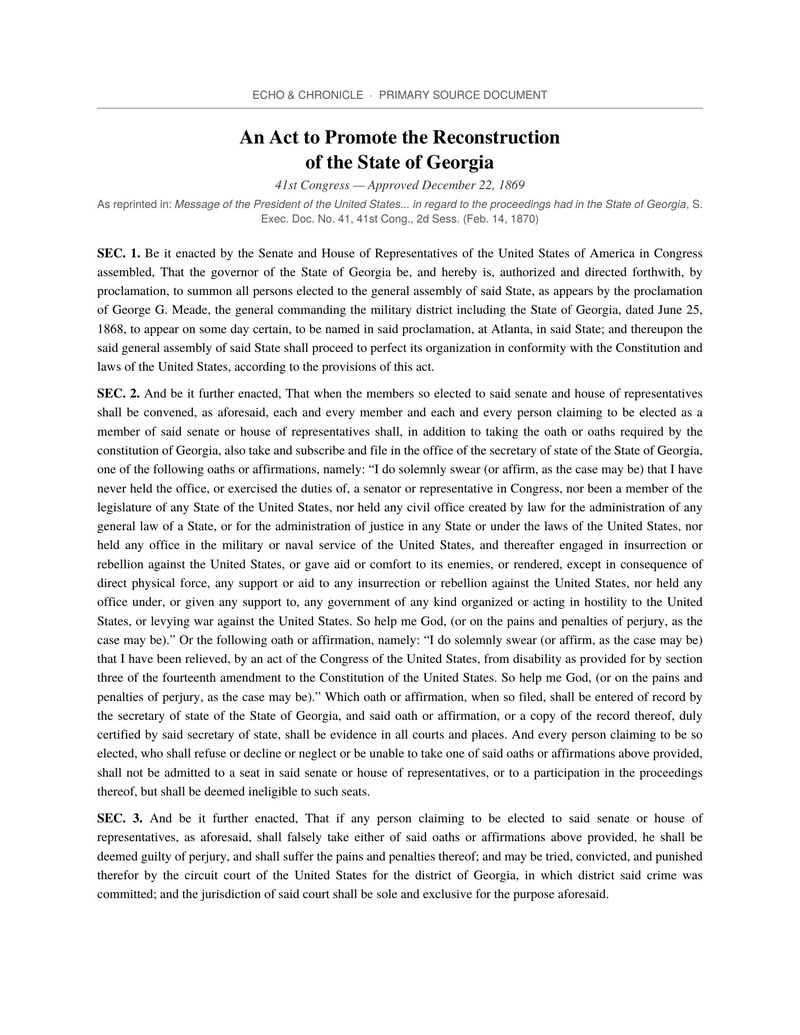
On December 22, 1869, Congress passed "An Act to Promote the Reconstruction of the State of Georgia." It is a short law with a blunt purpose. It ordered Georgia's governor to reconvene the legislature exactly as it had been elected in 1868. It required every member to take a loyalty oath before the state's own secretary of state. And in Section 6, it said outright what the courts had only implied: excluding anyone from the legislature "upon the ground of race, color, or previous condition of servitude, would be illegal and revolutionary, and is hereby prohibited."
Then it handed the job of enforcing all of it to one man.
Brevet Major General Alfred H. Terry took command of the Military District of Georgia in January 1870 and spent the month running what historians often call Terry's Purge. He removed the ex-Confederate legislators who couldn't pass the loyalty oath, replaced them with the Republican candidates who'd finished second in the 1868 election, and put the expelled Black legislators back in their seats. His telegrams to General William T. Sherman, preserved in the government's own printed record of the episode, show a man working out the mechanics of the thing in real time, asking Washington whether a disqualified man's second-highest challenger should simply be seated in his place, whether the oath alone settled a man's eligibility, or whether Terry himself had to judge it.
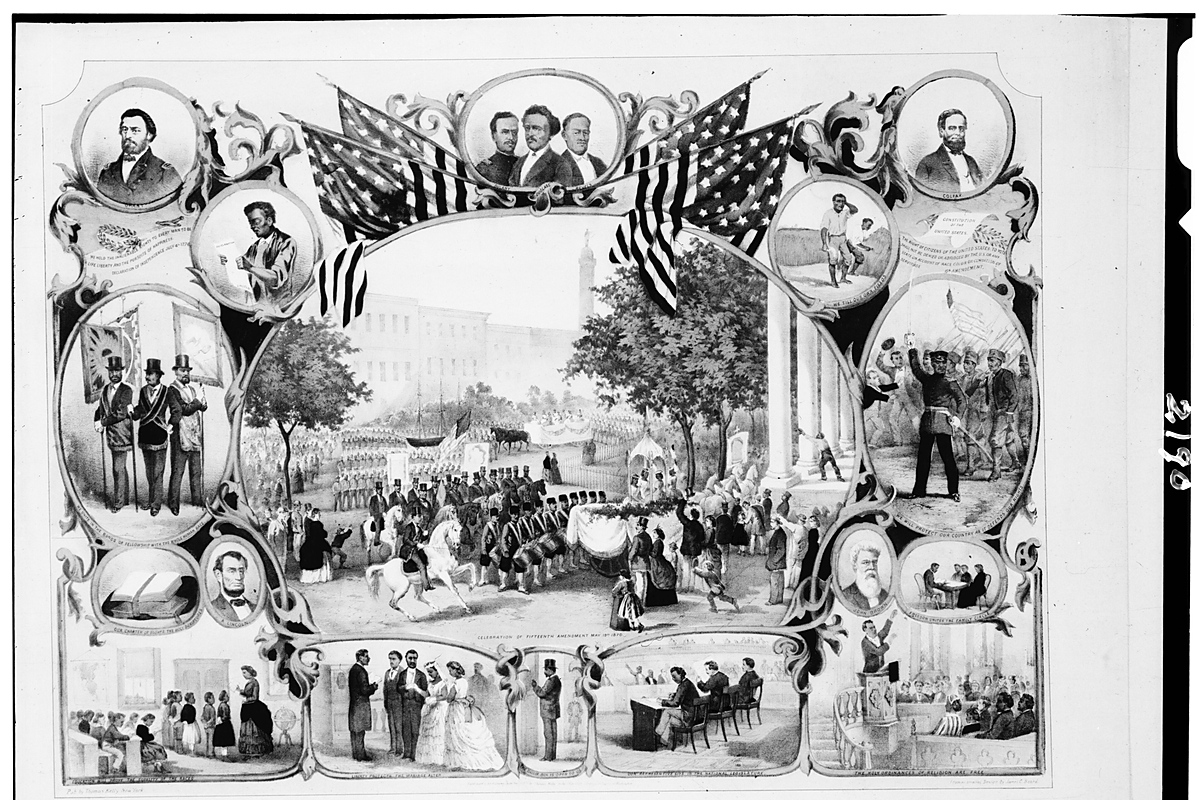
By late January, both chambers had reorganized under his authority. In February 1870, the reconstituted legislature did what the Act of December had ultimately been aiming at: it ratified the Fifteenth Amendment, guaranteeing the right to vote regardless of race. Not everyone in Georgia's Republican coalition had wanted to get here this fast. Governor Bullock himself had worked to delay ratification the previous year, hoping a slower pace of readmission would keep federal troops in the state longer and keep his own coalition in power. He feared that once Georgia satisfied every congressional requirement, the troops would leave before Reconstruction's institutions were secure enough to survive without them. Terry enforced Congress's mandate regardless of Bullock's political calculations.
The last day of the session
Five months later, on July 15, 1870, the very last day the 41st Congress sat before adjourning, Georgia's House delegation was finally seated. Unlike Virginia, Mississippi, and Texas, the three other holdout states readmitted that same year, each of which got its own numbered congressional act, the record shows no matching standalone statute for Georgia's second and final readmission. The state had already been formally "admitted" once, in 1868. What happened in July 1870 was Congress simply agreeing, at the close of business, that the conditions it had set the previous December had finally been met. Georgia's two U.S. Senate seats stayed vacant for several more months; the state's first Reconstruction-era senator wasn't sworn in until February 1871.
What the win actually bought
It didn't last. Democrats swept the General Assembly elections that December. Bullock, facing impeachment, fled the state in October 1871. By January 1872, Georgia was fully in the hands of the Redeemers, the resurgent white Democratic coalition that would dominate state politics for nearly a century. Some of the Original 33 were later beaten, threatened, or worse for having held the seats Terry's Purge gave back to them. Black representation in the General Assembly didn't disappear overnight, the last Black member of the Reconstruction-era General Assembly, W. H. Rogers, didn't resign until 1907, but the door Terry forced open in 1870 was already closing while he was still forcing it.
One footnote survived the closing door. In December 1870, Georgia sent its first Black congressman, Jefferson Franklin Long of Macon, to Washington to finish out an unexpired term. He served only a few months. In that time he became the first Black representative to speak on the floor of the U.S. House, arguing against a bill to restore the political rights of former Confederates. He warned it would leave Black communities exposed to exactly the kind of intimidation that had put men like Turner and Campbell out of office two years earlier, and put a dozen people in the ground at Camilla.
Congress passed the bill anyway.
The 33 men whose expulsion and reinstatement forced Georgia through the readmission process twice are remembered today mostly by a bronze sculpture on the grounds of the state capitol, dedicated in 1978 and titled, simply, Expelled Because of Color.