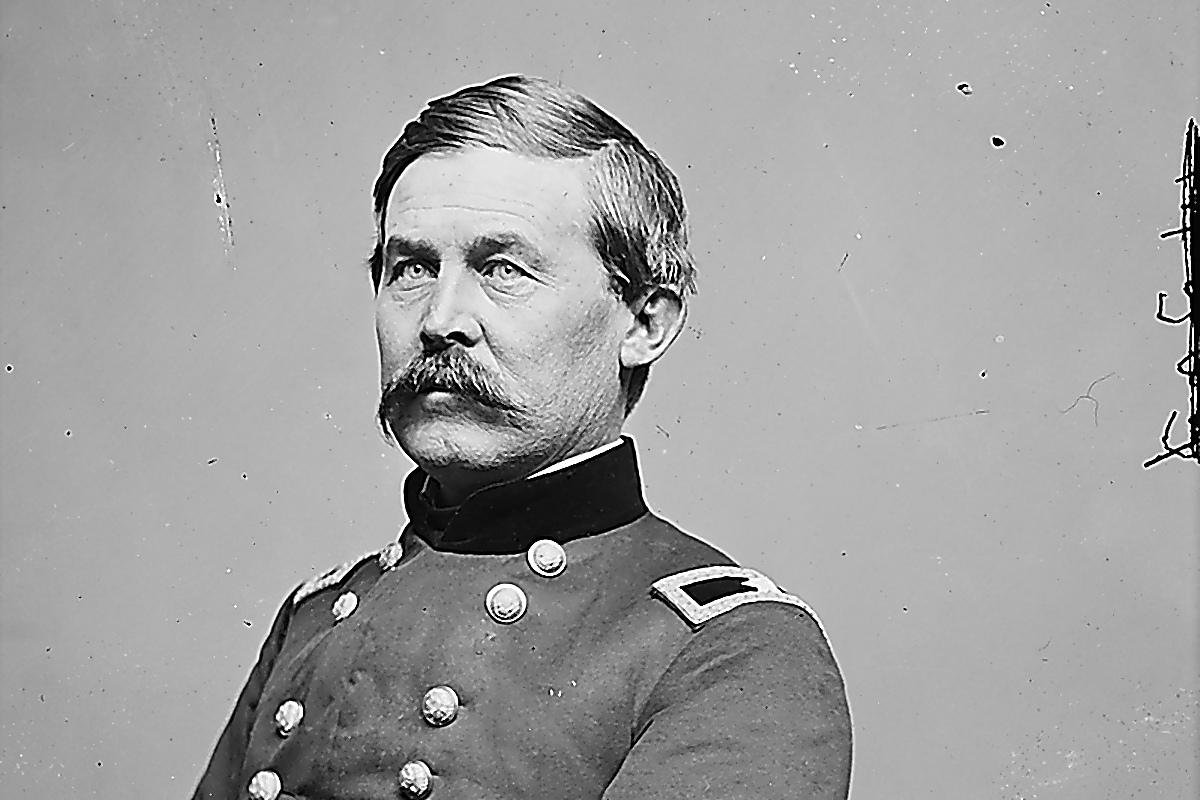
On the morning of July 1, 1863, fewer than 3,000 Union cavalrymen faced down the leading edge of Robert E. Lee's army west of a Pennsylvania crossroads town, with no infantry support yet on the field and no guarantee it would arrive before the Confederate advance reached them. What they bought with three hours of dismounted fighting was the ground the rest of the Army of the Potomac would need.
The Choice to Hold
John Buford rode into Gettysburg on the afternoon of June 30 and found the town already unsettled. Brigadier General J. Johnston Pettigrew's brigade, sent forward under Henry Heth's orders, had probed the town's edge that morning and pulled back rather than risk a fight against an unknown force. But Buford's own scouting parties confirmed what the retreat suggested: A. P. Hill's corps, including Anderson's, Heth's, and Pender's divisions, was reported massed near Cashtown, nine miles away. Buford reported it plainly to headquarters that evening. A captured courier told him that Ewell's corps was crossing the mountains from Carlisle, with Rodes' division in the lead at Petersburg, Pennsylvania. Longstreet, Buford reported, was still behind Hill. Whatever was coming, it was coming from multiple directions at once, and Buford's two brigades, under Colonels William Gamble and Thomas Devin, were the only Union force in position to meet it.
Buford did not have orders to fight a battle at Gettysburg. His job was to screen the army's advance and report what he found. But the ground mattered to him. West and north of town ran a series of ridges, including Herr Ridge, McPherson Ridge, and Seminary Ridge, offering successive defensive positions as they stepped back toward the town itself. The ridges offered commanding ground over the seven major roads converging on Gettysburg. Buford's own report never spells out a grand strategic theory. It says only that by daylight on July 1 he had gained positive information of the enemy's position and movements, and made his arrangements for entertaining him until General Reynolds could reach the scene. On his own authority, he had decided to delay the Confederate advance until Reynolds could reach the field.
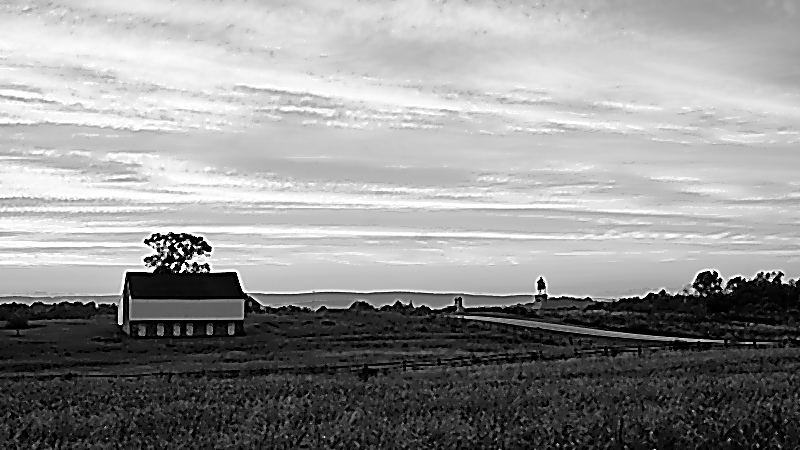 The McPherson farm on McPherson Ridge, the ground Buford's troopers held through the morning of July 1. National Park Service, Gettysburg National Military Park.
First Contact
The next morning, around 7:30, the leading elements of Heth's division came down the Chambersburg Pike, this time in force. Buford had Gamble's brigade dismounted and deployed along a line anchored on the pike, with pickets thrown out toward Herr Ridge. The first shots, by tradition fired by Second Lieutenant Marcellus Jones of the 8th Illinois Cavalry, opened what neither side yet knew would become the largest battle ever fought in North America.
What followed was not a cavalry charge. Buford's troopers fought on foot, some holding horses to the rear while the rest worked their breech-loading carbines from behind fences and low ground. Buford's own report describes Gamble's brigade holding its own for more than two hours against a far larger force, and having to be literally dragged back a few hundred yards to a position more secure and better sheltered. Gamble's own report tells the same fight from the inside: his skirmishers, fighting under cover of trees and fences, retarded the enemy's advance as much as could possibly be expected against three divisions of Hill's corps, falling back only some 200 yards from their first line before the First Corps arrived to relieve them. It was a delaying action in the most literal sense: the goal was never to win the ground, only to make the enemy pay in time for every yard of it.
Calef's Guns
Supporting Gamble was a single six-gun battery of horse artillery under Lieutenant John Calef, part of the regular army's 2nd U.S. Artillery. Calef's report describes his battery firing the first Union artillery shot of the battle on the Confederate column advancing along the pike, after cavalry carbines had already begun the fight, then watching two enemy batteries come into position on either side of the road, outnumbering him roughly two to one. As the fight developed and Calef repositioned his guns, the pressure only grew: at one point three more Confederate batteries, twelve guns in all, opened on his position at once. He held on until ordered to withdraw by section, and even then one gun lost its horses faster than they could be replaced. Sergeant Newman, one of Calef's section commanders, dragged the piece off by hand rather than abandon it.
Buford's own report singles the battery out for particular praise, saying it fought as is seldom witnessed, working its guns deliberately, with great judgment and skill, and with wonderful effect upon the enemy. For a battle remembered mostly for its infantry, six guns and a few hundred dismounted troopers were indispensable to the morning's outcome.
Reynolds Arrives
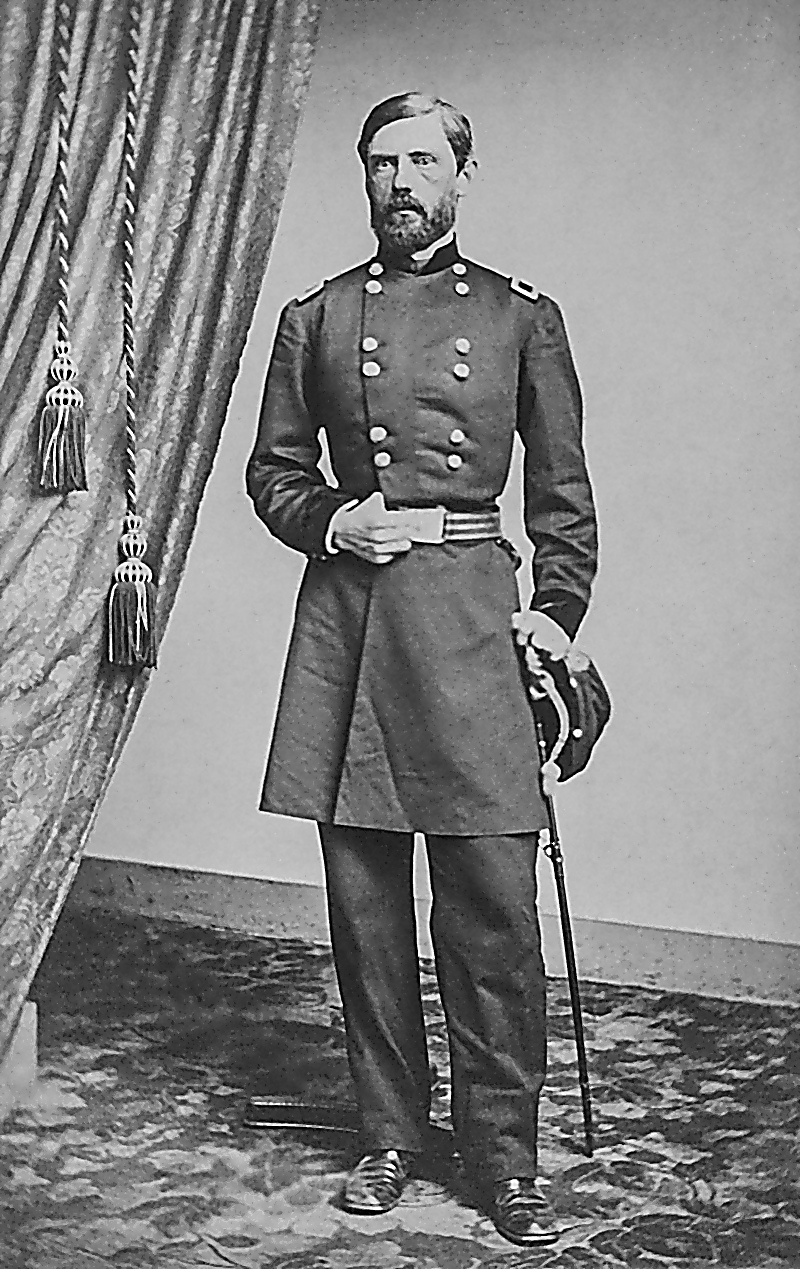 Major General John F. Reynolds, commanding the army's left wing, reached the field around mid-morning on July 1. Wikimedia Commons.
Buford had bought the time he needed. By mid-morning, Major General John Reynolds, commanding the army's left wing, reached the field with the lead elements of his First Corps. Buford met him, by most accounts at the Lutheran Theological Seminary, and laid out the situation. Reynolds committed the arriving First Corps to contest the Confederate advance at Gettysburg, and rode forward himself to direct the infantry into position.
It did not take long for the decision to cost him his life. Directing the Iron Brigade into the woods along Willoughby Run, Reynolds was struck in the back of the neck by a Confederate bullet and died instantly. He was the highest-ranking officer on either side to die at Gettysburg. Buford's own dispatch that afternoon carries the weight of it in a single flat line: General Reynolds was killed early this morning.
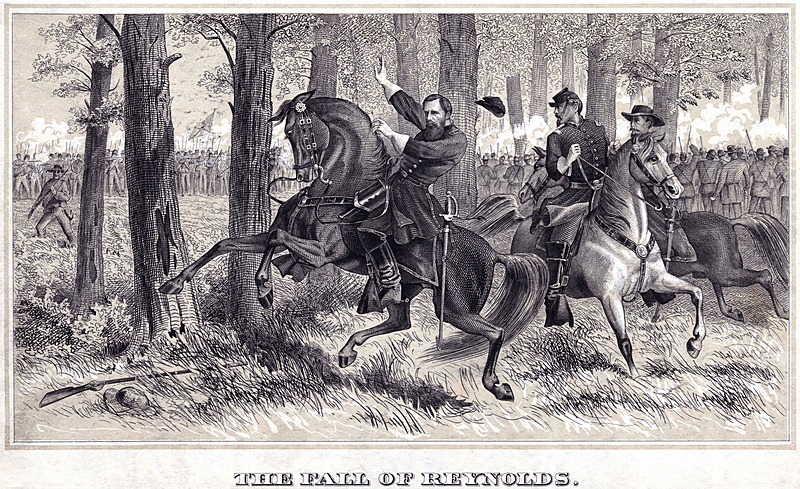 "The Fall of Reynolds," a wartime engraving by Alfred Waud depicting the general's death near Willoughby Run. Library of Congress.
The Iron Brigade's Charge
Reynolds' decision to commit the First Corps shaped the fighting that followed. The Iron Brigade, Solomon Meredith's mix of Wisconsin, Michigan, and Indiana regiments, drove forward into the woods and struck James Archer's Confederate brigade as it crossed Willoughby Run. Major General Abner Doubleday, on whom command of the corps fell in that instant, described the fighting in his own report: the Iron Brigade charged with the utmost steadiness and fury, hurled the enemy back into the run, and captured, after a sharp and desperate conflict, nearly 1,000 prisoners, all from Archer's brigade.
The number does not sit easily with the Confederate record. Lieutenant Colonel S. G. Shepard, writing Archer's brigade's report because Archer himself was among the captured, provides the relevant brigade-level figures: the brigade went into the fight roughly 1,048 strong, and Shepard reported that some 75 men were unable to make their escape after being driven back by overwhelming forces in front and on both flanks. Henry Heth's own report likewise puts the number captured with Archer at roughly 60 or 70. The two accounts cannot be reconciled cleanly. Doubleday's report gives the Union account; Shepard's and Heth's reports give much smaller Confederate figures for Archer's captured men. What is clear is that the Iron Brigade drove Archer's brigade back across Willoughby Run, captured its commander, and disrupted the Confederate advance.
Doubleday reported that Private Patrick Maloney of the 2nd Wisconsin captured Archer, making him the first general officer from Robert E. Lee's Army of Northern Virginia taken prisoner since Lee had assumed command.
By late morning, the position Buford had established at dawn was an infantry line. His cavalry, having spent the morning fighting dismounted, shifted to guard the army's flanks, its work for the day not yet finished, while Wadsworth's division of the First Corps held what the horsemen had bought them. The morning's delaying action was over. What came next belonged mainly to the infantry, and to an afternoon that would test how long that ground could actually be held.