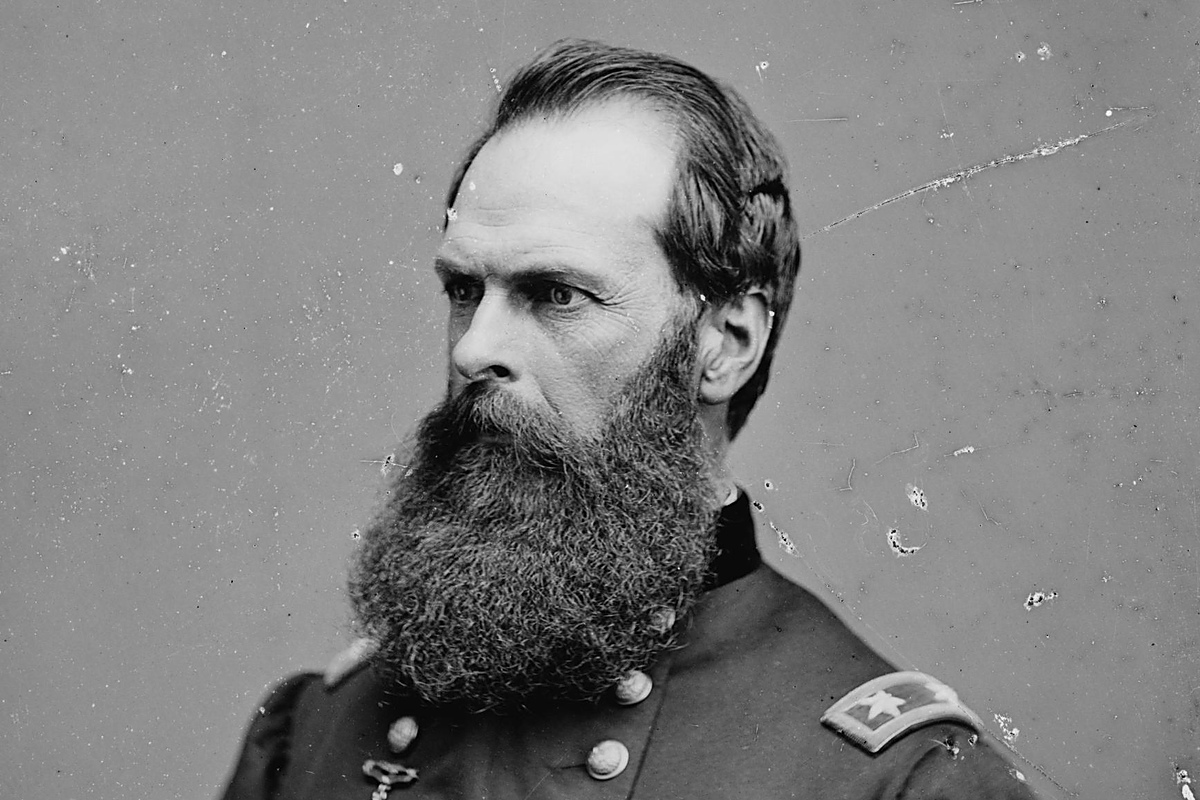
Lieutenant Colonel Thomas M. Walker's report for the 111th Pennsylvania describes the start of July 3 on Culp's Hill in a few lines. His regiment was shifting its position to use part of the trenches of Brigadier General George S. Greene's brigade, "a man at a time," when the Confederates saw the movement and opened fire. His men answered, then took their new place, "awaiting daylight for the work to begin." Then: "Picket firing began with the first streak of light, and about 3.45 o'clock the line of the enemy advanced with a yell."
That began about seven hours of fighting on the Union right, which Brigadier General Alpheus S. Williams, who commanded the Twelfth Corps, called a combat that "continued for seven hours in almost unremitting fury." Later in the day, farther out on the line, Union cavalry stopped a Confederate cavalry force that had come toward the army's rear. In both fights, the Union reports describe an attack aimed at the rear, and in both the work of stopping it fell to troops from more than one command. Part 6 ended with the Confederates holding part of the Twelfth Corps works. Part 8 turns to the artillery fire before the attack on Cemetery Ridge.
Orders for Daylight
Williams did not learn until nearly midnight on July 2 that the enemy held part of his corps's works. "I did not learn this state of affairs until nearly 12 o'clock at night," he wrote, "when I reported them to Major-General Slocum, and received his orders to drive the enemy from our intrenchments at daylight." Major General Henry W. Slocum commanded the right of the Union line. Williams's plan called for "a heavy artillery fire, with infantry feints upon the right, followed by a strong assault by Geary's division from Greene's position on the left." Brigadier General John W. Geary commanded the Second Division, of which Greene's brigade was one of three. Brigadier General Thomas H. Ruger, whose First Division formed on Geary's right, described his own line as running along "a rocky, wooded ridge, called Culp's Hill."
The Confederates had orders of their own. Lieutenant General Richard S. Ewell, commanding the Second Corps, wrote that he "was ordered to renew my attack at daylight Friday morning." He reinforced Major General Edward Johnson's division with a brigade from Early's division and with "Daniel's and Rodes' (old) brigades, of Rodes' division." Brigadier General George H. Steuart's brigade, on Johnson's left, had taken part of the Union works the evening before. Ewell then added a sentence that fits the Union reports: "Just before the time fixed for General Johnson to advance, the enemy attacked him, to regain the works captured by Steuart the evening before."
First Light on the Hill
The reports give different times for the opening, and each is given here as written. First Lieutenant Edward D. Muhlenberg, who commanded the Twelfth Corps artillery, wrote that at 4:30 four batteries, twenty guns in all, "opened, and fired for fifteen minutes without intermission." Williams called it "a tremendous fire at daylight." When it stopped, he wrote, "the enemy, without waiting our assault, themselves attacked Geary's division with great fury."
Geary wrote that the Confederates advanced "yelling in their peculiar style" and "were met at every point by the unswerving lines and deadly fire of my Second and Third Brigades." Greene's men were behind breastworks. Brigadier General Thomas L. Kane's brigade, on Greene's right, "fought without shelter, excepting such as might be afforded by inequalities of the ground."
Ewell's report describes the same hours from the other side. He wrote that after the Union attack was repulsed, Johnson "attacked in turn, pushing the enemy almost to the top of the mountain," but was stopped by "an abatis of logs and stones, with a very heavy work on the crest of the hill."
Greene's Breastworks
Greene wrote that "the attack was general on our line, and continued until 10.30 a.m., when the enemy retired." The regiments in the trenches "were relieved from thirty to ninety minutes by others with fresh ammunition and clean arms," he wrote, "so that the fire was kept up constantly and efficiently over our whole line."
Lieutenant Colonel Walker's regiment was relieved at 5:55 to renew its ammunition and later returned to the fight. "We expended 160 rounds to the man," he wrote. His men were fighting behind "the very rifle-pits they had built for their own protection," and "fought feeling they were Pennsylvanians in Pennsylvania."
On the Confederate side, Brigadier General James A. Walker, who commanded the Stonewall Brigade, described a similar rhythm. After "five hours' incessant firing," he wrote, he "drew my command back under the hill out of the fire, to give them an opportunity to rest and clean their guns and fill up their cartridge-boxes."
More troops came forward as the morning went on. About 8 o'clock, Geary wrote, "the enemy redoubled their efforts" and "pressed forward with an evident determination to carry the position at all hazards." Colonel James Wallace's First Eastern Shore Maryland Regiment, part of Brigadier General Henry H. Lockwood's brigade, reached the field shortly before 8 and "went forward with a shout to relieve their exhausted comrades." Maryland units served on both sides of the line that morning: Wallace's regiment and Colonel William P. Maulsby's First Potomac Home Brigade for the Union, and the First Maryland Battalion in Steuart's Confederate brigade.
The Last Charge
Steuart wrote that at about 10 a.m. his skirmishers went forward, and that the brigade then formed and "charged toward the enemy's second breastworks, partly through an open field and partly through a wood, exposed to a very heavy fire of artillery and musketry, the latter in part a cross-fire." Then: "The enemy's position was impregnable, attacked by our small force, and any further effort to storm it would have been futile, and attended with great disaster, if not total annihilation."
The Union reports describe the charge from the defending line. Geary wrote that at 10:25 "two brigades of Johnson's division, having formed in column by regiments, charged upon our line on the right." Kane's brigade, "though only 650 strong, poured into them so continuous a fire that when within 70 paces their columns wavered and soon broke to the rear." Kane named the attackers: "Their advance was Steuart's brigade, of Johnson's division. The First Maryland Battalion (Confederate States) left most of their dead in line with our own. It cannot be denied that they behaved courageously."
Geary recorded what followed. "Large numbers of them crawled under our breastworks and begged to be taken as prisoners." Among them were men of the Stonewall Brigade, who "rushed in with white flags, handkerchiefs, and even pieces of paper." When the commander of one regiment raised a white flag, Johnson's assistant adjutant general, Major B. W. Leigh, "rode forward to order it down, and fell, pierced by a dozen balls."
The Right of the Line
On the right of the Twelfth Corps line, Ruger's division faced the enemy across a meadow and swale. At about 10 a.m., Ruger wrote, "I received orders to try the enemy on the right of the line of breastworks, to the left of the swale, with two regiments, and, if practicable, to force him out." His order to Colonel Silas Colgrove, who commanded the Third Brigade, was "to advance skirmishers against the enemy at that point, and, if not found in too great force, to advance two regiments, and dislodge him from the breastworks." Ruger then wrote: "From mistake of the staff officer, or misunderstanding on the part of Colonel Colgrove, it was attempted to carry the position without first ascertaining the force of the enemy." Colgrove wrote that "a line of skirmishers would be cut down before they could fairly gain the open ground." The meadow was "about 100 yards in width." "The only possible chance I had to advance was to carry his position by storming it," he wrote. "I selected the Second Massachusetts and Twenty-seventh Indiana for the work."
"At the command, 'Forward, double-quick!' our breastworks were cleared, and both regiments, with deafening cheers, sprang forward. They had scarcely gained the open ground when they were met with one of the most terrible fires I have ever witnessed." Colgrove added: "It seemed that the two regiments were devoted to destruction." He wrote that both regiments fell back and that the Confederates then charged in turn. "At the first fire they were completely checked, and at the second they broke in confusion and fled, leaving their dead and wounded upon the field." The Second Massachusetts "lost about 130 killed and wounded," and its commander, Lieutenant Colonel Mudge, was among the dead. "The Twenty-seventh lost 112 in killed and wounded."
How the Fight Ended
The reports measure the end of the fight in different ways. Greene and Geary put the last Confederate charge and retreat at about 10:30. Maulsby wrote that the enemy's fire on his front ceased about noon. Ewell had Johnson leave the captured works about 1 p.m. Maulsby's report gives more detail: about 9 o'clock his regiment was ordered to the front of the rifle-pits, where it stayed "until the enemy's fire wholly ceased, about 12 m." During that time, he wrote, "a white flag was raised by the enemy, and the firing, by my order, ceased." Brigadier General Alexander Shaler's report for his Sixth Corps brigade has the 67th New York marching at 11 a.m. "into the woods and forward to the breastworks, from which the enemy were then fleeing," where it took "about 20 prisoners."
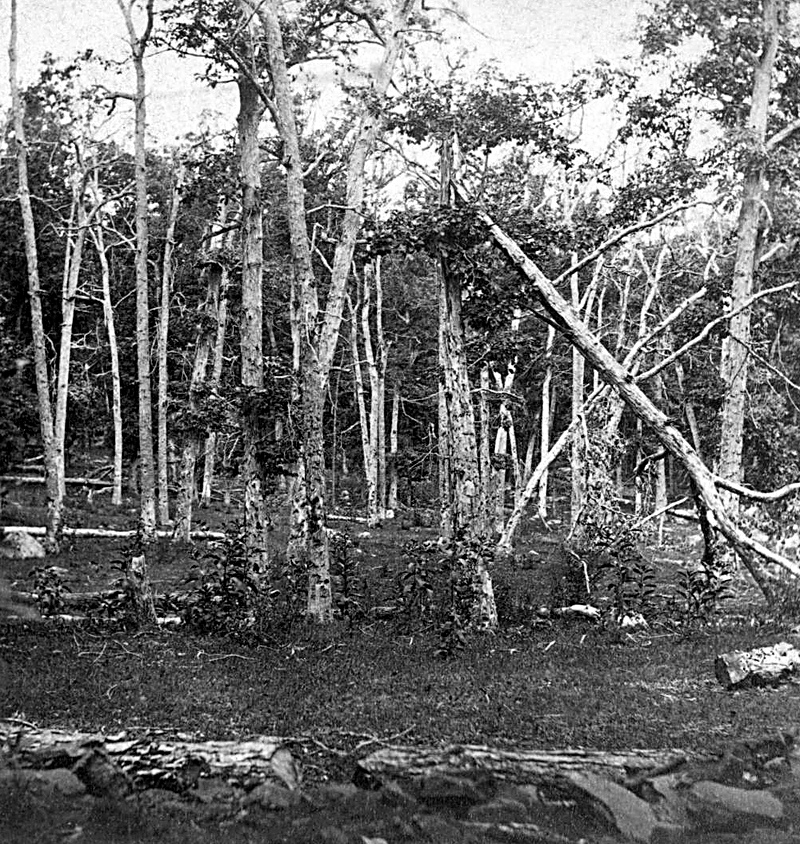 Trees on Culp's Hill damaged by musketry and shell, in front of the Union breastworks. Stereograph by Tipton & Myers, made after the battle. Library of Congress.
On the Confederate side, Ewell wrote that "repeated reports from the cavalry on our left that the enemy were moving heavy columns of infantry to turn General Johnson's left, at last caused him about 1 p.m. to evacuate the works already gained." Ewell sent a staff officer, Captain G. C. Brown, with cavalry to look, "who found them to be without foundation." Johnson wrote that "no further assault was made; all had been done that it was possible to do." Johnson counted 219 killed, 1,229 wounded, and 375 missing, 1,823 in all, "during the operations around Gettysburg."
Both Union commanders wrote about what failure would have meant. Williams said the Confederates were trying to gain "possession of the Baltimore pike, a movement of vast consequence had it been successful." Ruger was plainer: "If the enemy had succeeded, and thereby gained possession of the turnpike and a position in rear of Cemetery Hill, the army would have been in great peril."
East Cavalry Field
The reports do not use the name East Cavalry Field, which is what visitors call the ground today. Brigadier General David McM. Gregg, who commanded the Second Division of the Cavalry Corps, wrote of "the extreme right of our line of battle." On the morning of July 3 his brigades were posted on the right of the infantry, "about three-fourths of a mile nearer the Baltimore and Gettysburg turnpike," because Brigadier General George A. Custer's brigade, of another division, held the ground Gregg had held the day before.
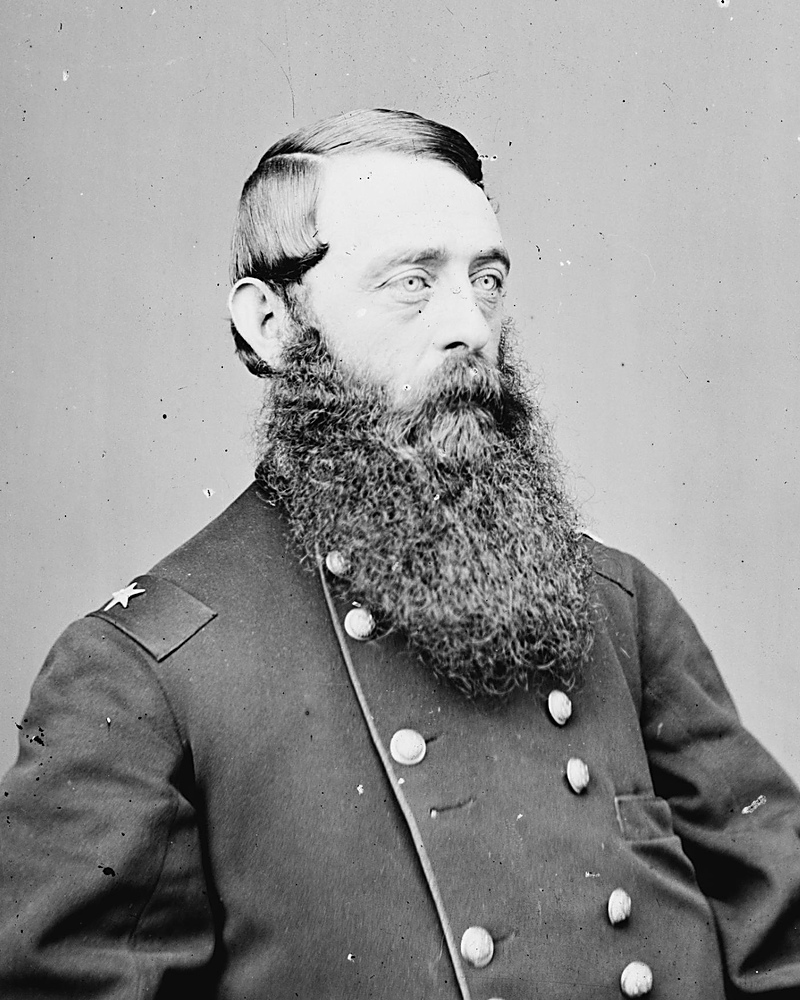 Brigadier General David McM. Gregg, who commanded the Second Cavalry Division at East Cavalry Field. Library of Congress.
At noon, Gregg wrote, he received a copy of a dispatch from the commander of the Eleventh Corps "that large columns of the enemy's cavalry were moving toward the right of our line." At the same time Major General Alfred Pleasonton, who commanded the Cavalry Corps, ordered Custer's brigade sent to the left. Then "a strong line of skirmishers displayed by the enemy was evidence that the enemy's cavalry had gained our right, and were about to attack, with the view of gaining the rear of our line of battle." Gregg kept Custer. "The importance of successfully resisting an attack at this point, which, if succeeded in by the enemy, would have been productive of the most serious consequences, determined me to retain the brigade of the Third Division until the enemy were driven back."
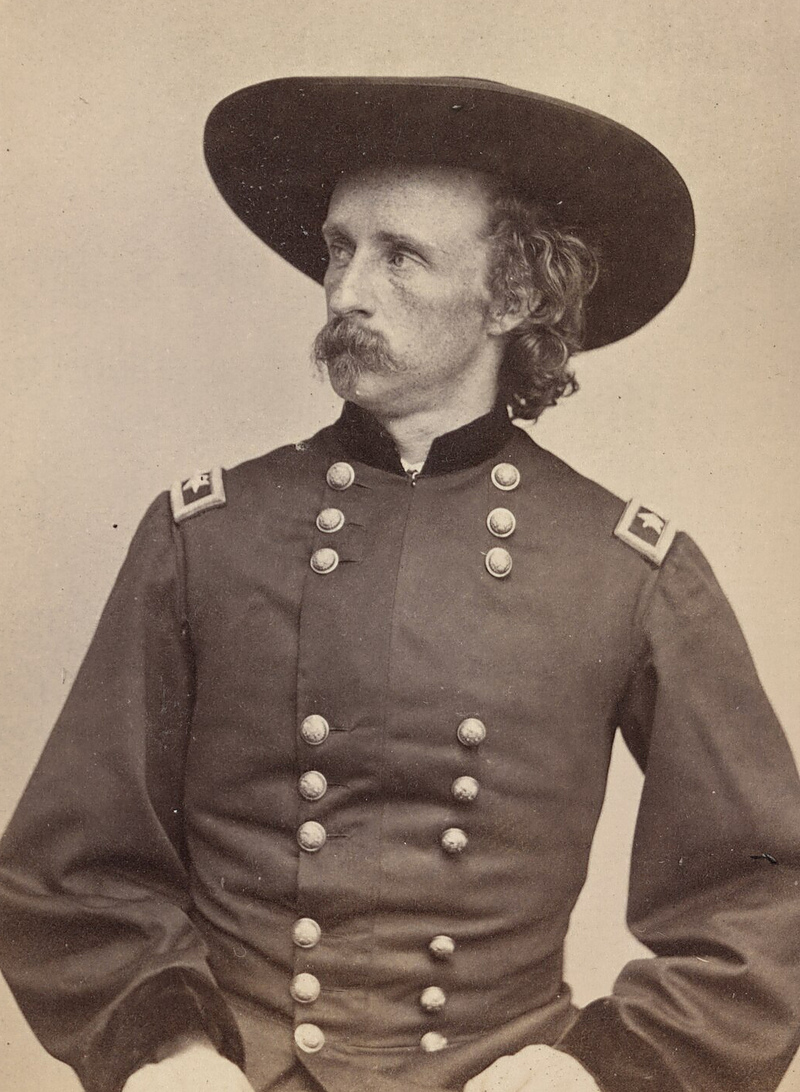 George A. Custer, who commanded the Michigan Cavalry Brigade at East Cavalry Field. Carte de visite made from a negative in Brady's National Portrait Gallery; the handwritten card gives his later rank. Library of Congress.
Major General J. E. B. Stuart, who commanded the Confederate cavalry, wrote that he moved out "pursuant to instructions from the commanding general" to "a position to the left of General Ewell's left." He moved his command and W. H. F. Lee's brigade through the woods to a position and "hoped to effect a surprise upon the enemy's rear, but Hampton's and Fitz. Lee's brigades, which had been ordered to follow me, unfortunately debouched into the open ground, disclosing the movement." Stuart's report adds that his position made Ewell's left "entirely secure" and "commanded a view of the routes leading to the enemy's rear," and that if the Union main body had been dislodged, "as was confidently hoped and expected," he was "in precisely the right position to discover it and improve the opportunity."
Gregg wrote that "the enemy brought upon the field a column for a charge." Custer's Seventh Michigan met it "but not successfully," and "the advantage gained in this charge was soon wrested from the enemy by the gallant charge of the First Michigan." Custer's own report says the First Michigan "charged in close column upon Hampton's brigade, using the saber only, and driving the enemy from the field, with a loss to this regiment of 6 officers and 80 men." When the enemy's column passed the wood where the First New Jersey was posted, Gregg wrote, "that regiment gallantly and successfully charged the flank of his column," and the Third Pennsylvania skirmished "until nightfall."
Stuart described his own side. He ordered "the nearest cavalry regiment (one of W. H. F. Lee's) quickly to charge." Then, he wrote, "gradually this hand-to-hand fighting involved the greater portion of the command till the enemy were driven from the field." He named two losses: "That brave and distinguished officer, Brigadier-General Hampton, was seriously wounded twice in this engagement." Major W. G. Conner of the Jeff. Davis Legion was killed. "Notwithstanding the favorable results obtained," Stuart added, "I would have preferred a different method of attack." Gregg's report ends the fight differently: the enemy "retired his column behind his artillery, and at dark withdrew from his former position." The reports give no clock time for the charges.
Before the Main Attack
By noon, the fighting on Culp's Hill was winding down. Gregg's report picks up with the warning that Confederate cavalry was moving toward the Union right.
Ewell's report places Johnson's fight ahead of the main Confederate attack. "Half an hour after Johnson attacked, and when too late to recall him, I received notice that Longstreet would not attack until 10 o'clock; but, as it turned out, his attack was delayed till after 2 o'clock." By then Johnson's assaults on the hill were over.
On the hill, the Twelfth Corps was helped by Lockwood's brigade and by Shaler's brigade of the Sixth Corps. Out on the right, Gregg held on with a brigade he had been ordered to send away. Part 8 turns to the guns that opened before the attack on Cemetery Ridge.
Sources: The War of the Rebellion: Official Records, Series I, Vol. 27, Part 1: Shaler, p. 683; Williams, p. 775; Ruger, pp. 778, 781–782; Maulsby, p. 806; Wallace, p. 808; Colgrove, pp. 813–814; Geary, pp. 828–830; Kane, p. 847; Walker (111th Pennsylvania), p. 855; Greene, p. 857; Muhlenberg, p. 870; Gregg, pp. 956–957; Custer, pp. 997–998. Part 2: Ewell, pp. 447–448; Johnson, pp. 504–506; Steuart, p. 511; Walker (Stonewall Brigade), p. 519; Stuart, pp. 697–699.