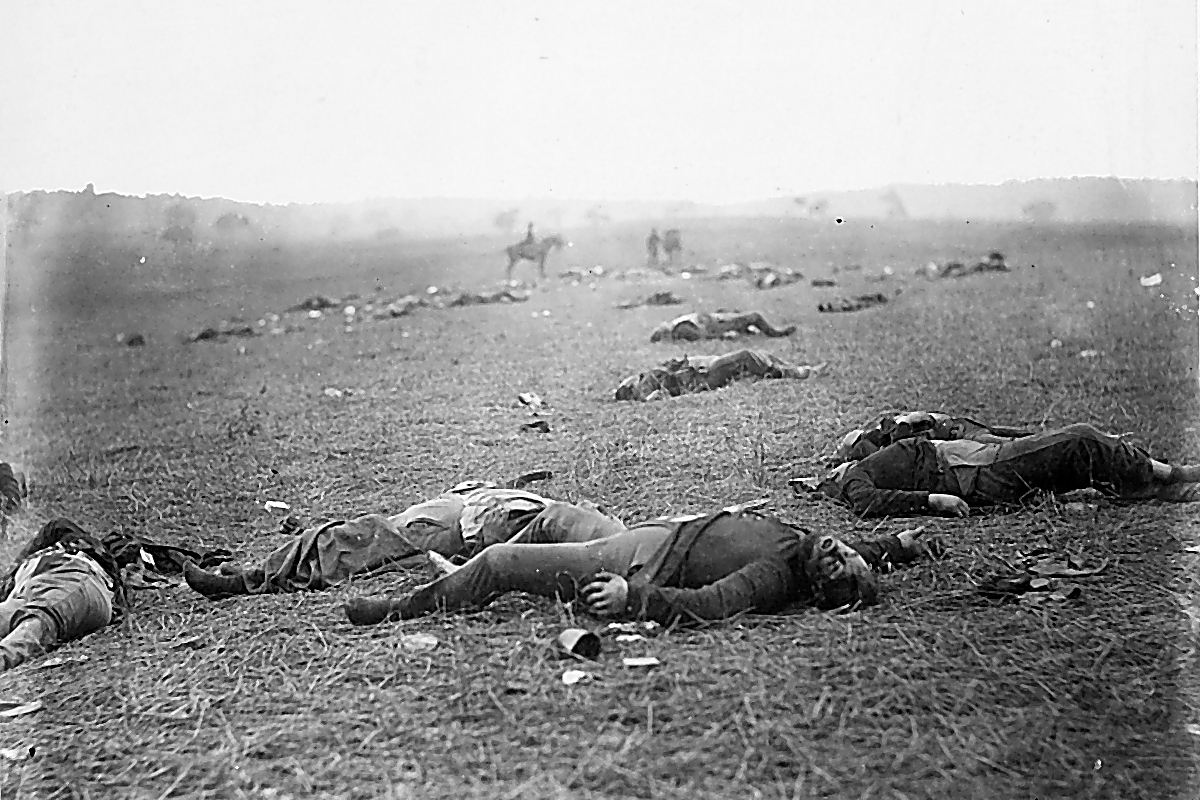
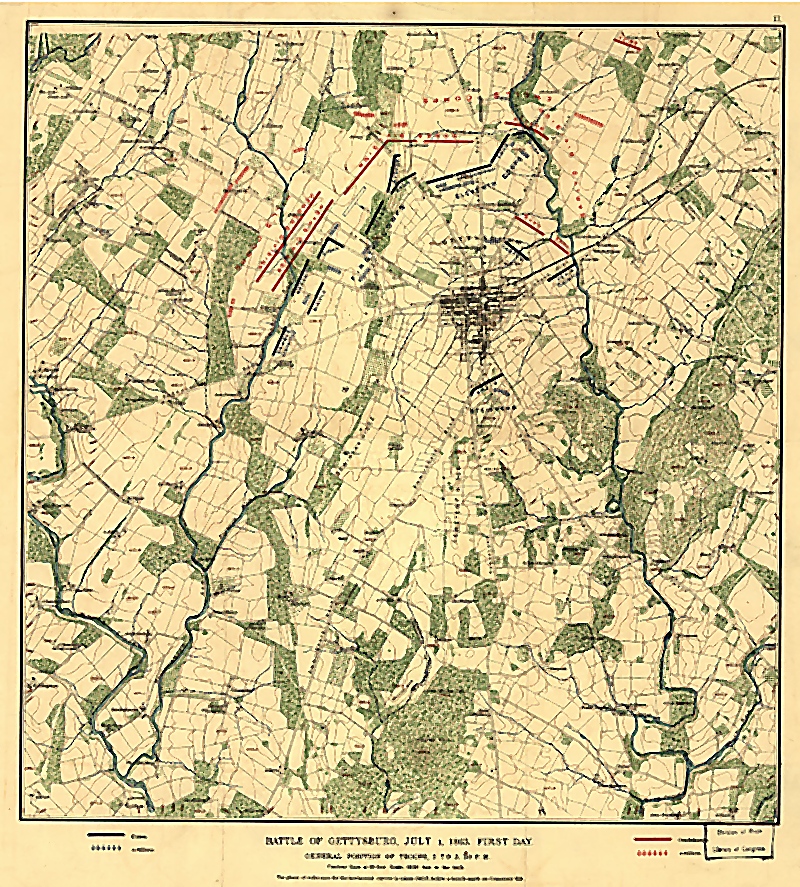
At seven thirty in the morning on July 1, 1863, somewhere along the Chambersburg Pike three miles west of a small Pennsylvania town, one of Buford's cavalry pickets fired a shot. Nobody planned for that shot to start the bloodiest battle in American history. Nobody planned for the battle to occur at Gettysburg.
By nightfall, roughly 9,000 Union soldiers and nearly 7,000 Confederates were dead, wounded, or missing. And the popular story of why they were there that day, repeated in books, documentaries, and even a Jeopardy clue, is largely a myth.
The Myth of the Shoes
Ask most people why the Confederate army marched on Gettysburg, and they will tell you it was for shoes. The story goes that Confederate General Henry Heth sent a brigade into town because he had heard there was a shoe factory there, and his men, many of them barefoot after weeks of marching, needed footwear before the campaign continued.
It is, by the assessment of historian and Licensed Battlefield Guide Tim Smith, one of the greatest myths in American history. There was no shoe factory in Gettysburg. There was no cache of shoes waiting to be seized. The Confederates were not marching there to resupply.
They were marching there because ten roads intersected at that one town, and both armies had already issued orders that pointed their columns toward that intersection. Lee's army was strung out in an arc stretching from Chambersburg to Carlisle to the outskirts of Harrisburg, scattered across south-central Pennsylvania in search of supplies and leverage. Hooker's Army of the Potomac, soon to be Meade's, was somewhere behind them, trying to stay between Lee and Washington. Gettysburg was not a target. It was simply where the roads led.
A Reconnaissance That Became a Battle
On June 30, a brigade of North Carolinians under Brigadier General J. Johnston Pettigrew approached Gettysburg and spotted something that changed everything: Union cavalry, arriving south of town under Brigadier General John Buford. Pettigrew turned back without engaging. When he reported what he had seen to his superiors, Major General Henry Heth and Lieutenant General A.P. Hill, neither believed him. They assumed it was Pennsylvania militia, not a real Union force.
Hill decided to find out for certain. Despite Lee's standing order to avoid a general engagement until the army could concentrate, Hill sent two of Heth's brigades back toward Gettysburg the next morning, July 1, to determine what was actually there. Around 5 a.m. that Wednesday, two brigades of Heth's division advanced toward the town.
What Hill intended as a reconnaissance in force became, within hours, a battle neither side had chosen on ground neither side had selected in advance.
Buford's Gamble
Buford understood the stakes before almost anyone else did. He laid out his defenses across three ridges west of town: Herr Ridge, McPherson Ridge, and Seminary Ridge. His cavalry division was small, and it stood no real chance against the Confederate infantry advancing toward it. But that was not the plan. The terrain was suited to a delaying action, meant to buy time until Union infantry could arrive and occupy the high ground south of town at Cemetery Hill, Cemetery Ridge, and Culp's Hill. Buford recognized that if the Confederates took those heights first, Meade's army would struggle to ever dislodge them.
It is a popular misconception, encouraged by novels and films, that this cavalry action was the dominant story of the day. According to Tim Smith, it was not. Although the cavalry suffered relatively light casualties, its delaying action bought enough time for Reynolds's infantry to reach the field. The far bloodier infantry fighting that followed ultimately determined the outcome of the day's battle.
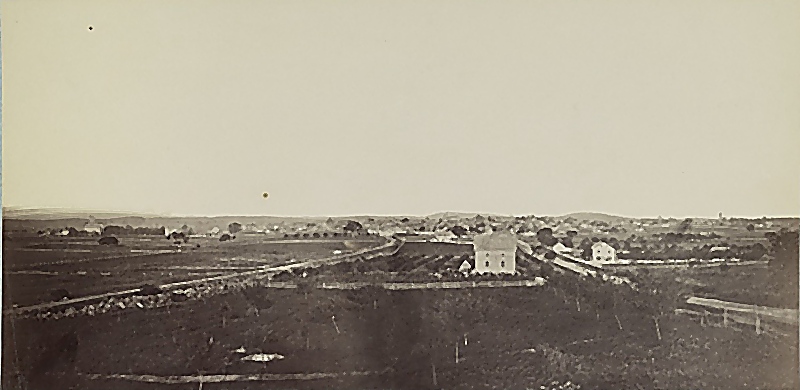 View of Gettysburg from the Northwest. The First and Eleventh Corps retreated across these fields, through the town, to Cemetery Hill and Culp's Hill beyond. Library of Congress.
Willoughby's Run
Between Herr Ridge and McPherson Ridge ran a small stream called Willoughby's Run, and the fighting that crossed it on the morning of July 1 was, by any measure, savage. On the eastern bank stood a wooded tract known as Herbst Woods, called McPherson's Woods by most soldiers who fought there. One Wisconsin soldier later described the grove as a citadel: every tree a breastwork, every log a barricade, every bush cover.
Confederate Brigadier General James Archer's brigade crossed Willoughby's Run that morning and pushed into the woods, only to be met by a line of Union infantry from the Iron Brigade that appeared without warning and quickly flanked them. Archer's men broke and tried to retreat back across the stream, but the dense underbrush slowed them down. Archer himself, along with roughly 300 of his soldiers, was surrounded and captured in a clump of willows near the water's edge.
It was a stinging reversal for the Confederates, but it would not last. By early afternoon, Heth's full division was engaged, reinforced by the brigades of Pettigrew and Colonel John M. Brockenbrough. The 26th North Carolina, part of Pettigrew's brigade and the largest regiment in either army at 839 men, swept across the same fields and drove the Iron Brigade out of the woods. By the end of the three-day battle, that regiment had only about 152 men left standing, one of the heaviest regimental losses of the entire Civil War.
The General Who Died Before Noon
Major General John F. Reynolds, commanding the Union I Corps, arrived on the field as Buford's cavalry was being pushed back toward McPherson Ridge. He was shot and killed almost immediately while directing troop and artillery placements near the woods. Historian Shelby Foote later wrote that the Union had lost a man many considered the best general in the army.
Reynolds's death did not stop the battle. Major General Abner Doubleday took over I Corps command, and the fighting along the Chambersburg Pike continued past noon, paused, and resumed again around 2:30 in the afternoon when Heth's entire division pressed forward at once.
By then, the battlefield had grown far beyond the original two brigades. Confederate divisions under Major Generals Robert E. Rodes and Jubal Early, part of Lieutenant General Richard Ewell's corps, arrived from the north and outflanked the Union position entirely. A blunder by Union Brigadier General Francis Barlow, who advanced his division to an exposed knoll north of town, gave Early's troops an opening. They overran Barlow's line, wounded and captured him, and collapsed the Union's right flank.
The Retreat Through Town
With their position crumbling on both the north and west sides of town, the Union I and XI Corps broke and retreated through the streets of Gettysburg itself, falling back to the high ground at Cemetery Hill that Buford had identified as essential hours earlier.
Major General Winfield Scott Hancock, sent by Meade after word reached him that Reynolds was dead, arrived to take command of the field and assess whether Gettysburg was worth making a stand. He surveyed the terrain and concluded it was the strongest natural defensive ground he had encountered. When Howard agreed, Hancock made the call: this was where they would fight.
General Lee, watching the Union retreat unfold, recognized the same thing Buford and Hancock had. He sent word to Ewell that Cemetery Hill should be taken, if practicable. Ewell, who had served under the famously aggressive Stonewall Jackson and was new to corps command, judged an assault impractical and did not attempt it. Many historians regard that decision as one of the great missed opportunities of the entire war. Had Ewell taken the hill that evening, the next two days of fighting, and the battle's outcome, might have looked entirely different.
What the First Day Cost
The fighting on July 1 is too often remembered as a prelude, a skirmish before the real battle began on the second and third days. The numbers say otherwise. Roughly 22,000 of Meade's eventual 100,000 men and 27,000 of Lee's 75,000 were engaged that day alone, making it, by troop count, the 23rd largest battle of the entire Civil War in its own right. Union casualties on July 1 ran close to 9,000 men out of about 18,000 engaged. Confederate losses approached 7,000 out of more than 30,000.
By dusk, the Confederates held the town. The Union army held the high ground south of it. Two more days of fighting remained, including the brutal second-day assaults at the Wheatfield, the Peach Orchard, Devil's Den, and East Cemetery Hill, and the doomed Confederate charge across open ground on July 3 that would break Lee's army for good. But the shape of the battle, and arguably its outcome, had already been set in the fields west of town, along a stream most people have never heard of, on a day that began with a single shot fired at men nobody had expected to find there.