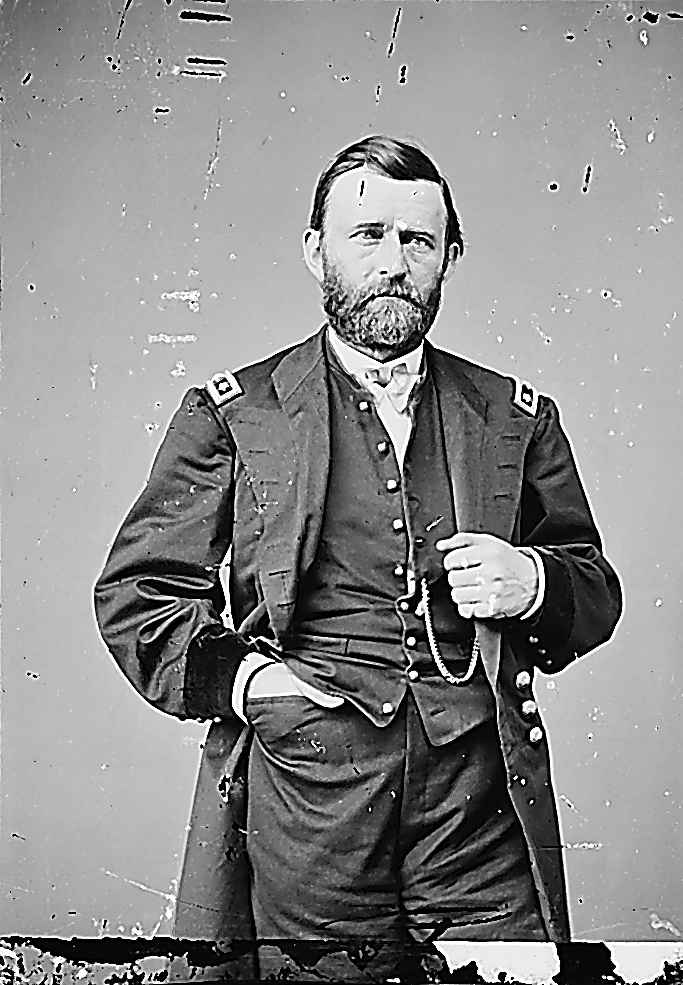
Most people who know their Civil War history remember that Ulysses Grant became a lieutenant general in 1864, the rank that put him in command of every Union army in the field. What gets left out is that lieutenant general was not actually the top of the mountain. It was the top of the mountain that existed at the time. Two years after Appomattox, Congress effectively had to build a new mountain, because no existing Army rank reflected Grant's wartime stature.
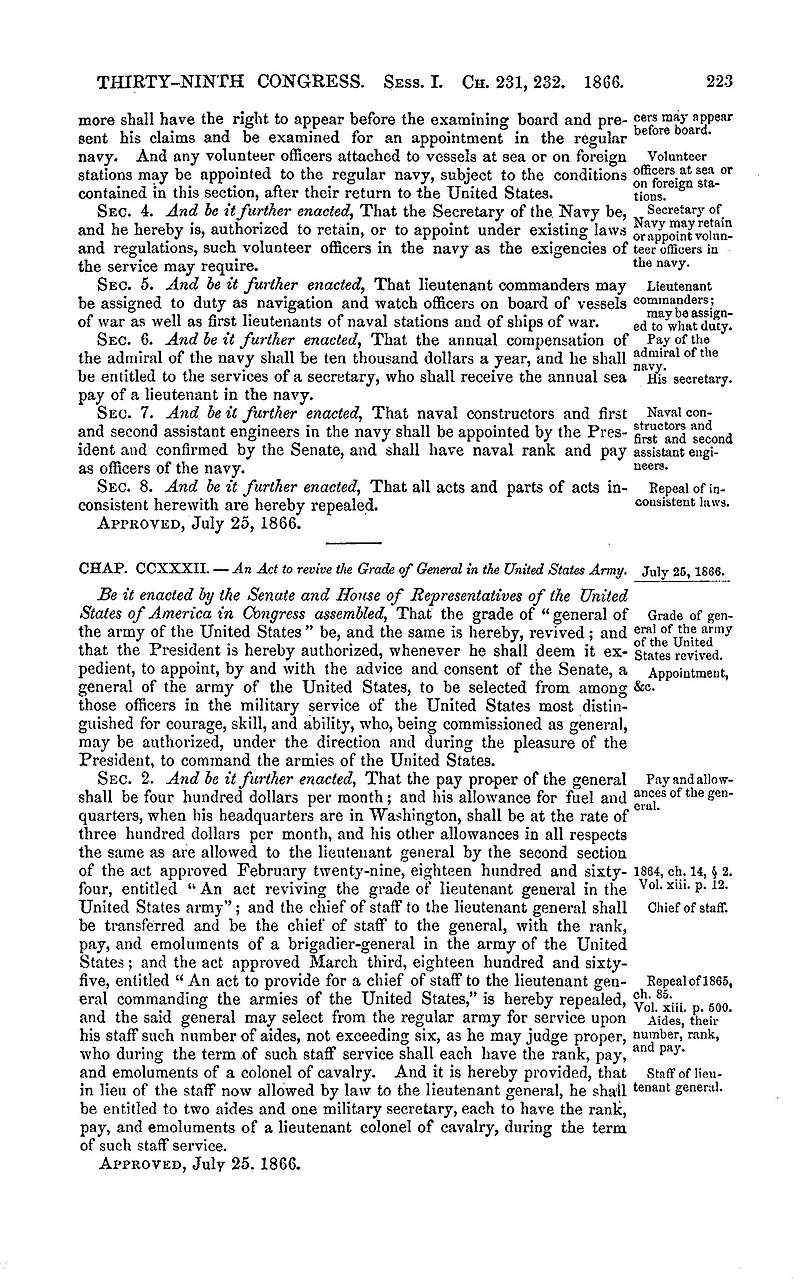
That happened on July 25, 1866, when Congress passed an act reviving the grade of "General of the Army of the United States" and President Andrew Johnson appointed Grant into it the same day. It made Grant the first officer to hold the revived grade of General of the Army of the United States. Its insignia displayed four stars, but it was legally distinct from the modern four-star general grade created decades later.
A grade revived after generations
The idea of a supreme general's grade above lieutenant general was not new in 1866. Congress had considered creating a supreme grade above lieutenant general for George Washington during the Quasi-War with France in 1799, but Washington died before the idea went anywhere. When lawmakers revived the concept after the Civil War, they were reaching for a level of command Congress had discussed once before and never actually used, not literally reinstating Washington's title. The still-higher rank of General of the Armies, the one Pershing and Washington would eventually hold, would not be created until 1919.
The text of the act itself is blunt about what it was for. It declared that the grade of General of the Army "be, and the same is hereby, revived," and authorized the president to appoint a general "selected from among those officers in the military service of the United States most distinguished for courage, skill, and ability." There was only one candidate anyone had in mind.
Johnson's actual nomination, dated that same July day, ran to a single sentence: "I nominate Lieutenant General Ulysses S. Grant to be General of the Army of the United States." No ceremony, no flourish. Just a president putting a name to a rank that had waited sixty-seven years for someone to earn it.
What the job actually paid
The law was specific about the details in a way that reads almost comically modern next to the weight of the moment. Grant's salary was set at four hundred dollars a month, with an additional three hundred a month for fuel and quarters while headquartered in Washington. He was entitled to a staff of aides pulled from the regular army, each carrying the rank and pay of a cavalry colonel. When Grant wore the uniform of his new rank, it showed four stars on the shoulder and coat buttons grouped in sets of four, a visual break from anything the army had used before.
Only one officer could hold the rank at a time. It was not a grade like brigadier or major general, where dozens of men might share the same stripes. It was built to fit exactly one person.
A promotion that arrived in the middle of a political war
The timing is worth sitting with. By the summer of 1866, Andrew Johnson and the Republican Congress were already at open war over how Reconstruction should work, and Grant was caught in the middle of it, publicly loyal to his commander in chief while increasingly at odds with him over Reconstruction. The following year, Congress would go further, passing the Command of the Army Act specifically to prevent Johnson from removing or relocating Grant without Senate approval, and to force the president to route military orders through him. Whether the 1866 promotion was purely a war reward or partly a hedge against Johnson is a question historians still weigh differently, and the record does not settle it cleanly. What is not in dispute is that within two years, Grant had gone from a general Congress wanted to honor to a general Congress felt it needed to protect.
The rank did not outlive the century
Grant held the position until he resigned his commission to become president in March 1869, at which point William Tecumseh Sherman succeeded him. Sherman later simplified the insignia to two stars flanking the coat of arms of the United States. Philip Sheridan received the grade in 1888 while gravely ill, and when Sheridan died that August, the rank of General of the Army quietly ceased to be occupied. It would not reappear until World War II, and that later five-star version, held by men like Eisenhower and MacArthur, is not legally the same grade Grant wore. It only borrowed the name.
The sequel nobody finished for eighteen months
Here is the part that rarely makes it into the story. In December 2022, as part of that year's defense authorization bill, Congress authorized the president to posthumously promote Grant one rank higher still, to General of the Armies of the United States, a title held before him only by John Pershing and, posthumously, George Washington. President Biden signed the bill. Then nothing happened for over a year. The authorization gave the president permission to act, but it did not act on its own, and for months Grant's status remained exactly where it had been since 1866. It was not until April 2024 that Defense Secretary Lloyd Austin signed the memo actually confirming the promotion, and the document did not become public until that October, nearly two years after Congress first voted on it.
So the general who once had a rank built specifically because nothing else fit him spent a year and a half in 2023 and early 2024 technically still awaiting the executive action needed to complete the promotion. It is an ending that seems oddly appropriate for a man whose career was repeatedly underestimated before the fact and debated afterward.