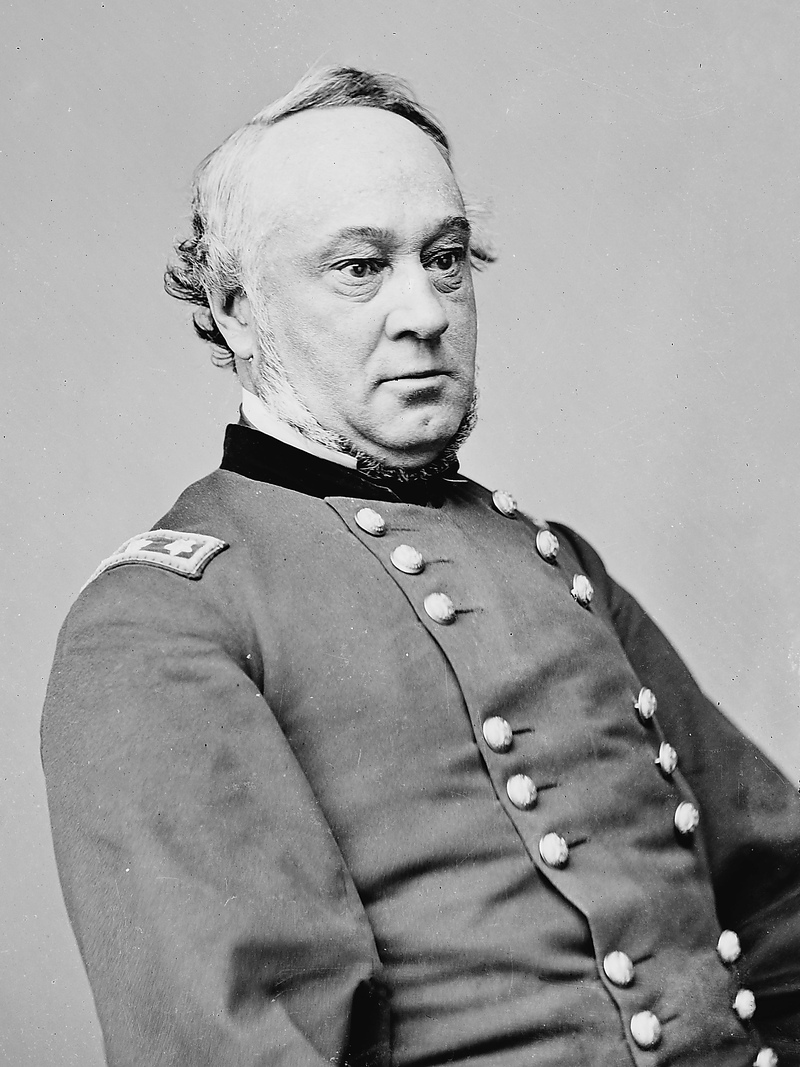
Most timelines list July 23, 1862, as the day Henry Halleck became General-in-Chief of the Union Army. That date is accurate. What it leaves out is that Lincoln had already given him the job twelve days earlier, and that Halleck spent part of that gap trying to get out of it.
The vacancy went back to March. On March 11, 1862, Lincoln relieved George McClellan as General-in-Chief, though McClellan kept command of the Army of the Potomac itself. No replacement was named. For the next four months, Lincoln and Secretary of War Edwin Stanton ran the Union's armies directly, leaning on an informal panel of officers called the War Board. It was not a system built to last, and after McClellan's Peninsula Campaign collapsed in front of Richmond that summer, Lincoln decided he needed someone in the post permanently.
His choice was already running a war of his own. Henry Halleck commanded the Department of the Mississippi from Corinth, Mississippi, where his subordinates, Grant at Forts Henry and Donelson, Curtis at Pea Ridge, Pope at Island Number 10, had strung together the Union's best run of victories anywhere in the country. Halleck himself rarely directed operations from the field, preferring to manage campaigns from headquarters, a pattern that would define his career, but the results made him the obvious pick on paper.
On July 10, Rhode Island's governor, William Sprague, arrived in Corinth carrying a letter from Lincoln. Officially, the letter asked Halleck to send troops east. Unofficially, Sprague was there to offer him command of the whole army. Halleck turned down both. Sending men east, he argued, risked the ground he had already won. As for the top job, he countered that Washington should stand up a new eastern command structured like his own, rather than pull him away from the West.
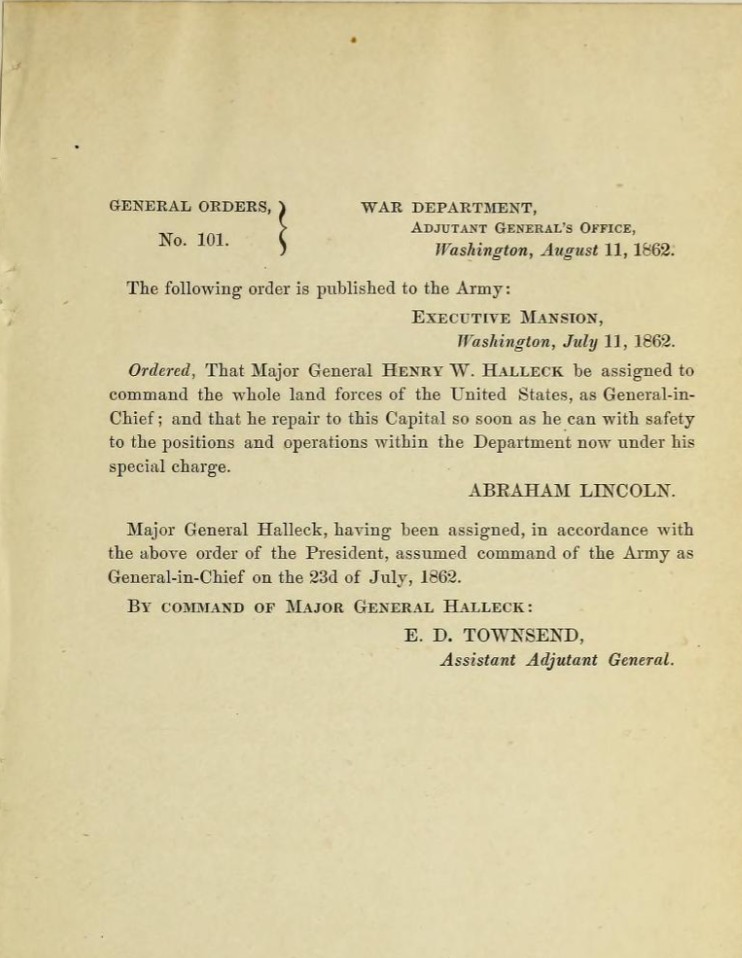
Lincoln did not ask a second time. The next day, July 11, 1862, the order went out from the Executive Mansion: Major General Henry W. Halleck was assigned to command the whole land forces of the United States as General-in-Chief, and was to report to Washington as soon as he safely could. It was signed simply, "Abraham Lincoln." The offer was over. This was an order.
Halleck told Sherman what he really thought of it. "I have done my best to avoid it," he wrote. "I have studied out and can finish the campaign in the West. Don't understand and cannot manage affairs in the East." Sherman wrote back with a mix of confidence and dread, telling Halleck he'd handle Washington fine, but warning that the West could not spare him: "You cannot be replaced out here, and it is too great a risk to trust a new man from the East."
Halleck went anyway. He wound down his command in the West, made the trip to Washington, and on July 23, twelve days after the order was written, he formally took over as General-in-Chief. The War Department did not even get around to publishing the appointment to the Army at large until August 11, when General Orders No. 101 laid out both dates side by side: the July 11 order from Lincoln, and a closing line confirming Halleck "assumed command of the Army as General-in-Chief on the 23d of July, 1862."
The job did not suit him. Known as "Old Brains" for a textbook on military strategy he'd written a decade earlier, Halleck turned out to be an excellent administrator and a hesitant commander. He was often reluctant to issue direct operational orders, preferring to advise rather than command, and strong personalities like McClellan and Pope simply ignored him when he did. Lincoln eventually said he was "little more than a first-rate clerk." Halleck held the post for a year and a half before Grant replaced him in March 1864, at which point he settled into a role that fit him far better: chief of staff, keeping the army supplied while someone else made the decisions.
The paperwork below is the whole story in miniature. One order, two dates, and a general who did not particularly want the promotion everyone assumed he'd been chasing.