By the summer of 1945, sixty-four Japanese cities had already been firebombed. Tokyo alone lost over a hundred thousand people in a single night in March. So when people learn that Hiroshima was hit by the atomic bomb on August 6, the natural assumption is that its luck simply ran out, that it was next in line for the same fate that had already come for Osaka, Nagoya, and dozens of smaller cities.
That is not what happened. Hiroshima had been deliberately spared from the devastating conventional bombing campaign.
On July 3, 1945, the Joint Chiefs of Staff formalized restrictions placing Hiroshima off limits to large-scale conventional bombing, along with Kokura, Niigata, and Kyoto, restrictions that had already been taking shape in internal discussions the month before. The city wasn't literally untouched. It saw reconnaissance flights and the occasional small or stray bomb. But it was deliberately spared the mass incendiary raids that leveled most of Japan's major cities, so that when the atomic bomb was finally used, its damage could be measured against a baseline with minimal previous bomb damage. Residents in Hiroshima noticed they had been spared and had no idea why. Some guessed the Americans were saving the city for their own postwar headquarters. Others thought relatives in Hawaii or California had somehow pleaded with Washington on the city's behalf. City officials, more practical than hopeful, used the calm to tear down buildings and cut long firebreaks across town, work that continued right up until the morning of August 6.
The Target Committee initially favored Kyoto, Japan's ancient capital and a strong candidate given its size and industry, but Secretary of War Henry Stimson repeatedly removed it from consideration, over the objections of the general running the Manhattan Project. For decades the story credited a young Army intelligence officer named Edwin Reischauer with saving the city. Reischauer spent much of his later life denying it. In his own telling, credit belonged to Stimson alone, a man who had visited Kyoto years earlier and never forgot it. With Kyoto off the table, Nagasaki was added to the target list on July 25, eleven days before the mission that would eventually hit it too.
Hiroshima's own selection came down to a mix of military reasoning and something closer to stagecraft. The Target Committee wanted a place large enough that a big share of it could be destroyed, with hills nearby that might focus the blast and add to the damage. The committee's minutes also described another goal: ensuring the bomb's first combat use would be, in their words, "sufficiently spectacular" that its significance would be internationally recognized the moment it was announced. Hiroshima, an army depot and embarkation port with a garrison of roughly forty thousand troops, fit both requirements.
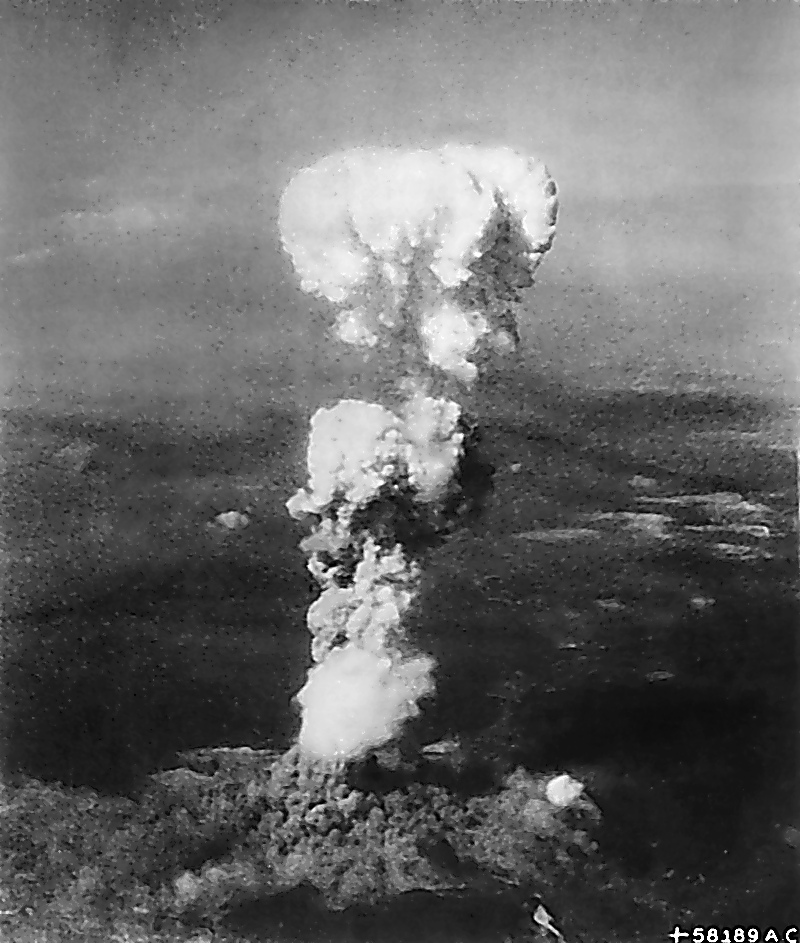 The atomic cloud over Hiroshima, photographed two to five minutes after detonation. National Archives.
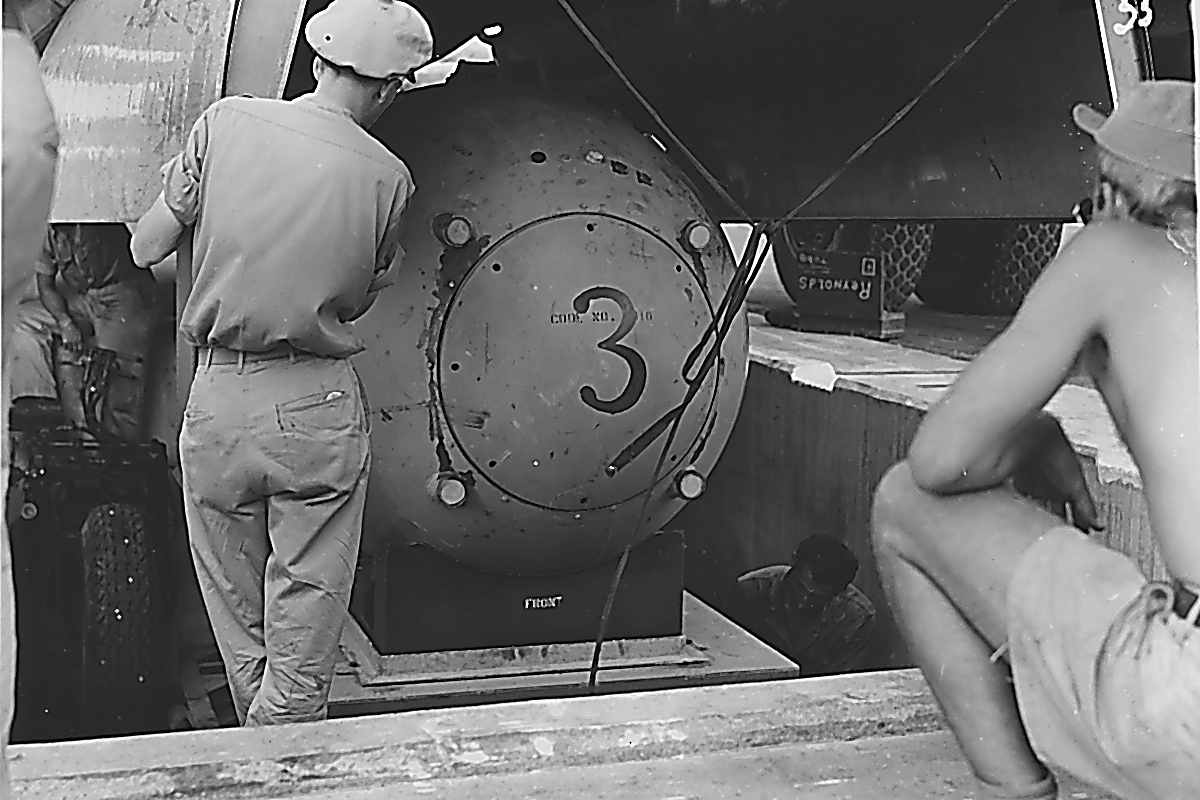
At 8:15 on the morning of August 6, the Enola Gay released Little Boy from just over five miles up. The bomb held about 64 kilograms of uranium-235, and less than two percent of it actually fissioned before the rest was scattered by the blast. The bomb drifted about 240 meters past its aim point, the distinctly T-shaped Aioi Bridge that bombardiers had studied because it was easy to pick out from the air. It detonated instead almost directly above the Shima Surgical Clinic, roughly 1,900 feet over the city.
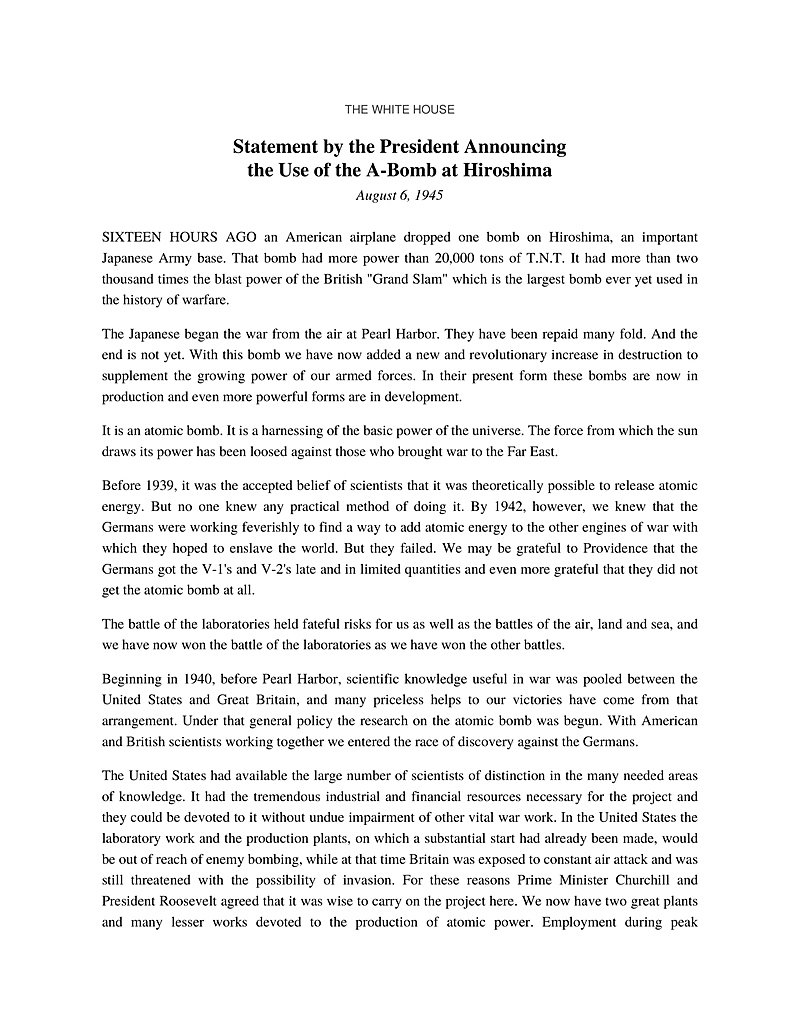
That detail matters, because Truman's own statement to the American public, released sixteen hours later, described the target as "an important Japanese Army base." Hiroshima did contain major military facilities, including the headquarters of the Second General Army and a garrison of roughly forty thousand troops. But the bombardiers weren't aiming at any of that. They were aiming at the Aioi Bridge, a distinctive T-shaped span near the city center that was simply easier to pick out from high altitude than any individual military installation.
The human toll has never settled into a single agreed number, and Echo and Chronicle isn't going to pretend otherwise. The Manhattan Project's own 1946 assessment counted about 66,000 dead. A joint US-Japanese commission in 1951 put it at roughly 64,500. Japanese-led studies in the 1970s pushed the estimate closer to 140,000 by the end of the year. The Radiation Effects Research Foundation, the modern binational body that has studied the survivors longest, now estimates the toll at somewhere between 90,000 and 166,000 dead by December 1945, out of a city of 340,000 to 350,000 people that morning. Whichever figure is used, the same fact holds across all of them: something close to ninety percent of the dead were civilians, despite the tens of thousands of soldiers stationed in the city.
Eleven days before the bombing, Truman had written in his own diary that he had instructed Stimson to use the weapon so that "the target will be a purely military one," aiming at soldiers and sailors rather than women and children. Truman wrote that before the mission was flown, and historians still debate how well he grasped what precision an air-dropped atomic bomb could actually offer against a single military installation. It is still worth sitting with that sentence next to what happened at 8:15 that morning.
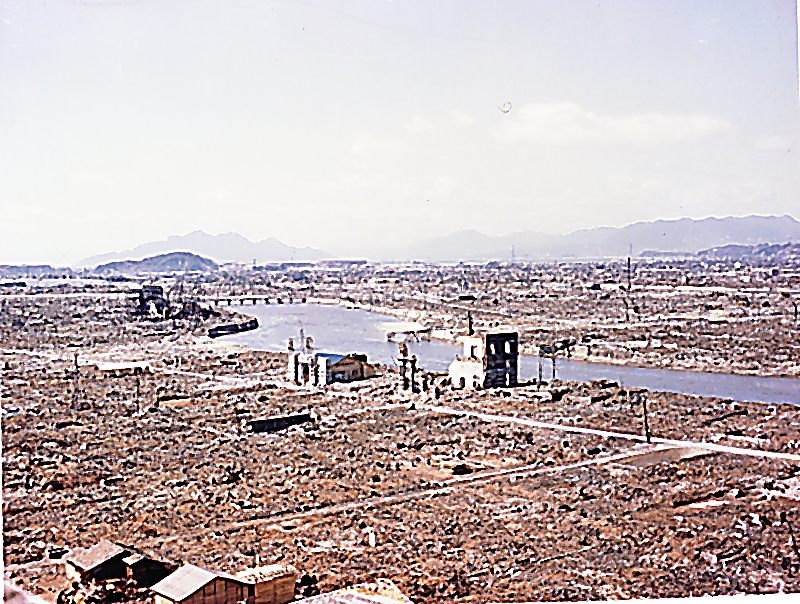 Hiroshima's industrial district along the river, flattened by the blast. National Archives.
No leaflets naming Hiroshima as a target were dropped before the bomb did. That doesn't mean Japan heard nothing. Over 63 million leaflets had rained down on Japanese cities in the weeks prior, warning that additional cities would soon be destroyed and naming dozens of specific targets slated for firebombing. Hiroshima simply wasn't named among them, and the leadership's own scientific panel weighed a public demonstration of the atomic weapon itself before rejecting the idea outright. They worried a demonstration might fail, might be dismissed as a bluff, or might hand Japan time to shoot down the plane carrying the only atomic bomb then ready for immediate combat use. So the first anyone in Hiroshima knew of the weapon that killed them was the flash itself.
Whether any of this made the bombing more or less justified is still argued today, by historians who mostly agree on the facts above and disagree sharply on what they add up to. Some maintain the bomb, whatever its costs, ended a war that would otherwise have cost far more lives on both sides in an invasion of the home islands. Others argue Japan was already close to surrender, particularly once the Soviet Union entered the Pacific War three days later, and that the bombing was never really about ending the war with Japan at all. Both camps rely heavily on many of the same primary sources, alongside Japanese government records, Soviet archives, memoirs, and postwar interviews, and reach different conclusions about what it all means.