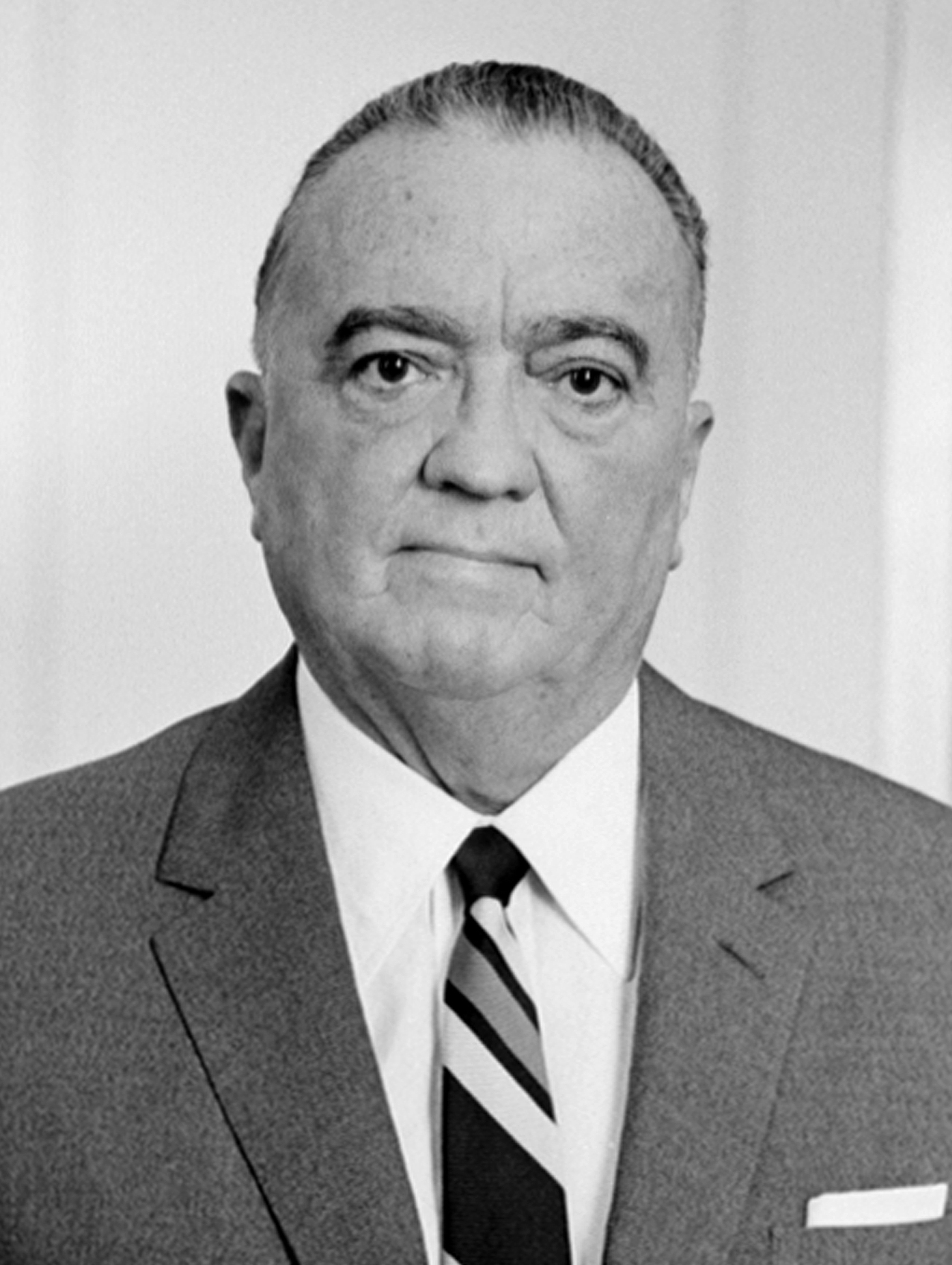
On June 9, 1954, the thirty-sixth day of the Army-McCarthy hearings, a 63-year-old Boston lawyer named Joseph Welch looked across the Senate chamber at Joe McCarthy and asked a question that would echo for the next seventy years.
"Have you no sense of decency, sir? At long last, have you left no sense of decency?"
The gallery erupted. McCarthy sat in stunned silence. Within months he would be censured by the Senate. Within three years he would be dead, at 48, his liver destroyed by alcohol.
The story most Americans know ends there. The reckless senator, finally stopped by a mild-mannered lawyer with a sharp tongue and a sense of moral outrage. The arc of justice bending, slowly but unmistakably, toward decency.
What that story leaves out is J. Edgar Hoover.
The Man Behind the List
When McCarthy stood at a podium in Wheeling, West Virginia on February 9, 1950, and claimed to have a list of 205 Communist Party members working inside the State Department, the country assumed he had done the work himself. The evidence. The names. The dossiers.
He hadn't.
McCarthy had been a mediocre senator from Wisconsin with a poor record and a reelection problem. He needed an issue. What he got instead was J. Edgar Hoover, the most powerful law enforcement official in the country, who had spent the previous decade building a surveillance apparatus that reached into virtually every corner of American life.
Hoover and McCarthy had been friends since 1947, when the senator made a point of visiting the director to pay his respects. They dined together at Harvey's Restaurant in Washington, Hoover's regular table, with Hoover's longtime companion Clyde Tolson. McCarthy understood something essential about Hoover: the man was susceptible to flattery, and the man had files on everyone.
"No one need erect a monument to you," McCarthy wrote to Hoover in one letter. "You have built your own monument in the form of the FBI, for the FBI is J. Edgar Hoover."
Hoover kept the letter.
After McCarthy's Wheeling speech began attracting national attention, Hoover gave an order to his staff that revealed everything about the nature of their arrangement. According to William Sullivan, who would later become the third-ranking official in the Bureau, Hoover told his team to "review the files and get anything you can for him."
The FBI did not have enough evidence to show there was a single Communist in the State Department. Hoover knew this. He ordered the work done anyway.
The Intelligence Operation
What followed was one of the most consequential covert political operations in American history, conducted entirely in secret, by a federal law enforcement agency that was supposed to be politically neutral.
FBI agents spent hundreds of hours reading through confidential files and preparing summaries for McCarthy's use. The Bureau supplied speechwriters for McCarthy and for two of his top aides, Roy Cohn and G. David Schine. Hoover's assistant director Louis Nichols served as a direct liaison between the FBI and McCarthy's office, providing public relations counsel and coaching McCarthy on how to phrase his accusations in ways that were impossible to disprove.
Nichols told McCarthy not to use the phrase "card-carrying Communists," because that could be challenged in court. Instead, he should say "Communist sympathizers" or "loyalty risks." The language was designed to be unfalsifiable. If you called someone a card-carrier, you needed proof of a card. If you called them a sympathizer, no proof was required.
The FBI's files were not evidence of Communist infiltration. They were, as Sullivan later admitted, a repository of rumors, third-hand accounts, and gossip. Names that had appeared in reports, often without context, often years earlier, often based on a single unverified informant. Hoover knew what was in them. He handed them to McCarthy anyway.
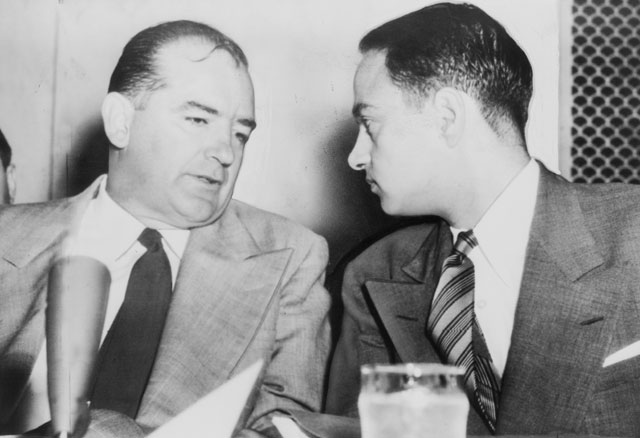 Senator Joseph McCarthy and chief counsel Roy Cohn during the Army-McCarthy hearings, 1954. Cohn was 26 years old when McCarthy appointed him. The FBI supplied speechwriters for both men.
The Tydings Committee and the Paper Trail
The paper trail that survives in the declassified FBI files is striking in what it reveals. Internal memoranda flowing between Hoover's senior deputies show the Bureau actively cross-referencing McCarthy's list of 81 alleged State Department subversives, tracking the employment status of every named individual, opening new investigations on McCarthy's targets, and routing results directly to the Director.
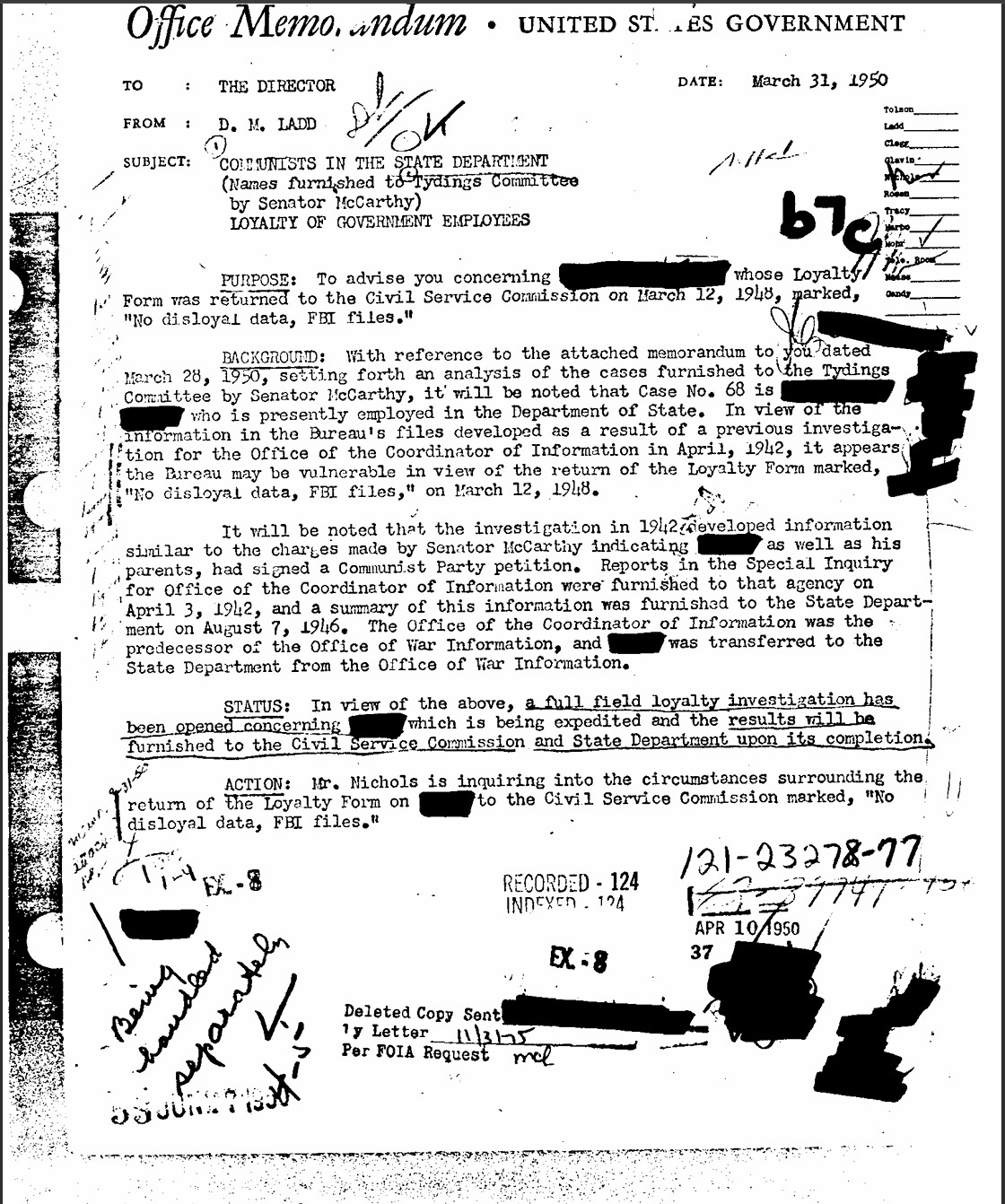
A March 31, 1950 memo from senior agent D.M. Ladd to Hoover, now available in the National Security Internet Archive, shows the FBI reporting on one of McCarthy's named cases, confirming a new full field loyalty investigation had been opened and that results would be furnished to the Civil Service Commission and State Department. The routing slip on the document shows it passed through Hoover's entire inner circle, including Clyde Tolson and Helen Gandy, the secretary who managed Hoover's private files for nearly fifty years.
The Tydings Committee, convened by the Senate to investigate McCarthy's charges, ultimately concluded that his list was "a fraud and a hoax." What the committee did not know, and what the public would not learn for decades, was how the list had been assembled in the first place.
The Moment the Machine Turned
By 1954, McCarthy had become a liability. He had attacked the Army, a branch of the government under the command of a president who had won a war. He had alienated members of his own party. His approval ratings were falling. And he had made the mistake of picking a fight on live television, where 80 million Americans could watch him work.
The Army-McCarthy hearings began on April 22, 1954, and ran for 36 days. They were broadcast gavel-to-gavel on ABC and the DuMont network, the first major political proceedings ever carried live on American television. What the country saw was not the crusading patriot of McCarthy's press releases. They saw a bully.
On June 9, the thirtieth day of the hearings, McCarthy made a move he had been holding in reserve. He attacked a young lawyer in Welch's firm named Fred Fisher, who had once been a member of the National Lawyers Guild, a group the Attorney General had called "the legal bulwark of the Communist Party." McCarthy and Welch had a prior agreement to keep Fisher's name out of the hearings. McCarthy broke it on live television.
What he did not anticipate was Welch.
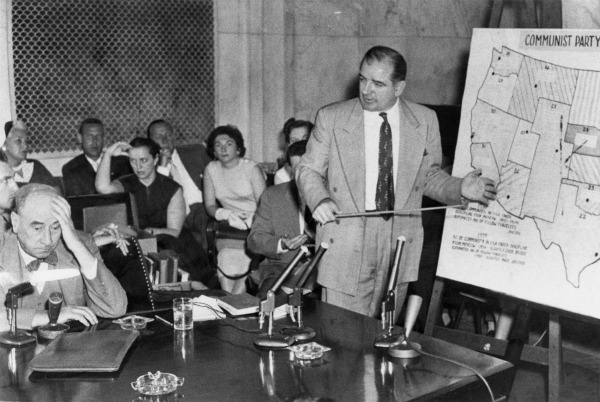 Senator McCarthy presents a map of alleged Communist Party infiltration during the Army-McCarthy hearings, 1954. The hearings were broadcast to an estimated 80 million Americans, the largest television audience for a political proceeding in the country's history to that point.
"Have You No Sense of Decency?"
Joseph Welch had been recruited specifically because the Army needed someone who could withstand McCarthy. He was a senior partner at one of Boston's most prestigious law firms, a graduate of Grinnell College and Harvard Law, a man with the manner of a New England gentleman and the instincts of a trial lawyer who had spent thirty years winning cases.
When McCarthy broke the agreement and named Fred Fisher on national television, Welch did not explode. He went quiet.
"Until this moment, Senator, I think I never really gauged your cruelty or your recklessness," Welch said. McCarthy tried to continue. Welch cut him off.
"Let us not assassinate this lad further, Senator. You've done enough. Have you no sense of decency, sir? At long last, have you left no sense of decency?"
The gallery burst into applause. McCarthy looked around the room, visibly disoriented, and tried to resume his attack on Fisher. Welch refused to engage. "Mr. McCarthy, I will not discuss this further with you. You have seen fit to bring it out, and if there is a God in heaven, it will do neither you nor your cause any good."
It didn't. In January 1954, Gallup had found McCarthy with a 50 percent approval rating. By June, that number had dropped to 34 percent, with 45 percent now disapproving. On December 2, 1954, the Senate voted 67 to 22 to censure him.
The Exit
What is almost never discussed is what Hoover did next, which was nothing. He did not defend McCarthy. He did not come forward to explain what the FBI had provided and why. He simply withdrew. The pipeline of intelligence closed. The speechwriters stopped calling. Louis Nichols, who had served as McCarthy's handler inside the Bureau, quietly distanced himself from the senator's operation.
Hoover had spent four years building McCarthy into the most feared political figure in America. When McCarthy became a liability, Hoover let him fall.
McCarthy died on May 2, 1957. He was 48 years old. The official cause was hepatitis, almost certainly brought on by years of heavy drinking. Hoover sent flowers to the funeral.
Hoover himself died in office on May 2, 1972, exactly fifteen years later to the day. He had been FBI Director for 48 years. He was never charged with anything.
The man who made McCarthyism possible outlived McCarthyism by two decades, continued to run the most powerful domestic intelligence agency in the country, and died in the same house in Washington he had lived in since 1938. His personal files, containing decades of surveillance records on presidents, senators, civil rights leaders, journalists, and private citizens, were destroyed by Helen Gandy in the days following his death.
Some of what was in them we will never know.
J. Edgar Hoover served as Director of the FBI from 1924 until his death in 1972, a tenure of 48 years across eight presidential administrations. The Army-McCarthy hearings ran from April 22 to June 17, 1954. McCarthy was censured by the Senate on December 2, 1954. He died on May 2, 1957. The declassified FBI files on Joseph McCarthy, running to more than 5,000 pages across 51 parts, are available through the Internet Archive.