On the morning of June 8, 1968, a British immigration officer at London's Heathrow Airport ran a routine passport check on a quiet, unremarkable man in horn-rimmed glasses who said he was flying to Brussels. The passport gave the name Ramon George Sneyd. The name came back on a Royal Canadian Mounted Police watchlist. A pat-down found a loaded revolver in the man's pocket.
The man was James Earl Ray, an escaped convict from the Missouri State Penitentiary who had been wanted for the assassination of Dr. Martin Luther King Jr. for sixty-five days. He had traveled from Memphis to Atlanta to Toronto to London to Lisbon and back to London, operating under at least three fake identities, with no known legitimate income. He was apprehended without incident and charged that same day.
Ray's arrest closed the most intensive manhunt in FBI history up to that point. What it did not close were the questions that would follow for the next half century.
Memphis, April 4, 1968
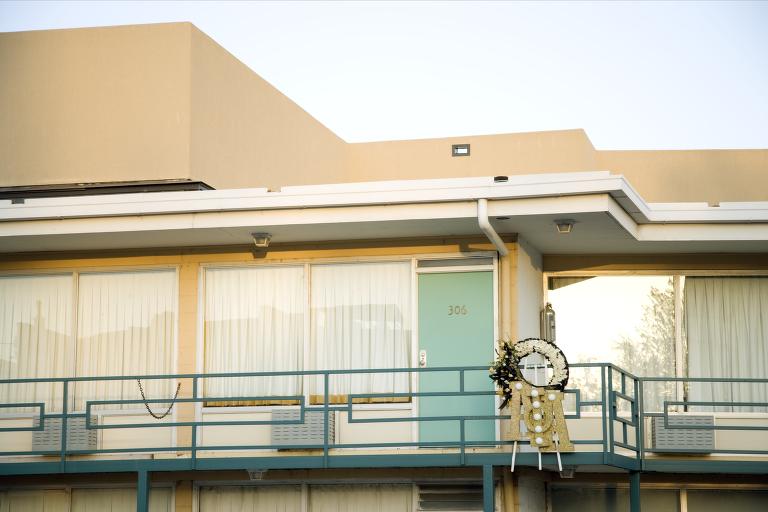
King had come to Memphis in support of the city's striking Black sanitation workers, who were paid a dollar an hour with no union, no uniforms, and no grievance procedure. He had led a march on March 28 that ended in violence, and returned on April 3 to try again, checking into room 306 at the Lorraine Motel.
That night, he delivered what would be his final speech at the Mason Temple, the now-famous "I've Been to the Mountaintop" address. He spoke of death threats, of not knowing what would happen to him, of having been to the mountaintop and seen the promised land. The next day, April 4, at 6:01 in the evening, King stepped onto the balcony outside room 306. A single .30-06 bullet fired from a Remington Model 760 rifle struck him in the right cheek, shattering his jaw and lodging near his left shoulder blade. He was pronounced dead at St. Joseph's Hospital at 7:05 p.m. He was thirty-nine years old.
Within the hour, police found a bundle containing the rifle and a pair of binoculars dropped near a rooming house at 422 and a half South Main Street, directly across from the Lorraine Motel. Both items carried the fingerprints of a man who, at that moment, the FBI did not yet know by name.
The Ghost Named Eric Starvo Galt
For the first two weeks after the assassination, the FBI's primary suspect was a phantom. The fingerprints from the rifle traced to an escaped convict named James Earl Ray, but Ray had been living under aliases so carefully constructed that investigators initially chased a name that may not have belonged to a real person at all.
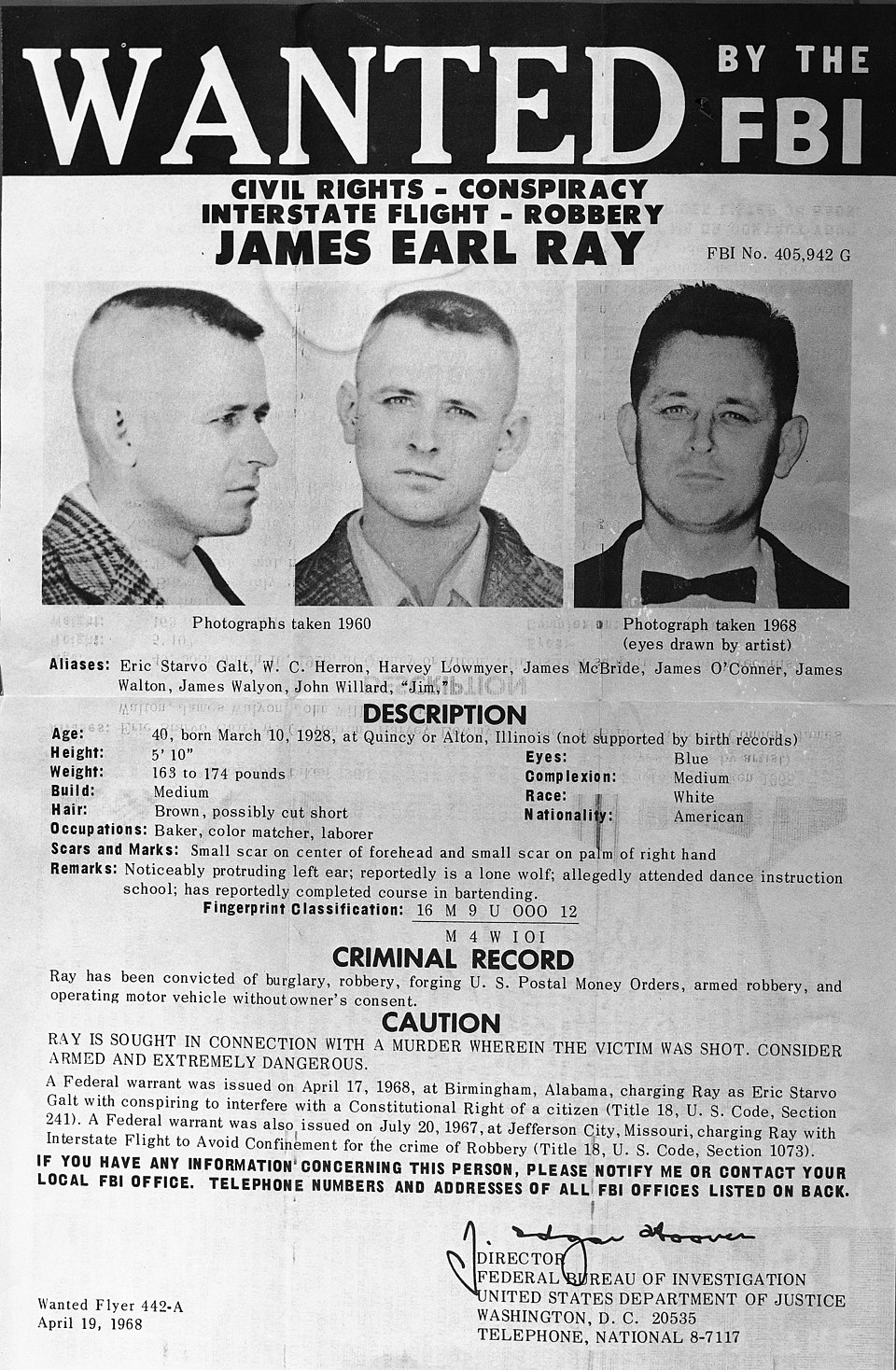
Ray had rented the room at Bessie Brewer's rooming house under the name John Willard. He had purchased the murder weapon at a Birmingham gun store under the name Harvey Lowmeyer. He had registered at a Memphis motel before the shooting under the name Eric Galt. By April 17, the FBI had issued a wanted circular for "Eric Starvo Galt," complete with a photograph of Ray taken in 1968 in which an artist had drawn in the eyes because the FBI wasn't certain what he looked like. The circular, stamped "Civil Rights, Conspiracy," described a lone wolf with a noticeably protruding left ear who had allegedly attended dance instruction school and completed a bartending course.
On April 19, fingerprint analysis confirmed that Galt was James Earl Ray, a forty-year-old former armed robber who had escaped from the Missouri State Penitentiary on April 23, 1967, by hiding in a bread truck. He had been free for nearly a year before the assassination.
Sixty-Five Days, Three Countries, Three Passports
What happened after April 4 raised questions that investigators and historians have debated ever since. Ray, a man with no documented income, no known contacts abroad, and a history of small-time robbery, managed to cross into Canada, obtain a Canadian passport through a travel agency in Toronto under the name Ramon George Sneyd, fly to London on May 5, travel to Lisbon on May 7, obtain a second Canadian passport in Lisbon on May 16, and fly back to London, where he lived in rooming houses in the Earls Court area while apparently planning to reach Rhodesia.
The Royal Canadian Mounted Police had been running through hundreds of thousands of passport photographs at the FBI's request, looking for anyone matching Ray's description. On June 1, they found a match. By June 8, the watchlist had reached Heathrow.
Ray was extradited to Memphis on July 19, 1968. On March 10, 1969, his forty-first birthday, he pleaded guilty to first-degree murder on the advice of his attorney, Percy Foreman, accepting a 99-year sentence to avoid the electric chair. Three days later, he recanted.
The Government That Watched King Die
The FBI's role in investigating King's assassination carried a particular weight that no official acknowledgment fully addressed. For the last six years of King's life, J. Edgar Hoover's bureau had run an aggressive covert campaign to destroy him. Agents wiretapped his home phone and his office. They bugged hotel rooms where he stayed. They infiltrated his inner circle. In 1964, they sent him an anonymous package containing an audiotape of alleged extramarital affairs and a letter that King correctly understood as urging him to commit suicide, warning that "there is but one way out for you." The letter was signed with the phrase "King, there is only one thing left for you to do." A draft of the letter was later found in FBI files.
This was all operating under COINTELPRO, the bureau's classified counterintelligence program targeting activists and organizations it deemed subversive. None of it was publicly known in April 1968. Hoover told President Lyndon Johnson that his agency would find King's killer. The FBI became the lead investigative agency in the case.
What Congress Found
In 1979, the House Select Committee on Assassinations completed a two-year investigation into both the Kennedy and King assassinations. Its finding on King was careful but unambiguous: the committee believed, on the basis of the available circumstantial evidence, that there was a likelihood that Ray had assassinated King as a result of a conspiracy. The committee could not identify who else was involved. It cleared federal and state agencies of direct participation while finding that the FBI and Justice Department had performed with, in the committee's words, "varying degrees of competency and legality" in the investigation.
Twenty years later, in 1999, the King family brought a civil wrongful death suit against a Memphis restaurant owner named Loyd Jowers, who had claimed in a 1993 television interview that he had been part of a conspiracy involving the mafia and federal government to kill King. The trial lasted three weeks. Seventy witnesses testified. The jury, six Black and six white Memphis residents, found unanimously that King had been the victim of a conspiracy involving Jowers and others, and awarded the King family the one hundred dollars in damages they had requested to demonstrate they sought no financial gain.
The Department of Justice reviewed Jowers' claims in 2000 and concluded there was no credible evidence to support them. Jowers' own sister said he had invented the story to sell it for $300,000.
2025: The Files Come Out
In July 2025, the Trump administration released more than 230,000 pages of previously classified records related to King's assassination under Executive Order 14176, including the full MURKIN investigation files, which the FBI had officially designated Murder-King. The files, many of which had never been digitized, contained internal memos, wiretap transcripts, field reports from sixteen FBI offices, leads pursued across the country, and CIA overseas intelligence records related to the hunt for Ray. Historians who reviewed the release described it as offering important procedural insight into the FBI's methods but said it did not fundamentally alter the established account of what happened.
Ray himself spent the rest of his life attempting to withdraw his guilty plea and secure a full trial, insisting that a man he knew only as Raoul had set him up. His efforts were consistently denied. He died in prison on April 23, 1998, from liver failure caused by hepatitis C, at the age of seventy.
King's son Dexter had met with Ray the previous year and asked him directly whether he had killed his father. Ray said he had not. Dexter King told reporters he believed him.
The Lorraine Motel still stands in Memphis. Room 306 is preserved exactly as it was on April 4, 1968. A white wreath marks the spot on the balcony where King stood when the shot was fired.
The FBI's internal investigation code name for the King assassination was MURKIN, derived from Murder-King. The case file ran to hundreds of thousands of pages. For decades, most of it sat in government storage facilities, undigitized and unavailable to the public. In 2025, it finally came out.