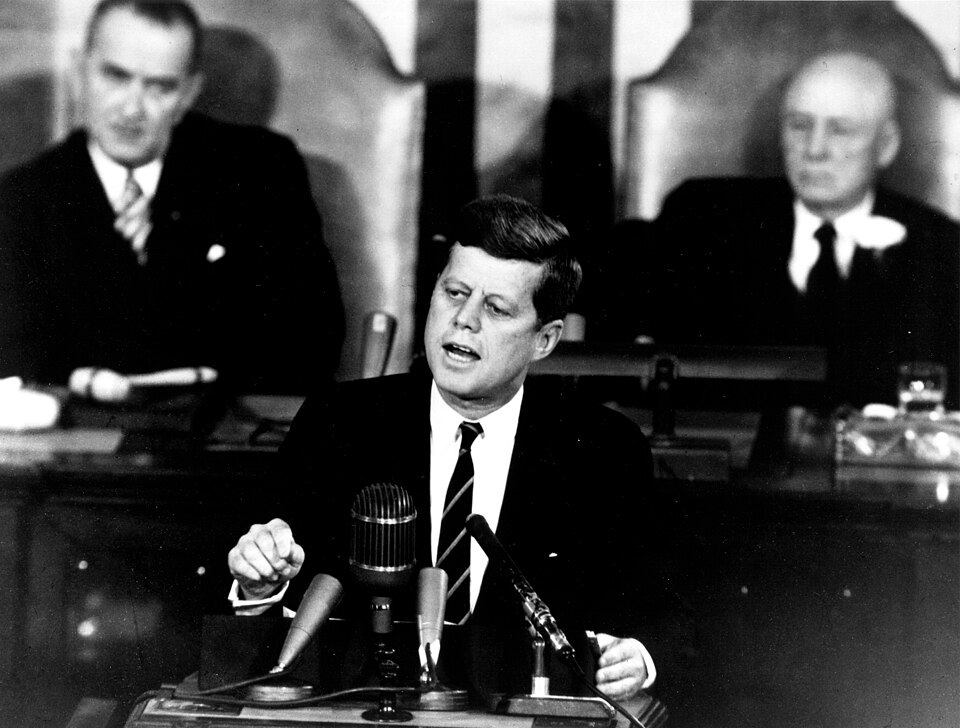
John F. Kennedy had been president for four months and seventeen days when he stood before Congress on May 25, 1961. He was not having a good spring.
On April 12, Soviet cosmonaut Yuri Gagarin had become the first human being to reach space, completing a full orbit of Earth in 108 minutes. The Americans had watched from the ground. Five days later, a CIA-trained force of Cuban exiles landed at the Bay of Pigs and was crushed within three days. The operation had been planned under Eisenhower and inherited by Kennedy, who had approved it and then watched it collapse in front of the entire world. Twenty days before the May 25 speech, Alan Shepard had become the first American in space, which was something. But Shepard's flight lasted fifteen minutes and never reached orbit. Soviet Premier Nikita Khrushchev called it a flea hop.
Kennedy needed to change the subject. He chose the largest subject available.
The speech he delivered that day was formally titled the Special Message to the Congress on Urgent National Needs. It ran 46 minutes and nearly 6,000 words, delivered from 81 printed pages without a teleprompter. It covered defense spending, foreign aid, civil defense, communications satellites, weather observation and nuclear rocket development. Most of Congress had no idea what was coming at the end.
The moon announcement was Section IX of nine sections. Kennedy buried the lead deliberately.
He opened the space portion of the speech not with triumph but with honesty. He acknowledged the Soviet lead directly. He told Congress that the Soviets had a significant head start with their rocket engines, giving them many months of advantage, and that they would likely exploit that lead further. He did not pretend America was winning. He said that while the United States could not guarantee it would one day be first, it could guarantee that any failure to make the effort would make it last.
Then he made the ask.
"First, I believe that this nation should commit itself to achieving the goal, before this decade is out, of landing a man on the moon and returning him safely to the earth. No single space project in this period will be more impressive to mankind, or more important for the long-range exploration of space; and none will be so difficult or expensive to accomplish."
He told Congress what it would cost. Five hundred and thirty-one million dollars in fiscal 1962. An estimated seven to nine billion dollars over the next five years. He told them this was not a partial commitment. "If we are to go only half way, or reduce our sights in the face of difficulty, in my judgment it would be better not to go at all."
He also told them something that tends to get left out of the mythology.
"But this is not merely a race." Kennedy said those words directly. He argued that space was open to everyone and that America's eagerness to explore it was not simply governed by what the Soviets were doing. He said the country was going to the moon because whatever mankind must undertake, free men must fully share. Whether he believed that in private is a separate question. In November 1962, in a recorded meeting with NASA Administrator James Webb, Kennedy said plainly that he was not that interested in space and that his position was purely about beating the Soviet Union. The speech he gave in May 1961 was the public version. The November recording was the private one. Both were true in different ways.
What is not in dispute is what the speech set in motion.
NASA had existed for three years when Kennedy made his commitment. The entire American space program at that point amounted to one suborbital flight lasting fifteen minutes. Kennedy was asking Congress to fund an endeavor that his own space agency privately acknowledged they did not know how to complete. He acknowledged in the speech itself that the commitment demanded a degree of dedication, organization and discipline which had not always characterized American research and development. He was not overselling it.
He was also not entirely sure Congress would say yes. The speech reads, when you study the Congressional Record carefully, like a president making an argument rather than a president issuing a command. He told Congress that every citizen and every member should consider the matter carefully. He said it was a heavy burden. He said there was no sense in agreeing to go to the moon unless the country was prepared to do the work and bear the cost. He explicitly said that if they were not prepared to do that, they should decide today and this year.
Congress said yes.
At its peak the Apollo program employed 400,000 Americans. Engineers, scientists, technicians, contractors and civil servants across the country spent eight years solving problems that had never been solved before. The budget reached its height in 1966 at four percent of the entire federal budget. Adjusted for inflation the total cost was somewhere between $150 and $180 billion in today's dollars.
On July 20, 1969, Neil Armstrong stepped off the ladder of the lunar module Eagle and onto the surface of the moon. Eight years and fifty-six days after Kennedy's speech to Congress. Fifty-one weeks before the end of the decade.
Kennedy did not live to see it. He was assassinated in Dallas on November 22, 1963, two and a half years after the speech. He never saw a Saturn V rocket leave the ground. He never saw an American orbit the Earth. Alan Shepard, who flew on that fifteen-minute suborbital hop in May 1961 that Kennedy had cited in the speech, later described the president as a genuine space cadet who was really, really moved by the idea of exploration. He said it was too bad Kennedy could not have lived to see his promise kept.
The Congressional Record from May 25, 1961, pages 8877 through 8882, is linked above. It is not just the speech. It is the full record of that session of the House of Representatives, the procedural votes, the members present, the applause noted in the transcript, and the moment the joint session was dissolved. It is the raw record of the day a president stood up in front of Congress and committed a nation to something nobody knew how to do.
They figured it out.