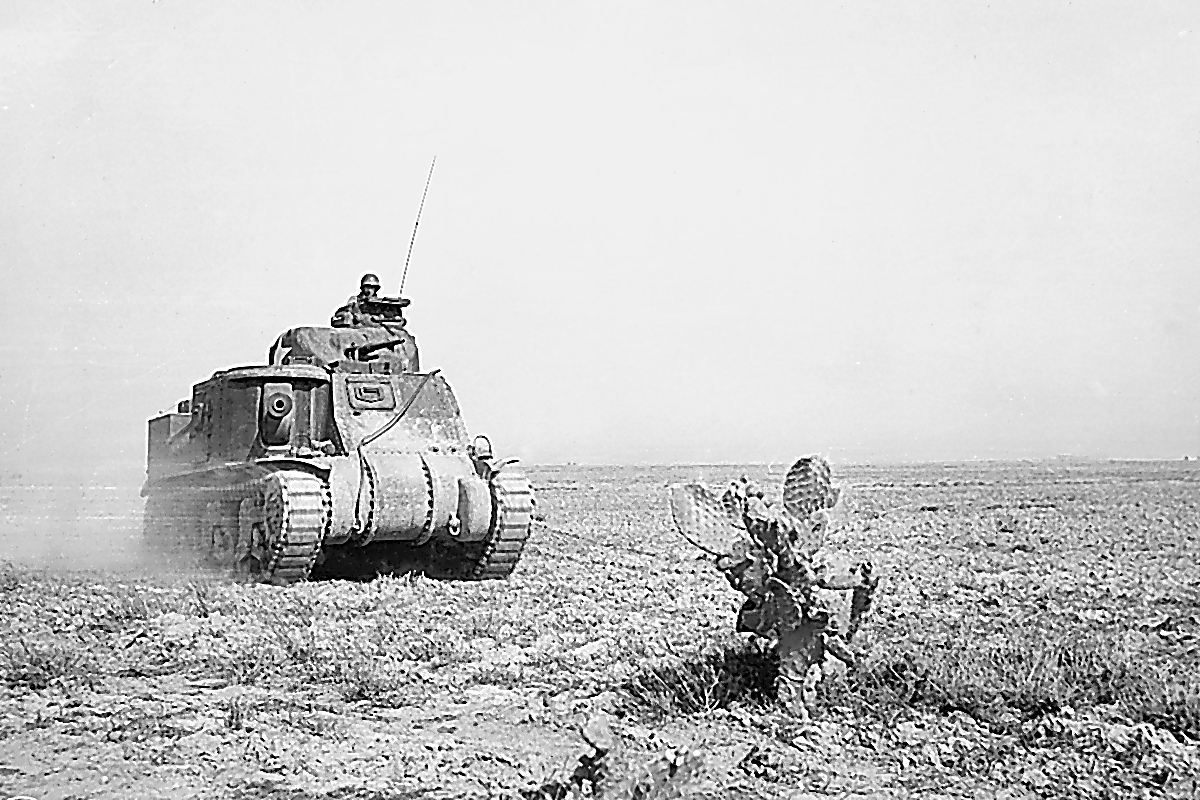
Ask anyone who has heard of the Battle of Kasserine Pass what happened there, and you will get the same answer. In February 1943, an inexperienced American army met Rommel's tanks for the first time and got run over. It is the standard opening scene of America's ground war against Germany: raw troops broke, retreated through Kasserine Pass, and had to be stabilized by British and American reinforcements. General Omar Bradley, writing near the end of his life, called it the worst performance in the Army's history. That verdict has helped define the battle ever since.
That part is true, and an honest article does not soften it. But there is a second question underneath the first one, and it matters more than whether American troops looked bad in the opening days. What was the Axis operation built on that breakthrough actually trying to accomplish, and did it succeed?
It didn't.
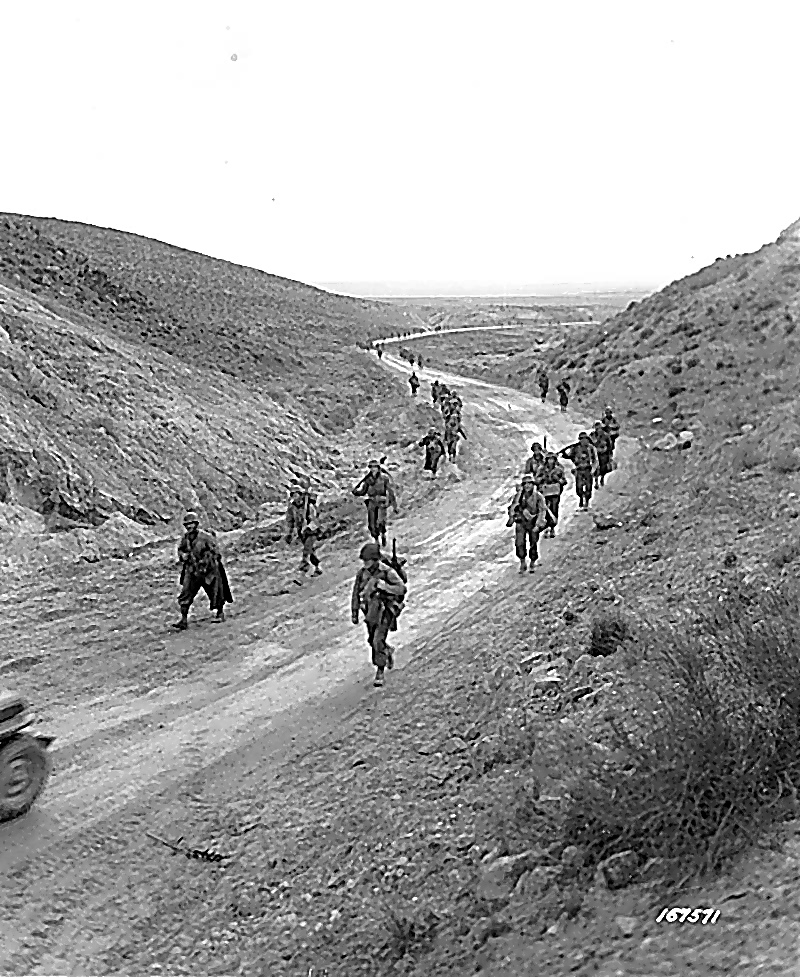 U.S. troops move through Kasserine Pass after the Allied recapture, February 26, 1943. U.S. Army Signal Corps, SC 167571.
What the offensive was actually trying to do
The popular version of Kasserine treats the capture of the pass as the outcome that mattered. It wasn't. After the Axis attacks at Faid and Sidi Bou Zid on February 14, Rommel wanted to push toward Tébessa, the major American logistics base to the west, hoping to turn a local breakthrough into a much larger Allied collapse. Kesselring approved the proposal and forwarded it to Rome, but the Italian Comando Supremo revised it before authorizing the attack: instead of Tébessa, the operation's objective became a drive through Kasserine and Sbiba toward Thala and Le Kef, clearing the Western Dorsal and threatening the Allied position further north.
That was the operation Rommel actually had to execute. Not "capture a mountain pass." Break the Allied line open far enough north to threaten the Allied position in Tunisia.
The part of the story everyone already knows
The opening days deserve their reputation. Major General Lloyd Fredendall had scattered II Corps in small, isolated pockets that were too far apart to support each other, some of them positioned by commanders who had never personally looked at the ground they were defending. When the 10th and 21st Panzer Divisions hit Sidi Bou Zid on February 14, American units were surrounded, cut off from radio contact, and destroyed piecemeal. By February 17, II Corps had lost thousands of men, more than a hundred tanks, and most of its forward positions. Rommel had won the opening battles and seized important ground, taking the pass itself, inflicting serious losses, and capturing thousands of prisoners along with substantial American equipment. The Army's own official history describes the American situation as serious and records German forces coming away with captured equipment more or less intact.
Tactically, the opening phase was an Axis victory. The question is whether Rommel could turn it into the operational breakthrough the plan required.
The part that gets left out
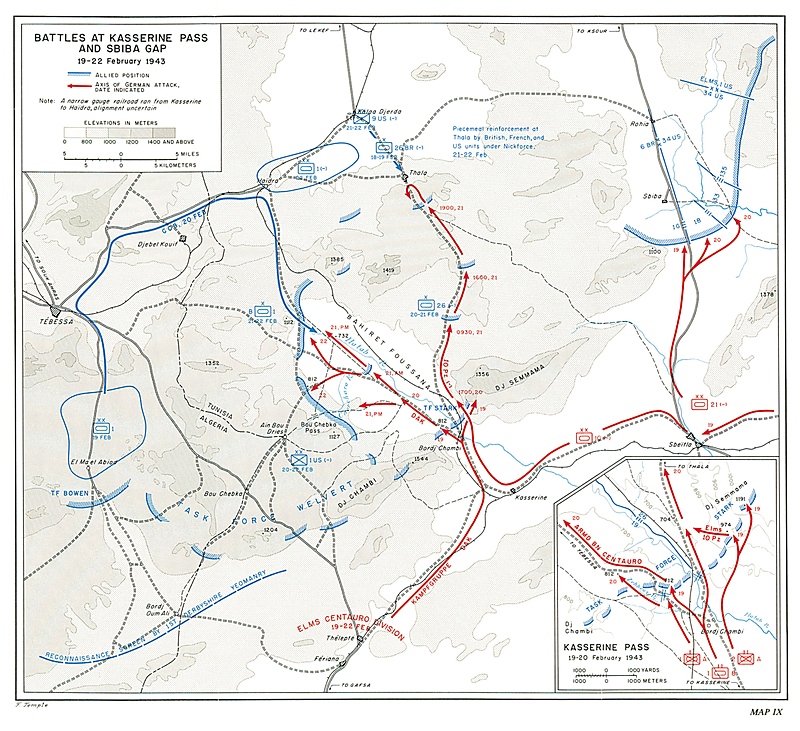 The Army's own map of the fighting along the Tébessa road and at Thala, February 19-22, 1943. From Howe, Northwest Africa: Seizing the Initiative in the West, Map IX.
By February 20, the retreat stopped being a rout. Southwest of the pass, in the fighting that developed along the Tébessa road, Brigadier General Paul Robinett's Combat Command B and elements of the 1st Infantry Division dug in with tanks in defilade, antitank guns in mutually supporting positions, and artillery preregistered on the likely German approach. When the German attack came on February 21, the lead panzergrenadier regiment seized a hill and then found itself trapped there, pinned by American artillery and unable to withdraw across the exposed ground behind it. To the north, in front of Thala, the picture was more dangerous for the Allies than it's usually given credit for: on the night of February 21, German tanks actually penetrated the British defensive line, and a chaotic three-hour engagement followed before the attack was stopped. The position was in bad shape. It was the U.S. 9th Infantry Division's artillery, which had driven 800 miles in four days to get there, arriving and emplacing overnight, dramatically strengthening a position the Germans had nearly broken the night before.
Rommel called off the offensive on February 22. The common explanation is that he ran out of fuel. The Army's own official history records something more specific: Rommel still had enough fuel on hand for another 250 to 300 kilometers of advance, plus additional reserves. The issue, then, was not simply fuel. Howe's own account lists what actually ended the offensive: terrain poorly suited to tank operations, weather grounding air support, the declining combat strength of the Axis units themselves, and Allied reinforcements approaching from the west. Fuel wasn't the decisive constraint. The offensive was running into terrain, weather, declining combat strength, and a rapidly strengthening Allied defense. The official history describes his hopes of penetrating to Le Kef as completely extinguished by that point. He judged the operation was no longer worth its cost and pulled back.
By February 25, Allied troops had reoccupied Kasserine Pass.
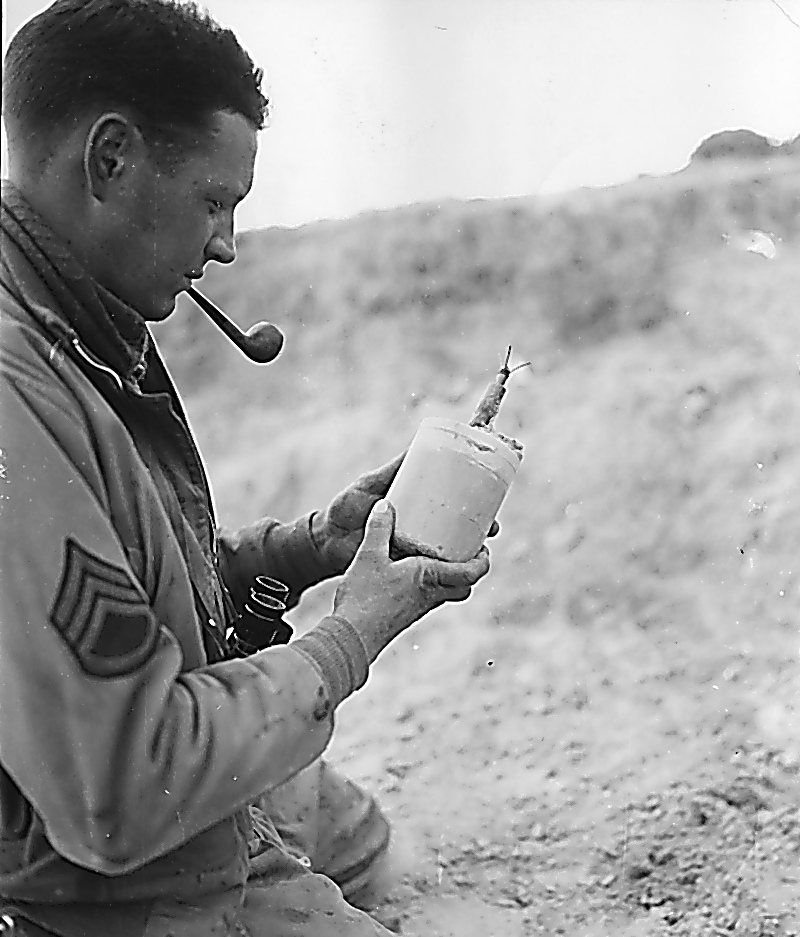 Staff Sergeant Garland Martin, of Cullman, Alabama, holds a mine laid by the retreating Axis forces. U.S. Army Signal Corps.
Tactical victory, operational failure
None of this erases what happened to II Corps in the opening days, and the U.S. Army did not treat it as a victory at the time. Fredendall was relieved within two weeks. Patton took over II Corps. The command structure that had left British, American, and French forces operating under overlapping chains of command was reorganized. Kasserine also exposed serious problems in how airpower was controlled on the battlefield, and it helped accelerate a doctrinal shift, already under discussion among American officers studying the RAF's model, toward centralized control of tactical airpower at the theater level. That shift became Field Manual 100-20. General Harold Alexander, who took command of the newly formed 18 Army Group in the middle of the battle, came away from it with a lasting distrust of American combat capability. The defeat damaged British confidence in American combat effectiveness and influenced how American forces were employed in the weeks that followed. The story wasn't only a press narrative. It affected Allied command decisions too.
But the Army's own historian, writing the official account a few years later, drew a distinction the popular story has never carried forward: the German offensive pursued a goal beyond the pass itself, and it failed to reach it. The official history's own balance sheet is direct about it: the Axis had achieved "a tactical success rather than a major victory influencing the strategy of the campaign." Eisenhower's own report on the fighting used almost the same framing, describing the German offensive as having reached its high point and then steadily receding by February 22, even while the American press was still reporting the story as a straightforward disaster. Rommel came away from it with a different opinion of American troops than the one he'd started with. In his own account, he later described the American defense at Kasserine Pass as very good.
Kasserine Pass was a genuine American battlefield defeat. Rommel seized the pass, inflicted heavy losses on American units, and took thousands of prisoners. What he could not do was turn that success into the breakthrough toward Le Kef the operation actually required. Kasserine wasn't the moment the U.S. Army became good. It was the moment its weaknesses became impossible to ignore, and the moment the process of fixing them accelerated.
The Army's own historian later compared the whole operation, from Sidi Bou Zid through the retreat back into Kasserine pass, to a fruit picker stretching farther and farther along a limb, only to leave the best fruit untouched rather than risk the fall.
It was a defeat. It just wasn't the defeat people think it was.
Primary source: Northwest Africa: Seizing the Initiative in the West, the U.S. Army's official history of the campaign, Chapter XXIV, "The Enemy Is Turned Back." The preceding chapter, XXIII, covers the initial German breakthrough and the loss of the pass on February 19 and 20.