Most people who know anything about the Vietnam War know about the Paris Peace Talks. Diplomats at a long table, arguing for years, finally producing an agreement in January 1973. What most people don't know is that those public talks were mostly theater. The negotiations that ultimately mattered most were happening somewhere else entirely, and almost nobody in Washington was allowed to know they existed.
A Meeting That Officially Never Happened
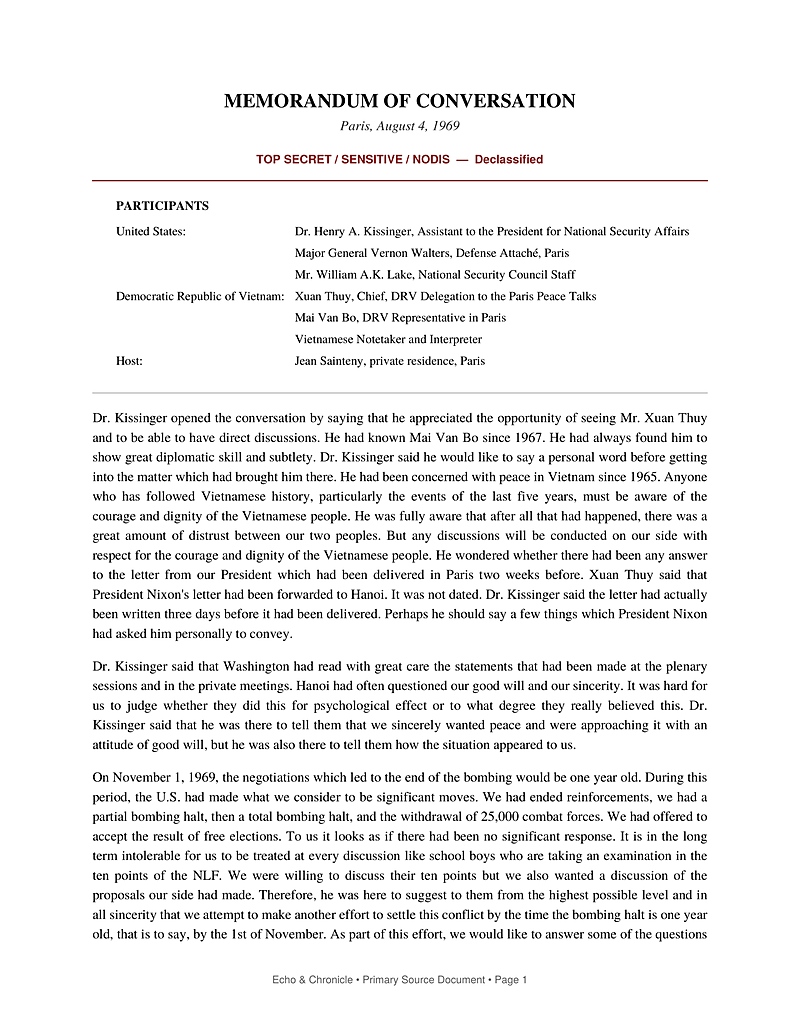
On the afternoon of August 4, 1969, Henry Kissinger slipped into a private Paris apartment belonging to Jean Sainteny, a former French colonial official who had offered to broker a back channel. Waiting for him was Xuan Thuy, the head of North Vietnam's delegation to the official talks, along with Mai Van Bo and a Vietnamese interpreter. Kissinger brought along Major General Vernon Walters and NSC staffer William Lake. There was no press pool, no transcript released to Congress, and for a long time, no acknowledgment that the meeting had ever taken place.
An Ultimatum With a Deadline Attached
Nixon had personally approved every word Kissinger was about to say. According to the declassified memorandum of the meeting, Kissinger opened by invoking his own history with the conflict, telling Xuan Thuy he had "been concerned with peace in Vietnam since 1965," before getting to the reason he'd actually come. The United States, he said, was prepared to withdraw all its forces from Vietnam as part of a broader removal of outside troops, and it would accept any outcome of a genuinely free political process in the South. Then came the deadline. If no major progress was made by November 1, the anniversary of the bombing halt, the United States would be "compelled, with great reluctance, to take measures of the greatest consequences."
That threat wasn't idle bluster meant to sound tough in a memo. Nixon and Kissinger were already quietly developing what would become known as Operation Duck Hook, a plan for a punishing new bombing campaign against the North that Kissinger would formally propose to Nixon the following month. Defense Secretary Melvin Laird was one of the strongest voices arguing against it, worried about the domestic fallout, and he wasn't alone. Secretary of State Rogers had doubts too, military planners questioned whether it would even work, and by November the Moratorium protests had made the whole idea politically radioactive. But in August 1969, the option was very much alive, and Xuan Thuy was being warned about it in a private apartment three months before the American public would hear anything like it.
The Concession Kissinger Didn't Believe In
There's a detail in the transcript that's easy to miss but says a lot about how this meeting actually went. Kissinger cited the withdrawal of 25,000 U.S. combat troops as proof of American good faith. What he didn't say, because he couldn't have said it without contradicting himself, was that he privately opposed that withdrawal. Nixon had ordered the pullout that June partly to get ahead of a public proposal from former Defense Secretary Clark Clifford, reportedly telling aides he hoped to "beat Mr. Clifford's timetable." Kissinger thought the whole approach was backwards. He would later write in an internal memo that pulling troops out was like handing the American public "salted peanuts," warning that the more that came home, the more people would demand, while the enemy simply had to "wait us out." So the very concession Kissinger was using as leverage across the table was one he'd argued against making in the first place.
Xuan Thuy Pushes Back
Xuan Thuy wasn't impressed by any of it. He pushed back point by point, calling the 25,000 troop figure insignificant next to the 540,000 Americans still in Vietnam, and he set his own conditions before he sat back at the table. Nguyen Van Thieu's government in Saigon had to go, he said, calling it a "warlike, dictatorial administration." Kissinger refused. That disagreement over the future of Nguyen Van Thieu's government would remain one of the central obstacles to a settlement for years, alongside the withdrawal timetable, the fate of North Vietnamese troops already in the South, and the question of what political structure would follow.
Wrong Man at the Table
Both sides walked away from that first meeting without much to show for it, and there's a reason the conversation didn't lead anywhere fast. Kissinger had been hoping to meet Le Duc Tho, the Politburo member who actually held authority over North Vietnam's negotiating position. Xuan Thuy admitted as much himself before the meeting ended, telling Kissinger that Hanoi had "entrusted" the Paris negotiations to himself and Tho jointly, and that he'd simply report back what was said. It would take another six and a half months, until February 1970, before Kissinger sat down with Tho directly. That meeting, not this one, is where the real bargaining began.
Kept in the Dark for Two Years
What's most striking, looking back, is how long the secrecy held. Kissinger kept this channel hidden not just from the public and from Congress, but from his own government. Secretary of State William Rogers and Defense Secretary Laird weren't briefed on the parallel Paris talks until February 1971, a year and a half after this first meeting and a full year after the more consequential sessions with Le Duc Tho had already begun. Nixon didn't reveal any of it publicly until a televised address in January 1972, more than two years after Kissinger first walked into Sainteny's apartment.
The public got the plenary sessions on Avenue Kleber, full of speeches Kissinger himself dismissed as unremarkable. The most important bargaining was taking place somewhere the public, and most of Nixon's own cabinet, weren't allowed to look, even if every private breakthrough still had to be carried back into the official process before it counted for anything.