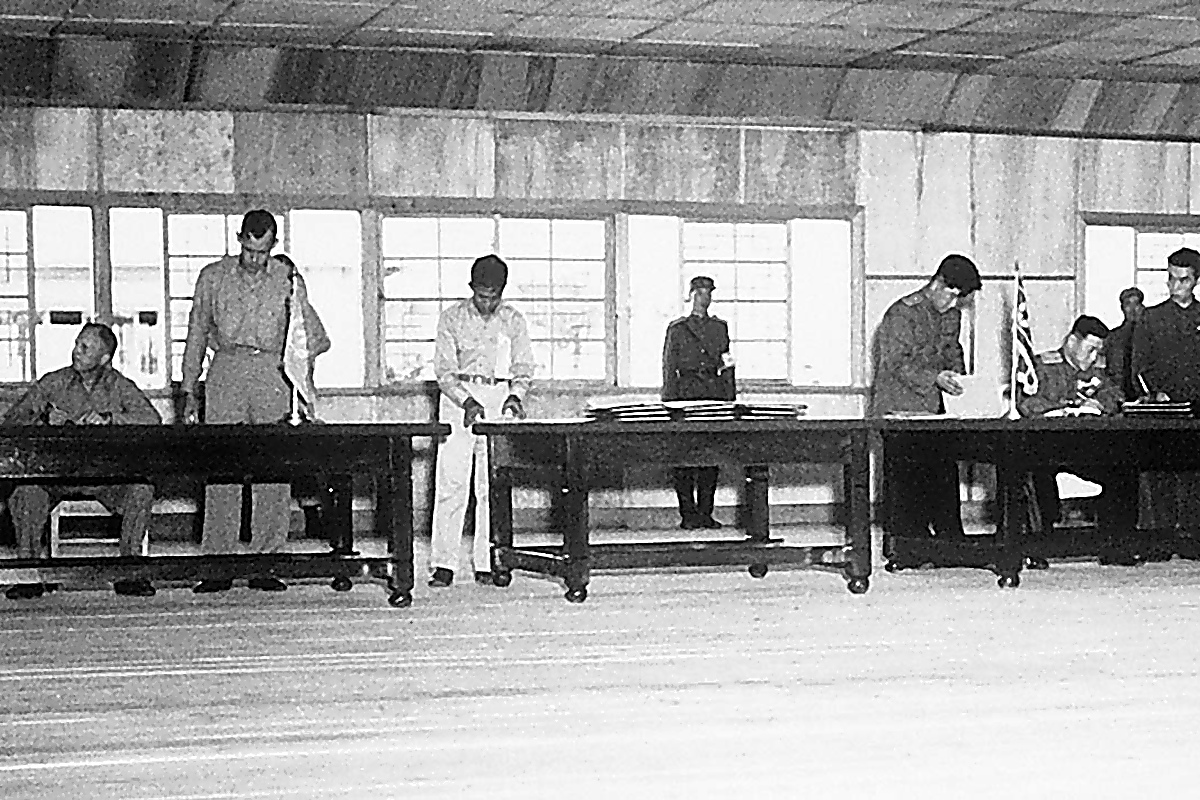
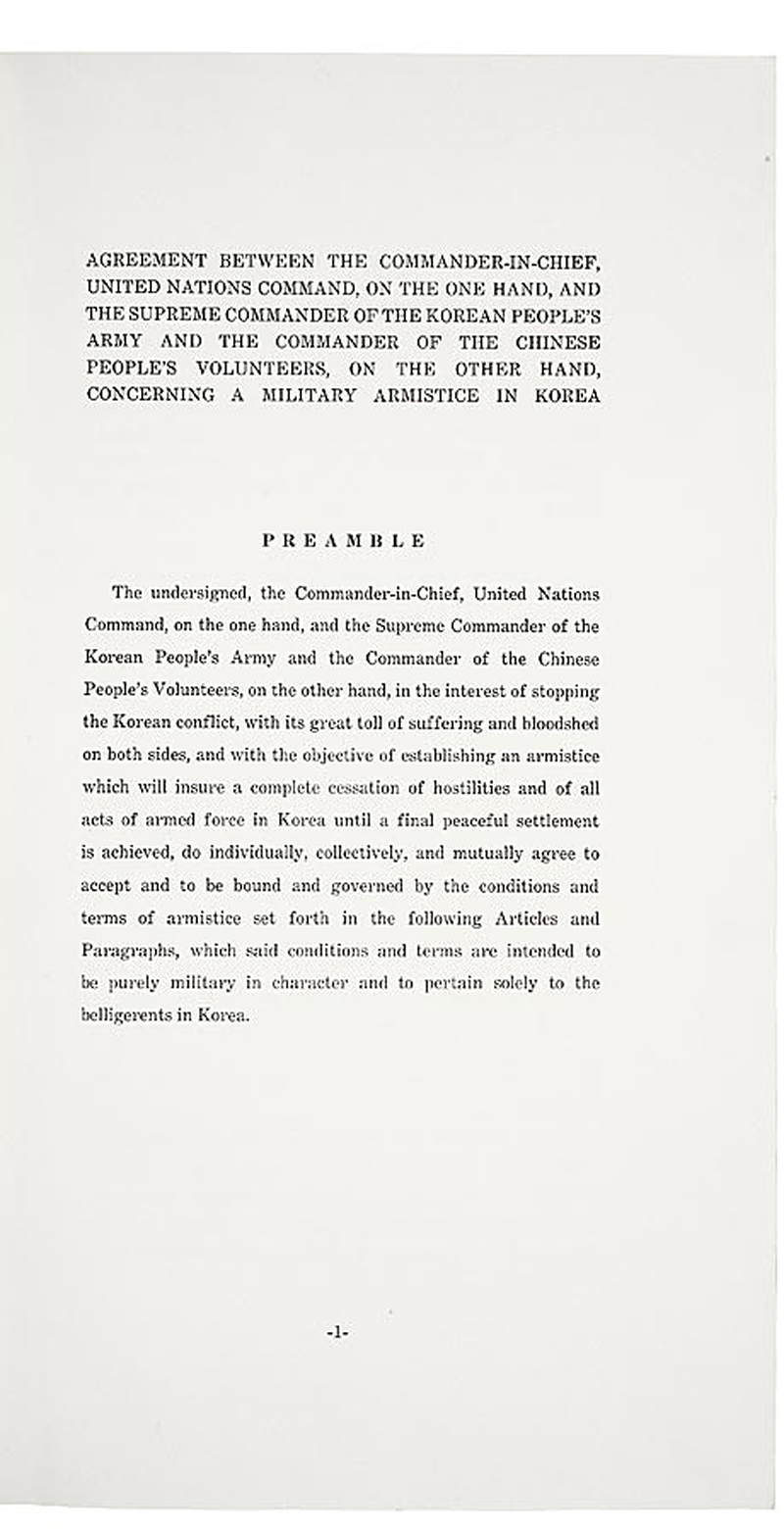
At ten o'clock on the morning of July 27, 1953, two men sat down at a plain wooden table inside a hall built for exactly this purpose and signed eighteen copies of a document in three languages, six each in English, Korean, and Chinese. They exchanged no words and no handshake, and left within ten minutes. That was the entire ceremony that brought the fighting to an end later that day.
What most people remember as "the end of the Korean War" was never a peace treaty. It was a ceasefire between soldiers, and it still is.
Two generals, not two nations
The document is called the Korean Armistice Agreement, and its opening line tells you almost everything you need to know about what it actually is. It was signed by U.S. Army Lt. Gen. William K. Harrison Jr., senior delegate for the United Nations Command, and Gen. Nam Il, senior delegate for the Korean People's Army and the Chinese People's Volunteers. Not presidents. Not prime ministers. Generals, acting on behalf of commanders.
No nation is a signatory to the Korean Armistice Agreement. That is not an accident of phrasing, it is the National Archives' own description of the document. The agreement was not signed by the governments of the participating states. It was signed by military commanders representing opposing forces, deliberately kept "purely military in character," in the document's own words, rather than a settlement between nations. The overall commanders, UN Command's Gen. Mark Clark, North Korea's premier and supreme commander Kim Il Sung, and China's Peng Dehuai, countersigned the agreement separately at their own headquarters that same day. The men who actually sat at the table in Panmunjom were the senior military negotiators.
South Korea's president, Syngman Rhee, refused to sign at all. He had spent the final weeks of the war trying to block any settlement that left the peninsula divided, and in June 1953 he unilaterally released an estimated 27,000 anti-communist North Korean prisoners of war from UN custody, an attempt to blow up the talks by making a clean prisoner exchange impossible. His name appears nowhere on the armistice.
Two years, seventeen days, one line on a map
Talks had opened in Kaesong on July 10, 1951, and dragged for two years and seventeen days across 158 separate meetings, first in Kaesong, later in the nearby village of Panmunjom after the original site was compromised. Territory was a live issue early on, but by the final year the biggest obstacle was not the line on the map. It was prisoners. When the two sides exchanged prisoner lists at the negotiating table in December 1951, the United Nations Command listed over 130,000 prisoners in its custody, while the Communist side declared just 11,559. Beyond the sheer imbalance in numbers, thousands of men on both sides also refused to go home when the fighting stopped. Resolving whether repatriation should be voluntary or forced took the creation of an entirely separate body, the Neutral Nations Repatriation Commission, chaired by an Indian general, to sort out who would return and who would not.
When the fighting finally stopped, the front line had barely moved from where it sat two years earlier. The armistice fixed a Military Demarcation Line close to that position and had both sides withdraw two kilometers from it, creating a four kilometer wide Demilitarized Zone as a buffer. That line, not the original 38th parallel, has separated the two Koreas ever since.
A document built to be temporary that outlived everyone who wrote it
Paragraph 60 of the armistice recommended that a political conference be held within three months to negotiate a lasting peace. A conference did convene, in Geneva in the spring of 1954, roughly nine months later than the ninety days the armistice had called for. It went nowhere. Tensions between Secretary of State John Foster Dulles and Chinese Premier Zhou Enlai were part of it, but the talks collapsed more broadly over disagreements about Korean elections, recognition of the communist governments, and what a unified Korea's political structure would even look like. The delegates went home with nothing signed. No formal peace treaty has been negotiated since. Technically, the Korean War has never ended.
Here is the part that rarely makes it into the textbook version of this story. The United States was the first side to stand up in front of the Military Armistice Commission and openly announce it would no longer observe one of the armistice's own restrictions.
Paragraph 13(d) of the agreement barred both sides from introducing new weapons into Korea beyond piece-for-piece replacement of what already existed. American officials believed North Korea and China had been quietly violating that clause for years, introducing modern Soviet aircraft and armor despite the restriction, while neutral inspection teams got stonewalled on the ground. Rather than keep pretending the restriction still functioned, the Joint Chiefs recommended introducing nuclear-capable weapons into South Korea in 1956, and President Eisenhower and the National Security Council signed off. On June 21, 1957, at the seventy-fifth meeting of the Military Armistice Commission, American representatives told the North Korean and Chinese delegates directly that the United Nations Command no longer considered itself bound by Paragraph 13(d). Nuclear-capable Honest John rockets and 280mm atomic cannons began arriving in South Korea in early 1958, followed by additional nuclear-capable systems, including atomic demolition munitions and Matador cruise missiles with the range to strike into China and the Soviet Union.
Whatever had or had not happened quietly on the other side of the line, Washington was the government that stood up and said, on the record, that it was done honoring part of its own ceasefire.
North Korea has since announced at least six times, in 1994, 1996, 2003, 2006, 2009, and 2013, that it no longer considers itself bound by the armistice either. China ceased active participation in the Military Armistice Commission in 1994. The United Nations has repeatedly stated that neither side can unilaterally dissolve an agreement adopted by the UN General Assembly, but enforcement of that position has always been more diplomatic than practical.
For seventy years the document that Harrison and Nam Il signed in ten minutes has done exactly what it was built to do and nothing more. It stopped the shooting. It never promised peace, and nobody who signed it pretended otherwise.