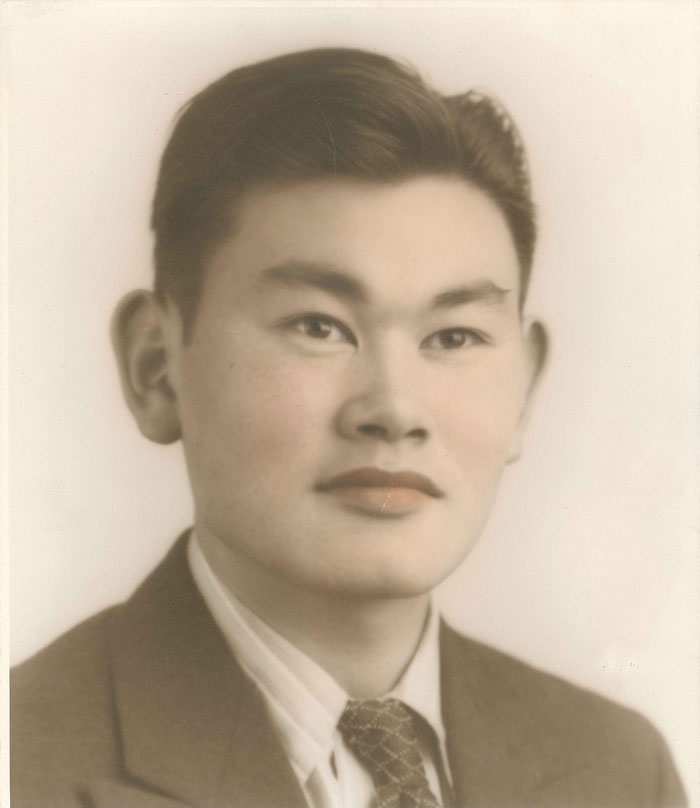
On May 30, 1942, a 23-year-old welder named Fred Korematsu was arrested on a street corner in San Leandro, California. His crime was staying home. He had been born in Oakland. He attended public school there. He swam and played tennis at Castlemont High. He worked in his family's flower nursery just down the road in San Leandro. He was, by every measure, an American kid — the kind of kid who tried to enlist after Pearl Harbor, only to be turned away by a Navy recruiter who had orders not to accept people who looked like him. Fred Korematsu never left. That was the whole of it. He simply refused to go.
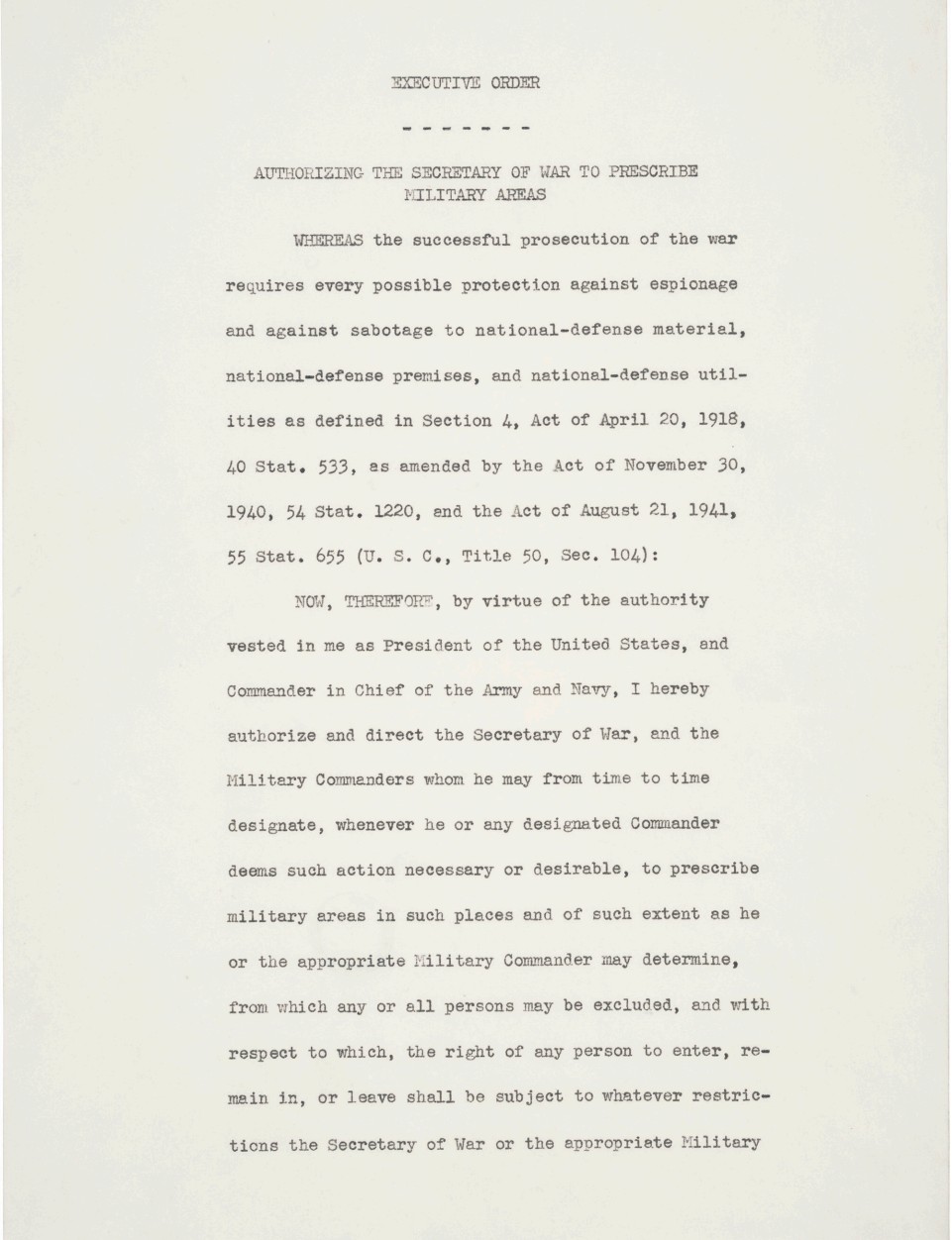
The Order Ten weeks before Fred's arrest, President Franklin D. Roosevelt signed Executive Order 9066 from the White House on February 19, 1942. The order did not name Japanese Americans. It did not need to. It authorized the Secretary of War and designated military commanders to prescribe "military areas" from which "any or all persons" could be excluded. It was written in the careful, bloodless language of bureaucracy. It said nothing about race. It didn't have to. Show Image What followed was the forced removal of approximately 120,000 people of Japanese ancestry from the West Coast of the United States. Nearly two thirds of them were American citizens. The government called it "evacuation." They were given days to sell their homes, their businesses, their cars, their furniture. Whatever they could not sell, they left behind. Read the original Executive Order 9066 The legal mechanism came from Public Law No. 503, passed by Congress shortly after the executive order, which made violations of military exclusion orders a federal crime. General John L. DeWitt, commander of the Western Defense Area, did the rest. On March 27, 1942, he prohibited Japanese Americans from leaving the limits of Military Area No. 1 at all, effectively trapping them in place while the camps were prepared. On May 3, he ordered them to report to Assembly Centers beginning May 9. Fred Korematsu did not report.
The Man Who Said No He had reasons that were personal before they were political. He was in love with a woman named Ida Boitano, an Italian American whose parents already disapproved of him for his ancestry. He did not want to leave her. He did not want to disappear into a camp in the desert for crimes he had not committed. So he tried to become someone else. He underwent plastic surgery on his eyelids in an attempt to pass as white. He changed his name to Clyde Sarah. He told people he was of Spanish and Hawaiian heritage. None of it worked. On May 30, 1942, police found him on a street corner in San Leandro and placed him under arrest. He was held at a jail in San Francisco. Ernest Besig, director of the American Civil Liberties Union in northern California, came to see him. He asked Fred if he would be willing to let his case become a test of the internment's legality. Fred said yes. The national ACLU, whose leadership was close to President Roosevelt and did not want the political trouble, told Besig not to take the case. Besig took it anyway. Fred was tried and convicted on September 8, 1942, for violating Public Law No. 503. He was sentenced to five years probation. He was taken from the courtroom and sent to the Tanforan Assembly Center, a converted racetrack in San Bruno, California, where Japanese American families were being held in horse stalls while the permanent camps were built. He later said that jail was better than Tanforan. He and his family were ultimately sent to the Central Utah War Relocation Center in Topaz, Utah. As an unskilled laborer under the camp classification system, he earned twelve dollars a month for eight hour days of work. He was placed in a horse stall with a single light bulb.
The Court That Failed Him Fred Korematsu's case reached the United States Supreme Court in 1944. On December 18, in a six to three decision written by Justice Hugo Black, the Court upheld the constitutionality of the exclusion order. The majority held that while compulsory exclusion of citizens was "constitutionally suspect," it was justified under the "circumstances of emergency and peril." The dissents were furious. Justice Frank Murphy called it the "legalization of racism." Justice Robert Jackson warned that the Court had created a loaded weapon, ready for any future authority that might claim military necessity. Justice Owen Roberts, writing in dissent as well, argued that the majority had simply accepted the government's claims without scrutiny. The scrutiny, it turned out, would come forty years later.
The Lie In the early 1980s, a lawyer named Peter Irons was researching a book on the wartime internment cases when he found something extraordinary buried in government archives. Charles Fahy, the Solicitor General who had argued Korematsu v. United States before the Supreme Court, had deliberately withheld reports from both the FBI and military intelligence. Those reports concluded that Japanese American citizens posed no meaningful security risk whatsoever. The military necessity argument, the single justification the government had offered for removing 120,000 people from their homes, had been a fabrication. The government's own intelligence agencies had said so. And the lawyers who argued the case before the Supreme Court had known it and said nothing. Irons assembled a legal team led by attorney Dale Minami and filed a petition for a writ of error coram nobis, an ancient legal remedy for convictions obtained through government misconduct. On November 10, 1983, Judge Marilyn Hall Patel of the U.S. District Court in San Francisco vacated Fred Korematsu's conviction. Fred testified before her that day. He told the court: "I would like to see the government admit that they were wrong and do something about it so this will never happen again to any American citizen of any race, creed, or color." He was 64 years old.
The Long Reckoning The United States did not move quickly toward accountability. In 1976, President Gerald Ford formally terminated Executive Order 9066 and acknowledged it had been wrong. In 1980, President Carter commissioned a formal investigation, which concluded that the internment had resulted from "race prejudice, war hysteria, and a failure of political leadership." In 1988, President Ronald Reagan signed the Civil Liberties Act, which provided $20,000 in reparations to each surviving detainee. Roughly 60,000 people were still alive to receive it. In 1998, President Bill Clinton awarded Fred Korematsu the Presidential Medal of Freedom, the highest civilian honor in the country. Clinton said: "In the long history of our country's constant search for justice, some names of ordinary citizens stand for millions of souls: Plessy, Brown, Parks. To that distinguished list, today we add the name of Fred Korematsu." Fred kept speaking. After September 11, 2001, as the government began detaining men of Middle Eastern descent without charge, he filed amicus briefs with the Supreme Court warning the justices not to make the same mistake twice. He wrote: "No one should ever be locked away simply because they share the same race, ethnicity, or religion as a spy or terrorist." He died on March 30, 2005, at his daughter's home in Marin County, California. One of the last things he said was: "I'll never forget my government treating me like this. And I really hope that this will never happen to anybody else because of the way they look, if they look like the enemy of our country." He also said: "Protest, but not with violence, and don't be afraid to speak up. One person can make a difference, even if it takes forty years." In 2018, the Supreme Court finally addressed the Korematsu decision directly. Chief Justice John Roberts, writing in Trump v. Hawaii, declared that the forced relocation of American citizens to concentration camps, solely on the basis of race, was "objectively unlawful and outside the scope of Presidential authority." He called the original ruling "gravely wrong the day it was decided." It had taken the nation's highest court seventy four years to say so.
Fred Korematsu was buried at Mountain View Cemetery in Oakland, California, not far from the flower nursery where he had worked as a boy, not far from the school where a recruiting officer once told him there were orders not to accept him. California now observes January 30, his birthday, as Fred Korematsu Day of Civil Liberties and the Constitution. It was the first such commemoration for an Asian American in United States history. He did not ask for a movement. He asked to stay home. The country eventually caught up to what he already knew: that a government capable of imprisoning its own citizens for how they look is a government that has failed its first obligation. One man said no. It took forty years to prove he was right.
Executive Order 9066 was signed at the White House on February 19, 1942, and filed with the National Archives on February 21, 1942. Fred Korematsu's conviction was vacated on November 10, 1983. He received the Presidential Medal of Freedom on January 15, 1998. He was 86 years old when he died.