On July 31, 1777, the Continental Congress voted to make a nineteen-year-old French nobleman a major general in the Continental Army.
He had never commanded troops. He had never seen a battlefield. He barely spoke English. What he had was money, a title, and a promise: he would serve without pay and cover his own expenses. Congress, eager not to alienate a wealthy young nobleman with influential French connections, agreed.
His name was Marie-Joseph Paul Yves Roch Gilbert du Motier, the Marquis de Lafayette. History remembers him as Washington's adopted son and the hero of two revolutions. In July 1777, Congress was mainly exhausted by the flood of unauthorized foreign commissions Silas Deane had promised out of Paris, and Lafayette's offer to serve for free made him easy to say yes to.
The Document on the Table
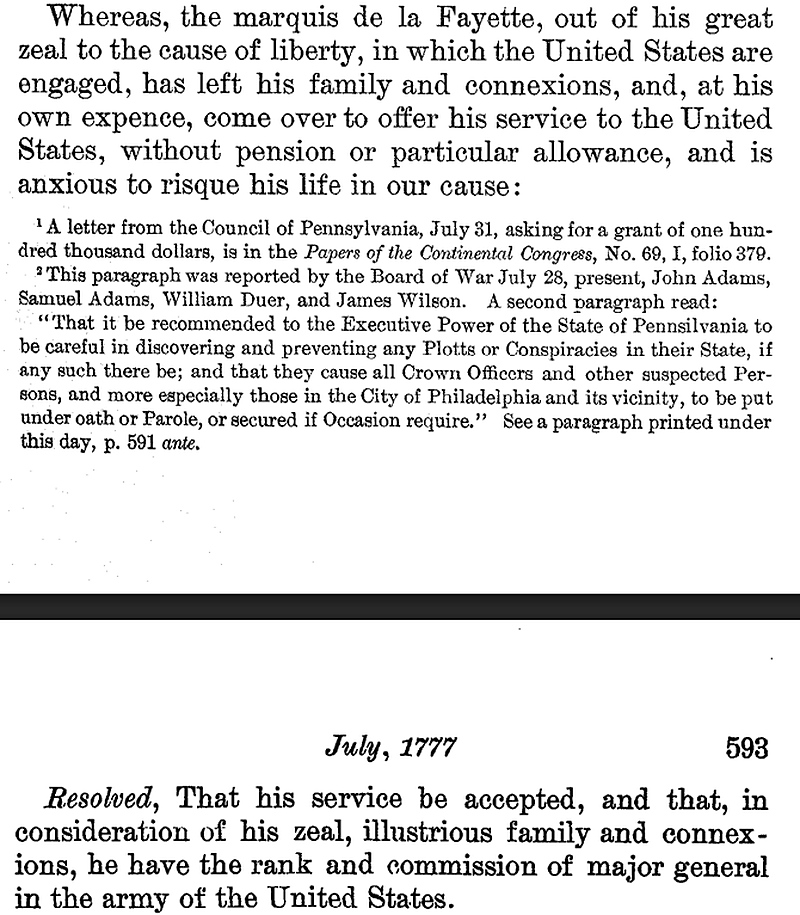
The resolution itself, printed in the official Journals of the Continental Congress, runs to a single paragraph. It reads in full: "Resolved, That his service be accepted, and that, in consideration of his zeal, illustrious family and connexions, he have the rank and commission of major general in the army of the United States."
Note what the resolution does not say. It does not mention combat experience, because Lafayette had none. It does not assign him troops, a division, or a command of any kind. Congress gave him a title and nothing to attach it to, and for months afterward, nobody was entirely sure whether that was an oversight or the point.
The page carries other business too. A footnote records a letter from the Council of Pennsylvania, also dated July 31, asking Congress for a grant of one hundred thousand dollars. Another paragraph, reported days earlier by the Board of War, recommends that Pennsylvania's government keep a close watch for "Plotts or Conspiracies" among Crown officers and other suspected persons in and around Philadelphia. Congress commissioned a French aristocrat as a general and fretted over its cash reserves and its spies on the very same page. That was the state of the American war effort in the summer of 1777: overextended, underfunded, and improvising.
A Contract Signed Before Congress Ever Agreed
Lafayette's commission did not begin in Philadelphia. It began seven months earlier and an ocean away, when Silas Deane, the Continental Congress's agent in Paris, signed a private agreement with him on December 7, 1776. Deane had no real authority to hand out American generalships, but he was desperate for European military talent and short on ways to pay for it. He offered Lafayette the rank of major general on the spot, on the understanding that Congress would later ratify it.
Deane made similar promises to a long list of French officers that year, and Congress was furious about most of them. By the time Lafayette reached Philadelphia in the summer of 1777, having sailed from France in defiance of his own king after financing and outfitting the ship that carried him, Congress had grown openly hostile to foreign volunteers waving Deane's contracts and demanding senior rank. Committee members had taken to referring to the parade of Frenchmen as more trouble than they were worth.
Lafayette got a different reception because he offered different terms. He asked for no salary and no pension. He would serve, he said, as a volunteer, at his own expense, out of devotion to the cause. Benjamin Franklin and the American commissioners in France recommended him. On July 31, Congress agreed.
A Rank With No Command Attached
The ambiguity in that one-paragraph resolution did not stay theoretical for long. Congress regarded the commission as largely honorary, a courtesy to a well-connected foreign volunteer. Lafayette regarded himself as a real general who would receive real troops as soon as he proved himself.
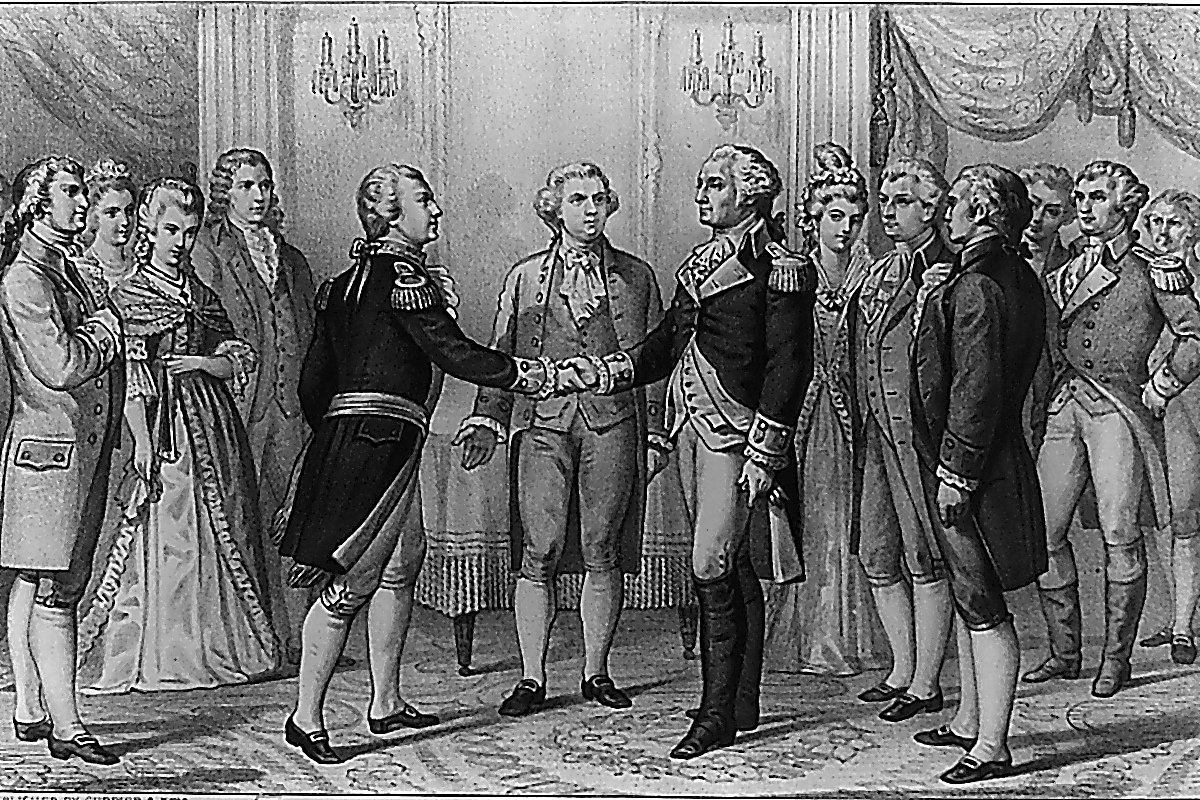
He met George Washington five days later, on August 5, 1777, when the commander in chief came to Philadelphia to brief Congress on the military situation. By most accounts the two men took to each other immediately. Washington, forty-five years old and childless, was drawn to the younger man's earnestness. According to later accounts, when Washington apologized for the sorry state of his camp and his troops, Lafayette answered that he had come to learn, not to teach.
Washington eventually told him plainly that a division was not possible, not yet, because giving a prestigious command to an inexperienced foreign volunteer, ahead of seasoned American officers, would not sit well with Congress or the army. What Washington offered instead was informal but no less real: a place on his staff, and his word that he would treat the young marquis as both friend and something like a son.
Lafayette got his chance to prove himself six weeks later. At the Battle of Brandywine on September 11, 1777, he rode into the fighting alongside a Pennsylvania brigade under heavy British and Hessian pressure, worked to rally the retreating line, and was shot through the leg for his trouble. Washington cited him afterward for bravery and recommended him for a real command. By November, recovered and back in the field, Lafayette had it: a division of his own, the same one once led by Major General Adam Stephen.
The teenager Congress had commissioned in a single paragraph, with no army attached, had earned one the hard way in under four months.