On June 4, 1944, the United States Army did something no Allied force had done since the war began. It captured an Axis capital city.
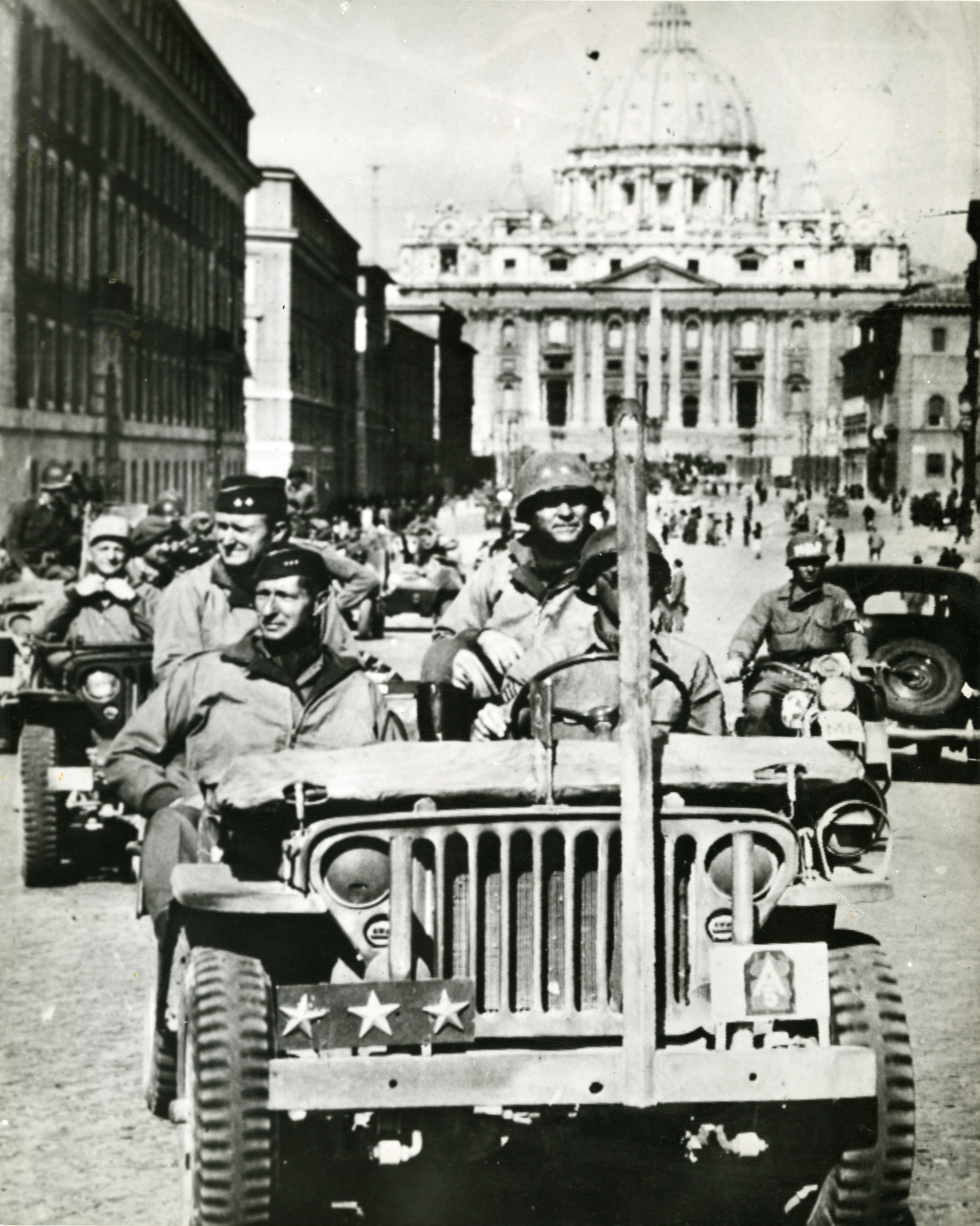
General Mark W. Clark rode into Rome in a three-star jeep, St. Peter's Basilica rising behind him, crowds lining the streets and shouting his name. It was, by any measure, a historic moment. The first enemy capital to fall in Europe. The culmination of nine months of brutal fighting up the Italian peninsula through mud, mountains, and fortified German lines that had chewed through Allied divisions one by one.
Clark got his headline for exactly 48 hours.
On June 6, 1944, 156,000 Allied troops landed on the beaches of Normandy. Rome vanished from every front page on earth. The liberation of the Eternal City, one of the most significant military achievements of the war, became a footnote to the week that followed it.
That is the story most people know, if they know it at all.
What they don't know is the other story. The one that explains why historians have spent eighty years arguing about whether Mark Clark's triumph in Rome was actually a catastrophic blunder in disguise.
The War Nobody Wanted
Italy was never supposed to be this hard.
When Allied forces landed in Sicily in July 1943 and crossed to the Italian mainland that September, the logic seemed sound. Knock Italy out of the war, drive north, and keep German divisions tied down and away from France. Winston Churchill famously called Italy the soft underbelly of Europe.
None of it worked as planned.
Field Marshal Albert Kesselring, one of the most skilled defensive commanders of the war, had no intention of giving up Italy without a fight. He established a series of fortified defensive lines across the mountainous peninsula, the Volturno Line, the Barbara Line, the Bernhardt Line, and most formidably of all, the Gustav Line, anchored at the ancient monastery of Monte Cassino.
The Allied advance ground to a halt.
Clark's Fifth Army spent the winter of 1943 to 1944 fighting for yards of frozen ground. The Battle of Monte Cassino became one of the bloodiest engagements of the entire war, fought four separate times before the Germans finally abandoned their positions. An amphibious landing at Anzio in January 1944, intended to outflank the Gustav Line and break the stalemate, instead produced months of brutal trench warfare as German forces quickly surrounded the beachhead and pinned the Allies against the sea.
By the spring of 1944, the Italian campaign had consumed over 43,000 Allied casualties across Fifth Army alone during the drive to Rome, with no end in sight.
Then came May, and with it, a plan.
The Decision That Changed Everything
Allied commander General Harold Alexander devised Operation Diadem: a coordinated assault to finally shatter the Gustav Line, break out of the Anzio beachhead, and trap the retreating German Tenth Army before it could escape north. The key to the plan was Valmontone, a town on Highway 6 southeast of Rome. If Allied forces could cut that highway, the retreating German army would have nowhere to go.
Clark's VI Corps, breaking out from Anzio under Major General Lucian Truscott, was ordered to drive northeast toward Valmontone and seal the trap.
On May 23, 1944, Truscott's forces broke out of Anzio. By May 25, they had linked up with the main Allied line. The German Tenth Army was in full retreat. Valmontone was within reach. The trap was closing.
Then Clark changed the orders.
In his order of May 31, Clark redirected the bulk of VI Corps away from Valmontone and swung it northwest, directly toward Rome. He left only a smaller force to continue toward the original objective. Truscott, informed of the change in the middle of the night by one of Clark's staff officers, was furious. He believed the encirclement plan was working and that abandoning it was a serious mistake. He was overruled.
Highway 6 was eventually cut east of Valmontone on June 1 by elements of the 3rd Infantry Division, and Valmontone itself fell on June 2. But it was too late to trap the bulk of the retreating Germans. The Tenth Army slipped through, retreated north in good order, and established a new defensive line, the Gothic Line, north of Florence. The Italian campaign would drag on for another eleven months.
Clark's stated reasoning was that the push toward Valmontone faced too much German resistance to succeed, and that the broader situation made a drive directly on Rome the sounder military decision. His critics, then and now, offered a different explanation.
He wanted Rome.
 General George Patton, General Henry "Hap" Arnold, and General Mark Clark. Clark was one of the youngest three-star generals in American history, promoted rapidly and acutely aware of his place in the historical record.
The Man Who Had to Be First
Mark Clark was born in 1896, one of the youngest three-star generals in American history, ambitious in the way that the Army's best officers tend to be ambitious. He was sharp, politically savvy, and deeply aware of how history would judge the men who led the great campaigns of the war.
He also understood that Rome was a prize unlike any other on the European continent.
The city had not been a capital of a hostile power since the ancient world. It was the seat of the Catholic Church, a place of irreplaceable historical and cultural significance, and the symbolic heart of the Fascist regime that Mussolini had ruled for 22 years. Whoever took Rome would take his place in the history books permanently.
Clark was determined to be that man, and he was determined to enter the city before any British officers could get there. He knew the optics. He knew the cameras would be waiting. He knew that the first photographs of an Allied general rolling through the streets of Rome would define that general's legacy.
He was right about all of it.
On June 4, 1944, Clark's forces entered Rome from the south. Kesselring had declared Rome an open city on June 3, ordering German forces to withdraw without fighting in the streets. American troops moved through the Porta San Giovanni, past the Colosseum, down the Via dei Fori Imperiali, and into the city center while crowds lined the streets cheering.
Clark gathered his corps commanders at the Capitoline Hill and met with the assembled press. He told them it was a great day for the Fifth Army.
He had 48 hours to enjoy it.
48 Hours
The news of Rome's liberation broke across the Allied world on June 4 and 5. Newspapers that had carried nothing but grim Italian campaign casualty reports for months suddenly had a triumph to celebrate. The first Axis capital had fallen. The war in Europe was turning.
Then, on the morning of June 6, the radio crackled with a different announcement.
Eisenhower's forces had landed in Normandy.
The liberation of Rome, which might otherwise have dominated the front pages for weeks, received its last major coverage that day. By June 7, it was buried. The Italian campaign, and Mark Clark with it, receded from public consciousness almost immediately, never to fully return.
The German Tenth Army, meanwhile, was already digging in along the Gothic Line.
Clark spent the rest of the war in Italy. He took Florence. He fought through the Apennines in winter conditions that recalled the worst of the previous year. He eventually broke through the Gothic Line in the spring of 1945 and reached the Po Valley just as Germany collapsed. He received a fourth star and eventually commanded all Allied forces in Italy, succeeding General Alexander in command of 15th Army Group in December 1944.
He spent the rest of his life defending the decision to turn toward Rome.
His subordinates never entirely forgave him. Truscott, in his memoirs, wrote that the failure to close the trap at Valmontone was the greatest missed opportunity of the Italian campaign. Alexander agreed, arguing that Clark's decision allowed the German Tenth Army to escape and prolonged the war in Italy by the better part of a year. Historians have noted that the escaped German army may have been responsible for doubling Allied casualties in the months that followed.
The historical verdict has been, at best, divided. Clark's defenders argue that the Valmontone operation faced genuine obstacles and that the capture of Rome was strategically and symbolically important in its own right. His own operational report, written under his command and signed with his name, frames each of the five phases of the campaign as a series of sound tactical decisions, each building toward an inevitable and triumphant conclusion. His critics argue that a general who diverts his forces from destroying an enemy army in order to be photographed in a famous city has confused personal glory with military mission.
What Was Left Behind
The liberation of Rome was genuinely significant. Nearly a year of brutal fighting had produced it. Tens of thousands of Allied soldiers, American, British, French, Polish, Canadian, gave their lives or their bodies in the Italian campaign. The men who walked into Rome on June 4 had earned that moment.
The city itself was taken intact. Unlike so many of the towns and cities that the Italian campaign had reduced to rubble, Rome emerged from the war with its art, its architecture, and its ancient monuments untouched. Kesselring's decision to declare it an open city saved the Colosseum. It saved the Vatican. It saved two thousand years of accumulated civilization from the kind of destruction that had already consumed Cassino, Ortona, and dozens of other Italian communities.
That, too, was part of what June 4, 1944 represented. Not just a military objective achieved, but a city preserved.
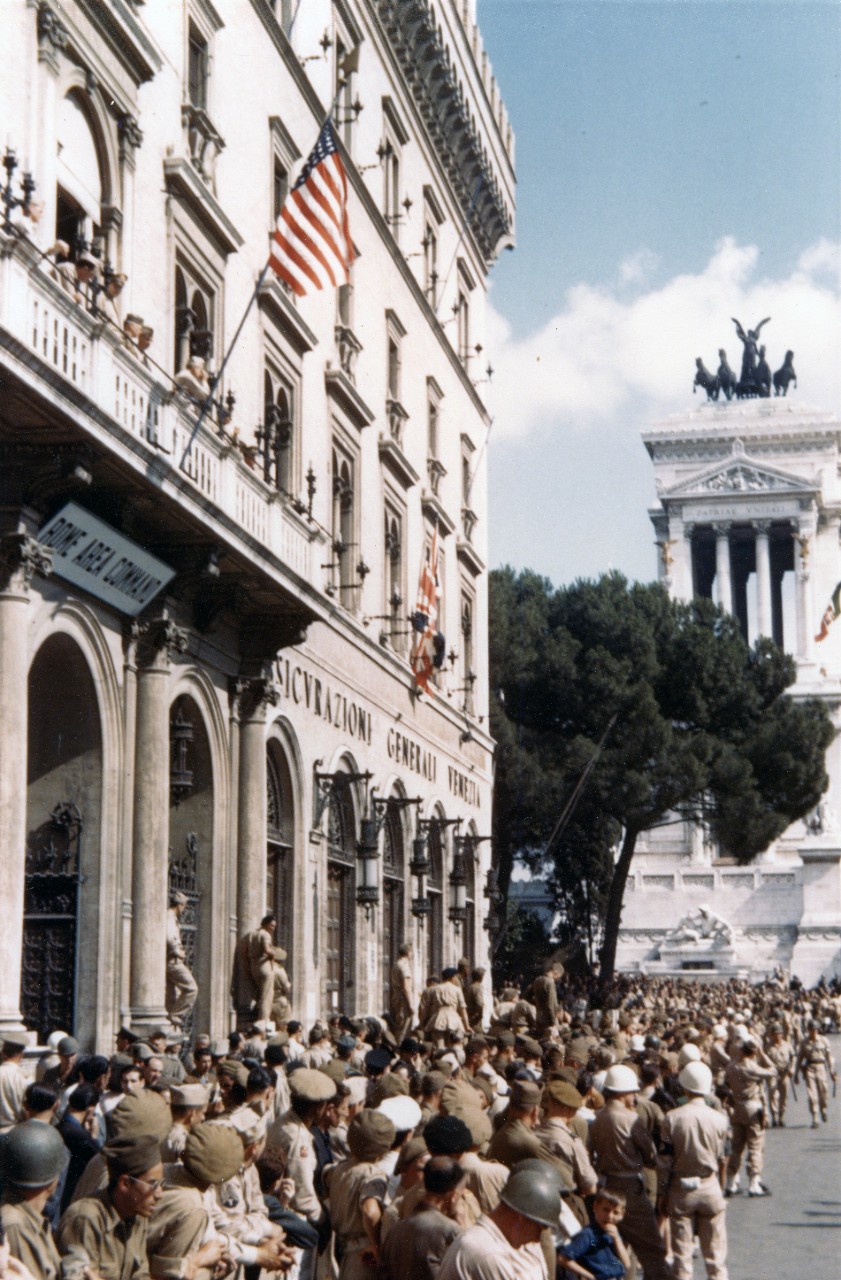
Within days of the liberation, the American flag that had flown over the White House on December 7, 1941 was raised over Rome Area Command headquarters near the Victor Emmanuel II Monument in Piazza Venezia. It was a deliberate symbol: the flag that had witnessed the beginning of American involvement in the war now flew over the first enemy capital the Americans had taken.
 The American flag raised over Rome Area Command headquarters in the days following liberation. The monument at right commemorates Italian unification. U.S. Army Signal Corps photo.
Two days later, history moved on.
Legacy
Mark Clark never entirely escaped the shadow of the debate over Valmontone. He went on to command United Nations forces in Korea, became president of The Citadel military college in South Carolina, and lived until 1984. He wrote his memoirs. He gave interviews. He defended his decisions.
The Italian campaign itself remained one of the most overlooked theaters of World War II. The soldiers who fought in it, the men who took Cassino and Anzio and the Gustav Line, did so largely without the recognition that went to the men who landed at Normandy or fought across France. The Italian campaign never had its Saving Private Ryan. It never fully entered the popular imagination the way the Western Front did.
On June 4, 1944, for 48 hours, it almost did.
The liberation of Rome was a genuine triumph, bought with genuine blood, achieved through ten months of fighting that tested the Allied armies as severely as anything they faced in the war. That it was almost immediately overshadowed by events larger than itself is not a diminishment of what it cost, or what it meant.
It is simply what happened.
Clark got his moment in Rome. He rode through the streets in his jeep, with St. Peter's Basilica rising behind him, while the crowds cheered. He stood on the Capitoline Hill and told the press it was a great day for the Fifth Army.
He was right. It was.
It just didn't last very long.
The primary source document for this article is "The Advance on Rome of the Fifth Army," the official operational report prepared by the G-3 Section of Fifth Army Headquarters under the command of Lt. Gen. Mark W. Clark. Declassified and approved for public release, the report details the five phases of the campaign from the initial breakthrough of the Gustav Line through the capture of Rome and includes Clark's signed foreword.