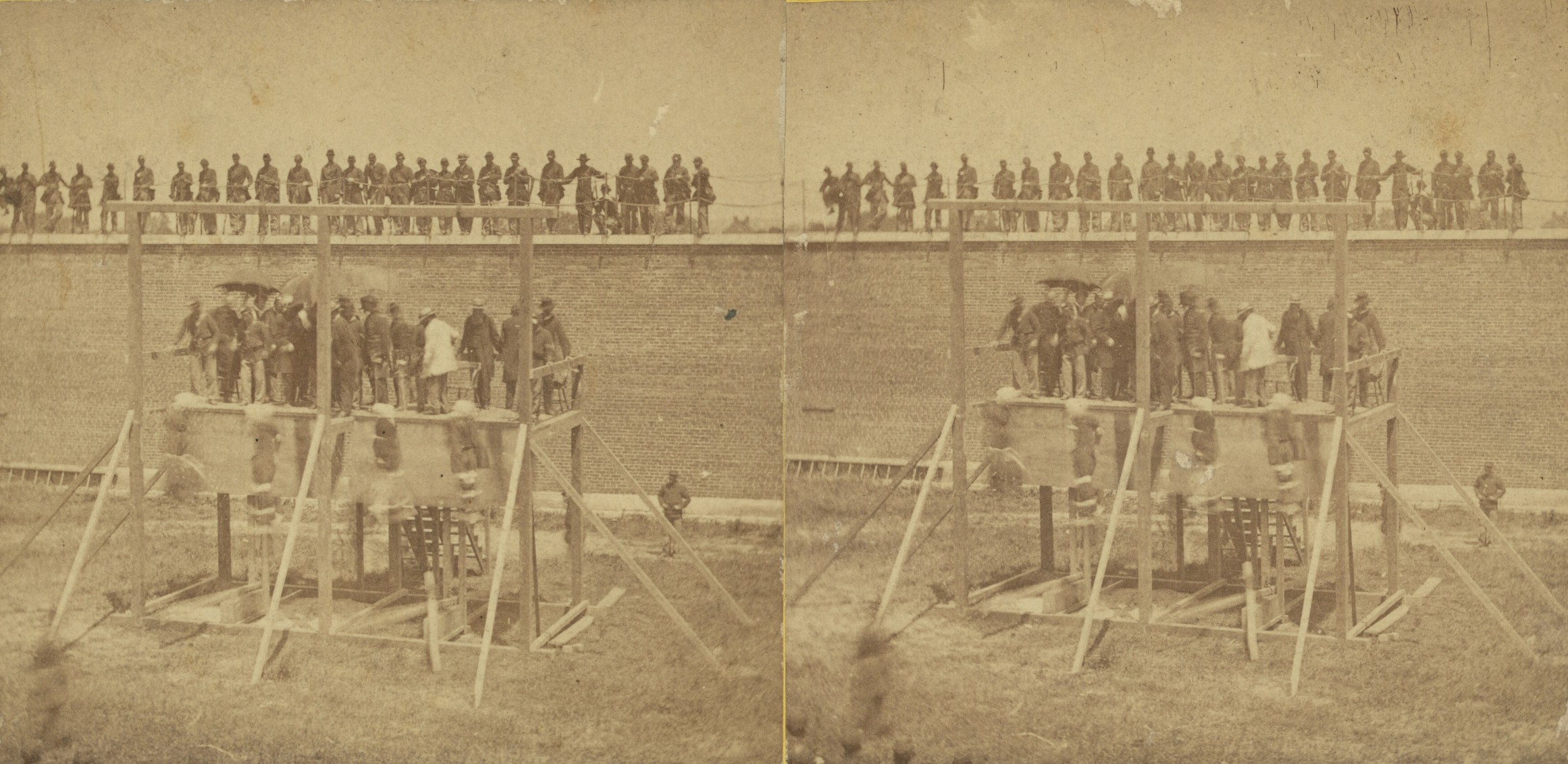
On the morning of July 7, 1865, four people climbed a scaffold in the courtyard of the Old Arsenal Penitentiary in Washington, D.C. One of them was a woman. The United States government had never executed one before.
Her name was Mary Surratt. Five of the nine men who convicted her had signed a letter asking the president to spare her life. He signed her death warrant anyway.
Eight Suspects, One Military Tribunal
The chain of events started three months earlier. On the night of April 14, 1865, John Wilkes Booth shot President Abraham Lincoln at Ford's Theatre while Lincoln watched a performance of Our American Cousin. Booth was not acting alone. His plan called for the simultaneous killing of Lincoln, Secretary of State William H. Seward, and Vice President Andrew Johnson, an attempt to decapitate the federal government in a single night.
It did not go as planned. Lewis Powell forced his way into Seward's home and stabbed him repeatedly. A metal jaw splint Seward was wearing after a recent carriage accident helped deflect or absorb several of the blows, and Seward survived. George Atzerodt, assigned to kill Johnson at the Kirkwood House hotel, lost his nerve entirely. He spent the night getting drunk at the hotel bar instead and never went near Johnson's room. Only Booth succeeded in carrying out his assignment.
Booth fled into Maryland with David Herold, who had guided Powell partway to Seward's house before running off when the attack went wrong. Twelve days later, after what was widely regarded as the largest manhunt in American history to that point, federal troops cornered Booth and Herold at a Virginia tobacco farm. Herold surrendered. Booth did not, and was shot dead by Sergeant Boston Corbett.
That left eight people for the government to try: Powell, Herold, Atzerodt, Samuel Arnold, Dr. Samuel Mudd, Michael O'Laughlen, Edmund Spangler, and Mary Surratt, who owned the Washington boarding house where Booth and the others had met to plan first a kidnapping, then a killing.
On May 1, 1865, President Johnson ordered these eight tried not in a civilian courtroom but before a military commission of nine army officers, with the power to convict on a simple majority and execute on a two-thirds vote. Attorney General James Speed defended the choice by arguing the defendants had acted as enemy combatants during wartime. Others in Johnson's own cabinet, including former Attorney General Edward Bates, thought a civilian court should have handled it. A year later, the Supreme Court would rule in Ex parte Milligan that military tribunals could not try civilians where civilian courts were open and functioning. That ruling came too late to help anyone standing trial in the summer of 1865.
A Vote of Six to Four
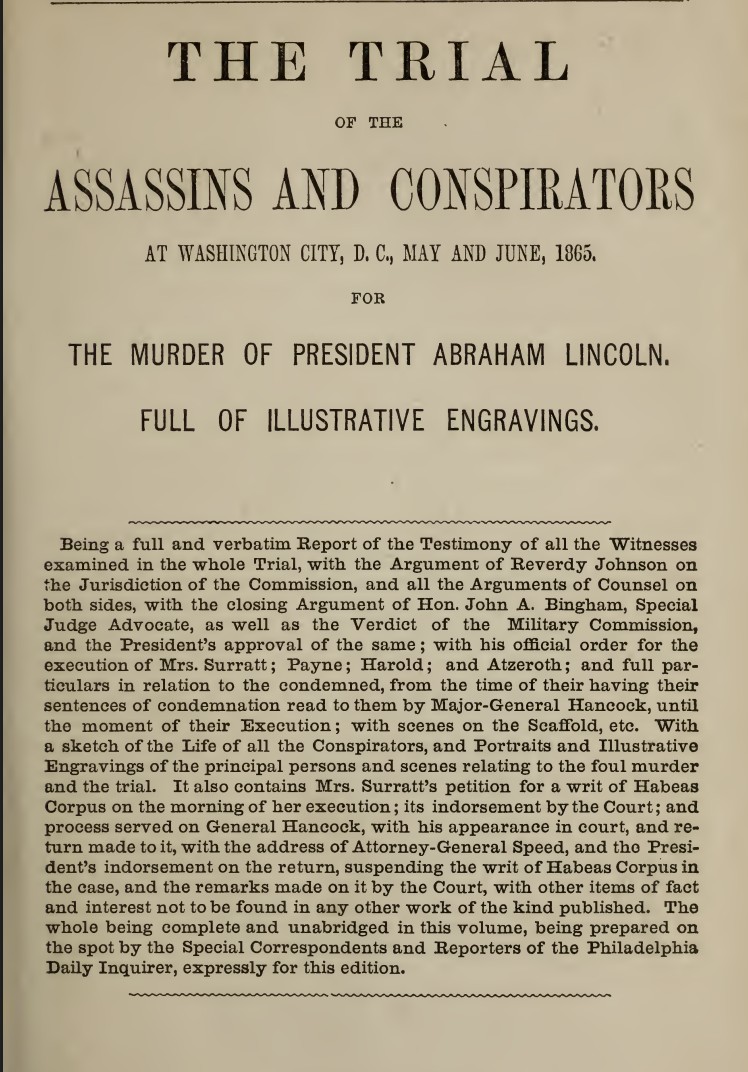
The trial ran seven weeks and heard testimony from 366 witnesses. On June 30, the commission delivered its verdicts. All eight were found guilty. Four, Surratt, Powell, Herold, and Atzerodt, were sentenced to hang. Arnold, Mudd, and O'Laughlen received life sentences at hard labor. Spangler, a Ford's Theatre stagehand whose main offense seems to have been handing Booth's horse to someone else to hold, got six years.
Surratt's case was the one that split the commission. The evidence against her was largely circumstantial, built on the testimony of two men: her boarder Louis Weichmann, who described her long association with Booth and the others, and John Lloyd, who leased her Maryland tavern and testified that she'd told him to have "shooting irons" ready the night of the assassination. She had also, undeniably, run the boarding house where the conspiracy took shape. Whether she understood what she was hosting is a question historians still argue over, and the trial record itself doesn't resolve it cleanly. Most historians agree she knew about Booth's earlier plan to kidnap Lincoln; whether she knowingly joined the later conspiracy to kill him remains far more disputed.
The commission convicted her on a vote of six to four, exactly the two-thirds majority required and not a single vote more. Immediately afterward, five of the nine commissioners signed a letter urging President Johnson to commute her sentence to life imprisonment because of her age and sex.
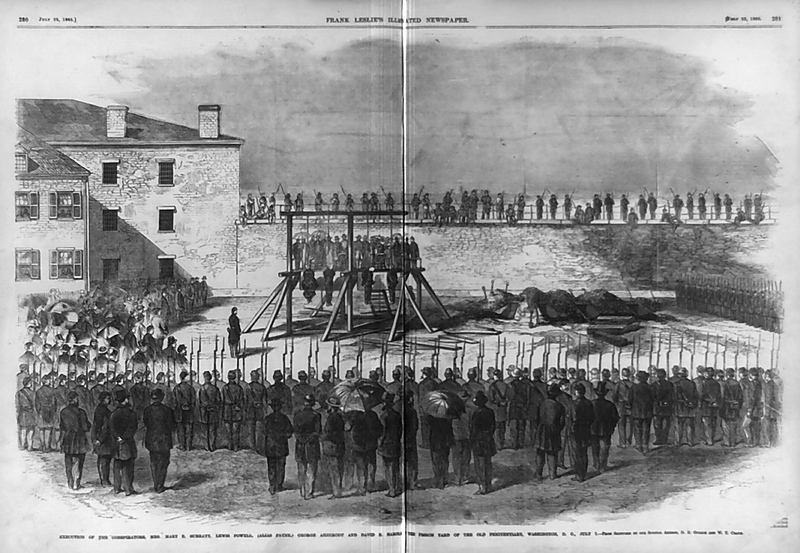 Frank Leslie's Illustrated Newspaper's rendering of the execution, published July 22, 1865.
What happened to that letter afterward depends on whose account you believe. Judge Advocate General Joseph Holt later said he personally showed it to Johnson and discussed it with him. Johnson maintained for the rest of his life that he never saw it at all. There is no way now to settle which man was telling the truth.
"She Kept the Nest That Hatched the Egg"
On July 5, Johnson approved the death sentences and signed the order of execution. Construction on the gallows began the same day. Johnson is reported to have said of Surratt, "She kept the nest that hatched the egg."
Two days later, shortly after 1 p.m., Powell, Herold, Atzerodt, and Surratt were led into the prison yard. Alexander Gardner, the only photographer granted access, documented the scene, the crowd gathered on the surrounding wall, the four condemned seated on the platform, the drop itself. According to some accounts, Powell used his final moments to declare that Surratt was innocent, though witness accounts of exactly what was said on the scaffold that day don't all agree with one another.
The trapdoor fell. Mary Surratt became the first woman executed by the United States federal government.
What Came After
John Surratt, Mary's son and one of Booth's associates and a participant in the earlier kidnapping conspiracy, had been in Elmira, New York on the night of the assassination and avoided arrest entirely. He fled to Canada, then to Europe, eventually surfacing under a false name in the Papal Zouaves before he was recognized and captured in Egypt in November 1866. He stood trial in a civilian court in 1867. That jury could not reach a verdict. He was released and never tried again.
Of the four who received prison sentences, Michael O'Laughlen died of yellow fever at Fort Jefferson in 1867. Johnson pardoned Mudd, Arnold, and Spangler in February 1869. Mudd spent the rest of his life insisting his only contact with Booth was setting a broken leg for a man he claimed not to recognize, a claim that has never stopped being argued about either.
The question the Surratt case leaves behind isn't really about her guilt or innocence. It's about what happens when a government facing a national trauma decides that the ordinary rules of evidence, appeal, and clemency can bend to the urgency of the moment. Five commissioners asked for mercy. The president who could have granted it chose not to, and there was no court left to ask twice.