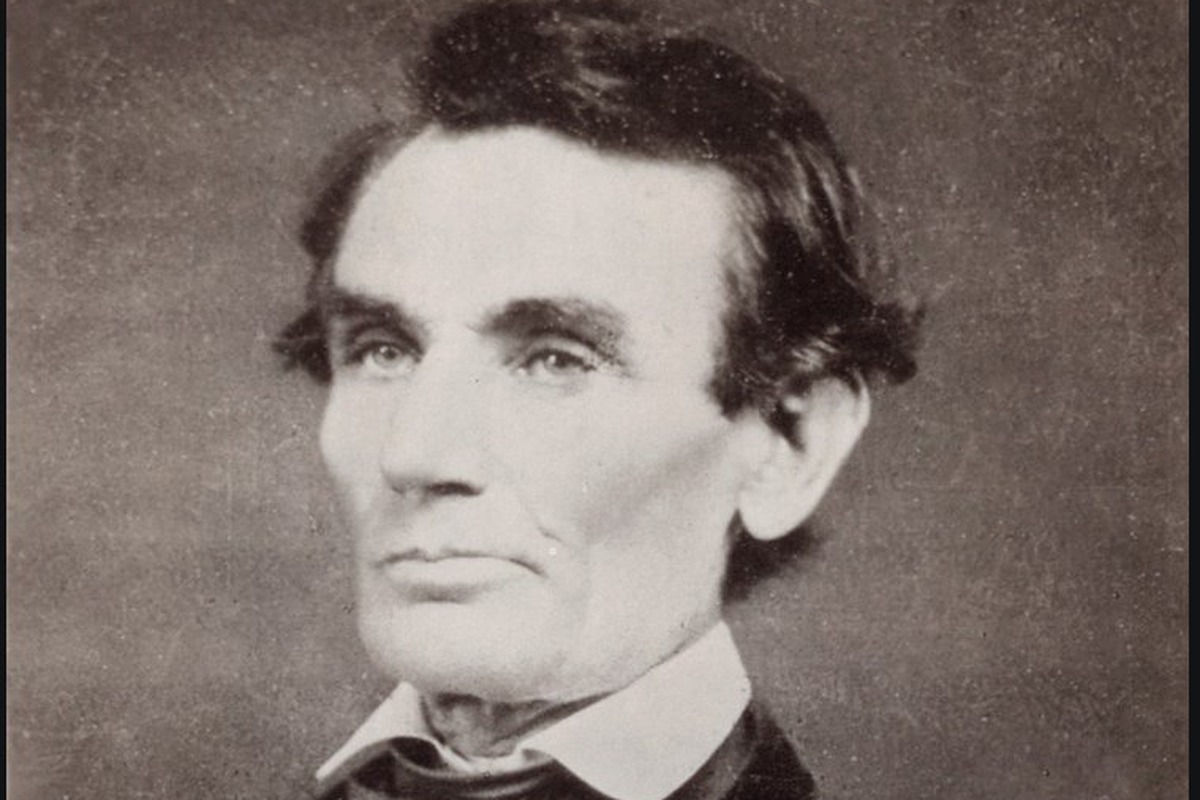
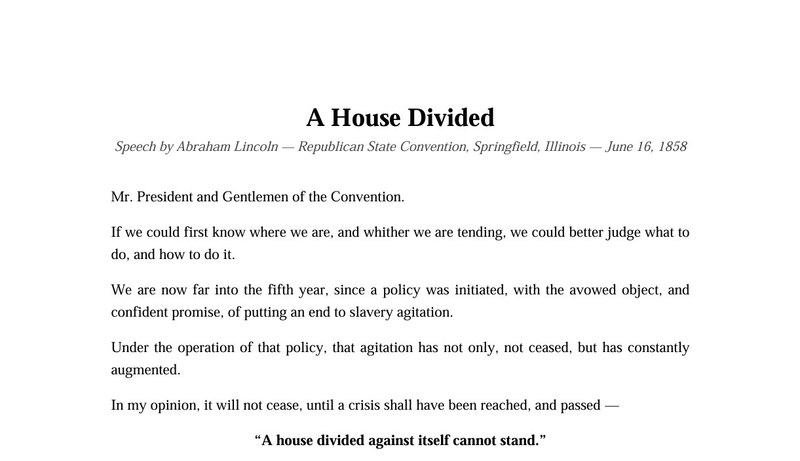
On the evening of June 16, 1858, Abraham Lincoln stood before the Illinois Republican State Convention in Springfield and delivered a line that would follow him for the rest of his life. "A house divided against itself cannot stand," he told the assembled delegates. "I believe this government cannot endure, permanently half slave and half free."
It is one of the most quoted lines in American political history. It is also, in its way, one of the most misunderstood.
Most people encounter the line stripped of context: a confident prophecy from a man already destined for the presidency, delivered with the easy authority of hindsight. The reality was messier. Lincoln had just been unanimously endorsed by the Illinois Republican Convention as its candidate for the U.S. Senate seat held by Stephen A. Douglas. He had a draft of an acceptance speech. And before he gave it, he called together a small circle of his closest political friends and asked them a simple question: should he deliver it as written?
According to later recollections, the answer was not the one Lincoln might have hoped for.
An Unusual Nomination
To understand why the speech mattered so much, it helps to understand how unusual the day already was. In 1858, U.S. senators were chosen by state legislatures, not by popular vote, and candidates typically campaigned quietly, if at all, after the fall elections. But on June 16, Illinois Republicans broke with that tradition and formally endorsed Lincoln months ahead of time, an early and very public show of support meant to settle, once and for all, who would carry the party's banner against Douglas that fall.
That decision was not as obvious as it might look in hindsight. Douglas, the incumbent, had recently broken with President James Buchanan and the national Democratic Party over the Lecompton Constitution, a proposed proslavery charter for Kansas that Douglas refused to support. To some prominent Republicans outside Illinois, especially influential New York editor Horace Greeley, Douglas's break with Buchanan looked like an opportunity. If Illinois Republicans simply stepped aside and let Douglas win reelection, the thinking went, it would deepen the split in the Democratic Party and pay dividends in the 1860 presidential race.
Illinois Republicans were not interested. Whatever his quarrel with Buchanan, Douglas remained committed to popular sovereignty, the idea that settlers in each new territory should decide for themselves whether to permit slavery. That was the same doctrine Republicans blamed for opening Kansas to slavery in the first place, and no amount of friction with Buchanan changed Douglas's position on it. Lincoln's nomination was, in part, a direct answer to Greeley and the Eastern Republicans: this seat, and this fight, belonged to Illinois.
A Caucus Before the Convention
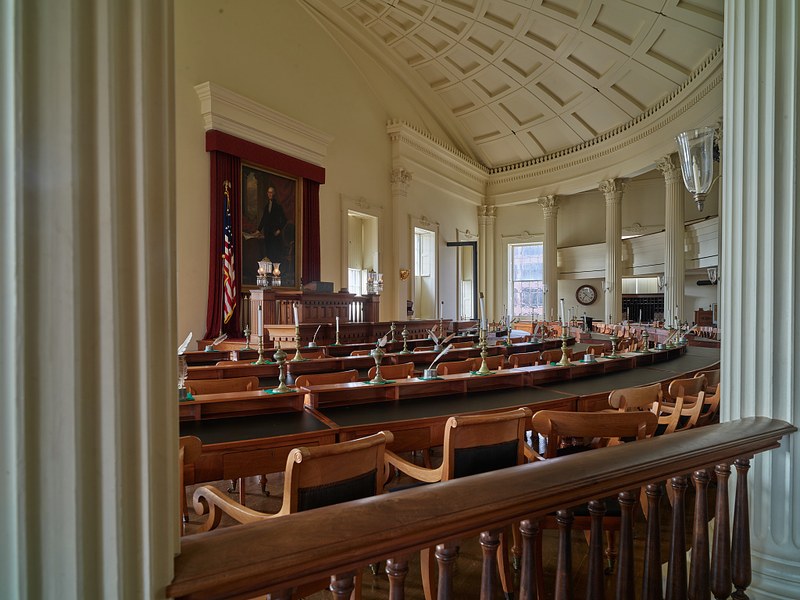 The Hall of Representatives in the Old State Capitol, Springfield, Illinois, where Lincoln delivered the House Divided speech on the evening of June 16, 1858.
That evening, after the convention had broken for dinner, Lincoln gathered a handful of trusted friends and read them the opening of his speech, the part built around the "house divided" image and the prediction that the nation would not remain forever half slave and half free.
According to accounts collected by the National Park Service from those who knew Lincoln, he called the group together specifically to weigh whether he should deliver the speech as written. By most of these later accounts, nearly everyone present urged him to soften or cut the opening. They warned that the language was too sweeping, too certain to be twisted by Douglas and the Democratic press, and likely to cost him the election.
William H. Herndon, Lincoln's law partner, was reportedly the lone dissenter. By Herndon's own later account, he encouraged Lincoln to deliver the speech as written and told him the proposition was true, regardless of the political cost. Herndon also claimed, years afterward, that he predicted the speech would someday help carry Lincoln to the presidency, though that claim rests on Herndon's own retrospective telling rather than any contemporary record.
Lincoln listened to all of it, and delivered the speech unchanged.
"Too Radical for the Occasion"
It is worth sitting with how the speech sounded to the people in that room, because it is easy to lose the sense of risk once a line has been carved into monuments. Lincoln was not simply describing a moral problem. He was making a structural argument, that the country's drift over slavery in the territories was not an accident, but the product of a connected sequence of political moves, one that pointed toward only two possible endings. Either slavery would be put on a path to "ultimate extinction," or it would become lawful everywhere, in every state, old and new alike.
To Republican ears in 1858, that was not a safe thing to say out loud. Lincoln's biographer Ida Tarbell later wrote plainly that the speech was severely criticized by Lincoln's own friends as too radical and too sectional for the moment. Leonard Swett, a lawyer who knew Lincoln well, called the speech's opening lines "unfortunate and inappropriate," and reportedly predicted that those first lines alone would cost Lincoln the election.
Herndon himself never pretended the speech was a safe political document. He recalled reading it beforehand and discussing exactly the line that would become famous. Lincoln's response, as Herndon remembered it, was that the proposition was true, and that he intended to use plain, universally recognizable language to strike home to the minds of his audience. He was not interested in softening it.
The Argument Beneath the Line
What gets lost in the popular memory of the speech is everything Lincoln built around that one famous sentence. The bulk of the address is a methodical argument: Lincoln walks through the Kansas-Nebraska Act, the Dred Scott decision, and the public statements of Douglas, President Buchanan, and Chief Justice Roger Taney, laying them side by side like pieces of a single structure. He compared them to a set of framed timbers, cut by different workmen at different times and places, that nonetheless fit together perfectly, every joint and measurement aligned, as though built from a single plan from the start.
His point was not that war was coming. His point was that a deliberate political effort was already underway, one that had moved further than most Northerners realized, and that pretending otherwise was its own kind of danger. That argument, the careful one, is largely forgotten. The sentence that survives is the one Lincoln's friends begged him to cut.
After November
Douglas and the Democratic press did not let the speech pass quietly. Within weeks, Lincoln's opening lines were being read back to him on the campaign trail, used as evidence that he was a dangerous radical out of step with ordinary voters. By the time Lincoln spoke in Chicago that July, he was already re-explaining the "house divided" passage, quoting his own words nearly verbatim because Douglas had made them the center of the campaign.
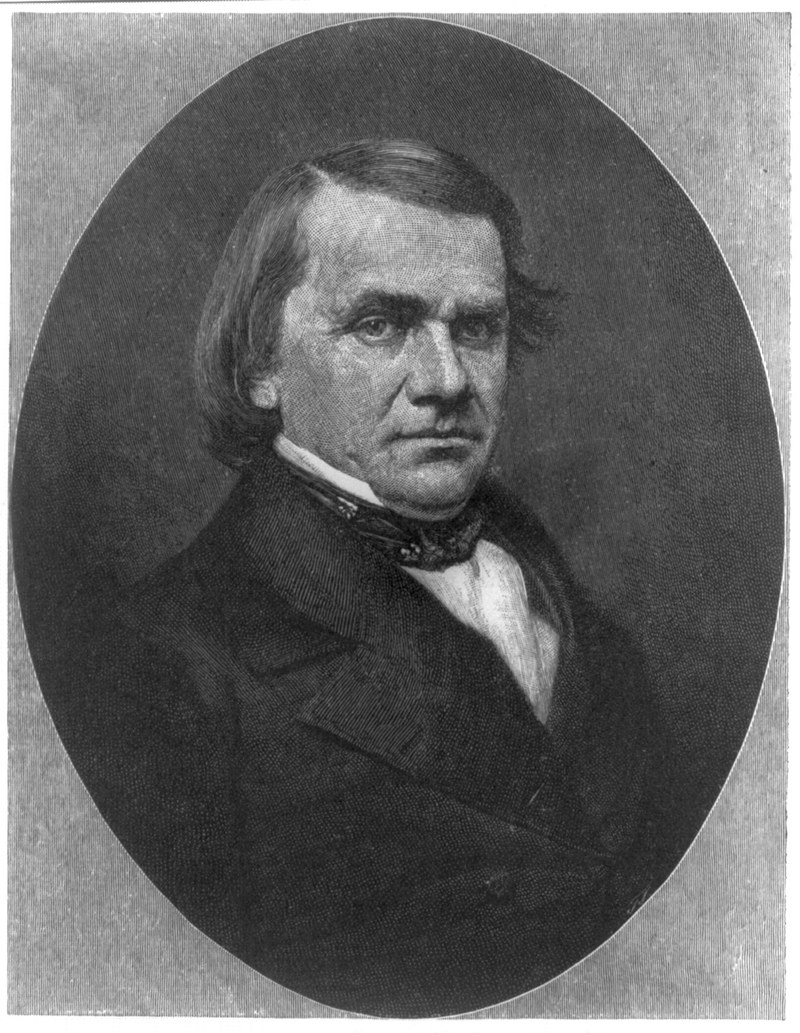 Stephen A. Douglas, Lincoln's opponent in the 1858 Senate race and the target of the House Divided speech's central argument.
Douglas made the speech a central target of his campaign, and many contemporaries believed it contributed to Lincoln's defeat. In November, Republican candidates for the state legislature received more votes statewide than their Democratic counterparts, but the existing district map, drawn to Democratic advantage, still produced a Democratic majority in the legislature, and that legislature returned Douglas to his seat. Lincoln's friends had not been wrong that the speech carried real political cost.
And yet two years later, the same speech that nearly sank a Senate campaign opened the published volume of the Lincoln-Douglas debates as Lincoln launched his bid for the presidency. The "house divided" line did not disappear after 1858. It became part of the case for why Lincoln, alone among Republicans, had seen the crisis coming.
On June 16, 1858, in the Hall of Representatives of the Illinois State Capitol, Abraham Lincoln delivered the speech his own advisors had asked him not to give. Two years later, it helped carry him to the presidency.
Read the full speech
A complete transcript of the House Divided speech, cross-checked against the Illinois State Journal printing of June 18, 1858, is available here as a PDF.