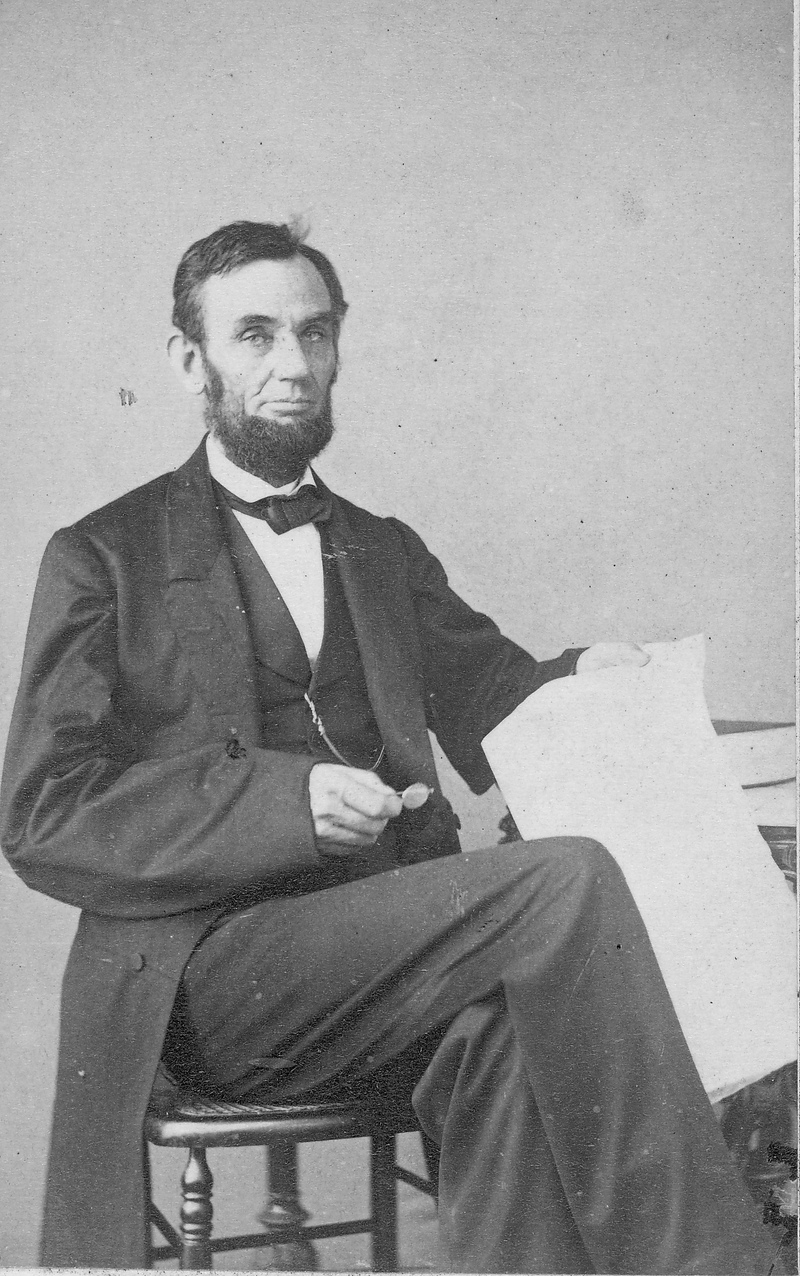
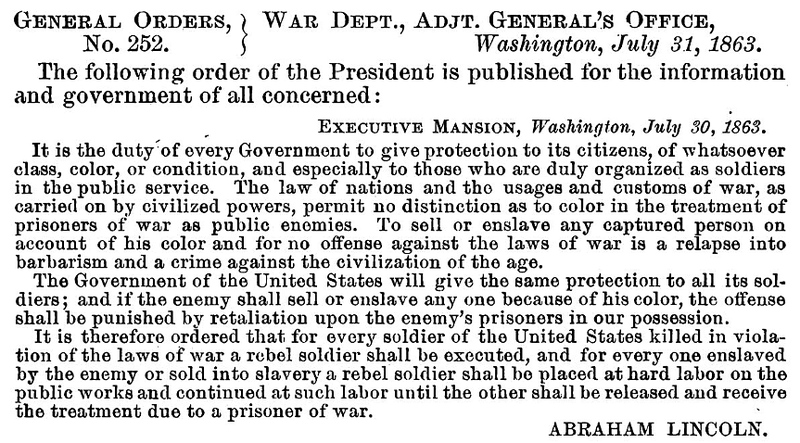
On July 30, 1863, Abraham Lincoln signed one of the most violent orders of his presidency, and almost nobody has heard of it.
It is three paragraphs long. It carries none of the language people associate with Lincoln. There is no appeal to a better angel, no call to bind up a nation's wounds. It reads instead like a threat, because that is exactly what it was. Prompted by Confederate threats against Black Union soldiers, Lincoln ordered that a Confederate prisoner of war be executed for every U.S. soldier the Confederacy killed after capture in violation of the laws of war. For every one sold into slavery, a Confederate prisoner would be sentenced to hard labor until the practice stopped.
The order applied to every U.S. soldier on paper, not only Black troops, but the crisis behind it was specific, and everyone reading it in the summer of 1863 knew exactly what it was answering.
The document is General Orders No. 252, often called the Order of Retaliation. It came out of a crisis that had been building for months, and it blew up the system the Union and the Confederacy had been using to trade prisoners since the war's second summer.
A Working System, Then a Refusal
A year earlier, prisoner exchange had actually been functioning. On July 22, 1862, Union Major General John A. Dix and Confederate Major General D. H. Hill signed what became known as the Dix-Hill Cartel at Haxall's Landing on the James River. It set a scale of equivalents, so many privates for an officer, and named agents on both sides to run the swaps. For about half a year it worked about as well as anything did in that war.
Then the Union began arming Black men. Congress had already opened the door the year before, through the Second Confiscation Act and the Militia Act of 1862. Lincoln's preliminary Emancipation Proclamation in September 1862 signaled that Black enlistment was coming, and the final Proclamation took effect January 1, 1863, and declared that freed men "will be received into the armed service of the United States." Confederate President Jefferson Davis moved first, though, issuing his own proclamation on December 23, 1862, that addressed the treatment of Black soldiers captured in the field. They were not to be treated as prisoners of war, but instead returned to slavery or prosecuted under state law, a process that made execution possible, though not automatic, and that in practice was frequently overtaken by outright killing in the field. Any white officer captured while commanding them was to be tried as a criminal for inciting what the Confederacy called a servile insurrection, a charge that carried the death penalty. On May 1, 1863, the Confederate Congress wrote this policy into law.
That law made the Dix-Hill Cartel impossible to sustain. An exchange system only works if both sides agree on who counts as a prisoner of war. The Confederacy had just declared that an entire class of Union soldiers did not qualify at all.
Lincoln Had Already Made the Argument Once
Three months before the Order of Retaliation, Lincoln had signed the Lieber Code, the Union's formal instructions on the laws of war, on April 24, 1863. Article 58 stated plainly that the law of nations recognized no distinction of color, and that if an enemy enslaved or sold captured soldiers, it would justify the severest retaliation. The principle was already on the books. What Lincoln did on July 30 was turn that principle into a specific, personal threat, one aimed at Jefferson Davis by name in everything but the address line.
The order is short enough to read in under a minute. It opens with the duty of every government to protect its citizens, "of whatever class, color, or condition," and states that the customs of war permit no distinction of color among prisoners. Then it gets specific. For every U.S. soldier killed in violation of the laws of war, a Confederate soldier would be executed. For every one enslaved, a Confederate soldier would be placed at hard labor until the offense was corrected.
It was published to the army the next day, July 31, as General Orders No. 252, so that no field commander could claim not to know it existed.
The Threat That Mostly Stayed a Threat
Here is the part that rarely makes it into the story. No clear evidence shows Lincoln ever carried the order out. No documented retaliatory executions under it are known. The order was intended less as revenge than deterrence: Lincoln hoped that making Confederate prisoners' lives contingent on the safety of Black Union soldiers would keep the policy from ever being carried out systematically in the field, without the Union actually having to start executing men who had personally done nothing wrong.
That restraint had limits it could not overcome. On April 12, 1864, Confederate cavalry under Nathan Bedford Forrest overran the garrison at Fort Pillow, Tennessee, and killed Black soldiers after they had stopped fighting. The massacre became a rallying cry across Union ranks. It also proved that the Order of Retaliation, whatever pressure it applied behind the scenes, had not been enough to stop the thing it was written to prevent.
The exchange system stayed broken for most of the following year. When Union General Benjamin Butler tried to negotiate a resumption in late 1863 and into 1864, he insisted that Black soldiers and their officers be included on equal terms. By the time Ulysses S. Grant became general-in-chief in the spring of 1864, large-scale exchanges had already largely collapsed, and he refused to revive them, citing both the discrimination against Black troops and a separate dispute over paroles from Vicksburg and Port Hudson. By August 1864, Grant had another reason to hold the line: the Union was by then holding far more Confederate prisoners than the Confederacy held Union soldiers, and a full exchange would have handed the South a battlefield advantage it badly needed. Some limited exchanges, mostly of the sick and disabled, continued through late 1864. A general resumption did not come until January 1865, when the Confederacy finally agreed to exchange all prisoners without regard to color.
Why the Order Still Matters
Lincoln is remembered for the Emancipation Proclamation, and rightly so. The Order of Retaliation gets a fraction of that attention, but it rests on the same authority and makes a more uncomfortable argument. The Emancipation Proclamation freed people. The Order of Retaliation instructed the United States government to kill prisoners who had committed no individual crime, purely because of what their government had done to someone else. It is the kind of document that does not fit neatly into how Lincoln is usually taught, which may be exactly why it is rarely taught at all.
It is also a document that shows a president discovering the limits of his own leverage. Lincoln had one card to play on behalf of Black soldiers being enslaved or executed after surrender, and that card was the safety of Confederate prisoners already in Union hands. He played it as far as he was willing to go, and when Fort Pillow happened anyway, he did not escalate. The order remained on the books, unenforced in any documented mass sense, right up until the war's final winter, when the whole question of exchange was settled the way most of the war's questions eventually were: by which side had more men left to trade.