Three weeks before the battle, Sitting Bull danced for three days without stopping.
It was the Sun Dance ceremony, held in early June of 1876 near present-day Lame Deer, Montana. Sitting Bull, the spiritual leader of the Hunkpapa Lakota, reportedly cut one hundred pieces of flesh from his arms as an offering, then fell into a vision. He saw soldiers falling upside down into his village like grasshoppers from the sky. He told his people: there will be a great victory.
On the morning of June 25, 1876, Lieutenant Colonel George Armstrong Custer divided his regiment of roughly 600 men into three battalions and rode toward the largest gathering of Plains Indians in recorded American history. By sundown, Custer and 268 of his men were dead.
The Lakota and Cheyenne had won the most decisive military victory in the history of the Plains Indian Wars.
Within five years, nearly every warrior who fought that day was confined to a reservation. Within a decade, the Black Hills, the sacred land the U.S. government had promised them forever, had been seized by Congress without their consent. The battle that looked like liberation was the trigger for final conquest.
This is not the story of Custer's last stand. It is the story of what that victory cost the people who won it.
The Promise That Started It
Eight years before the battle, the United States government sat down at Fort Laramie, Dakota Territory, and made a solemn promise.
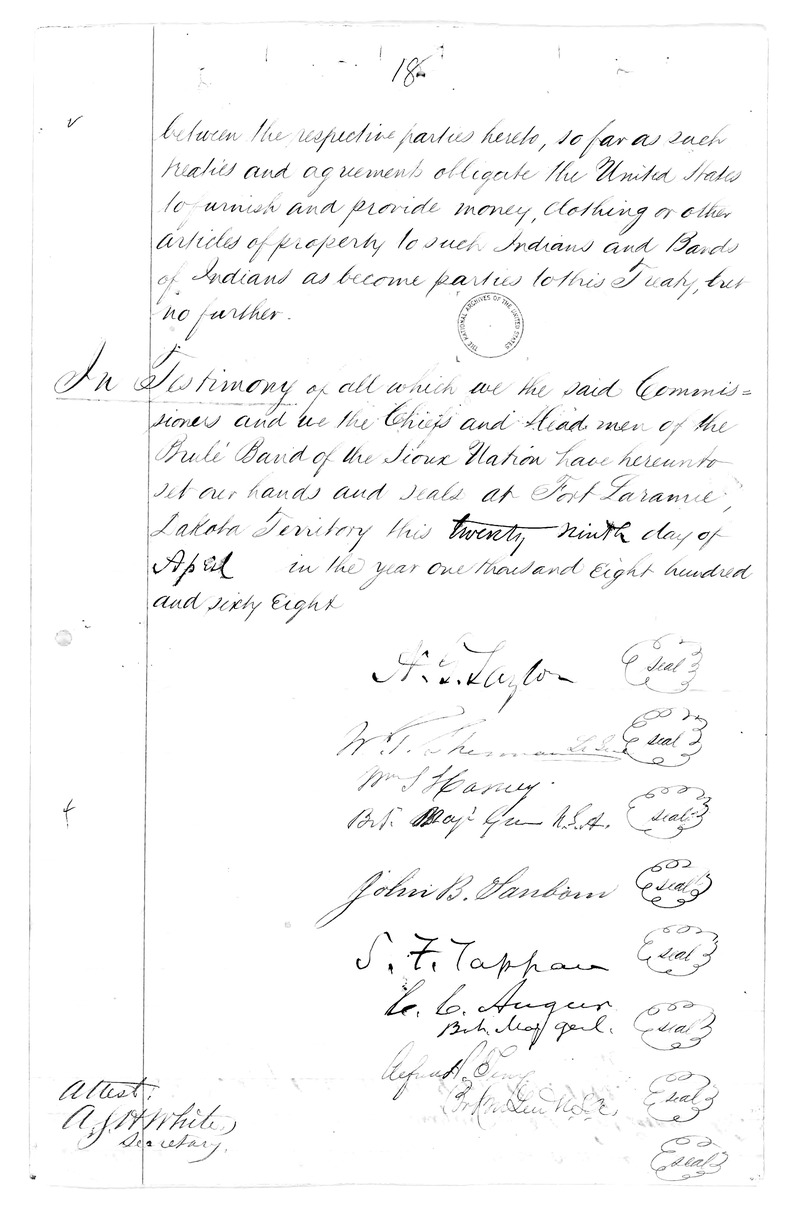
The Treaty of Fort Laramie, signed on April 29, 1868, ended three years of brutal conflict on the northern plains. Under its terms, the United States guaranteed the Great Sioux Reservation, including the Black Hills, to the Lakota people as their permanent homeland. Article II of the treaty declared the territory "set apart for the absolute and undisturbed use and occupation of the Indians herein named." Article XII went further: no future cession of any reservation land would be valid unless signed by at least three-fourths of all adult male Indians.
The document was signed by eight U.S. commissioners. One of them was Lieutenant General William T. Sherman, the man who had burned Georgia to end the Civil War, and who would later command the Army campaign that destroyed the world the treaty was supposed to protect.
The ink had barely dried before the violations began.
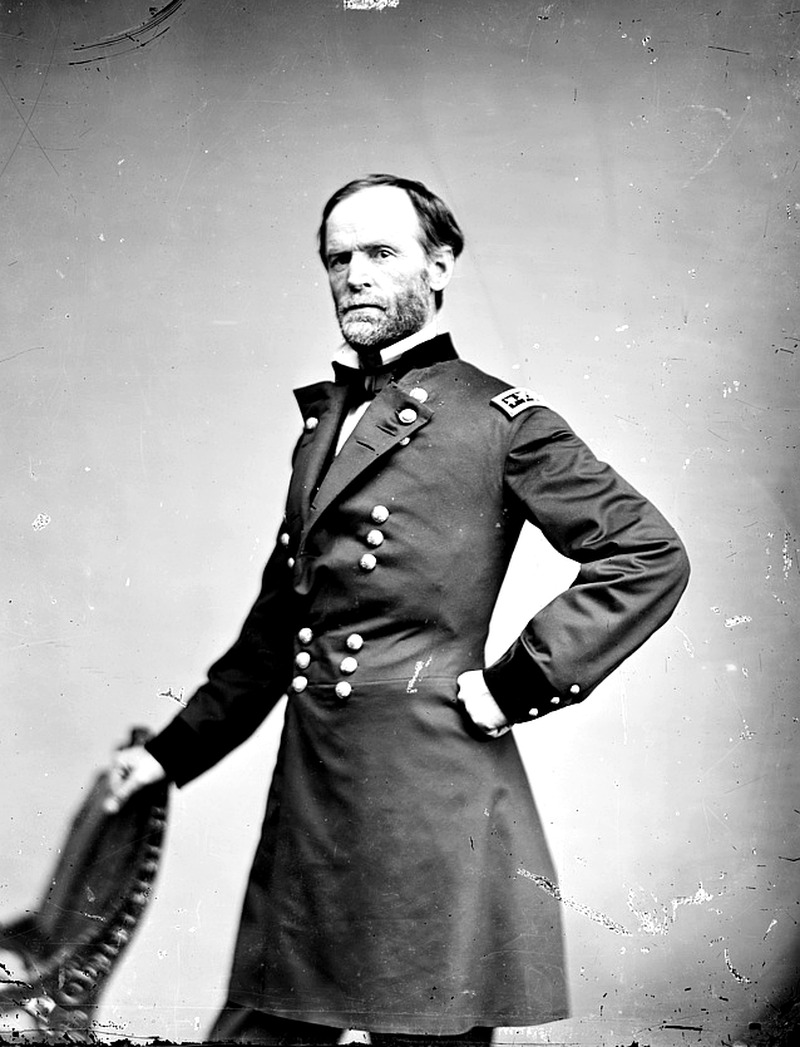 General William T. Sherman, photographed circa 1869, one year after he signed the Treaty of Fort Laramie guaranteeing the Black Hills to the Lakota Nation in perpetuity. As Commanding General of the Army in 1876, Sherman authorized the military campaign that culminated at Little Bighorn.
In 1874, Custer himself led an expedition into the Black Hills and allowed his accompanying geologists to publicize the discovery of gold. Thousands of prospectors flooded into Lakota territory in direct violation of the treaty. The U.S. government, unwilling to remove the settlers and unable to persuade the Lakota to sell, took a different approach. In the winter of 1875, the Commissioner of Indian Affairs issued an ultimatum: all Lakota must report to a reservation by January 31, 1876, or be declared hostile. Many of the bands in their remote winter camps never even received the order. The deadline passed with almost no compliance. The matter was handed to the military.
This was the world Sitting Bull had refused to accept. He had never signed the 1868 treaty. He had never agreed to the reservation. When the spring hunting season arrived in 1876, thousands of Lakota and Cheyenne left their agencies and rode out to join him along the Little Bighorn River, which his people called the Greasy Grass.
By June, an estimated eight thousand people had gathered in one of the largest encampments in Plains Indian history. Among them were somewhere between fifteen hundred and two thousand warriors.
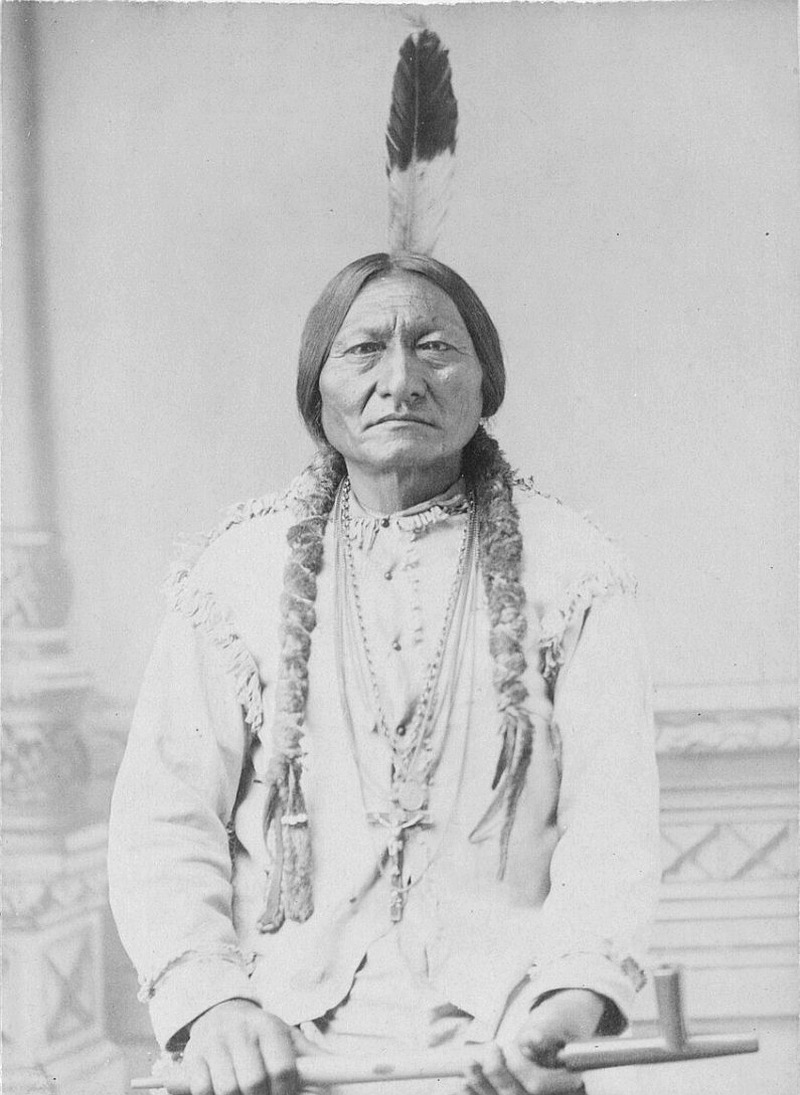 Sitting Bull, spiritual leader of the Hunkpapa Lakota. During a Sun Dance ceremony in early June 1876, he experienced a vision of soldiers falling into his village. He interpreted it as a prophecy of victory. The battle confirmed it. Within a year, he had fled to Canada to avoid capture.
June 25, 1876
The U.S. Army's plan was a three-column pincer movement designed to trap the Lakota and force them back to the reservation. General George Crook would push north from Wyoming. Colonel John Gibbon would march east from Fort Ellis. General Alfred Terry, with Custer's 7th Cavalry as his strike force, would approach from the east.
The plan fell apart almost immediately. On June 17, Crook's column was turned back at the Battle of the Rosebud by a large Lakota force led by Crazy Horse. Crook retreated and waited for reinforcements, but never told Terry. Terry, unaware one leg of the trap had already collapsed, sent Custer and the 7th Cavalry ahead to locate the village and prevent the Indians from scattering.
On the morning of June 25, Custer's Crow scouts climbed to a lookout called the Crow's Nest and reported what they could see in the valley: a massive pony herd and the unmistakable signs of an enormous village. Mitch Bouyer, one of Custer's most experienced scouts, told him directly: "I have been with these Indians for thirty years, and this is the largest village I have ever heard of." Custer pressed forward anyway. He had been told to expect no more than eight hundred warriors. The Army's intelligence was catastrophically wrong.
Fearing the village would scatter before he could engage it, Custer divided his regiment into three battalions at noon on June 25. Major Marcus Reno took three companies south to charge the village from that end. Captain Frederick Benteen took three companies on a scouting sweep to the south. Custer himself took five companies, approximately 210 men, and moved north along the bluffs to strike the village from above.
Reno's charge collapsed within minutes. The warriors who met him numbered far beyond anything in the Army's estimates. After a desperate skirmish in the open, Reno pulled his men into a stand of timber along the river, then ordered a chaotic retreat up the bluffs to the east. Men at the rear of the column were ridden down and killed as they fled.
Custer's battalion, meanwhile, had disappeared to the north. Reno and Benteen, pinned down on the bluffs above the river, could hear distant rifle fire. They never reached Custer in time.
What happened to Custer's five companies in the next hour has never been fully reconstructed, because no soldier who rode with him survived to tell it. From the accounts of Lakota and Cheyenne warriors, from the positions of the bodies found two days later, from the archaeological evidence uncovered over the following century, historians have pieced together the outline: Custer's battalion was surrounded, overwhelmed, and annihilated. Lakota and Cheyenne accounts credit Crazy Horse with leading a charge from the north that collapsed Custer's command structure entirely. The last survivors made a final stand on a hilltop that would come to bear Custer's name.
By the time the shooting stopped, 268 soldiers were dead. The warriors called the fight a buffalo run.
The Pyrrhic Victory
The victory was absolute. It was also the beginning of the end.
News of the defeat reached the American public during the nation's centennial celebrations on July 4, 1876. The outrage was immediate and total. Congress authorized two thousand additional troops within weeks. The Army poured into the plains with a force that dwarfed anything the Lakota and Cheyenne could resist.
Then came the document that sealed it.
In August 1876, Congress attached what the Lakota called the "sell or starve" rider to the Indian Appropriations Act. It cut off all government rations to the Sioux until they terminated hostilities and ceded the Black Hills to the United States. Article XII of the 1868 treaty required three-fourths of adult male Indians to approve any land cession. The rider ignored that entirely. Faced with starvation, Lakota leaders signed under duress. The Black Hills, sacred land guaranteed by treaty, were gone.
The Agreement of 1877 made the seizure permanent, establishing the reservation boundaries that confined the Lakota for generations. In 1980, the United States Supreme Court ruled in United States v. Sioux Nation of Indians that the Black Hills had been taken without just compensation, an unconstitutional taking. The Court ordered financial reparations. The Lakota refused the money. They have never stopped demanding the land.
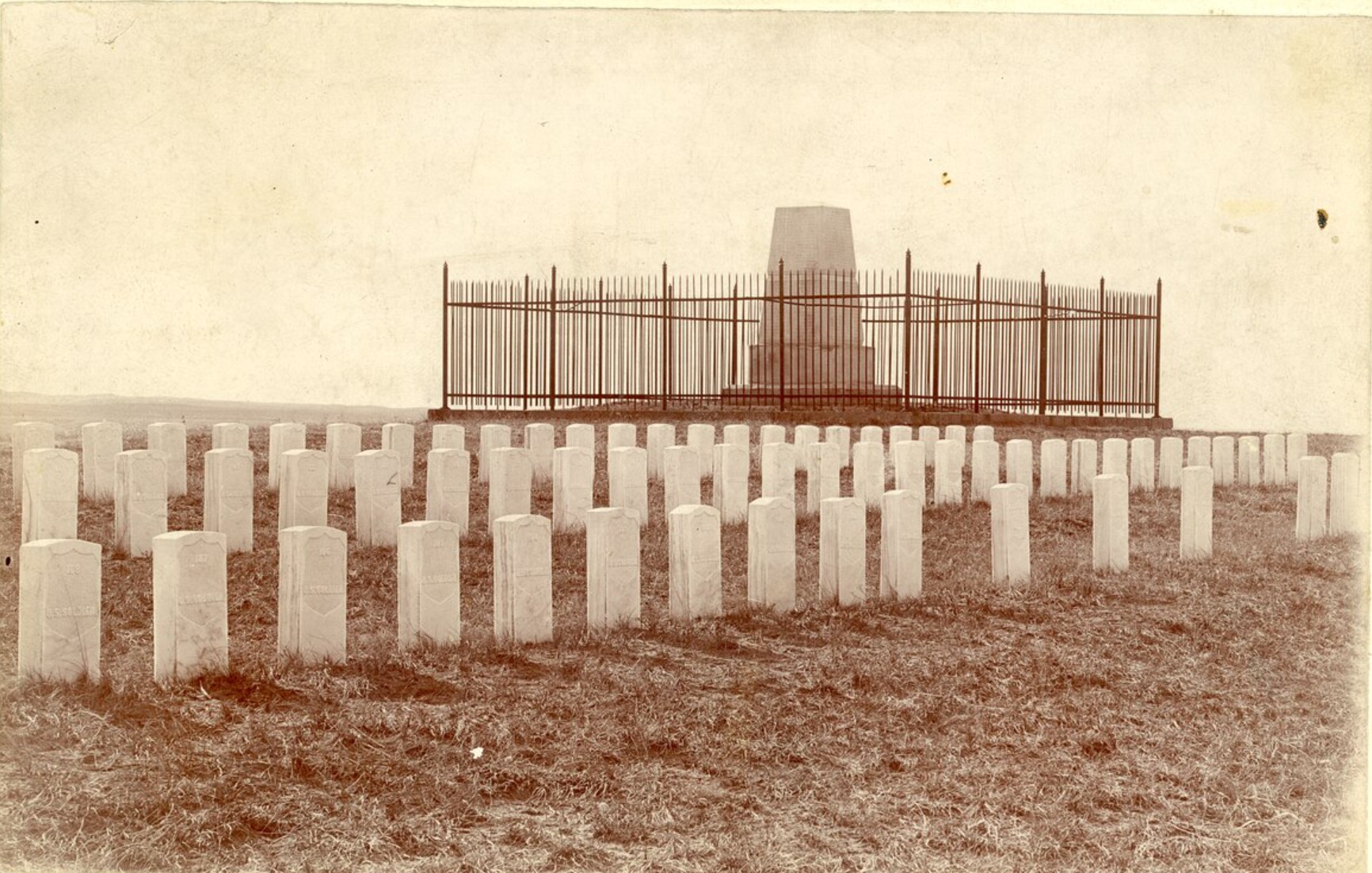
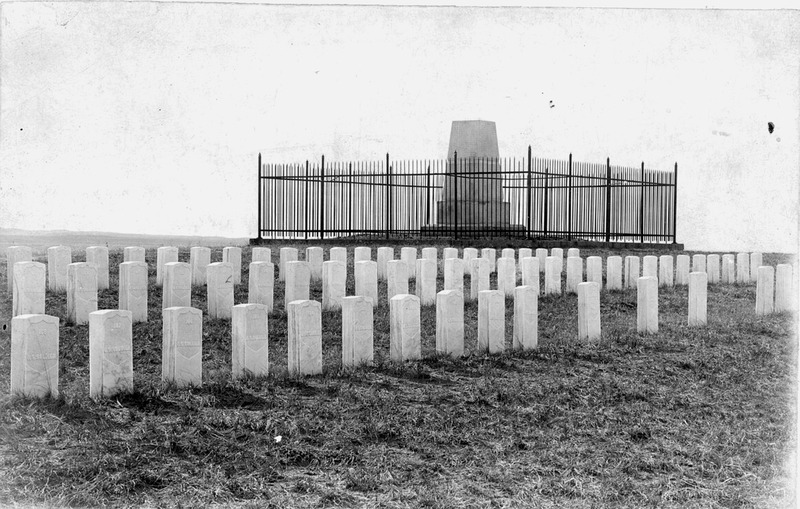 Last Stand Hill, photographed in 1897, twenty-one years after the battle. The white marble headstones mark where soldiers of the 7th Cavalry fell on June 25 and 26, 1876. The Custer Monument obelisk stands at center. The battlefield became a national cemetery in 1879. It was not until 1991 that Congress authorized an Indian Memorial at the site to honor the Lakota and Cheyenne warriors who fought there.
Sitting Bull fled to Canada in May 1877, his supporters on the brink of starvation. He returned to the United States in 1881 and surrendered at Standing Rock Agency in North Dakota. On December 15, 1890, he was shot and killed by Indian police on the reservation during an attempt to arrest him.
Crazy Horse surrendered at Fort Robinson, Nebraska, in May 1877, days after Sitting Bull reached Canada. On September 5, 1877, he was bayoneted by a soldier while being escorted to the guardhouse. He was thirty-five years old.
The great encampment on the Greasy Grass, which had numbered eight thousand people at its peak, dispersed within forty-eight hours of the battle. There was not enough game or grass to sustain that many people and horses in one place. They scattered across the plains, and the Army hunted them one band at a time.
What the Document Says
The Treaty of Fort Laramie sits today in the National Archives in Washington, nineteen pages of handwritten cursive signed by U.S. commissioners and the chiefs and headmen of the Sioux Nation. Sherman's signature appears on page 18, second from the top, in the neat script of a man who had spent thirty years signing military documents.
Below his signature and those of the other commissioners are pages of X marks, one for each chief who could not write English, each labeled "his mark" in the hand of a U.S. scribe. Iron Shell. Red Leaf. Black Horn. White Tail. Day Hawk. Men who had no way of knowing that the document they were signing would be used as the legal framework for stripping them of everything it promised to protect.
Article I declared: "From this day forward all war between the parties to this agreement shall forever cease."
The war did not cease. The United States changed its mind about what the treaty required whenever it became inconvenient, and the Black Hills were too valuable to leave in Lakota hands once gold was found beneath them.
The battle of Little Bighorn was not the cause of what followed. It was the pretext. The machinery to dispossess the Lakota was already in motion before a single shot was fired on June 25. The Army's campaign that year had one objective regardless of what happened: force the Lakota back to the reservation and open the Black Hills. Custer's death accelerated the timeline and eliminated what little political resistance remained to using overwhelming force.
The warriors who destroyed the 7th Cavalry on the Greasy Grass on June 25, 1876, achieved arguably the greatest tactical victory in the history of the Plains Indian Wars. They were right to fight. They knew what the alternative was.
They won the battle. The treaty was already broken. The outcome was the same.