The history books remember Gettysburg as a three-day battle fought in a small Pennsylvania town from July 1 to July 3, 1863. What they tend to skip over is the day it actually began: June 3, 1863, when Robert E. Lee quietly set 75,000 men in motion and nobody on the other side noticed until it was too late.
That morning, with the Army of the Potomac still camped north of Fredericksburg, Virginia, Lee began pulling his army out of its entrenchments along the Rappahannock River. He left General A.P. Hill's Corps in place to man the lines, cover the departure, and make the Union commanders think nothing had changed. It was one of the most audacious feints of the entire war. The clock that ended at Gettysburg started ticking on June 3.
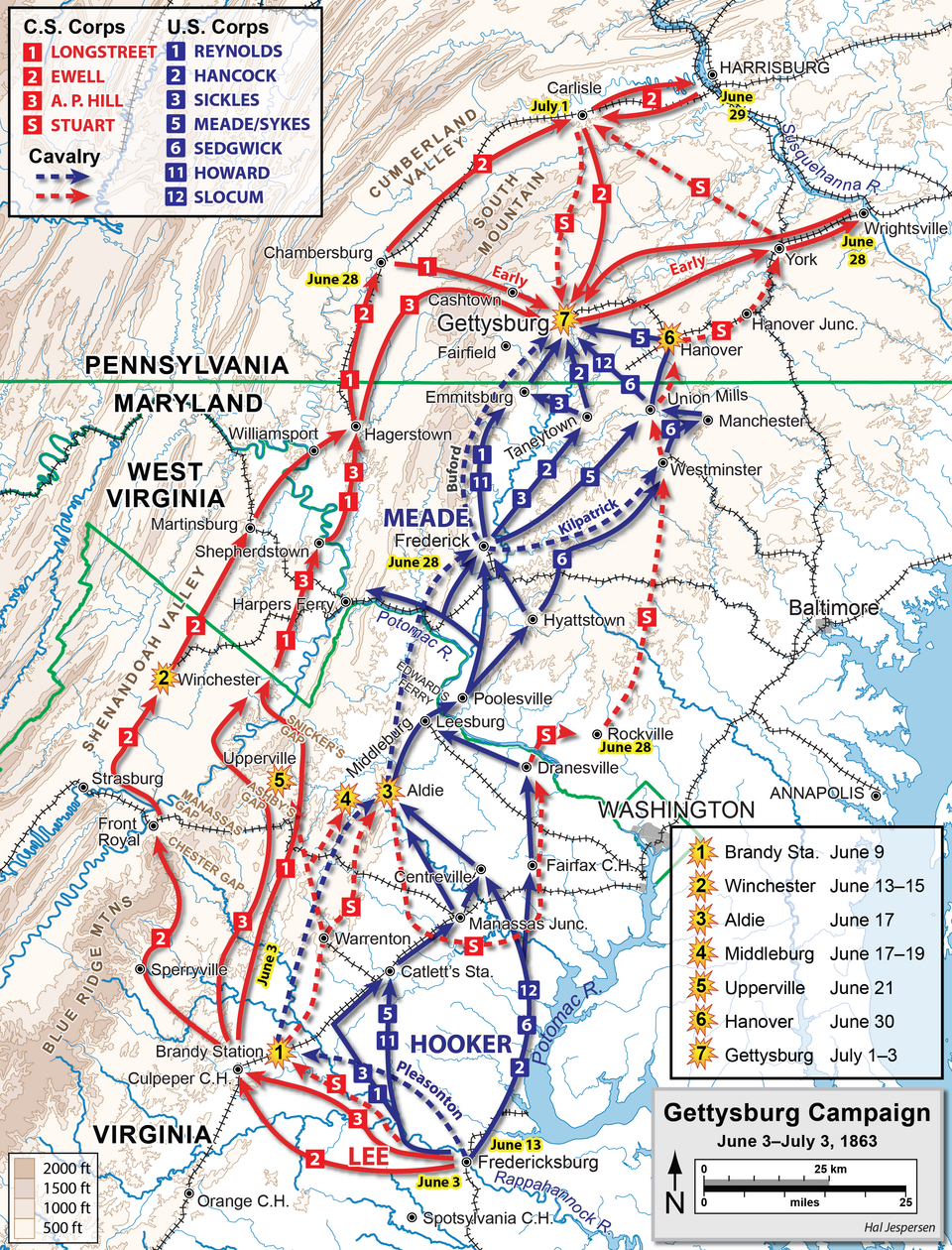 The Gettysburg Campaign, June 3 to July 3, 1863. Confederate movements in red, Union movements in blue. Note Lee's departure point at Fredericksburg, bottom right. Map by Hal Jespersen.
Why Lee Marched North
After his stunning victory at Chancellorsville in early May 1863, Lee faced a strategic problem that no battlefield success could solve. His army was camped in war-ravaged Virginia, short on food, forage, and nearly everything else. The Shenandoah Valley, once a reliable supply corridor, had been stripped clean. Meanwhile, across the Rappahannock, General Joseph Hooker commanded a Union army that was larger, better supplied, and preparing for another summer offensive.
Lee's answer was to take the war north.
In his own official report, filed July 31, 1863, and preserved today by the National Park Service at Gettysburg National Military Park, Lee laid out his thinking with the matter-of-fact clarity of a man who had been planning this for weeks. The position held by Hooker at Fredericksburg, he wrote, was "one in which he could not be attacked to advantage." The solution was to draw him out of it. Lee believed that moving north would force Hooker to abandon Virginia entirely, disrupt whatever Union campaign plans existed for the summer, and open the rich Pennsylvania farmlands to Confederate foragers who desperately needed them.
There was also a larger gamble at work. Lee was betting that a decisive Confederate victory on Northern soil could break the Union's political will to continue the war. The 1864 presidential election was just over a year away. Peace Democrats in the North were growing louder. If Lee could crush the Army of the Potomac in Pennsylvania, the Lincoln administration might not survive to fight another campaign season.
"Actuated by these and other important considerations," Lee wrote, "the movement began on June 3."
The Departure Nobody Saw Coming
On the morning of June 3, McLaws' Division of Longstreet's Corps broke camp at Fredericksburg and marched west toward Culpeper Court House. Hood's Division, which had been encamped along the Rapidan River, moved to join them. They moved quietly, away from the Union observers on the north bank of the Rappahannock, screened by the Blue Ridge Mountains and by A.P. Hill's men who stayed behind and kept their campfires burning.
Ewell's Corps followed on June 4 and 5.
Union commander Hooker's headquarters picked up vague signals almost immediately. Dust clouds on the horizon. Reduced activity in the Confederate lines. Cavalry reports from the flanks that something was in motion. But the picture refused to come together. On June 7, George Sharpe, head of the Army of the Potomac's intelligence bureau, actually reported to Hooker that while Stuart might be preparing a cavalry raid, Lee's infantry was probably withdrawing toward Richmond. It was a catastrophic misread. Lee's infantry was already marching in the opposite direction.
By June 8, Longstreet's and Ewell's Corps were at Culpeper Court House. Jeb Stuart's cavalry was concentrated there as well, tasked with screening the army's movement and preventing Union scouts from discovering what was happening. The Army of Northern Virginia was a full corps deep into its invasion before Washington had any real idea an invasion was underway.
A.P. Hill Holds the Curtain
The performance of Hill's Corps at Fredericksburg during those first critical days deserves more credit than it usually receives. Three full corps of the Confederate Army, nearly 50,000 men, slipped away under Hill's cover. When Union General John Sedgwick sent troops across the Rappahannock on June 5 to probe the Confederate lines, Hill's men resisted just firmly enough to suggest the full army was still in place. Lee briefly paused Ewell's march as a precaution, but when it became clear Hooker would not press the attack, Lee ordered the movement to continue.
It was not until June 9, when Hooker sent his cavalry commander Alfred Pleasonton across the Rappahannock at Brandy Station, that the Union got its first real confirmation that something had changed. The resulting battle was the largest cavalry engagement of the entire war, roughly 17,000 horsemen clashing across open fields in a confused, brutal day of fighting. Stuart's troopers held, but the surprise was complete and humiliating. Confederate cavalry had been caught in camp, partially unprepared, and it took everything Stuart had to push the Union riders back across the river.
More importantly, Brandy Station told Hooker what Sharpe's intelligence bureau had gotten wrong. Lee was moving. The question was where.
The Trap Sets Itself
In the days that followed June 3, Lee's plan unfolded with remarkable precision. Ewell's Corps swept north through the Shenandoah Valley, routing a Union garrison at Winchester on June 13 to 15 and capturing more than 4,000 prisoners along with artillery and supplies. By June 15, Confederate infantry had crossed the Potomac into Maryland. By June 27, the lead elements of Lee's army were encamped near Chambersburg, Pennsylvania, and Early's Division had pushed as far east as York, within striking distance of the Susquehanna River and the state capital at Harrisburg.
Lee's army was 100 miles deep into the North before the Union had replaced its own commanding general. Hooker, frustrated by Lincoln's refusal to let him attack Richmond and by disputes over the garrison at Harper's Ferry, offered his resignation on June 27. Lincoln accepted it the same day and replaced him with General George Meade, who had commanded less than 72 hours when the two armies stumbled into each other at Gettysburg on July 1.
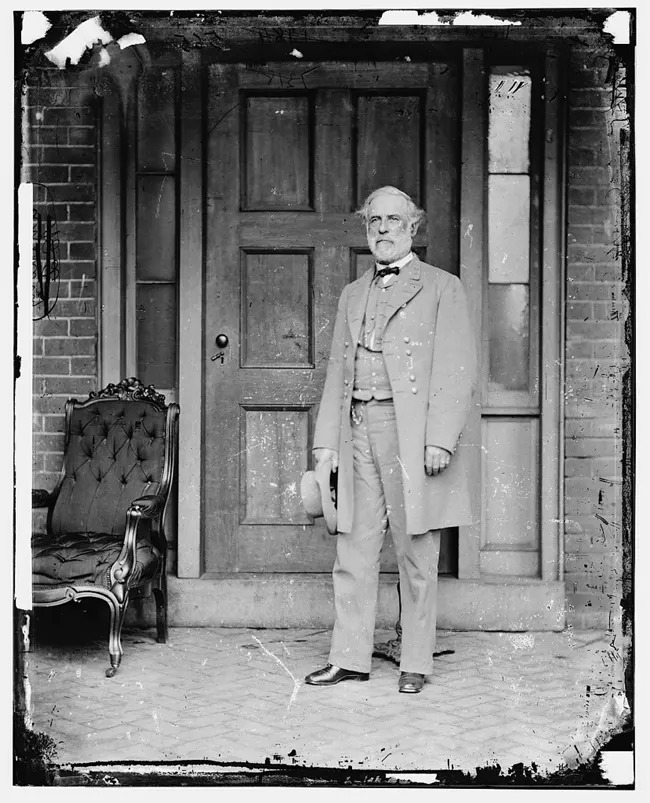 Official map of the Battle Field of Gettysburg, July 1st, 2nd, and 3rd, 1863. Published by authority of the Secretary of War, Office of the Chief of Engineers, U.S. Army, 1876. Library of Congress.
The Collision Nobody Planned
There was nothing inevitable about the specific location of the battle. Lee had not chosen Gettysburg. His army was scattered across a 50-mile arc of Pennsylvania when word reached him on the night of June 28 that Meade had crossed the Potomac and was closing fast. In his own report, Lee described receiving the news "from a scout" and immediately ordering his army to concentrate east of the mountains. Gettysburg was simply the crossroads where the roads converged.
On the morning of July 1, General Henry Heth sent a brigade toward Gettysburg, reportedly to look for shoes. What he found instead was Union cavalry under General John Buford, who had recognized the high ground south of town and made the decision to hold it. The battle that followed drew in corps after corps from both sides, each army feeding men into a fight neither had planned to start there.
By the time it was over, three days later, more than 50,000 men had been killed, wounded, or captured. Lee had failed to destroy Meade's army. He had failed to crack the Union center on July 3 with Pickett's Charge. He retreated back across the Potomac on the night of July 13 to 14, his army battered and the Confederacy's strategic gamble spent.
In his report, Lee acknowledged that the battle had not gone as intended. "It had not been intended to fight a general battle at such a distance from our base," he wrote, "unless attacked by the enemy, but finding ourselves unexpectedly confronted by the Federal Army, it became a matter of difficulty to withdraw."
That single sentence contains everything. Lee had set a masterpiece of misdirection in motion on June 3, executed a march that left Hooker confused and overmatched, and driven deep into Pennsylvania with a plan that depended on fighting the battle he wanted, on ground of his choosing. In the end, Gettysburg was none of those things. It was an accident that became a catastrophe, and the road to it began on a quiet morning in Fredericksburg, 28 days before the first shot was fired.
Read the Full Document
Lee filed his official after-action report on July 31, 1863, just four weeks after the army returned to Virginia. Written in the clipped, formal language of a professional soldier, it is one of the most revealing documents in American military history. Lee describes the June 3 departure, the march through the Shenandoah, the invasion of Pennsylvania, and the three days of fighting at Gettysburg in his own words, including a candid accounting of what went wrong. The report is preserved and published by the National Park Service at Gettysburg National Military Park.
In the months after Gettysburg, the Confederate War Department pressed Lee to file a more detailed final report. He submitted it in January 1864. Both reports together form the most complete firsthand account of the campaign that exists. They remain, as one historian noted, a lesson in both the art of war and the cost of overconfidence.